Frustum PointNets for 3D Object Detection from RGB-D Data
Charles R. QiWei LiuChenxia WuHao SuLeonidas J. Guibas
Proposes a real-time 3D object detection framework that projects 2D region proposals into 3D viewing frustums to directly process raw point clouds with PointNet, achieving state-of-the-art accuracy on KITTI and SUN RGB-D benchmarks.
The article addresses the challenge of accurate and efficient 3D object detection from RGB-D data for applications such as autonomous driving and augmented reality. Prior approaches often project point clouds into 2D images or 3D voxels, which can obscure natural geometric patterns and increase computational cost for large scenes.
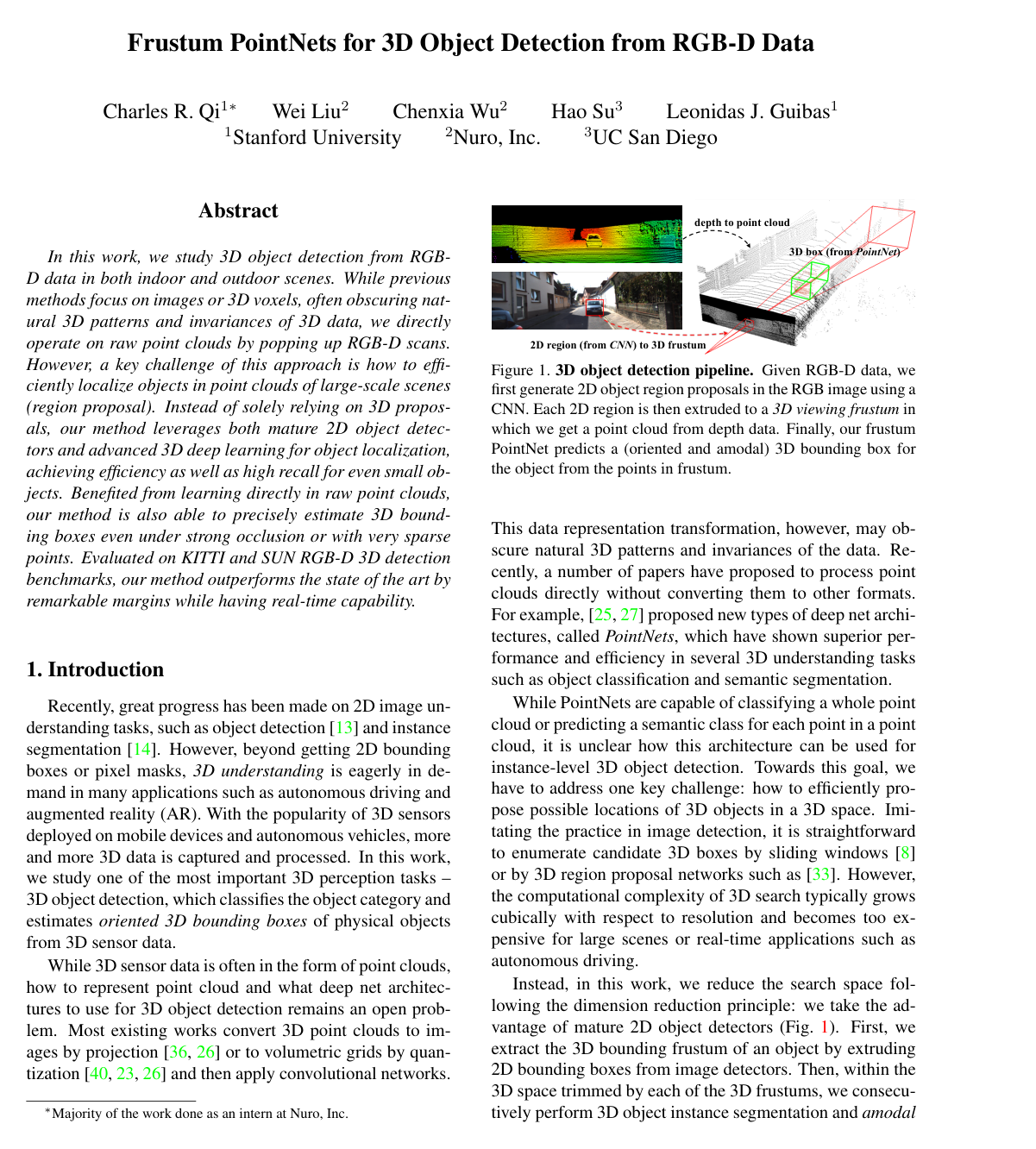
The work evaluates a new pipeline that lifts mature 2D object detections into 3D viewing frustums and then applies PointNet variants directly on the resulting raw point clouds to perform instance segmentation followed by amodal oriented bounding-box regression.
Experiments were conducted on the KITTI outdoor LiDAR benchmark and the SUN RGB-D indoor depth benchmark using standard train/val/test splits and established 3D IoU metrics. The method achieved 8 percentage-point gains in 3D average precision for cars on KITTI while running at 5 frames per second, and 6–9 percentage-point gains in mean average precision on SUN RGB-D with one to three orders of magnitude faster inference than previous state-of-the-art systems.
These results demonstrate that operating natively in 3D point space after 2D-guided frustum cropping yields both higher accuracy under occlusion and sparsity and real-time performance, directly lowering risk and latency for downstream planning and perception modules.
Next steps supported by the article include combining RGB-view and bird’s-eye-view proposals via 3D non-maximum suppression, adding image features to handle extremely sparse distant objects, and extending the single-object-per-frustum assumption to multiple instances.
The main limitations are dependence on the quality of the upstream 2D detector, reduced robustness when multiple same-category objects occupy one frustum, and the need for denser data or auxiliary cues for objects with fewer than five points; readers should therefore treat the reported gains as conditional on reliable 2D proposals and moderate point density.
- Paper: PointNet: Deep Learning on Point Sets for 3D Classification and Segmentation, Charles R. Qi et al. (2017). PointNet introduces the fundamental architecture for directly processing unordered point clouds with permutation-invariant neural networks, which serves as the core module inside Frustum PointNets.
- Paper: PointNet++: Deep Hierarchical Feature Learning on Point Sets in a Metric Space, C. Qi et al. (2017). PointNet++ establishes hierarchical feature learning across local neighborhoods in metric space, which Frustum PointNets relies upon for 3D instance segmentation and coordinate refinement.
- Paper: Multi-view 3D Object Detection Network for Autonomous Driving, Xiaozhi Chen et al. (2017). MV3D provides the key multi-view fusion benchmark and paradigm for 3D bounding-box generation that Frustum PointNets directly compares against and aims to improve upon in point space.
- Paper: VoxelNet: End-to-End Learning for Point Cloud Based 3D Object Detection, Yin Zhou et al. (2017). VoxelNet represents the primary end-to-end volumetric 3D detection baseline whose quantization trade-offs motivatate Frustum PointNets' unquantized frustum proposal approach.
- Paper: SUN RGB-D: A RGB-D scene understanding benchmark suite, Shuran Song et al. (2015). SUN RGB-D defines the standard indoor dataset, annotation format, and evaluation protocol utilized to measure Frustum PointNets' indoor 3D detection performance.
- Paper: Faster R-CNN: Towards Real-Time Object Detection with Region Proposal Networks, Shaoqing Ren et al. (2015). Faster R-CNN establishes the region-proposal-based 2D detection framework that generates the initial 2D bounding boxes lifted into 3D frustums.
- Paper: PointRCNN: 3D Object Proposal Generation and Detection From Point Cloud, Shaoshuai Shi et al. (2019). PointRCNN eliminates the dependence on upstream 2D image detectors by generating 3D proposals directly from point clouds and refining them in a canonical coordinate frame.
- Paper: PointPillars: Fast Encoders for Object Detection From Point Clouds, Alex H. Lang et al. (2018). PointPillars optimizes point cloud encoding into vertical columns to achieve high-speed inference using purely 2D convolutions, improving real-time 3D object detection.
- Paper: PV-RCNN: Point-Voxel Feature Set Abstraction for 3D Object Detection, Shaoshuai Shi et al. (2019). PV-RCNN combines the high spatial precision of point-based architectures like PointNet with the computational efficiency and proposal quality of 3D voxel convolutions.
- Paper: Center-based 3D Object Detection and Tracking, Tianwei Yin et al. (2020). CenterPoint moves beyond box-based anchors to detect and track 3D objects as orientation-free center points across LiDAR representations.
- Paper: Deep Learning for 3D Point Clouds: A Survey, Yulan Guo et al. (2019). This survey provides a comprehensive synthesis of 3D deep learning architectures, contextualizing frustum-based, point-based, and voxel-based detection pipelines.
- Paper: Dynamic Graph CNN for Learning on Point Clouds, Yue Wang et al. (2018). Dynamic Graph CNN introduces dynamic feature-space edge convolutions that capture richer local geometric relationships beyond fixed spatial neighborhoods.