TrackFormer: Multi-Object Tracking with Transformers
Tim MeinhardtAlexander KirillovLaura Leal-TaixéChristoph Feichtenhofer
Introduces TrackFormer, an end-to-end multi-object tracking framework that unifies detection and frame-to-frame data association into a single Transformer-based set prediction architecture using autoregressive track queries.
Multi-object tracking is critical for computer vision applications such as autonomous navigation, robotics, and automated surveillance. Traditional approaches separate the task into distinct steps—first detecting objects on individual frames and then linking those detections across time using complex graph algorithms, motion models, or appearance matching. These multi-step pipelines often struggle in crowded scenes, suffer from identity switches during occlusions, and involve computationally heavy optimization routines that limit real-time deployment.
The article introduces and evaluates TrackFormer, an end-to-end framework based on a Transformer encoder-decoder architecture that performs multi-object tracking and segmentation. The main objective is to demonstrate that object detection and frame-to-frame data association can be unified into a single "tracking-by-attention" process without relying on external motion models, appearance heuristics, or complex post-processing graphs.
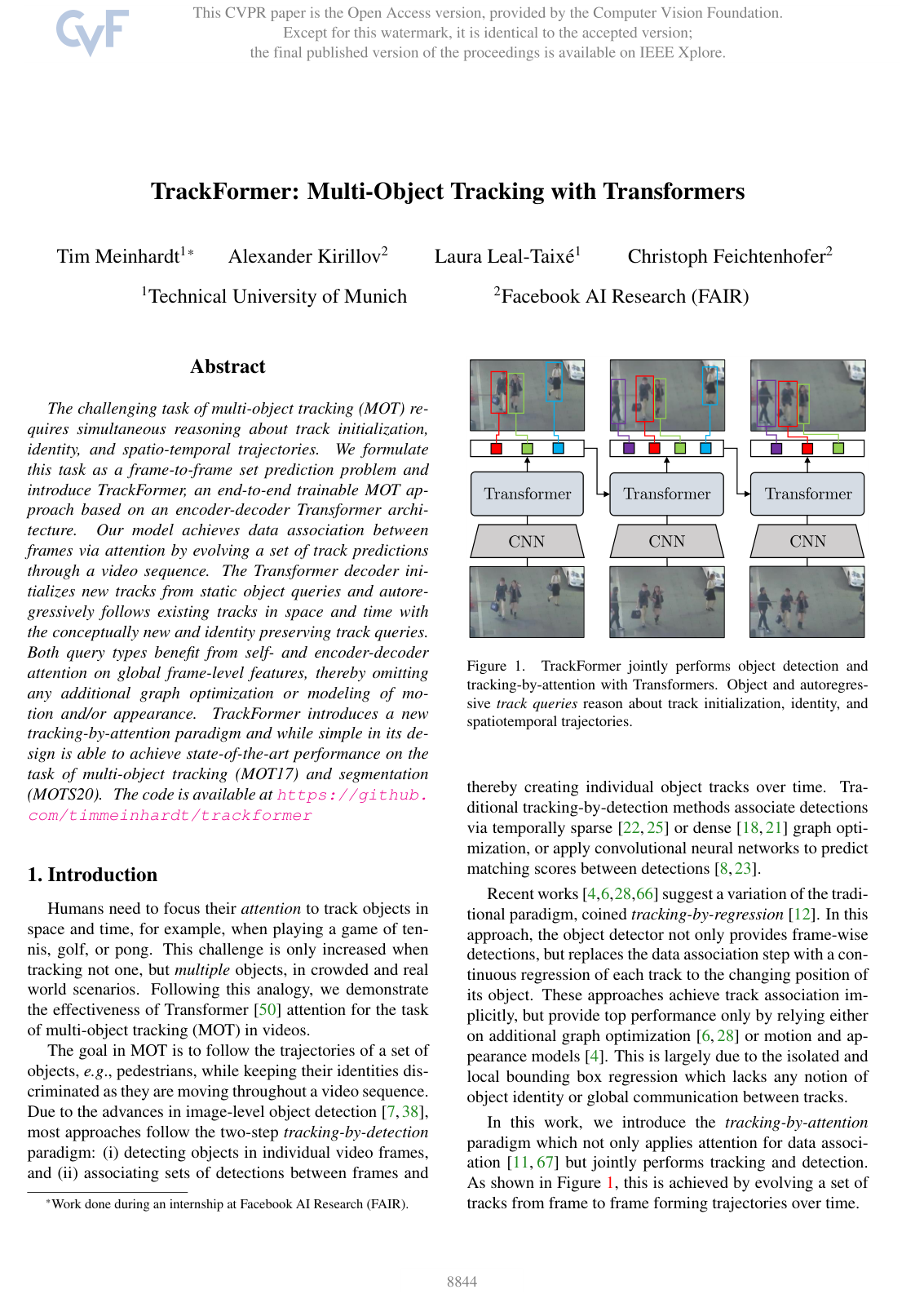
The approach formulates multi-object tracking as a continuous set prediction problem across video frames. The model uses a standard convolutional neural network backbone to extract image features and an attention-based Transformer to reason about objects. It initializes new tracks using static object queries and maintains existing tracks over time via autoregressive track queries that embed identity and spatial location. The authors evaluated the system on standard benchmark datasets, including the MOT17 tracking benchmark and the MOTS20 segmentation challenge, using simulated frame pairs from person detection datasets to train the attention mechanisms effectively.
Across the evaluations, the article reports three key findings. First, TrackFormer achieved state-of-the-art results among online tracking methods trained on comparable public data, reaching a 74.1 tracking accuracy score and a 68.0 identity preservation score on MOT17 private detections. Second, when extended to video object segmentation on MOTS20, the model set a new benchmark by raising the tracking and segmentation accuracy from 40.6 to 54.9 and identity score from 42.4 to 63.6 compared to previous baseline models. Third, ablation analyses confirmed that autoregressive track queries and targeted data augmentations—such as temporal frame perturbation—are crucial, preventing tracking accuracy drops of more than 10 to 14 points.
These findings indicate that unifying detection and association into a single Transformer model significantly streamlines the tracking pipeline. Eliminating secondary graph solvers and handcrafted matching rules reduces engineering complexity and mitigates failure points in dense environments. For decision-makers and engineering leads, this architecture provides a simpler, highly competitive baseline that reduces the overhead of maintaining multi-component tracking software.
Organizations developing video analytics pipelines should consider adopting Transformer-based set prediction architectures to simplify system design and improve tracking consistency. Future work should focus on extending the training and inference pipeline beyond adjacent two-frame pairs to multi-frame temporal reasoning, which can further strengthen long-term tracking stability.
The primary limitation of the current approach is its dependence on large amounts of training data and its focus on short-term rather than long-term re-identification across prolonged occlusions with extensive movement. TrackFormer also runs at roughly 7.4 frames per second in the reported setup, which requires optimization for strict real-time edge applications. Nevertheless, confidence in the reported tracking improvements remains high due to rigorous benchmarking on standard industry datasets.
- Paper: End-to-End Object Detection with Transformers, Nicolas Carion et al. (2020). Learn the foundational DEtection TRansformer (DETR) framework, which introduces the set prediction formulation and object query decoding mechanism that TrackFormer extends to video multi-object tracking.
- Paper: Transformer Tracking, Xin Chen et al. (2021). Understand how Transformer attention replaces traditional correlation operations for visual tracking, establishing the conceptual bridge from convolutional feature matching to attention-based tracking.
- Paper: Tracking Objects as Points, Xingyi Zhou et al. (2020). Examine how single-stage simultaneous detection and tracking through continuous point association works before seeing how TrackFormer reformulates it autoregressively with Transformer queries.
- Paper: FairMOT: On the Fairness of Detection and Re-identification in Multiple Object Tracking, Yifu Zhang et al. (2020). Discover how joint detection and appearance-based re-identification are balanced in single-network multi-object tracking pipelines prior to TrackFormer's query-based tracking-by-attention paradigm.
- Paper: Simple online and realtime tracking, Alex Bewley et al. (2016). Review the classic tracking-by-detection baseline that TrackFormer aims to supersede by replacing heuristic Kalman filtering and bipartite data association with end-to-end attention.
- Paper: HOTA: A Higher Order Metric for Evaluating Multi-object Tracking, Jonathon Luiten et al. (2020). Study the Higher Order Tracking Accuracy (HOTA) evaluation metric used to benchmark and balance detection and association performance in multi-object tracking methods like TrackFormer.
- Paper: MOT16: A Benchmark for Multi-Object Tracking, Anton Milan et al. (2016). Explore the standard MOT benchmark and evaluation protocols that define the multi-object tracking challenges TrackFormer is evaluated on.
- Paper: DanceTrack: Multi-Object Tracking in Uniform Appearance and Diverse Motion, Peize Sun et al. (2022). Examine the DanceTrack benchmark to evaluate how Transformer-based multi-object trackers perform when visual re-identification cues fail under uniform appearance and complex motion.
- Paper: MixFormerV2: Efficient Fully Transformer Tracking, Yutao Cui et al. (2023). See how fully Transformer-based tracking architectures can be made highly efficient for real-time inference through unified token interaction and progressive distillation.
- Paper: End-to-End Referring Video Object Segmentation with Multimodal Transformers, Adam Botach et al. (2022). Explore how Transformer-based multi-object tracking principles are extended to multimodal video object segmentation guided by natural language descriptions.