Transformer Tracking
Xin ChenBin YanJiawen ZhuDong WangXiaoyun YangHuchuan Lu
Introduces TransT, a high-speed visual tracking framework that replaces traditional cross-correlation with a Transformer-based attention fusion network to capture global semantic dependencies and achieve top performance across major tracking benchmarks at 50 fps.
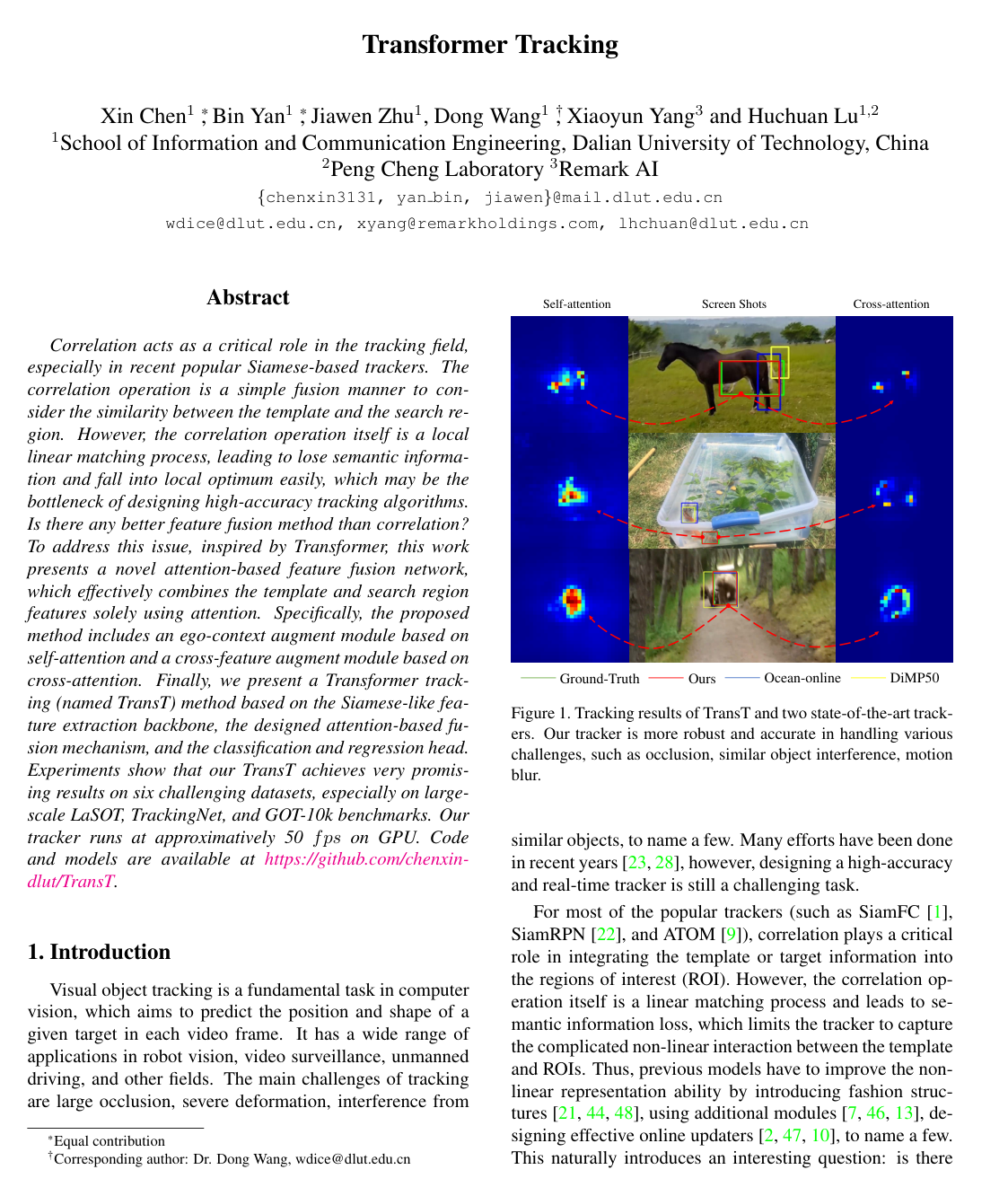
Visual object tracking—the task of estimating the location and bounding box of a target throughout a video sequence—is essential for autonomous driving, robotics, and surveillance systems. Most prevailing tracking architectures rely heavily on correlation operations to match the initial target template with subsequent search regions. However, correlation acts as a local linear comparison that causes substantial loss of semantic information and lacks global context, making systems vulnerable to occlusions, deformations, and similar background distractors.
The article evaluates whether replacing traditional correlation with an attention-based network can resolve these accuracy bottlenecks. The authors demonstrate a novel tracking architecture, termed Transformer Tracking (TransT), which completely eliminates correlation operations in favor of attention-driven feature fusion.
The proposed framework extracts visual features using a modified standard convolutional network and fuses them through stacked attention modules before passing them to a prediction head. The fusion engine employs two mechanisms: ego-context augment modules using self-attention to enrich local context within each branch, and cross-feature augment modules using cross-attention to dynamically associate the template and search areas. The tracker was evaluated against roughly twenty competing methods across six diverse, large-scale visual tracking benchmarks (including LaSOT, TrackingNet, and GOT-10k) and trained offline on extensive standard datasets.
The experimental findings show that TransT establishes a new state-of-the-art performance level across major benchmarks. On the large-scale LaSOT dataset, TransT achieved a 64.9% success rate (AUC), outperforming established models like Ocean (56.0%) and DiMP (56.9%). On the TrackingNet and GOT-10k benchmarks, it achieved top-tier scores of 81.4% AUC and 72.3% average overlap, respectively. Ablation experiments revealed that removing attention mechanisms and substituting back correlation led to steep drops in accuracy, confirming the necessity of the attention modules. Furthermore, TransT operates at approximately 50 frames per second on a single GPU, easily exceeding real-time deployment requirements and proving more than ten times faster than competing high-accuracy frameworks such as SiamR-CNN, which runs at under 5 frames per second.
These results indicate that computer vision systems can achieve superior tracking robustness without the computational overhead of complex online update routines or anchor adjustments. By shifting to attention-based fusion, engineering teams can build tracking pipelines that maintain precision during severe environmental disruptions while preserving high operational throughput and lower computational latency.
Organizations developing real-time computer vision applications should consider adopting attention-based fusion architectures in place of correlation-centric pipelines. Teams can implement the open-source codebase to evaluate performance on domain-specific edge devices. Because the evaluation was conducted primarily on curated academic benchmarks and requires high-end GPU acceleration for 50 frames per second processing, stakeholders should conduct targeted pilot tests in edge environments with constrained hardware or specialized optical sensors before broad operational deployment.
- Paper: Fully-Convolutional Siamese Networks for Object Tracking, Luca Bertinetto et al. (2016). This paper establishes the foundational fully-convolutional Siamese tracking framework based on cross-correlation feature matching that TransT seeks to replace with an attention-based fusion network.
- Paper: SiamRPN++: Evolution of Siamese Visual Tracking With Very Deep Networks, Bo Li et al. (2018). This work introduces deep Siamese tracking architectures and depth-wise cross-correlation fusion, providing the direct baseline and performance bottleneck analyzed by TransT.
- Paper: SuperGlue: Learning Feature Matching With Graph Neural Networks, Paul-Edouard Sarlin et al. (2020). This paper introduces the concept of combining self-attention and cross-attention modules for matching visual features across distinct image regions, directly inspiring TransT's feature fusion architecture.
- Paper: On the Relationship between Self-Attention and Convolutional Layers, Jean-Baptiste Cordonnier et al. (2020). This theoretical study demonstrates how self-attention layers can generalize and surpass standard convolutional operations, establishing the conceptual basis for replacing correlation with attention in vision.
- Paper: Object Tracking Benchmark, Yi Wu et al. (2015). This paper provides the standard benchmarking methodology and evaluation protocols widely used to assess visual tracking performance across diverse challenges.
- Paper: LoFTR: Detector-Free Local Feature Matching with Transformers, Jiaming Sun et al. (2021). This work extends Transformer-based cross-attention and self-attention feature fusion mechanisms to dense, detector-free local feature matching.
- Paper: Transformers in Vision: A Survey, Salman Khan et al. (2021). This comprehensive survey contextualizes attention-driven visual matching models like TransT within the broader landscape of vision Transformer architectures.
- Paper: Attention mechanisms in computer vision: A survey, Meng-Hao Guo et al. (2021). This survey provides a systematic categorization of cross-feature and spatial attention mechanisms, contextualizing the specific attention designs used in tracking and matching.
- Paper: Efficient Multi-Scale Attention Module with Cross-Spatial Learning, Daliang Ouyang et al. (2023). This paper develops cross-spatial multi-scale attention mechanisms that build upon the cross-feature interaction concepts introduced in Transformer-based visual architectures.
- Paper: TransNeXt: Robust Foveal Visual Perception for Vision Transformers, Dai Shi (2024). This research designs advanced visual attention backbones that address depth degradation and long-range feature mixing in downstream Transformer vision frameworks.