
keyword
object tracking
Object tracking is a computer vision task that involves estimating the position, trajectory, and extent of one or more target objects continuously across a sequence of video frames or sensor data over time. Initiated by specifying a target through an initial bounding region, point, or automatic detection, the tracking process maintains a persistent identity for each object by associating visual appearances, spatial features, and temporal motion cues across consecutive observations. Tracking methods operate on single or multiple objects in two-dimensional image space or three-dimensional physical space, addressing complexities such as target occlusions, scale variations, fast motion, illumination shifts, and camera movements. It serves as a foundational technology in applications including autonomous driving, robotic perception, video surveillance, and human-computer interaction.
11 items
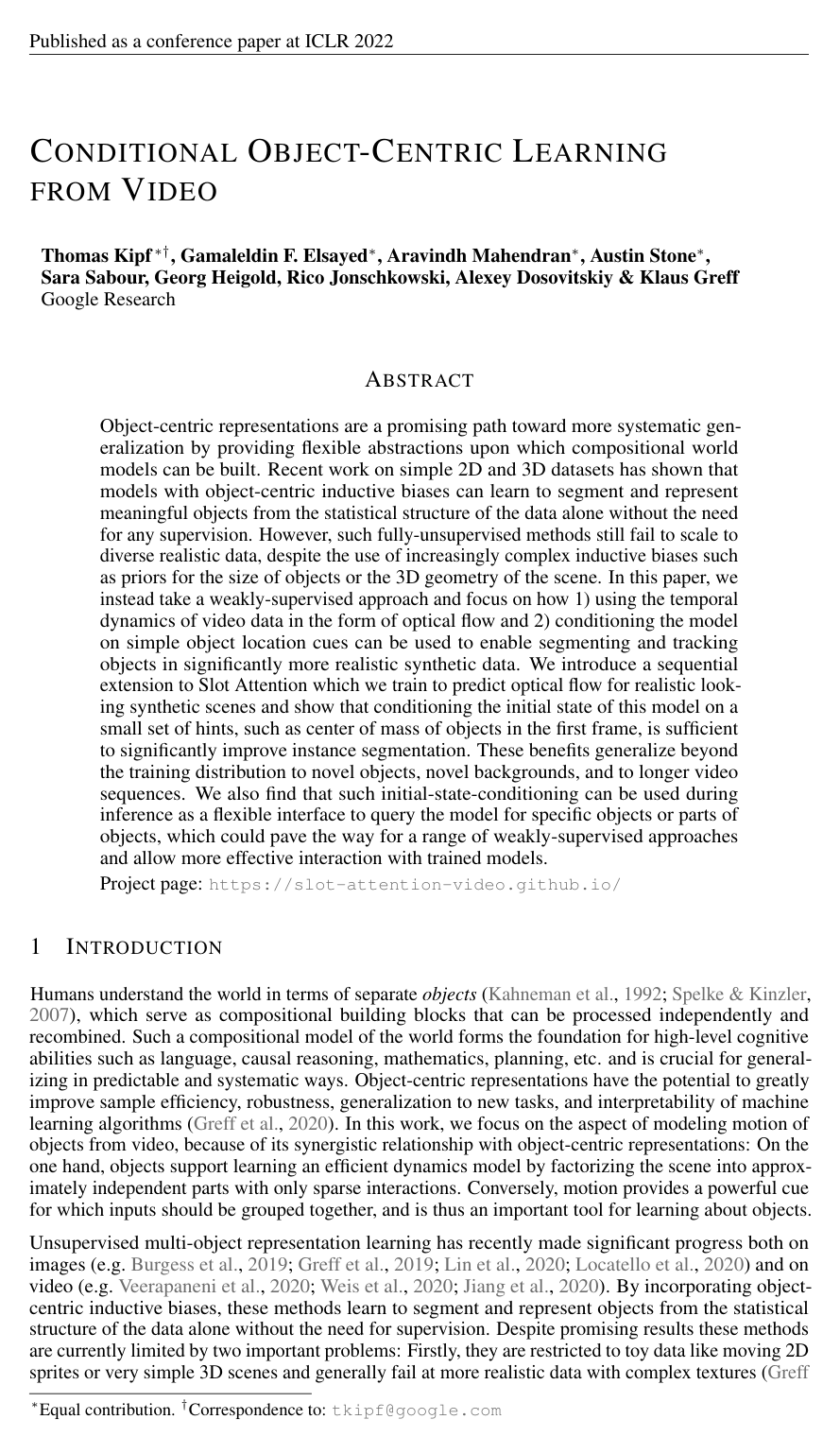
Conditional Object-Centric Learning from Video
Thomas Kipf, Gamaleldin Fathy Elsayed, Aravindh Mahendran, Austin Stone, Sara Sabour, Georg Heigold, Rico Jonschkowski, Alexey Dosovitskiy, Klaus Greff
Why you should read this
Proposes a sequential extension to Slot Attention that combines optical flow prediction with sparse initial location cues, enabling object-centric models to segment, track, and generalize across complex video scenes with minimal supervision.
Object-centric representations are a promising path toward more systematic generalization by providing flexible abstractions upon which compositional world models can be built. Recent work on simple 2D and 3D datasets has shown that models with object-centric inductive biases can learn to segment and represent meaningful objects from the statistical structure of the data alone without the need for any supervision. However, such fully-unsupervised methods still fail to scale to diverse realistic data, despite the use of increasingly complex inductive biases such as priors for the size of objects or the 3D geometry of the scene. In this paper, we instead take a weakly-supervised approach and focus on how 1) using the temporal dynamics of video data in the form of optical flow and 2) conditioning the model on simple object location cues can be used to enable segmenting and tracking objects in significantly more realistic synthetic data. We introduce a sequential extension to Slot Attention which we train to predict optical flow for realistic looking synthetic scenes and show that conditioning the initial state of this model on a small set of hints, such as center of mass of objects in the first frame, is sufficient to significantly improve instance segmentation. These benefits generalize beyond the training distribution to novel objects, novel backgrounds, and to longer video sequences. We also find that such initial-state-conditioning can be used during inference as a flexible interface to query the model for specific objects or parts of objects, which could pave the way for a range of weakly-supervised approaches and allow more effective interaction with trained models.
Added
2026-09-29
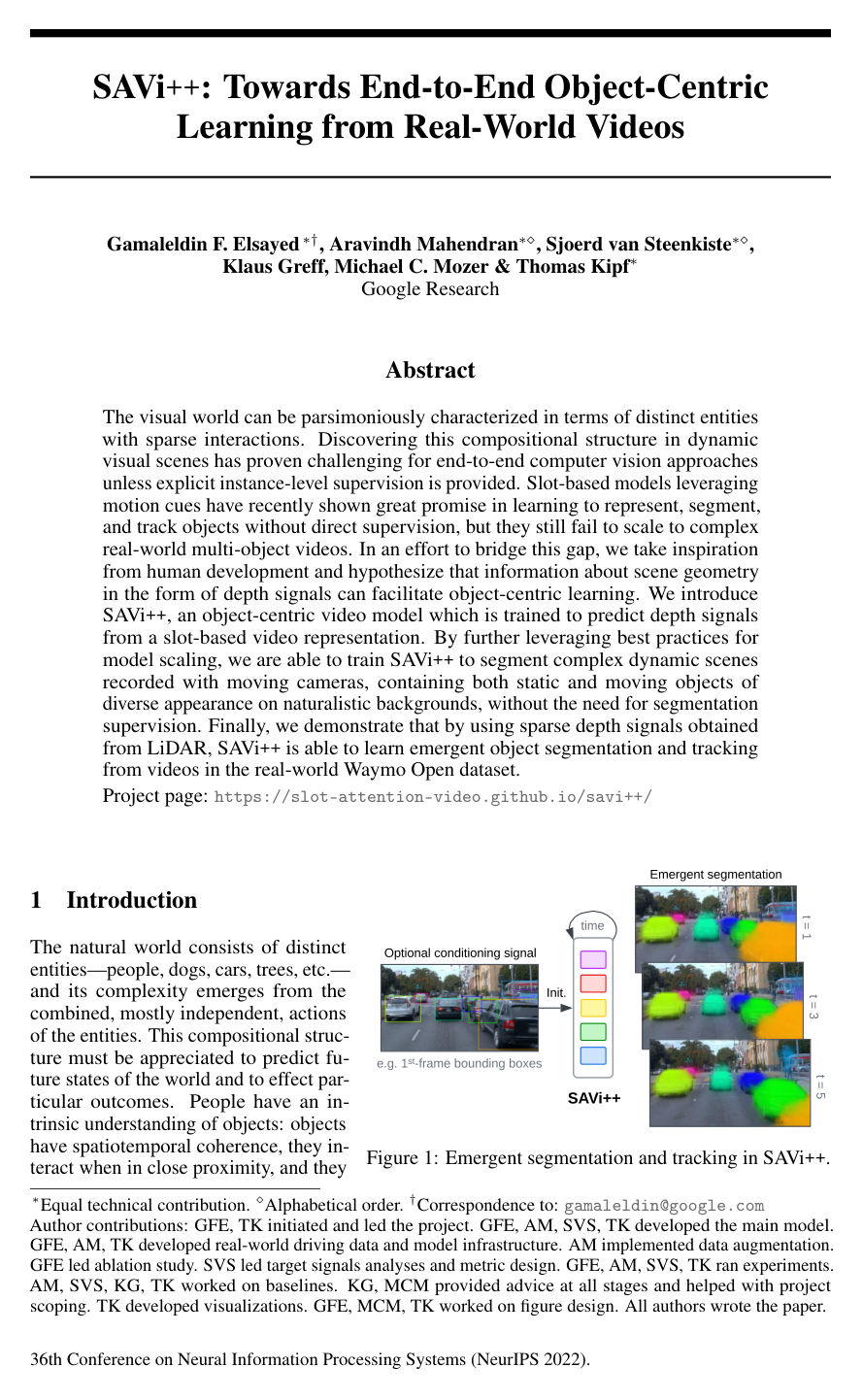
SAVi++: Towards End-to-End Object-Centric Learning from Real-World Videos
Gamaleldin F. Elsayed, Aravindh Mahendran, Sjoerd van Steenkiste, Klaus Greff, Michael C. Mozer, Thomas Kipf
Why you should read this
Presents an end-to-end slot-based video model that leverages depth prediction and architectural scaling to achieve unsupervised object segmentation and tracking in complex real-world driving scenes.
The visual world can be parsimoniously characterized in terms of distinct entities with sparse interactions. Discovering this compositional structure in dynamic visual scenes has proven challenging for end-to-end computer vision approaches unless explicit instance-level supervision is provided. Slot-based models leveraging motion cues have recently shown great promise in learning to represent, segment, and track objects without direct supervision, but they still fail to scale to complex real-world multi-object videos. In an effort to bridge this gap, we take inspiration from human development and hypothesize that information about scene geometry in the form of depth signals can facilitate object-centric learning. We introduce SAVi++, an object-centric video model which is trained to predict depth signals from a slot-based video representation. By further leveraging best practices for model scaling, we are able to train SAVi++ to segment complex dynamic scenes recorded with moving cameras, containing both static and moving objects of diverse appearance on naturalistic backgrounds, without the need for segmentation supervision. Finally, we demonstrate that by using sparse depth signals obtained from LiDAR, SAVi++ is able to learn emergent object segmentation and tracking from videos in the real-world Waymo Open dataset.
Added
2026-09-28
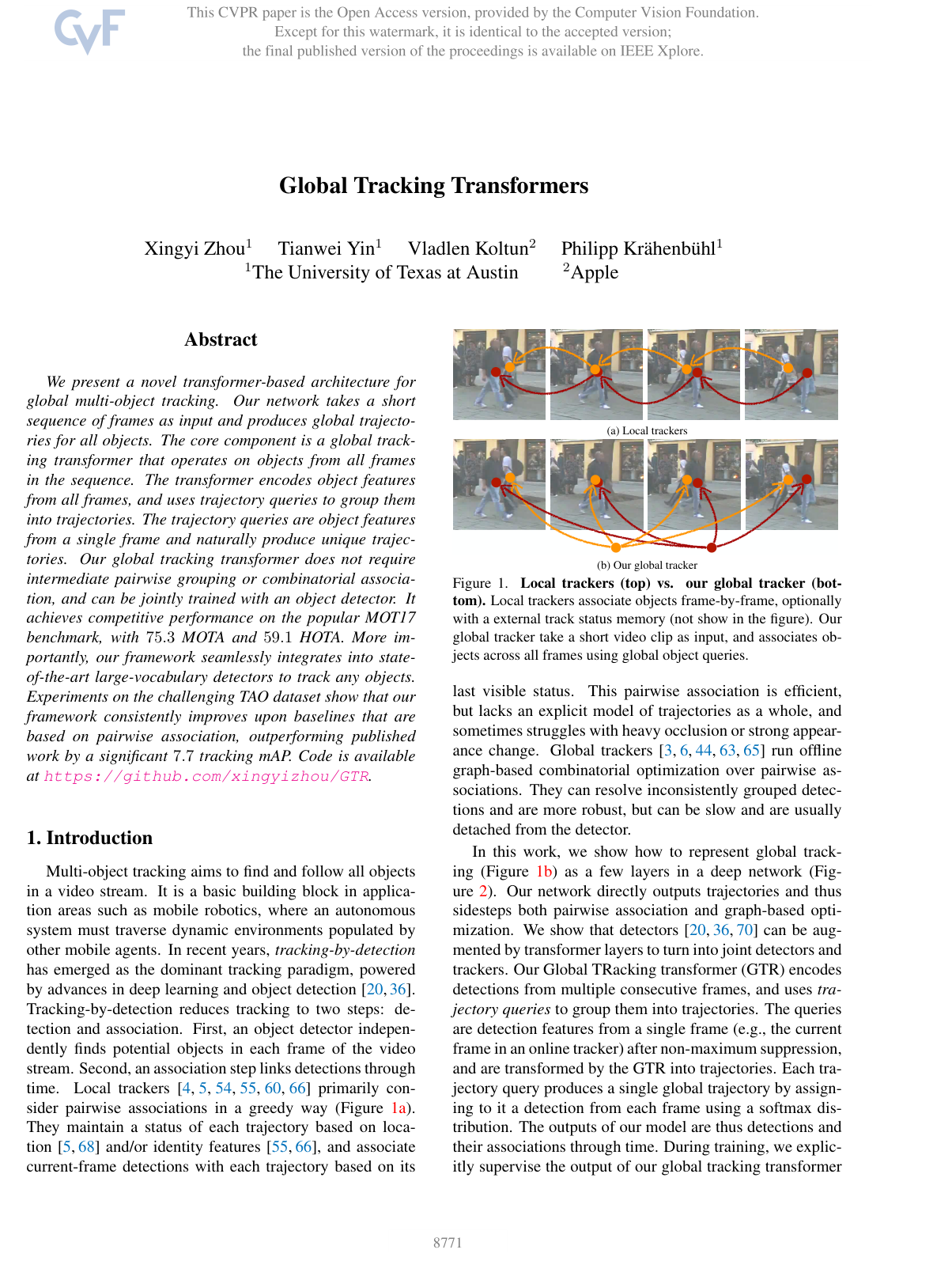
Global Tracking Transformers
Xingyi Zhou, Tianwei Yin, Vladlen Koltun, Philipp Krähenbühl
Why you should read this
Introduces a transformer-based multi-object tracking framework that directly groups detections across video sequences into global trajectories via trajectory queries, eliminating heuristic pairwise association while enabling end-to-end joint training with modern object detectors.
We present a novel transformer-based architecture for global multi-object tracking. Our network takes a short sequence of frames as input and produces global trajectories for all objects. The core component is a global tracking transformer that operates on objects from all frames in the sequence. The transformer encodes object features from all frames, and uses trajectory queries to group them into trajectories. The trajectory queries are object features from a single frame and naturally produce unique trajectories. Our global tracking transformer does not require intermediate pairwise grouping or combinatorial association, and can be jointly trained with an object detector. It achieves competitive performance on the popular MOT17 benchmark, with 75.3 MOTA and 59.1 HOTA. More importantly, our framework seamlessly integrates into state-of-the-art large-vocabulary detectors to track any objects. Experiments on the challenging TAO dataset show that our framework consistently improves upon baselines that are based on pairwise association, outperforming published work by a significant 7 tracking mAP. Code is available at https://github.com/xingyizhou/GTR.
Added
2026-09-26
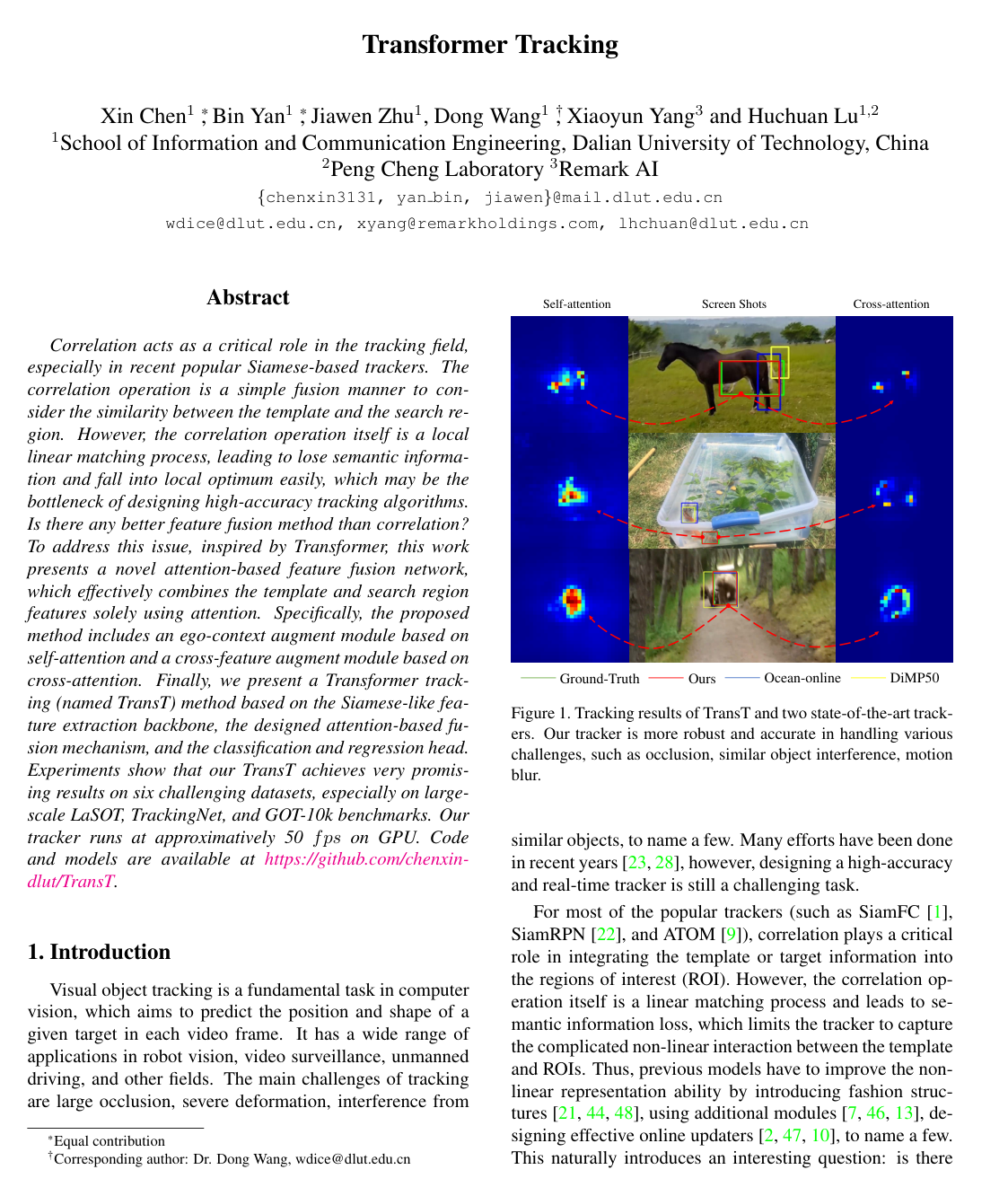
Transformer Tracking
Xin Chen, Bin Yan, Jiawen Zhu, Dong Wang, Xiaoyun Yang, Huchuan Lu
Why you should read this
Introduces TransT, a high-speed visual tracking framework that replaces traditional cross-correlation with a Transformer-based attention fusion network to capture global semantic dependencies and achieve top performance across major tracking benchmarks at 50 fps.
Correlation acts as a critical role in the tracking field, especially in recent popular Siamese-based trackers. The correlation operation is a simple fusion manner to consider the similarity between the template and the search region. However, the correlation operation itself is a local linear matching process, leading to lose semantic information and fall into local optimum easily, which may be the bottleneck of designing high-accuracy tracking algorithms. Is there any better feature fusion method than correlation? To address this issue, inspired by Transformer, this work presents a novel attention-based feature fusion network, which effectively combines the template and search region features solely using attention. Specifically, the proposed method includes an ego-context augment module based on self-attention and a cross-feature augment module based on cross-attention. Finally, we present a Transformer tracking (named TransT) method based on the Siamese-like feature extraction backbone, the designed attention-based fusion mechanism, and the classification and regression head. Experiments show that our TransT achieves very promising results on six challenging datasets, especially on large-scale LaSOT, TrackingNet, and GOT-10k benchmarks. Our tracker runs at approximatively 50 fps on GPU. Code and models are available at this https URL.
Added
2026-09-25
Robust Fragments-based Tracking using the Integral Histogram
Amit Adam, E. Rivlin, I. Shimshoni
Why you should read this
Proposes FragTrack, a visual tracking method that represents objects via arbitrary image fragments and aggregates their histogram-similarity votes using integral histograms to effectively handle severe occlusions and pose variations at constant computational cost.
We present a novel algorithm (which we call "FragTrack") for tracking an object in a video sequence. The template object is represented by multiple image fragments or patches. The patches are arbitrary and are not based on an object model (in contrast with traditional use of model-based parts e.g. limbs and torso in human tracking). Every patch votes on the possible positions and scales of the object in the current frame, by comparing its histogram with the corresponding image patch histogram. We then minimize a robust statistic in order to combine the vote maps of the multiple patches. A key tool enabling the application of our algorithm to tracking is the integral histogram data structure [18]. Its use allows to extract histograms of multiple rectangular regions in the image in a very efficient manner. Our algorithm overcomes several difficulties which cannot be handled by traditional histogram-based algorithms [8, 6]. First, by robustly combining multiple patch votes, we are able to handle partial occlusions or pose change. Second, the geometric relations between the template patches allow us to take into account the spatial distribution of the pixel intensities - information which is lost in traditional histogram-based algorithms. Third, as noted by [18], tracking large targets has the same computational cost as tracking small targets. We present extensive experimental results on challenging sequences, which demonstrate the robust tracking achieved by our algorithm (even with the use of only gray-scale (non-color) information).
Added
2026-09-24
YOLOv11: An Overview of the Key Architectural Enhancements
Rahima Khanam, Muhammad Hussain
Why you should read this
Presents an architectural breakdown of YOLOv11, detailing how components like C3k2 blocks and C2PSA attention mechanisms optimize feature extraction and speed-accuracy trade-offs across detection, segmentation, and pose estimation tasks.
This study presents an architectural analysis of YOLOv11, the latest iteration in the YOLO (You Only Look Once) series of object detection models. We examine the models architectural innovations, including the introduction of the C3k2 (Cross Stage Partial with kernel size 2) block, SPPF (Spatial Pyramid Pooling - Fast), and C2PSA (Convolutional block with Parallel Spatial Attention) components, which contribute in improving the models performance in several ways such as enhanced feature extraction. The paper explores YOLOv11's expanded capabilities across various computer vision tasks, including object detection, instance segmentation, pose estimation, and oriented object detection (OBB). We review the model's performance improvements in terms of mean Average Precision (mAP) and computational efficiency compared to its predecessors, with a focus on the trade-off between parameter count and accuracy. Additionally, the study discusses YOLOv11's versatility across different model sizes, from nano to extra-large, catering to diverse application needs from edge devices to high-performance computing environments. Our research provides insights into YOLOv11's position within the broader landscape of object detection and its potential impact on real-time computer vision applications.
Added
2026-09-24
Fully-Convolutional Siamese Networks for Object Tracking
Luca Bertinetto, Jack Valmadre, João F. Henriques, Andrea Vedaldi, Philip H. S. Torr
Why you should read this
Introduces a fully-convolutional Siamese network for visual object tracking that replaces slow online model adaptation with end-to-end offline learning, delivering state-of-the-art tracking accuracy at speeds well beyond real time.
The problem of arbitrary object tracking has traditionally been tackled by learning a model of the object's appearance exclusively online, using as sole training data the video itself. Despite the success of these methods, their online-only approach inherently limits the richness of the model they can learn. Recently, several attempts have been made to exploit the expressive power of deep convolutional networks. However, when the object to track is not known beforehand, it is necessary to perform Stochastic Gradient Descent online to adapt the weights of the network, severely compromising the speed of the system. In this paper we equip a basic tracking algorithm with a novel fully-convolutional Siamese network trained end-to-end on the ILSVRC15 dataset for object detection in video. Our tracker operates at frame-rates beyond real-time and, despite its extreme simplicity, achieves state-of-the-art performance in multiple benchmarks.
Added
2026-09-16
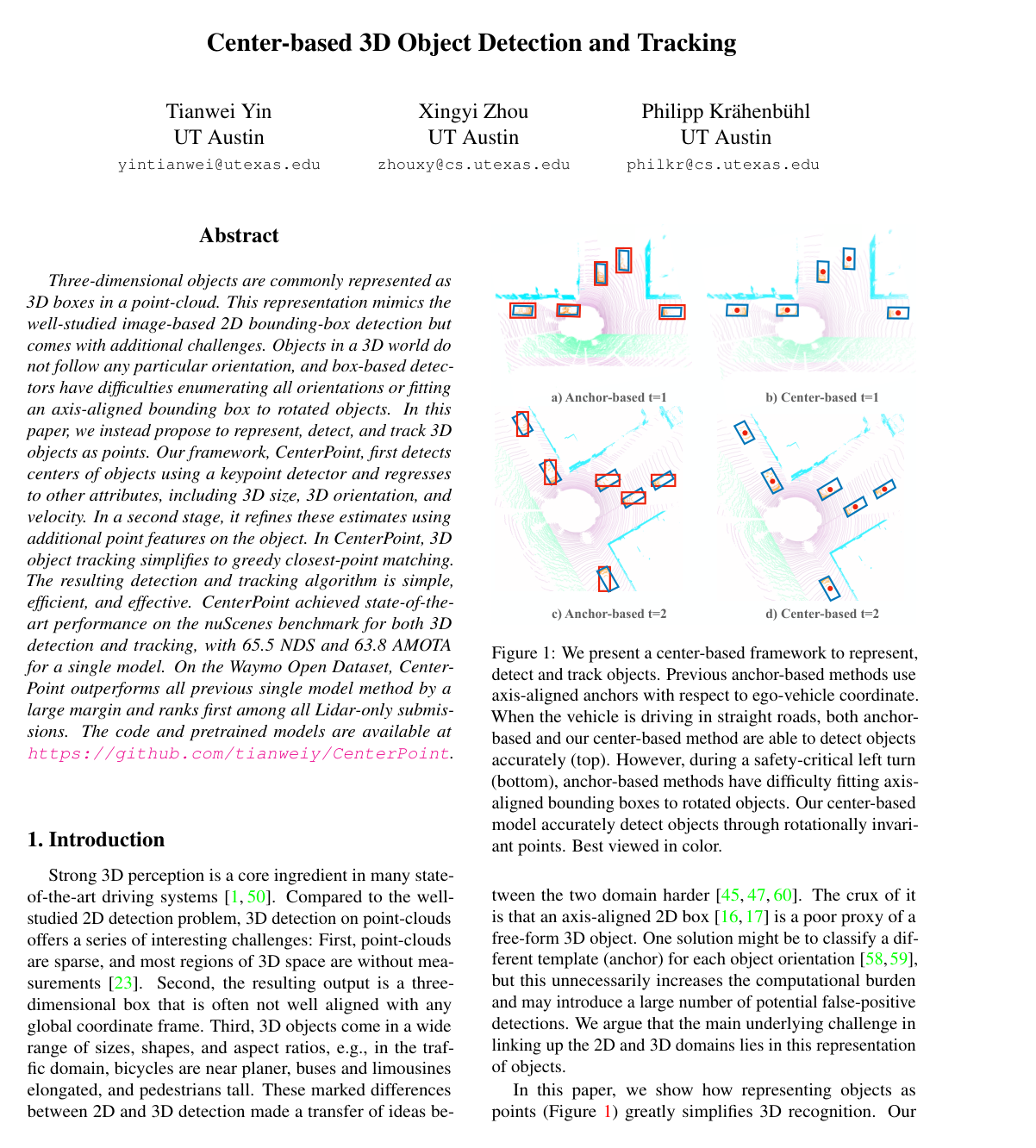
Center-based 3D Object Detection and Tracking
Tianwei Yin, Xingyi Zhou, Philipp Krähenbühl
Why you should read this
Proposes CenterPoint, an anchor-free framework that detects 3D objects as center points and simplifies tracking to closest-point matching, achieving state-of-the-art results on the nuScenes and Waymo Open Dataset benchmarks.
Three-dimensional objects are commonly represented as 3D boxes in a point-cloud. This representation mimics the well-studied image-based 2D bounding-box detection but comes with additional challenges. Objects in a 3D world do not follow any particular orientation, and box-based detectors have difficulties enumerating all orientations or fitting an axis-aligned bounding box to rotated objects. In this paper, we instead propose to represent, detect, and track 3D objects as points. Our framework, CenterPoint, first detects centers of objects using a keypoint detector and regresses to other attributes, including 3D size, 3D orientation, and velocity. In a second stage, it refines these estimates using additional point features on the object. In CenterPoint, 3D object tracking simplifies to greedy closest-point matching. The resulting detection and tracking algorithm is simple, efficient, and effective. CenterPoint achieved state-of-the-art performance on the nuScenes benchmark for both 3D detection and tracking, with 65.5 NDS and 63.8 AMOTA for a single model. On the Waymo Open Dataset, CenterPoint outperforms all previous single model method by a large margin and ranks first among all Lidar-only submissions. The code and pretrained models are available at this https URL.
Added
2026-09-15
A Benchmark Dataset and Evaluation Methodology for Video Object Segmentation
Federico Perazzi, J. Pont-Tuset, B. McWilliams, L. Gool, M. Gross, A. Sorkine-Hornung
Why you should read this
Introduces the densely annotated DAVIS video-segmentation benchmark and complementary spatial, contour, and temporal metrics that expose the strengths and weaknesses of current methods.
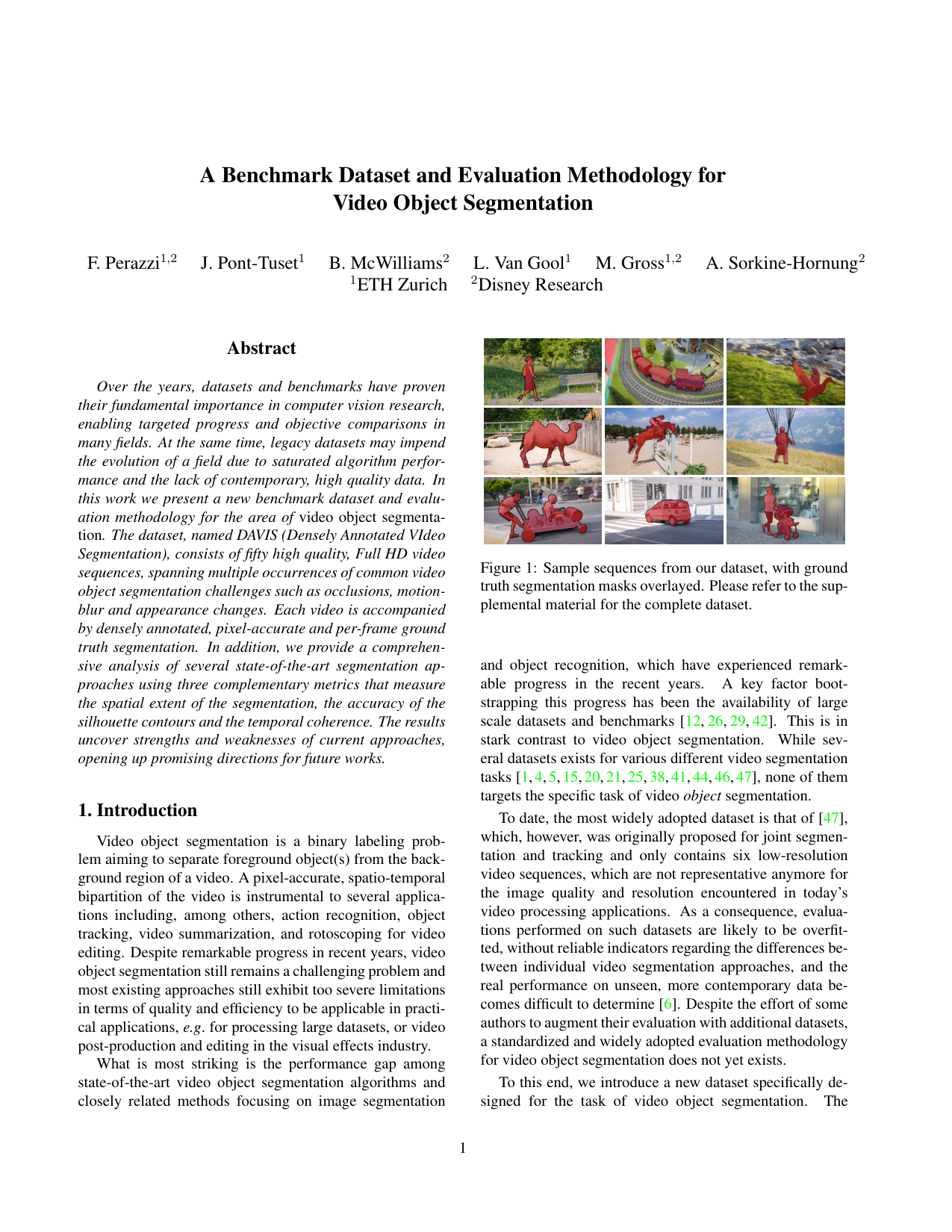
Over the years, datasets and benchmarks have proven their fundamental importance in computer vision research, enabling targeted progress and objective comparisons in many fields. At the same time, legacy datasets may impend the evolution of a field due to saturated algorithm performance and the lack of contemporary, high quality data. In this work we present a new benchmark dataset and evaluation methodology for the area of video object segmentation. The dataset, named DAVIS (Densely Annotated VIdeo Segmentation), consists of fifty high quality, Full HD video sequences, spanning multiple occurrences of common video object segmentation challenges such as occlusions, motion-blur and appearance changes. Each video is accompanied by densely annotated, pixel-accurate and per-frame ground truth segmentation. In addition, we provide a comprehensive analysis of several state-of-the-art segmentation approaches using three complementary metrics that measure the spatial extent of the segmentation, the accuracy of the silhouette contours and the temporal coherence. The results uncover strengths and weaknesses of current approaches, opening up promising directions for future works.
Added
2026-09-14
Tracking-Learning-Detection
Zdenek Kalal, K. Mikolajczyk, Jiri Matas
Why you should read this
Proposes a real-time framework that decomposes long-term visual tracking into tracking, detection, and self-correcting P-N learning to sustain tracking of unknown objects through full occlusions, camera disappearances, and severe appearance changes.
This paper investigates long-term tracking of unknown objects in a video stream. The object is defined by its location and extent in a single frame. In every frame that follows, the task is to determine the object's location and extent or indicate that the object is not present. We propose a novel tracking framework (TLD) that explicitly decomposes the long-term tracking task into tracking, learning and detection. The tracker follows the object from frame to frame. The detector localizes all appearances that have been observed so far and corrects the tracker if necessary. The learning estimates detector's errors and updates it to avoid these errors in the future. We study how to identify detector's errors and learn from them. We develop a novel learning method (P-N learning) which estimates the errors by a pair of “experts”: (i) P-expert estimates missed detections, and (ii) N-expert estimates false alarms. The learning process is modeled as a discrete dynamical system and the conditions under which the learning guarantees improvement are found. We describe our real-time implementation of the TLD framework and the P-N learning. We carry out an extensive quantitative evaluation which shows a significant improvement over state-of-the-art approaches.
Source
http://vision.stanford.edu/teaching/cs231b_spring1415/papers/PAMI2011_KalalMikolajczykMatas.pdfAdded
2026-09-12
Scalability in Perception for Autonomous Driving: Waymo Open Dataset
Pei Sun, Henrik Kretzschmar, Xerxes Dotiwalla, Aurelien Chouard, Vijaysai Patnaik, P. Tsui, James Guo, Yin Zhou, Yuning Chai, Benjamin Caine, Vijay Vasudevan, Wei Han, Jiquan Ngiam, Hang Zhao, Aleksei Timofeev, S. Ettinger, Maxim Krivokon, A. Gao, Aditya Joshi, Yu Zhang, Jonathon Shlens, Zhifeng Chen, Dragomir Anguelov
Why you should read this
Presents the Waymo Open Dataset, a large-scale multimodal benchmark combining synchronized LiDAR and camera streams with exhaustive 2D and 3D annotations to evaluate perception scalability and cross-geographic generalization in autonomous driving.
The research community has increasing interest in autonomous driving research, despite the resource intensity of obtaining representative real world data. Existing self-driving datasets are limited in the scale and variation of the environments they capture, even though generalization within and between operating regions is crucial to the overall viability of the technology. In an effort to help align the research community's contributions with real-world self-driving problems, we introduce a new large scale, high quality, diverse dataset. Our new dataset consists of 1150 scenes that each span 20 seconds, consisting of well synchronized and calibrated high quality LiDAR and camera data captured across a range of urban and suburban geographies. It is 15x more diverse than the largest camera+LiDAR dataset available based on our proposed diversity metric. We exhaustively annotated this data with 2D (camera image) and 3D (LiDAR) bounding boxes, with consistent identifiers across frames. Finally, we provide strong baselines for 2D as well as 3D detection and tracking tasks. We further study the effects of dataset size and generalization across geographies on 3D detection methods. Find data, code and more up-to-date information at this http URL.
Added
2026-09-10