A Benchmark Dataset and Evaluation Methodology for Video Object Segmentation
Federico PerazziJordi Pont-TusetBrian McWilliamsLuc Van GoolM. GrossAlexander Sorkine‐Hornung
Introduces the densely annotated DAVIS video-segmentation benchmark and complementary spatial, contour, and temporal metrics that expose the strengths and weaknesses of current methods.
Separating moving foreground objects from background video at pixel-level accuracy is essential for visual effects, video editing, tracking, and action recognition. However, progress in video object segmentation has lagged behind still-image segmentation, primarily due to the lack of high-resolution, standardized, and densely annotated benchmarks. Existing datasets are constrained by low spatial resolution, sparse frame annotations, or limited sequence diversity, leading to algorithm overfitting and saturated performance on outdated metrics.
To address this bottleneck, the article introduces DAVIS (Densely Annotated VIdeo Segmentation), a high-definition benchmark dataset and evaluation methodology. The article set out to rigorously benchmark and analyze the performance, strengths, and failure modes of state-of-the-art video object segmentation algorithms under realistic and diverse video conditions.
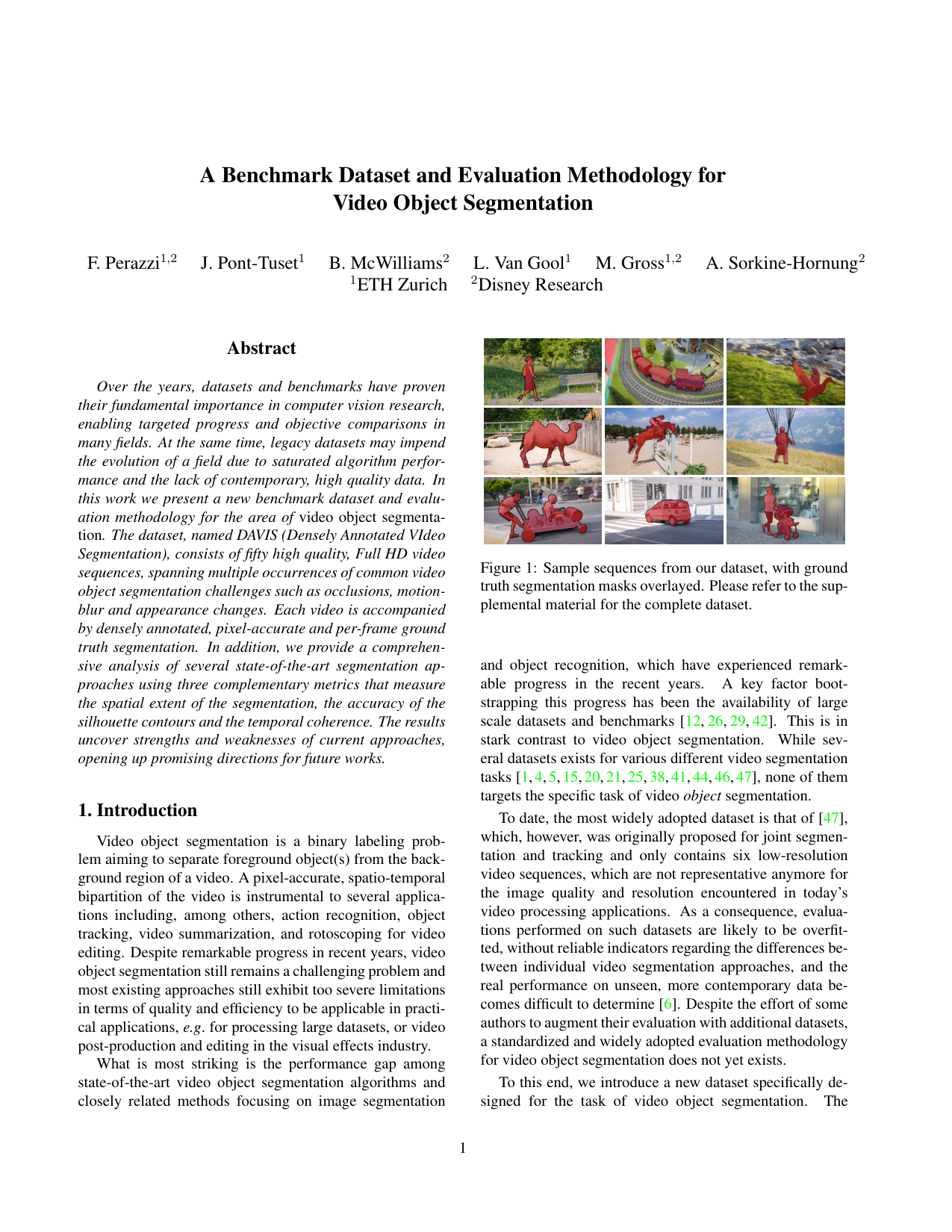
The benchmark comprises 50 Full HD 1080p video sequences totaling 3,455 frames, each manually annotated with pixel-accurate ground truth segmentation masks. The sequences cover four diverse content categories (humans, animals, vehicles, and objects) and systematically incorporate 15 challenging real-world attributes, including occlusions, motion blur, fast motion, and dynamic backgrounds. Using these data, the article evaluated 12 state-of-the-art unsupervised and semi-supervised algorithms alongside two preprocessing methods across three complementary metrics: region similarity (Jaccard index), contour accuracy (F-measure), and temporal stability.
The empirical findings demonstrate that current state-of-the-art segmentation methods leave substantial room for improvement. The top-performing methods, Non-Local Consensus (NLC) and Fully Connected Proposals (FCP), achieved average region similarity scores of only 0.641 and 0.631, respectively, falling short of the 0.70 threshold considered necessary for production-quality accuracy. Furthermore, sequential frame-propagation techniques suffered severe performance decay over time, whereas non-local, proposal-based methods maintained higher temporal stability and recall. Specific scene challenges caused sharp performance drops across most models; for instance, appearance changes degraded the performance of color-reliant models by nearly 50%, while dynamic backgrounds and fast motion severely disrupted optical-flow and trajectory-clustering methods.
These findings indicate that existing video segmentation algorithms remain too brittle and computationally demanding for fully automated commercial deployment in post-production and large-scale video processing pipelines. To make meaningful operational progress, development must move away from simple sequential frame propagation and localized motion clustering toward architectures that leverage robust object proposals, non-local spatio-temporal connectivity, and high-resolution contour refinement.
Organizations developing or deploying video segmentation tools should prioritize proposal-driven, non-locally connected models like FCP or NLC when handling unconstrained video, while utilizing boundary-focused refinement techniques to ensure contour precision. Future research must specifically target computational efficiency and memory footprints, as heavy preprocessing requirements for motion estimation and boundary extraction currently limit the real-time utility of these methods on high-resolution Full HD video.
- Paper: The Pascal Visual Object Classes Challenge: A Retrospective, M. Everingham et al. (2014). Reading the PASCAL VOC retrospective first clarifies the benchmark evolution and annotation practices that directly enabled modern video segmentation datasets like DAVIS.
- Paper: Object Tracking Benchmark, Yi Wu et al. (2015). Understanding this foundational object tracking benchmark provides essential context for the rigorous evaluation protocols and performance metrics later adopted in video segmentation.
- Paper: SAM 2: Segment Anything in Images and Videos, Nikhila Ravi et al. (2025). This work directly extends the benchmark principles of DAVIS to massive-scale interactive video object segmentation using modern transformer architectures.
- Paper: Adversarial Video Generation on Complex Datasets, Aidan Clark et al. (2019). This study builds upon foundational video datasets like DAVIS to explore complex generative adversarial modeling of video dynamics.