UCMCTrack: Multi-Object Tracking with Uniform Camera Motion Compensation
Kefu YiKai LuoXiaolei LuoJiangui HuangHao WuRongdong HuWei Hao
Presents a purely motion-based multi-object tracker that avoids expensive frame-by-frame camera motion compensation by mapping Kalman filter state estimation and probability distributions onto the ground plane, achieving state-of-the-art accuracy at over 1000 FPS on a single CPU.
Real-time multi-object tracking in video is essential for autonomous systems and intelligent surveillance, yet it struggles when cameras move or jitter. Traditional solutions either extract visual appearance features or calculate camera motion compensation on every single frame. While effective, these techniques impose severe computational overhead, which prevents tracking systems from operating in real-time on edge devices.
The article demonstrates an efficient multi-object tracker, named UCMCTrack, that achieves state-of-the-art accuracy relying strictly on motion cues while using uniform camera motion compensation parameters across an entire video sequence.
To accomplish this, the authors shifted object motion modeling from the 2D image plane to the 3D ground plane using a standard linear camera projection model. Instead of relying on conventional bounding box overlap metrics like Intersection over Union, the method introduces the Mapped Mahalanobis Distance combined with a Correlated Measurement Distribution, which accurately accounts for spatial projection uncertainties. Motion noise from camera movements is absorbed into a standard Kalman filter's process noise covariance matrix. The system was evaluated across established tracking benchmarks, including MOT17, MOT20, DanceTrack, and KITTI, using standard detections from baseline detectors.
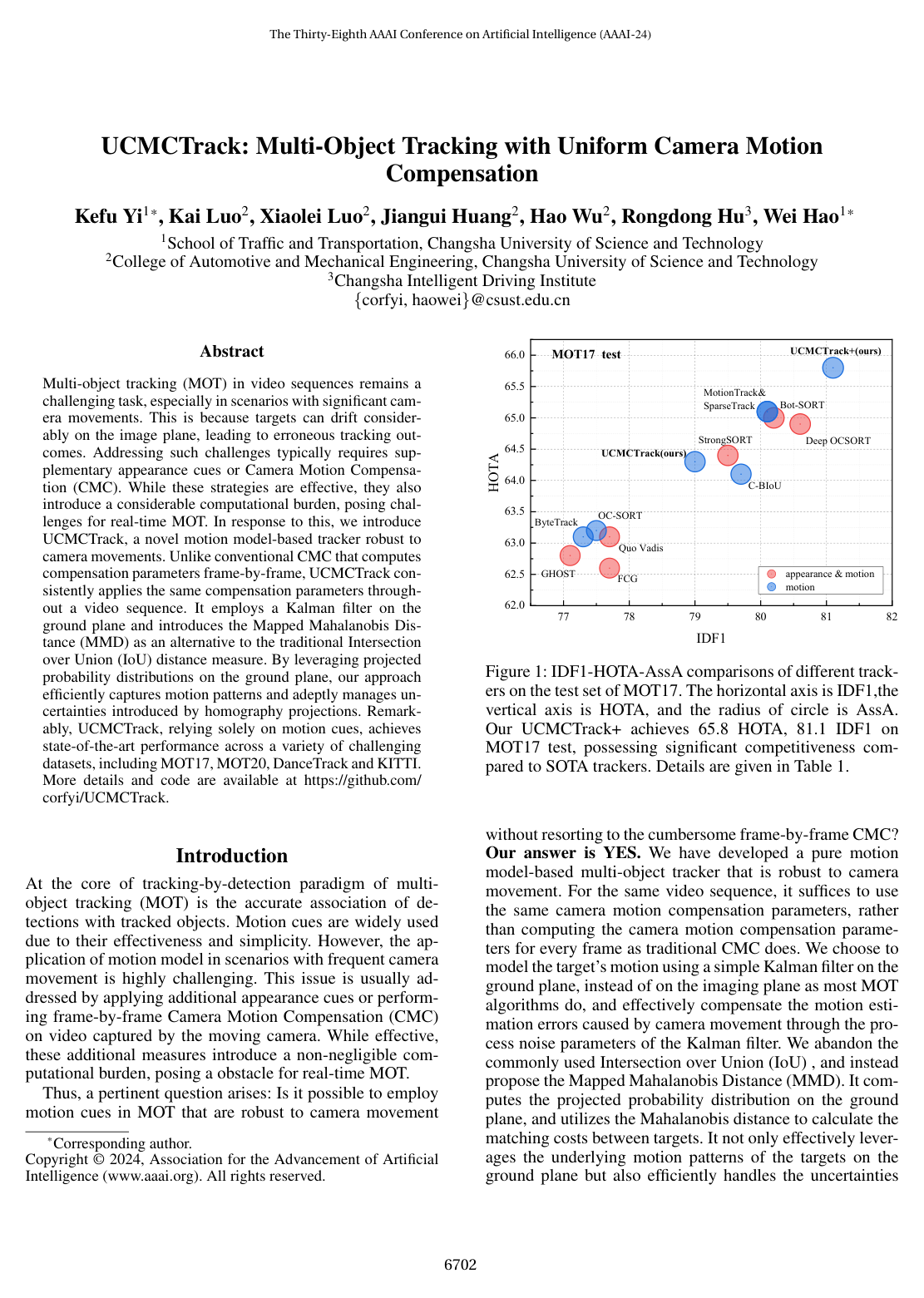
The evaluation produced several significant findings. First, UCMCTrack matches or outperforms complex trackers on MOT17, achieving 65.8 Higher Order Tracking Accuracy (HOTA) and 81.1 identification score (IDF1) when paired with traditional compensation, surpassing leading appearance-and-motion models. Second, on the complex DanceTrack dataset featuring irregular movements, it outperformed existing methods by 2.3 in HOTA, 3.4 in IDF1, and 5.5 in association accuracy. Third, in low frame-rate driving conditions on KITTI, standalone UCMCTrack proved more robust than traditional frame-by-frame compensation, which suffered from parameter estimation inaccuracies. Finally, the tracking association step runs at over 1,000 frames per second on a single CPU given detections, providing orders-of-magnitude computational efficiency improvements.
These findings indicate that complex, resource-intensive appearance networks and frame-by-frame image alignment are not required to handle camera motion. Ground-plane motion modeling successfully absorbs camera movement as system noise. This drastically lowers computing requirements and system latency, enabling high-performance tracking on low-power embedded hardware in robotics and vehicles.
Organizations developing computer vision systems should consider adopting ground-plane motion modeling to replace expensive alignment pipelines. For implementation, teams must tailor process compensation factors based on whether a scene is predominantly static or dynamic. Future development should explore combining this metric with appearance cues or bounding box heights for complex multi-level environments.
Decision-makers should note that the approach relies on the assumption of a single flat ground plane and requires camera calibration parameters. While the tracker is robust to detector noise, large errors in estimated camera tilt and roll can degrade tracking accuracy, warranting adequate camera parameter calibration during deployment.
- Paper: Simple online and realtime tracking, Alex Bewley et al. (2016). Introduces the foundational SORT pipeline that combines Kalman filtering with Hungarian data association, which UCMCTrack reformulates by shifting motion modeling from the image plane to the ground plane.
- Paper: ByteTrack: Multi-Object Tracking by Associating Every Detection Box, Yifu Zhang et al. (2021). Presents ByteTrack's motion-based association strategy that leverages detection confidences, establishing the baseline paradigm that UCMCTrack enhances for camera motion compensation.
- Paper: DanceTrack: Multi-Object Tracking in Uniform Appearance and Diverse Motion, Peize Sun et al. (2022). Establishes the DanceTrack benchmark designed to stress-test motion-centric multi-object tracking against complex motion and appearance ambiguities, which serves as a primary evaluation benchmark for UCMCTrack.
- Paper: HOTA: A Higher Order Metric for Evaluating Multi-object Tracking, Jonathon Luiten et al. (2020). Defines the Higher Order Tracking Accuracy (HOTA) metric essential for measuring detection and association tradeoffs in modern tracking evaluations, including UCMCTrack.
- Paper: Simple online and realtime tracking with a deep association metric, Nicolai Wojke et al. (2017). Demonstrates the integration of Mahalanobis distance with Kalman filtering in multi-object tracking, motivating UCMCTrack's Mapped Mahalanobis Distance formulation.
- Paper: FairMOT: On the Fairness of Detection and Re-identification in Multiple Object Tracking, Yifu Zhang et al. (2020). Provides fundamental background on multi-object tracking architecture and performance tradeoffs between appearance cues and real-time efficiency.
- Paper: MOT16: A Benchmark for Multi-Object Tracking, Anton Milan et al. (2016). Introduces the standardized MOT benchmark dataset and evaluation protocol used to validate multi-object tracking algorithms.
No sufficiently relevant recommendations were found.