Robust and Resource-Efficient Data-Free Knowledge Distillation by Generative Pseudo Replay
Kuluhan BiniciShivam AggarwalNam Trung PhamKarianto LemanTulika Mitra
Presents a data-free knowledge distillation framework that uses a variational autoencoder to generate replay samples, preventing student accuracy degradation over training epochs without storing past synthetic data in memory.
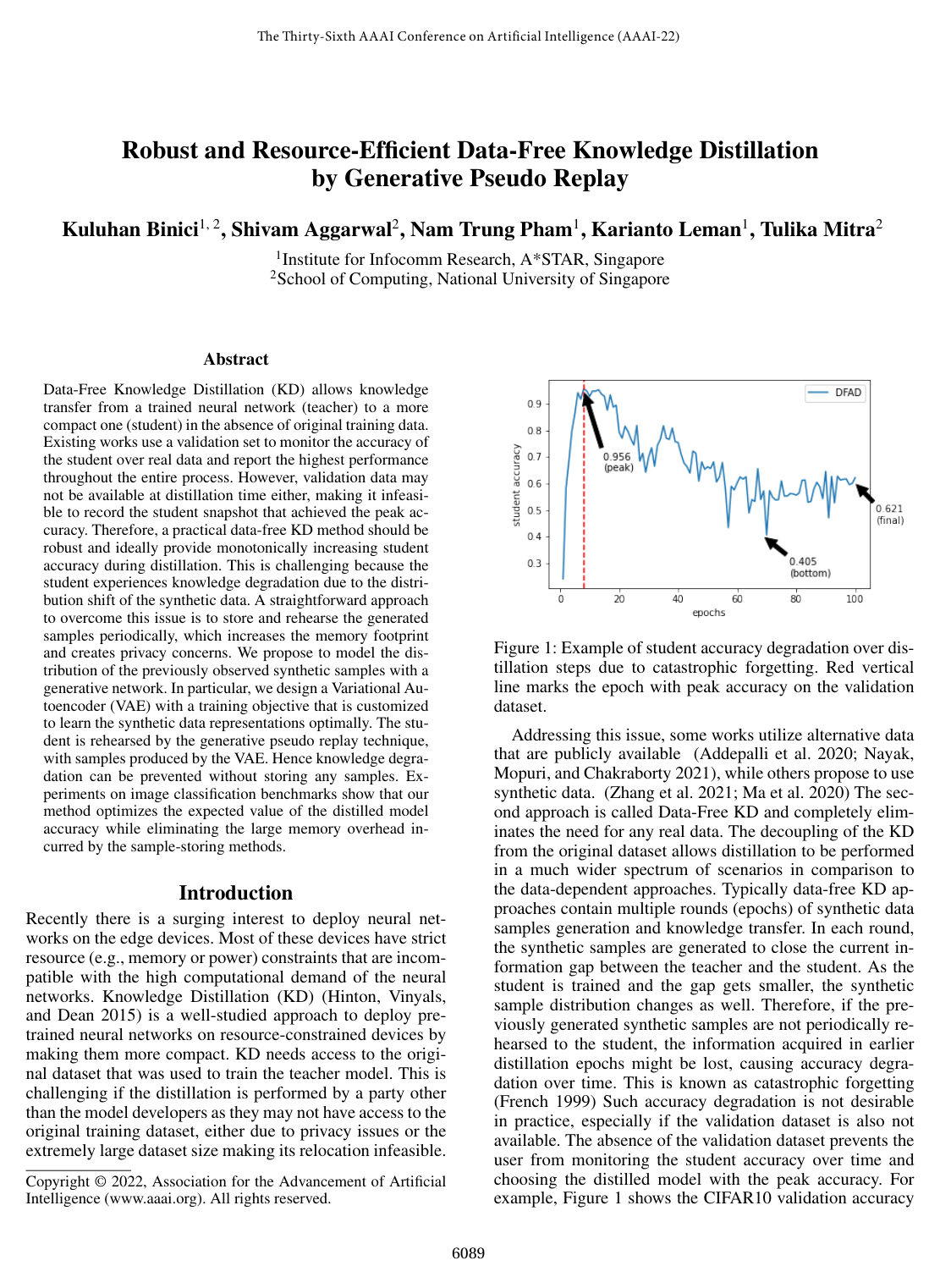
Deploying advanced artificial intelligence models to edge devices requires compressing large, high-performing networks into smaller, efficient architectures. Knowledge distillation is the standard technique for this task, but conventional approaches require access to the original training data, which is frequently unavailable due to privacy restrictions, proprietary barriers, or extreme dataset sizes. While data-free distillation methods address this by generating synthetic training samples, they suffer from a severe operational flaw: the distribution of synthetic samples shifts over time, causing the compact model to forget previously learned information and experience rapid performance degradation. Because real validation data is absent during deployment, practitioners cannot monitor model accuracy in real time to capture peak performance before degradation occurs. Alternative solutions attempt to retain knowledge by caching past synthetic samples in memory buffers, but this introduces massive memory footprints, extends runtime substantially, and undermines data privacy.
The article demonstrates a novel framework called Pseudo Replay Enhanced Data-Free Knowledge Distillation (PRE-DFKD) that stabilizes the training process and eliminates memory overhead without requiring access to real validation data. The objective is to enable compact models to continuously retain prior knowledge and maintain high, predictable accuracy across arbitrary training durations while avoiding physical sample storage.
To achieve this, the authors designed a dual-generator architecture. One generator continuously synthesizes novel samples to close the immediate information gap between the teacher and student networks, while a secondary generative model—specifically a Variational Autoencoder (VAE)—learns the historical distribution of synthetic samples and generates "memory samples" for rehearsal. Crucially, because standard VAE loss functions fail on synthetic images where small pixel perturbations can alter core content, the approach integrates a synthetic-data-aware reconstruction loss that forces reconstructed samples to match feature representations inside the teacher network. The method also introduces an inference technique to ensure balanced class representation across memory batches. The framework was evaluated across four standard image classification benchmarks—MNIST, CIFAR-10, CIFAR-100, and Tiny ImageNet—against established replay-free and sample-storing distillation baselines.
The experimental findings show that PRE-DFKD outperforms prior data-free distillation approaches in both reliability and resource efficiency. First, the framework significantly increased expected model accuracy, delivering up to a 26.8% increase in average student accuracy compared to replay-free baselines, while substantially narrowing the variance across training epochs. Second, PRE-DFKD achieved a constant, minimal memory overhead of just 2.1 megabytes across all benchmarks, reducing the memory footprint from several hundred megabytes or gigabytes required by sample-storing methods. Third, the framework matched or approached the peak distillation accuracy of complex baselines (e.g., reaching 94.1% on CIFAR-10 and 70.2% average accuracy on CIFAR-100) while closely tracking the performance of models trained on real data. Ablation analyses confirmed that the synthetic-aware reconstruction loss and class-balancing mechanisms are vital; removing either component caused significant degradation in training stability.
These results demonstrate that organizations can reliably compress deep neural networks without needing original datasets or intermediate validation checks. By eliminating the risk of catastrophic forgetting, engineering teams can safely terminate distillation jobs after a set duration without worrying about model collapse. Furthermore, eliminating the need to store raw synthetic images directly mitigates data leak and compliance risks, significantly lowers high-performance computing hardware costs, and prevents the memory scaling bottlenecks associated with complex datasets.
For technical leaders seeking to compress models in privacy-sensitive or resource-constrained settings, adopting generative pseudo replay offers a viable, production-friendly path. Teams transitioning from sample-storing pipelines should consider replacing physical replay buffers with parameterized generative replay to reduce infrastructure footprint and memory bottlenecks. The primary boundary condition noted is that the approach still relies on dataset-specific hyper-parameter tuning, and future work is recommended to automate hyper-parameter optimization to improve usability across diverse operational settings. Overall, the methodology provides high confidence for deployment across standard vision classification tasks.
- Paper: Dreaming to Distill: Data-Free Knowledge Transfer via DeepInversion, Hongxu Yin et al. (2020). DeepInversion introduces generative data-free knowledge transfer via teacher feature inversion, providing the foundational synthesis mechanics and baseline challenges that PRE-DFKD directly stabilizes against forgetting.
- Paper: Distilling the Knowledge in a Neural Network, Geoffrey Hinton et al. (2015). This seminal text establishes the core framework of knowledge distillation via softened teacher output distributions that underlying data-free distillation methods rely upon.
- Paper: Dark Experience for General Continual Learning: a Strong, Simple Baseline, Pietro Buzzega et al. (2020). Dark Experience Replay demonstrates the value of replaying past model outputs (dark experience) to prevent catastrophic forgetting, motivating PRE-DFKD's generative pseudo-replay mechanism.
- Paper: Knowledge Distillation: A Survey, Jianping Gou et al. (2020). This survey provides a comprehensive taxonomy of response-based, feature-based, and relation-based distillation methods essential for contextualizing data-free distillation architectures.
- Paper: FitNets: Hints for Thin Deep Nets, Adriana Romero et al. (2015). FitNets establishes feature-based distillation using intermediate hints, which underpins the synthetic-data-aware feature reconstruction loss formulated in PRE-DFKD.
- Paper: Up to 100x Faster Data-Free Knowledge Distillation, Gongfan Fang et al. (2022). FastDFKD extends data-free knowledge distillation by tackling the synthesis speed bottleneck through meta-generators, complementing PRE-DFKD's focus on stability and memory efficiency.
- Paper: Adaptive Data-Free Quantization, Biao Qian et al. (2023). Adaptive Data-Free Quantization extends data-free generative learning principles to neural network quantization by framing synthetic calibration sample generation as a game between teacher and compressed models.
- Paper: Remember the Past: Distilling Datasets into Addressable Memories for Neural Networks, Zhiwei Deng et al. (2022). This work explores an alternative approach to memory-efficient continual learning and dataset distillation by compressing datasets into shared, addressable memory bases without storing raw historical data.
- Paper: One-Step Diffusion Distillation through Score Implicit Matching, Weijian Luo et al. (2024). Score Implicit Matching explores data-free distillation within diffusion architectures, applying implicit score matching to compress generative models without real training data.