Adaptive Data-Free Quantization
Biao QianYang WangRichang HongMeng Wang
Proposes an adaptive data-free quantization framework that frames synthetic sample generation as a zero-sum game between the generator and quantized network, dynamically balancing agreement and disagreement samples to prevent over- and under-fitting across varied bit-widths.
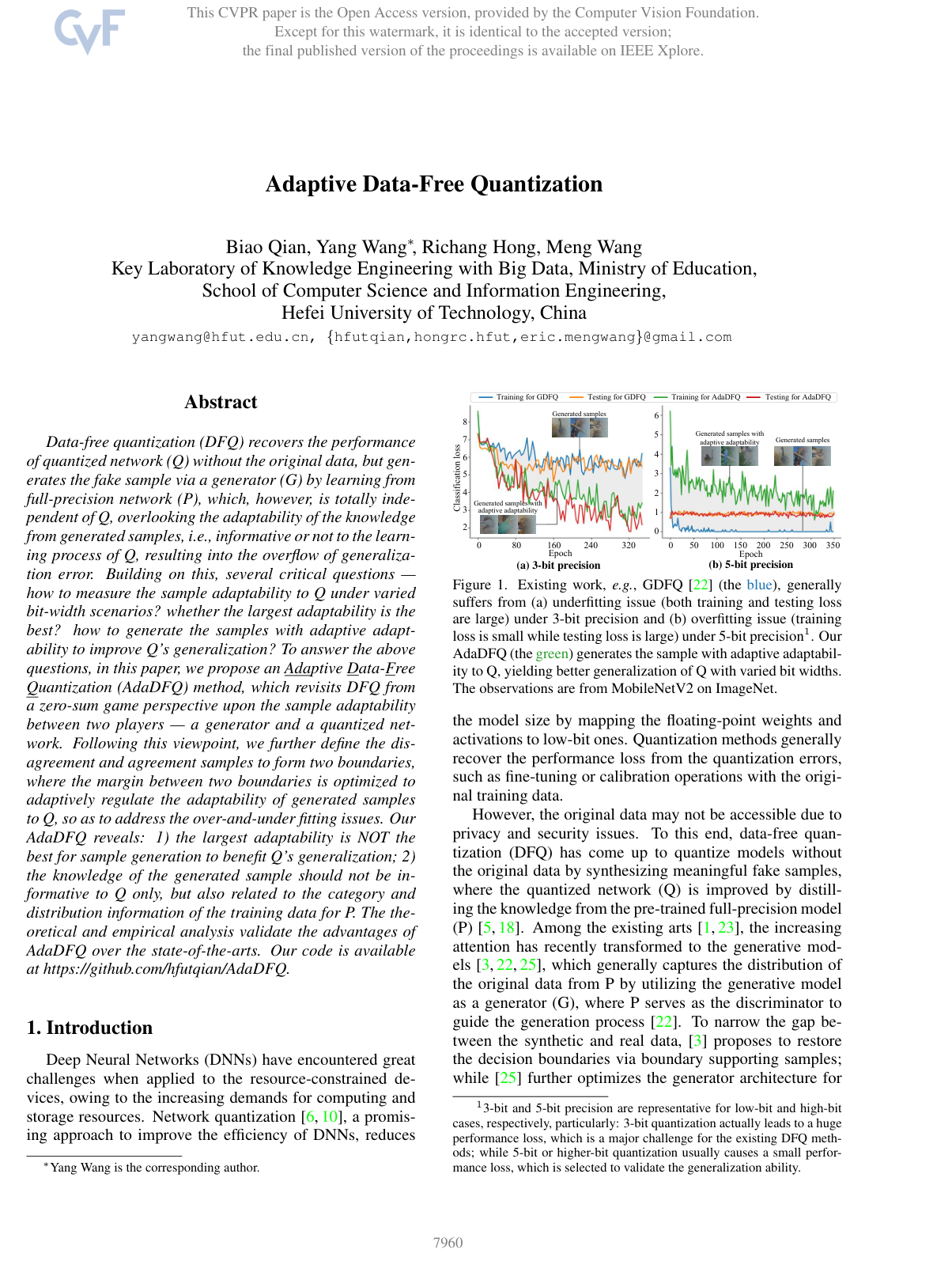
Deploying deep neural networks onto resource-constrained edge hardware requires model compression, such as network quantization, to reduce computational demands and memory footprints. When original training datasets cannot be shared due to strict privacy, proprietary, or security regulations, organizations must rely on data-free quantization to compress models using synthetically generated samples. However, conventional synthetic data approaches generate calibration samples independently of the compressed model's internal learning state, leading to severe underfitting at aggressive low-bit precision (such as 3-bit) or overfitting at moderate precision (such as 5-bit).
The article develops and evaluates an Adaptive Data-Free Quantization framework to resolve this limitation. The primary objective is to demonstrate that optimizing synthetic sample generation dynamically around the compressed model's specific learning capacity prevents generalization errors and substantially restores model accuracy across varied bit-width scenarios without accessing private training data.
The researchers formulated the data-free compression process as a two-player zero-sum game between a synthetic sample generator and the compressed model. The approach establishes explicit upper and lower boundaries using agreement samples (where both original and compressed models predict the same class) and disagreement samples (where the original model is correct but the compressed model fails). A regulated margin between these boundaries balances the informativeness of generated samples. The evaluation benchmarked multiple vision architectures, including ResNet-18, ResNet-20, ResNet-50, and MobileNetV2, across standard image recognition datasets such as CIFAR-10, CIFAR-100, and ImageNet under 3-bit, 4-bit, and 5-bit precision.
The findings show that the proposed method consistently outperforms state-of-the-art data-free quantization techniques, achieving its most dramatic improvements in challenging low-bit regimes. In 3-bit compression on ImageNet using ResNet-18, the proposed method achieved an accuracy of 38.10%, delivering a 36.93 percentage point gain over baseline synthetic generation methods that failed to converge. For MobileNetV2 under 3-bit precision, accuracy reached 28.99%, compared to near-complete failure (around 1.46% accuracy) in prior generative methods. In moderate 4-bit and 5-bit precision, the framework matched or exceeded existing benchmarks while effectively curbing overfitting. Ablation analyses confirmed that removing either agreement or disagreement constraints resulted in sharp performance drops of up to 19.57 percentage points, proving that extreme disagreement is counterproductive and that an optimized middle margin is necessary.
These results demonstrate that data-free model compression does not require an all-or-nothing trade-off between model efficiency and predictive reliability. Enterprise and engineering leaders can achieve aggressive low-bit compression on resource-limited hardware while fully complying with data privacy mandates. By calibrating synthetic data generation directly to compressed model capacity, teams can lower hardware deployment costs, decrease latency, and prevent project failure caused by convergence collapse during low-bit deployment.
Organizations aiming to compress edge artificial intelligence models under strict data governance policies should adopt margin-regulated zero-sum generation frameworks. Engineering teams should target the identified stable parameter ranges for boundary margins, which proved robust across grid search evaluations. Before production deployment, teams should conduct pilot calibration runs across their specific edge hardware configurations to determine whether 3-bit or 4-bit quantization best balances execution latency against task-specific accuracy thresholds.
Confidence in these findings is high given the consistent theoretical grounding and extensive benchmarking across diverse network architectures and datasets. However, decision-makers should note that the evaluation is currently bounded to image classification models and convolutional architectures. Further validation is recommended before applying the framework to non-vision modalities, such as natural language processing or multimodal systems.
- Paper: Dreaming to Distill: Data-Free Knowledge Transfer via DeepInversion, Hongxu Yin et al. (2020). Introduces batch-norm statistic inversion and adversarial student-teacher disagreement for data-free knowledge transfer, providing the core generative paradigm adapted by the source.
- Paper: Up to 100x Faster Data-Free Knowledge Distillation, Gongfan Fang et al. (2022). Establishes accelerated generator-based synthetic data synthesis for data-free model compression without access to private source datasets.
- Paper: A Survey of Quantization Methods for Efficient Neural Network Inference, Amir Gholami et al. (2021). Provides a comprehensive foundation and taxonomy of neural network quantization techniques and trade-offs across low-bit regimes.
- Paper: Quantization and Training of Neural Networks for Efficient Integer-Arithmetic-Only Inference, Benoit Jacob et al. (2018). Establishes standard integer quantization and simulated quantization training dynamics on convolutional architectures like MobileNet and ResNet.
- Paper: DoReFa-Net: Training Low Bitwidth Convolutional Neural Networks with Low Bitwidth Gradients, Shuchang Zhou et al. (2016). Pioneers low-bitwidth neural network quantization methods and explores gradient sensitivity across aggressive sub-4-bit precision.
- Paper: Spectrally-normalized margin bounds for neural networks, Peter Bartlett et al. (2017). Develops the theoretical framework connecting classification margin boundaries to neural network generalization error.
- Paper: Model Compression, Cristian Bucila et al. (2006). Introduces the foundational concept of model compression via synthetic pseudo-data generation when original datasets are restricted.
- Paper: QuIP#: Even Better LLM Quantization with Hadamard Incoherence and Lattice Codebooks, Albert Tseng et al. (2024). Extends aggressive low-bit (2-bit to 4-bit) post-training quantization techniques to massive modern transformer language models.
- Paper: AWQ: Activation-aware Weight Quantization for On-Device LLM Compression and Acceleration, Ji Lin et al. (2024). Applies activation-aware low-bit compression principles to enable efficient on-device execution of large-scale models without full retraining.
- Paper: KronQ: LLM Quantization via Kronecker-Factored Hessian, Donghyun Lee et al. (2026). Develops advanced second-order Hessian formulations to push accurate post-training quantization to extreme 2-bit and 3-bit regimes.
- Paper: TurboQuant: Online Vector Quantization with Near-optimal Distortion Rate, Amir Zandieh et al. (2026). Generalizes low-bit quantization bounds to real-time online vector compression with near-optimal distortion rates.
- Paper: PolarQuant: Quantizing KV Caches with Polar Transformation, Insu Han et al. (2025). Investigates specialized coordinate-transformation quantization strategies for compressing dynamic attention state embeddings.