Up to 100x Faster Data-Free Knowledge Distillation
Gongfan FangKanya MoXinchao WangJie SongShitao BeiHaofei ZhangMingli Song
Accelerates data-free knowledge distillation by up to two orders of magnitude by learning a meta-synthesizer that extracts reusable domain features to generate synthetic training data in only a few optimization steps.
Deploying artificial intelligence models on resource-limited devices requires model compression techniques such as knowledge distillation, which transfers knowledge from a large teacher model to a compact student model. However, privacy concerns, proprietary restrictions, and data protection regulations frequently prevent developers from accessing the original training data. While data-free knowledge distillation creates synthetic data directly from the teacher model to circumvent this issue, current approaches require thousands of optimization steps per image batch or hundreds of specialized generators. This extreme computational inefficiency creates severe processing bottlenecks and high computing costs, making data-free compression impractical for complex, large-scale applications.
The article demonstrates an acceleration framework called FastDFKD, which drastically reduces synthetic data generation time without sacrificing model accuracy. The method rests on the insight that data instances within a single domain naturally share common underlying features, such as basic textures or structural components. Instead of synthesizing every data sample from scratch in isolation, the framework learns a meta-generator that captures these shared features and quickly adapts them in only a few steps to produce diverse training samples. The researchers evaluated this approach across standard image classification benchmarks—CIFAR-10, CIFAR-100, and ImageNet—as well as the NYUv2 semantic segmentation dataset, comparing synthesis speed and model accuracy against leading data-free methods.
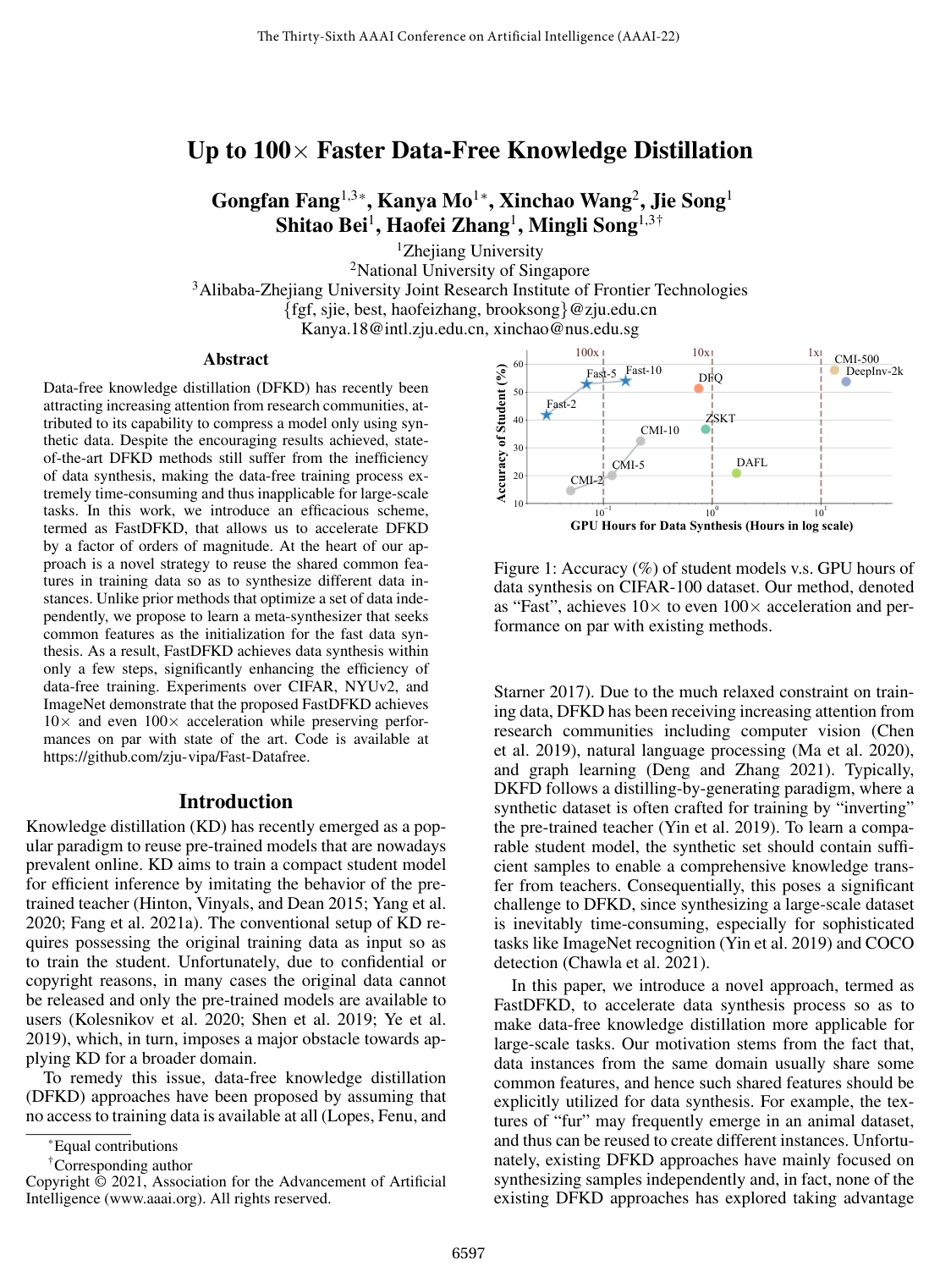
The findings confirm that FastDFKD reduces data synthesis time by a factor of 10 to over 100 while maintaining competitive accuracy across all tested benchmarks. On CIFAR benchmarks, the method achieved up to 120-fold to 650-fold average speedups over conventional batch-optimization techniques. On the large-scale ImageNet dataset, FastDFKD synthesized a complete transfer dataset of 140,000 images in just 6.28 single-GPU hours—approximately 48 times faster than previous inversion baselines taking 166 hours and drastically faster than multi-generator approaches requiring roughly 300 hours—while achieving a 68.61% accuracy on ResNet-18. In semantic segmentation on NYUv2, it generated the training set in 0.82 hours compared to 4.0 to 6.0 hours for existing generative methods, attaining a superior mean intersection-over-union score of 0.366. Ablation experiments also showed that competing methods fail completely when restricted to few-step synthesis, whereas the proposed common-feature adaptation remains effective with as few as two to five optimization steps.
These results demonstrate that organizations can reliably compress complex deep learning models in secure, privacy-constrained environments in hours rather than weeks of compute time. By significantly lowering hardware usage and associated cloud costs, the framework removes the primary adoption barrier for data-free model deployment across vision and segmentation pipelines.
Organizations operating under data confidentiality constraints should consider adopting meta-learning-based feature reuse for model compression pipelines. Teams seeking to apply the method should conduct initial pilots comparing few-step configurations to balance data generation speed against required model accuracy. While the experimental evidence provides high confidence for visual classification and segmentation tasks, practitioners should exercise caution and conduct further validation before applying the method to non-visual data domains, such as tabular or natural language processing pipelines, which were not tested in the article.
- Paper: Dreaming to Distill: Data-Free Knowledge Transfer via DeepInversion, Hongxu Yin et al. (2020). DeepInversion establishes foundational techniques for data-free knowledge distillation by inverting teacher network statistics, directly motivating FastDFKD's goal to overcome its synthesis inefficiency.
- Paper: Distilling the Knowledge in a Neural Network, Geoffrey Hinton et al. (2015). This seminal paper introduces the core principles of knowledge distillation that all subsequent data-free and accelerated distillation methods build upon.
- Paper: Knowledge Distillation: A Survey, Jianping Gou et al. (2020). This survey provides a comprehensive taxonomy of teacher-student compression algorithms and distillation schemes necessary for understanding data-free extensions.
- Paper: Relational Knowledge Distillation, Wonpyo Park et al. (2019). Relational knowledge distillation formulates structural knowledge transfer across instances, informing feature-level relationships and representations leveraged in distillation pipelines.
- Paper: On the Efficacy of Knowledge Distillation, Jang Hyun Cho et al. (2019). This study analyzes capacity mismatches and optimization bottlenecks in knowledge distillation that motivate specialized synthesis and transfer strategies.
- Paper: Improved Knowledge Distillation via Teacher Assistant, Seyed Iman Mirzadeh et al. (2020). This paper analyzes the challenges of transferring knowledge across large model capacity gaps, providing valuable context for student training dynamics in data-free settings.
No sufficiently relevant recommendations were found.