
keyword
meta learning
Meta-learning, commonly described as learning to learn, is a subfield of machine learning in which models are trained across multiple tasks to improve their ability to rapidly acquire new skills and generalize to unseen problems. While conventional machine learning focuses on optimizing performance on a single fixed task using large datasets, meta-learning leverages experiences from diverse tasks to learn higher-level representations, effective parameter initializations, or optimization rules. This framework typically involves a base-learning mechanism that adapts to specific task data and a higher-level meta-optimization process that guides how the base learner updates. By capturing common underlying structures across problem domains, meta-learning facilitates rapid adaptation in few-shot learning scenarios, automates machine learning pipeline and hyperparameter selection, and enhances model flexibility with minimal task-specific data.
14 items
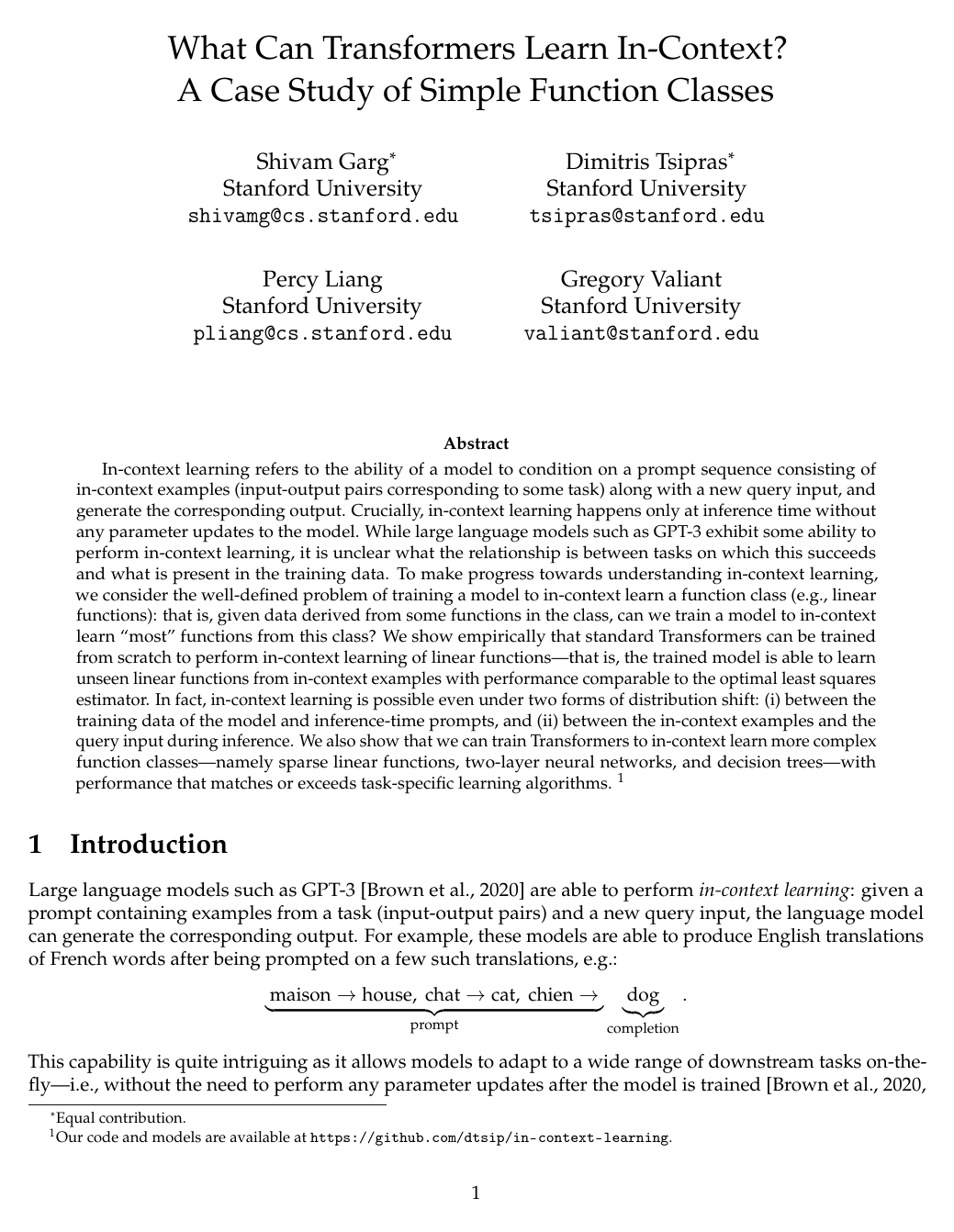
What Can Transformers Learn In-Context? A Case Study of Simple Function Classes
Shivam Garg, Dimitris Tsipras, Percy Liang, Gregory Valiant
Why you should read this
Demonstrates that standard Transformers can be trained from scratch to in-context learn fundamental function classes such as linear models, two-layer neural networks, and decision trees, matching or exceeding the performance of classical task-specific learning algorithms even under distribution shifts.
In-context learning refers to the ability of a model to condition on a prompt sequence consisting of in-context examples (input-output pairs corresponding to some task) along with a new query input, and generate the corresponding output. Crucially, in-context learning happens only at inference time without any parameter updates to the model. While large language models such as GPT-3 exhibit some ability to perform in-context learning, it is unclear what the relationship is between tasks on which this succeeds and what is present in the training data. To make progress towards understanding in-context learning, we consider the well-defined problem of training a model to in-context learn a function class (e.g., linear functions): that is, given data derived from some functions in the class, can we train a model to in-context learn "most" functions from this class? We show empirically that standard Transformers can be trained from scratch to perform in-context learning of linear functions -- that is, the trained model is able to learn unseen linear functions from in-context examples with performance comparable to the optimal least squares estimator. In fact, in-context learning is possible even under two forms of distribution shift: (i) between the training data of the model and inference-time prompts, and (ii) between the in-context examples and the query input during inference. We also show that we can train Transformers to in-context learn more complex function classes -- namely sparse linear functions, two-layer neural networks, and decision trees -- with performance that matches or exceeds task-specific learning algorithms. Our code and models are available at this https URL .
Added
2026-10-05
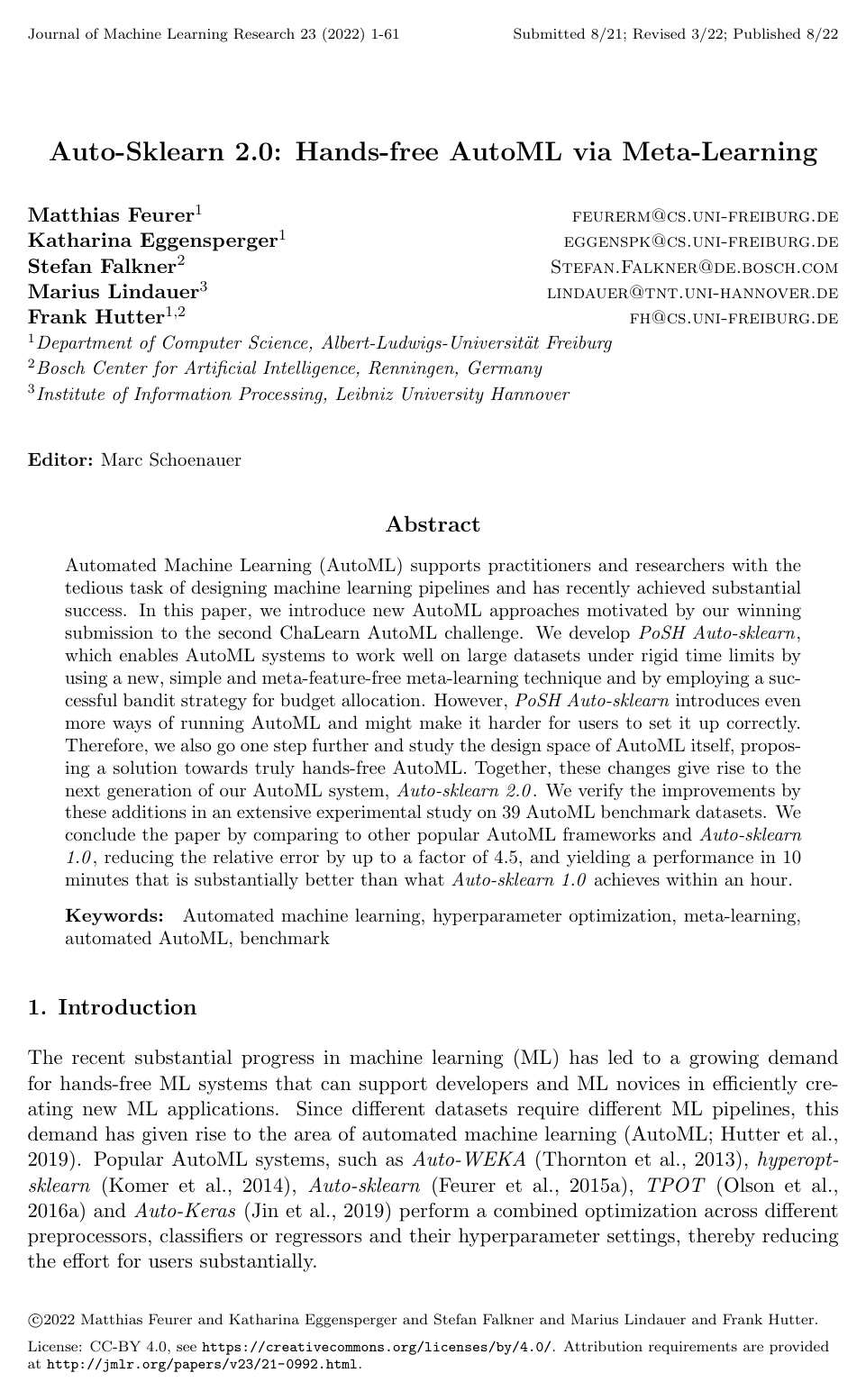
Auto-Sklearn 2.0: Hands-free AutoML via Meta-Learning
Matthias Feurer, Katharina Eggensperger, Stefan Falkner, Marius Lindauer, Frank Hutter
Why you should read this
Presents Auto-Sklearn 2.0, a truly hands-free automated machine learning framework that uses meta-learning and bandit-based budget allocation to automatically configure its own optimization strategy, outperforming its predecessor in ten minutes compared to an hour of compute time across 39 benchmark datasets.
Automated Machine Learning (AutoML) supports practitioners and researchers with the tedious task of designing machine learning pipelines and has recently achieved substantial success. In this paper, we introduce new AutoML approaches motivated by our winning submission to the second ChaLearn AutoML challenge. We develop PoSH Auto-sklearn, which enables AutoML systems to work well on large datasets under rigid time limits by using a new, simple and meta-feature-free meta-learning technique and by employing a successful bandit strategy for budget allocation. However, PoSH Auto-sklearn introduces even more ways of running AutoML and might make it harder for users to set it up correctly. Therefore, we also go one step further and study the design space of AutoML itself, proposing a solution towards truly hands-free AutoML. Together, these changes give rise to the next generation of our AutoML system, Auto-sklearn 2.0. We verify the improvements by these additions in an extensive experimental study on 39 AutoML benchmark datasets. We conclude the paper by comparing to other popular AutoML frameworks and Auto-sklearn 1.0, reducing the relative error by up to a factor of 4.5, and yielding a performance in 10 minutes that is substantially better than what Auto-sklearn 1.0 achieves within an hour.
Added
2026-09-28
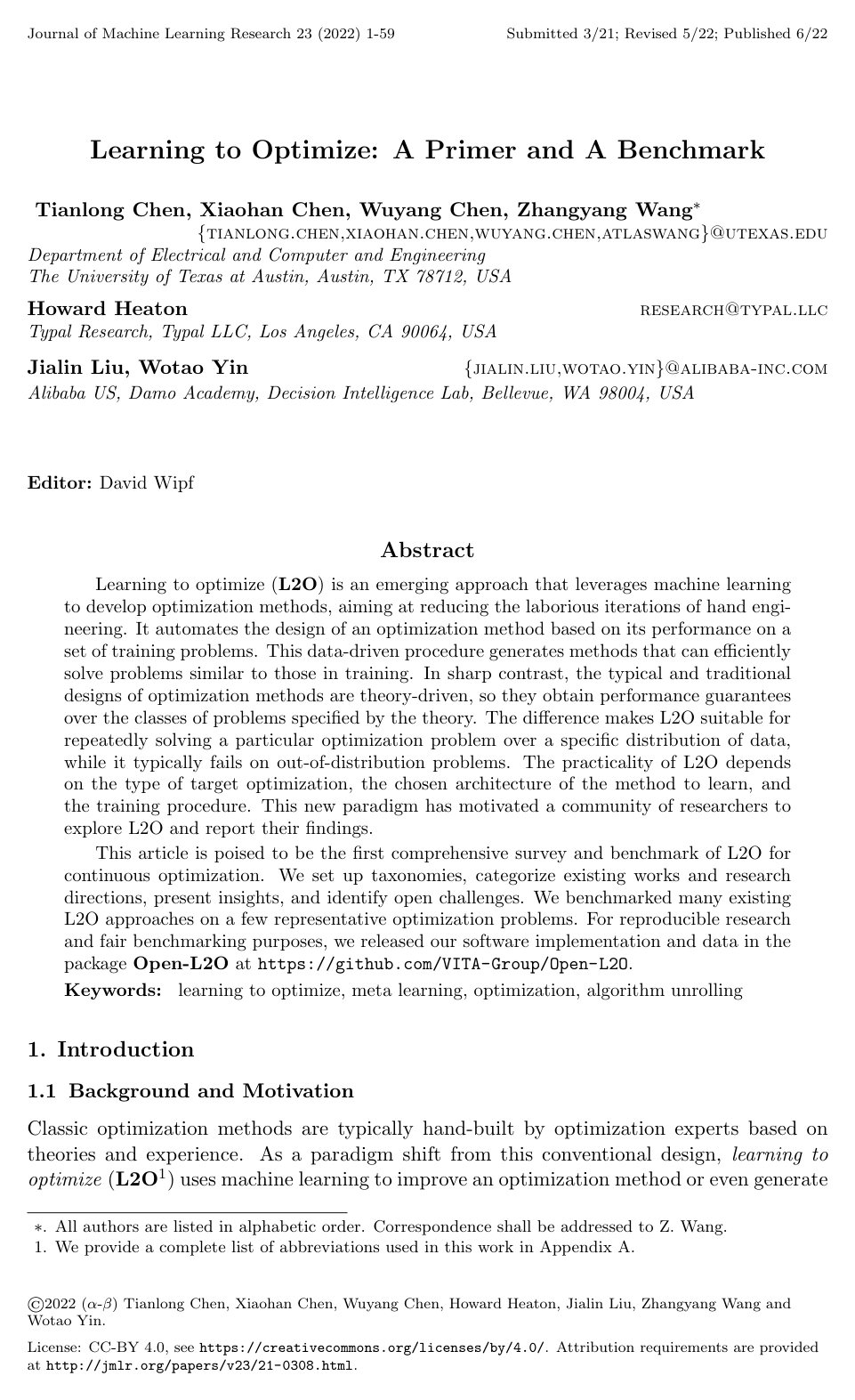
Learning to Optimize: A Primer and A Benchmark
Tianlong Chen, Xiaohan Chen, Wuyang Chen, Howard Heaton, Jialin Liu, Zhangyang Wang, Wotao Yin
Why you should read this
Presents a comprehensive survey and standardized benchmarking framework for learning-to-optimize methods in continuous optimization, providing practical categorizations, open challenges, and the open-source Open-L2O package for reproducible evaluation.
Learning to optimize (L2O) is an emerging approach that leverages machine learning to develop optimization methods, aiming at reducing the laborious iterations of hand engineering. It automates the design of an optimization method based on its performance on a set of training problems. This data-driven procedure generates methods that can efficiently solve problems similar to those in training. In sharp contrast, the typical and traditional designs of optimization methods are theory-driven, so they obtain performance guarantees over the classes of problems specified by the theory. The difference makes L2O suitable for repeatedly solving a particular optimization problem over a specific distribution of data, while it typically fails on out-of-distribution problems. The practicality of L2O depends on the type of target optimization, the chosen architecture of the method to learn, and the training procedure. This new paradigm has motivated a community of researchers to explore L2O and report their findings. This article is poised to be the first comprehensive survey and benchmark of L2O for continuous optimization. We set up taxonomies, categorize existing works and research directions, present insights, and identify open challenges. We benchmarked many existing L2O approaches on a few representative optimization problems. For reproducible research and fair benchmarking purposes, we released our software implementation and data in the package Open-L2O at https://github.com/VITA-Group/Open-L2O.
Added
2026-09-28
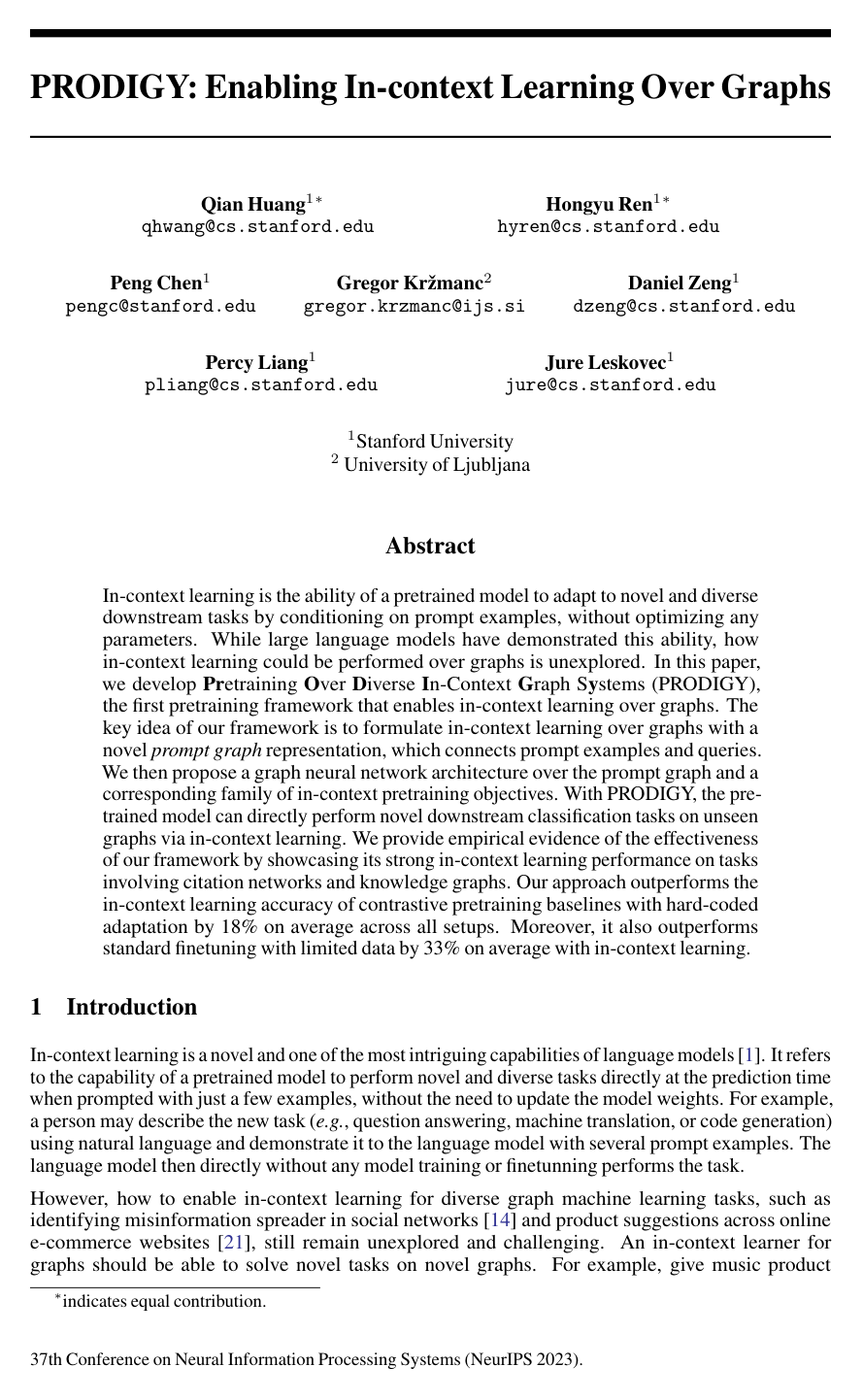
PRODIGY: Enabling In-context Learning Over Graphs
Qian Huang, Hongyu Ren, Peng Chen, Gregor Krzmanc, Daniel Zeng, Percy Liang, Jure Leskovec
Why you should read this
Presents PRODIGY, the first pretraining framework for graph in-context learning that unifies prompt examples and queries into a prompt graph representation to solve node and edge classification tasks on unseen graphs without fine-tuning.
In-context learning is the ability of a pretrained model to adapt to novel and diverse downstream tasks by conditioning on prompt examples, without optimizing any parameters. While large language models have demonstrated this ability, how in-context learning could be performed over graphs is unexplored. In this paper, we develop Pretraining Over Diverse In-Context Graph Systems (PRODIGY), the first pretraining framework that enables in-context learning over graphs. The key idea of our framework is to formulate in-context learning over graphs with a novel prompt graph representation, which connects prompt examples and queries. We then propose a graph neural network architecture over the prompt graph and a corresponding family of in-context pretraining objectives. With PRODIGY, the pretrained model can directly perform novel downstream classification tasks on unseen graphs via in-context learning. We provide empirical evidence of the effectiveness of our framework by showcasing its strong in-context learning performance on tasks involving citation networks and knowledge graphs. Our approach outperforms the in-context learning accuracy of contrastive pretraining baselines with hard-coded adaptation by 18% on average across all setups. Moreover, it also outperforms standard finetuning with limited data by 33% on average with in-context learning.
Added
2026-09-26

Matching Feature Sets for Few-Shot Image Classification
Arman Afrasiyabi, Hugo Larochelle, Jean-François Lalonde, Christian Gagné
Why you should read this
Proposes SetFeat, an approach that inserts shallow self-attention mappers into standard CNN backbones to extract sets of multi-scale feature vectors paired with set-to-set matching metrics, setting new state-of-the-art accuracy across major few-shot classification benchmarks without increasing parameter complexity.
In image classification, it is common practice to train deep networks to extract a single feature vector per input image. Few-shot classification methods also mostly follow this trend. In this work, we depart from this established direction and instead propose to extract sets of feature vectors for each image. We argue that a set-based representation intrinsically builds a richer representation of images from the base classes, which can subsequently better transfer to the few-shot classes. To do so, we propose to adapt existing feature extractors to instead produce sets of feature vectors from images. Our approach, dubbed SetFeat, embeds shallow self-attention mechanisms inside existing encoder architectures. The attention modules are lightweight, and as such our method results in encoders that have approximately the same number of parameters as their original versions. During training and inference, a set-to-set matching metric is used to perform image classification. The effectiveness of our proposed architecture and metrics is demonstrated via thorough experiments on standard few-shot datasets—namely miniImageNet, tieredImageNet, and CUB—in both the 1- and 5-shot scenarios. In all cases but one, our method outperforms the state-of-the-art.
Added
2026-09-26
A Fully Single Loop Algorithm for Bilevel Optimization without Hessian Inverse
Junyi Li, Bin Gu, Heng Huang
Why you should read this
Proposes a fully single-loop bilevel optimization algorithm that eliminates expensive Hessian inverses and inner-loop hyper-gradient evaluations by tracking historical gradient information with guaranteed convergence.
In this paper, we propose a novel Hessian inverse free Fully Single Loop Algorithm (FSLA) for bilevel optimization problems. Classic algorithms for bilevel optimization admit a double loop structure which is computationally expensive. Recently, several single loop algorithms have been proposed with optimizing the inner and outer variable alternatively. However, these algorithms not yet achieve fully single loop. As they overlook the loop needed to evaluate the hyper-gradient for a given inner and outer state. In order to develop a fully single loop algorithm, we first study the structure of the hyper-gradient and identify a general approximation formulation of hyper-gradient computation that encompasses several previous common approaches, e.g. back-propagation through time, conjugate gradient, etc. Based on this formulation, we introduce a new state variable to maintain the historical hyper-gradient information. Combining our new formulation with the alternative update of the inner and outer variables, we propose an efficient fully single loop algorithm. We theoretically show that the error generated by the new state can be bounded and our algorithm converges with the rate of O(ϵ^{-2}). Finally, we verify the efficacy our algorithm empirically through multiple bilevel optimization based machine learning tasks. A long version of this paper can be found in: https://arxiv.org/abs/2112.04660.
Added
2026-09-26
Up to 100x Faster Data-Free Knowledge Distillation
Gongfan Fang, Kanya Mo, Xinchao Wang, Jie Song, Shitao Bei, Haofei Zhang, Mingli Song
Why you should read this
Accelerates data-free knowledge distillation by up to two orders of magnitude by learning a meta-synthesizer that extracts reusable domain features to generate synthetic training data in only a few optimization steps.
Data-free knowledge distillation (DFKD) has recently been attracting increasing attention from research communities, attributed to its capability to compress a model only using synthetic data. Despite the encouraging results achieved, state-of-the-art DFKD methods still suffer from the inefficiency of data synthesis, making the data-free training process extremely time-consuming and thus inapplicable for large-scale tasks. In this work, we introduce an efficacious scheme, termed as FastDFKD, that allows us to accelerate DFKD by a factor of orders of magnitude. At the heart of our approach is a novel strategy to reuse the shared common features in training data so as to synthesize different data instances. Unlike prior methods that optimize a set of data independently, we propose to learn a meta-synthesizer that seeks common features as the initialization for the fast data synthesis. As a result, FastDFKD achieves data synthesis within only a few steps, significantly enhancing the efficiency of data-free training. Experiments over CIFAR, NYUv2, and ImageNet demonstrate that the proposed FastDFKD achieves 10× and even 100× acceleration while preserving performances on par with state of the art. Code is available at https://github.com/zju-vipa/Fast-Datafree.
Added
2026-09-26
An Efficient Framework for Clustered Federated Learning
Avishek Ghosh, Jichan Chung, Dong Yin, Kannan Ramchandran
Why you should read this
Proposes the Iterative Federated Clustering Algorithm to alternately identify client group assignments and optimize cluster-specific models, establishing theoretical convergence guarantees alongside strong empirical performance on heterogeneous distributed learning tasks.
We address the problem of federated learning (FL) where users are distributed and partitioned into clusters. This setup captures settings where different groups of users have their own objectives (learning tasks) but by aggregating their data with others in the same cluster (same learning task), they can leverage the strength in numbers in order to perform more efficient federated learning. For this new framework of clustered federated learning, we propose the Iterative Federated Clustering Algorithm (IFCA), which alternately estimates the cluster identities of the users and optimizes model parameters for the user clusters via gradient descent. We analyze the convergence rate of this algorithm first in a linear model with squared loss and then for generic strongly convex and smooth loss functions. We show that in both settings, with good initialization, IFCA is guaranteed to converge, and discuss the optimality of the statistical error rate. In particular, for the linear model with two clusters, we can guarantee that our algorithm converges as long as the initialization is slightly better than random. When the clustering structure is ambiguous, we propose to train the models by combining IFCA with the weight sharing technique in multi-task learning. In the experiments, we show that our algorithm can succeed even if we relax the requirements on initialization with random initialization and multiple restarts. We also present experimental results showing that our algorithm is efficient in non-convex problems such as neural networks. We demonstrate the benefits of IFCA over the baselines on several clustered FL benchmarks.
Added
2026-09-25
Federated Learning with Personalization Layers
Manoj Ghuhan Arivazhagan, Vinay Aggarwal, Aaditya Kumar Singh, Sunav Choudhary
Why you should read this
Introduces FedPer, a federated learning framework that splits deep neural networks into shared base layers and local personalization layers to overcome performance degradation caused by statistical data heterogeneity across edge devices.
The emerging paradigm of federated learning strives to enable collaborative training of machine learning models on the network edge without centrally aggregating raw data and hence, improving data privacy. This sharply deviates from traditional machine learning and necessitates the design of algorithms robust to various sources of heterogeneity. Specifically, statistical heterogeneity of data across user devices can severely degrade the performance of standard federated averaging for traditional machine learning applications like personalization with deep learning. This paper pro-posesFedPer, a base + personalization layer approach for federated training of deep feedforward neural networks, which can combat the ill-effects of statistical heterogeneity. We demonstrate effectiveness ofFedPerfor non-identical data partitions ofCIFARdatasetsand on a personalized image aesthetics dataset from Flickr.
Added
2026-09-25
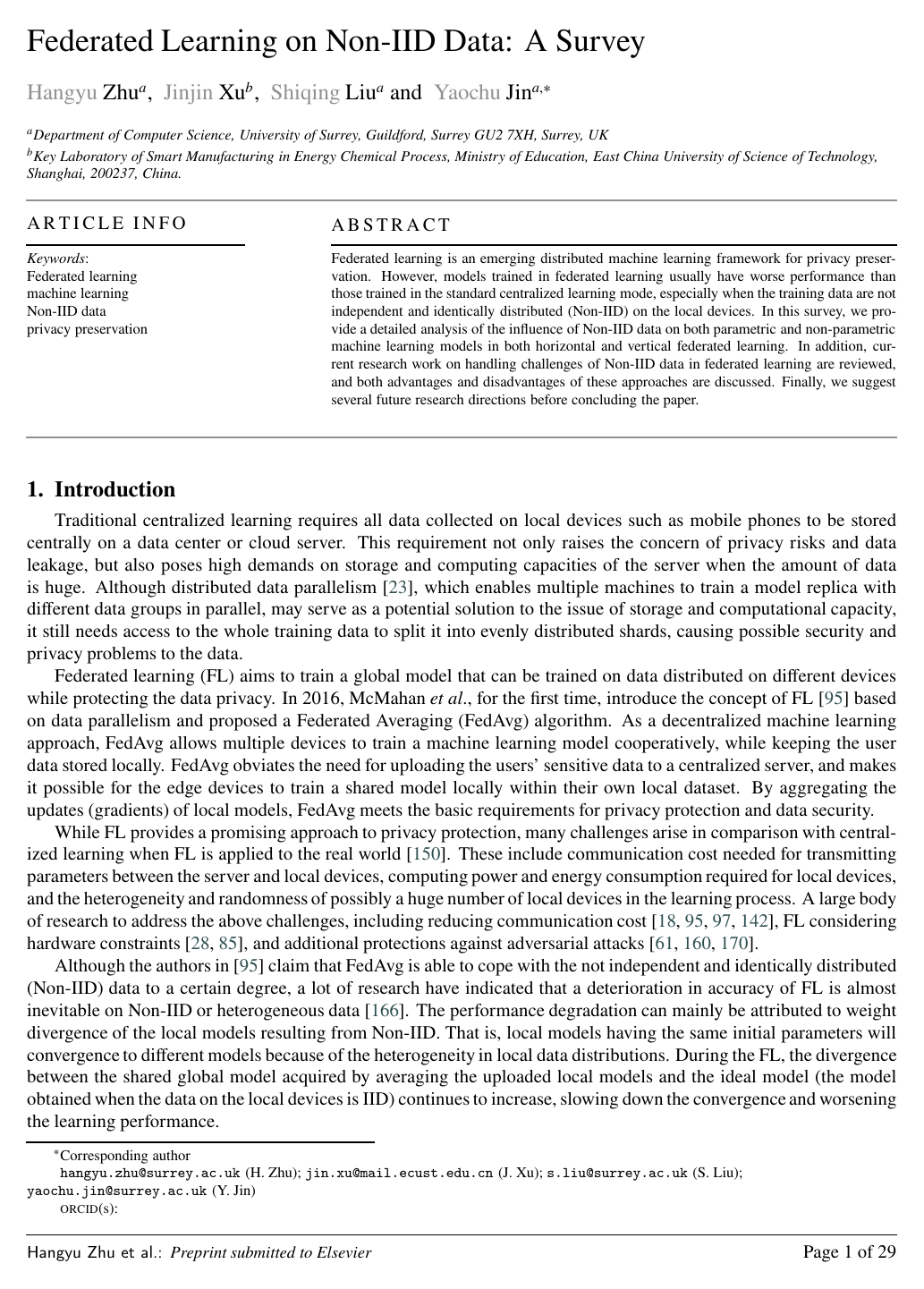
Federated Learning on Non-IID Data: A Survey
Hangyu Zhu, Jinjin Xu, Shiqing Liu, Yaochu Jin
Why you should read this
Analyzes how non-IID data degrades model performance across horizontal and vertical federated learning systems while critically evaluating current mitigation techniques and their practical trade-offs.
Federated learning is an emerging distributed machine learning framework for privacy preservation. However, models trained in federated learning usually have worse performance than those trained in the standard centralized learning mode, especially when the training data are not independent and identically distributed (Non-IID) on the local devices. In this survey, we pro-vide a detailed analysis of the influence of Non-IID data on both parametric and non-parametric machine learning models in both horizontal and vertical federated learning. In addition, cur-rent research work on handling challenges of Non-IID data in federated learning are reviewed, and both advantages and disadvantages of these approaches are discussed. Finally, we suggest several future research directions before concluding the paper.
Added
2026-09-25
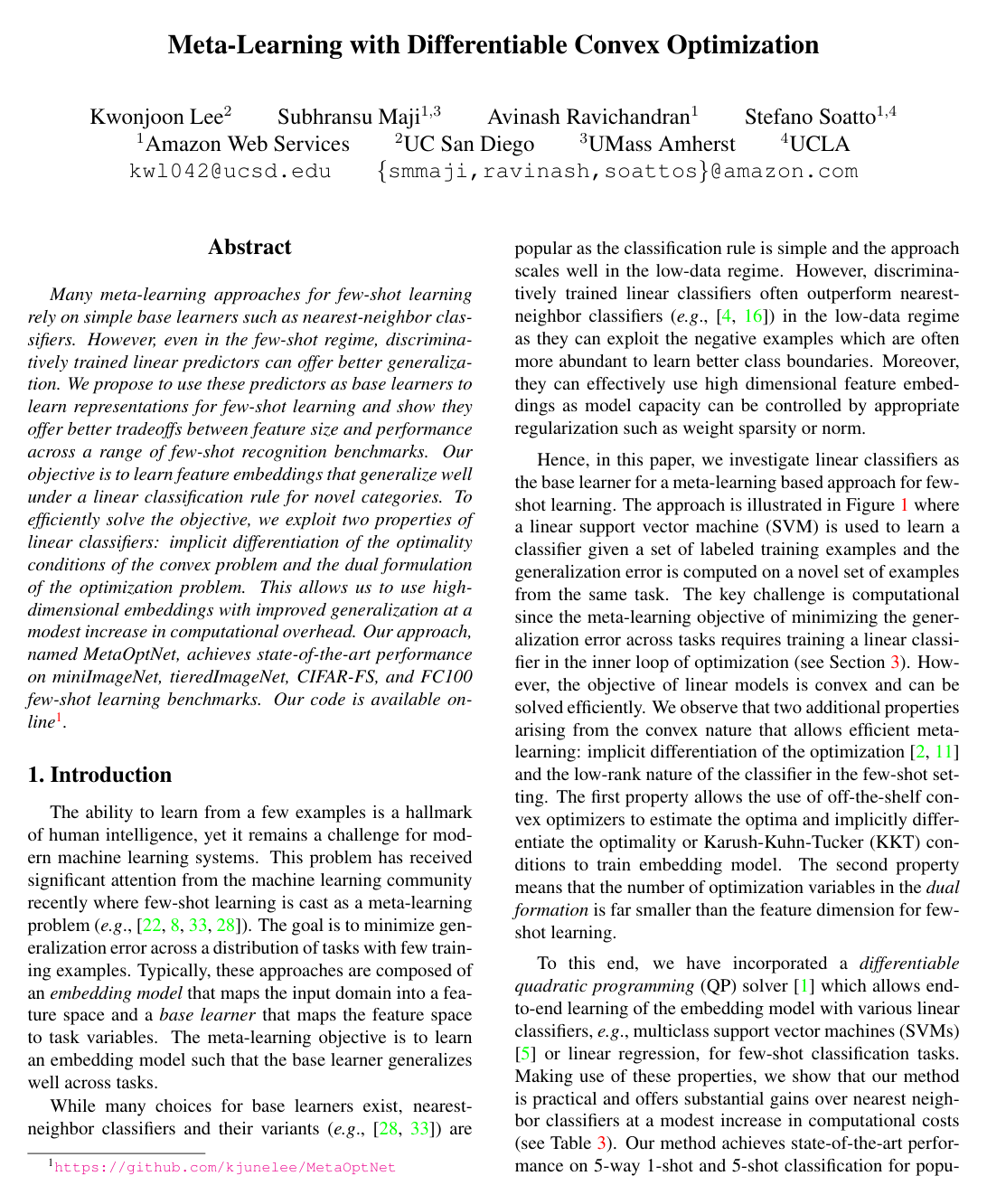
Meta-Learning With Differentiable Convex Optimization
Kwonjoon Lee, Subhransu Maji, Avinash Ravichandran, Stefano Soatto
Why you should read this
Proposes MetaOptNet, an end-to-end meta-learning method that incorporates differentiable convex optimization as a base learner via implicit differentiation, outperforming standard nearest-neighbor approaches across standard few-shot classification benchmarks.
Many meta-learning approaches for few-shot learning rely on simple base learners such as nearest-neighbor classifiers. However, even in the few-shot regime, discriminatively trained linear predictors can offer better generalization. We propose to use these predictors as base learners to learn representations for few-shot learning and show they offer better tradeoffs between feature size and performance across a range of few-shot recognition benchmarks. Our objective is to learn feature embeddings that generalize well under a linear classification rule for novel categories. To efficiently solve the objective, we exploit two properties of linear classifiers: implicit differentiation of the optimality conditions of the convex problem and the dual formulation of the optimization problem. This allows us to use high-dimensional embeddings with improved generalization at a modest increase in computational overhead. Our approach, named MetaOptNet, achieves state-of-the-art performance on miniImageNet, tieredImageNet, CIFAR-FS, and FC100 few-shot learning benchmarks. Our code is available at this https URL.
Added
2026-09-25
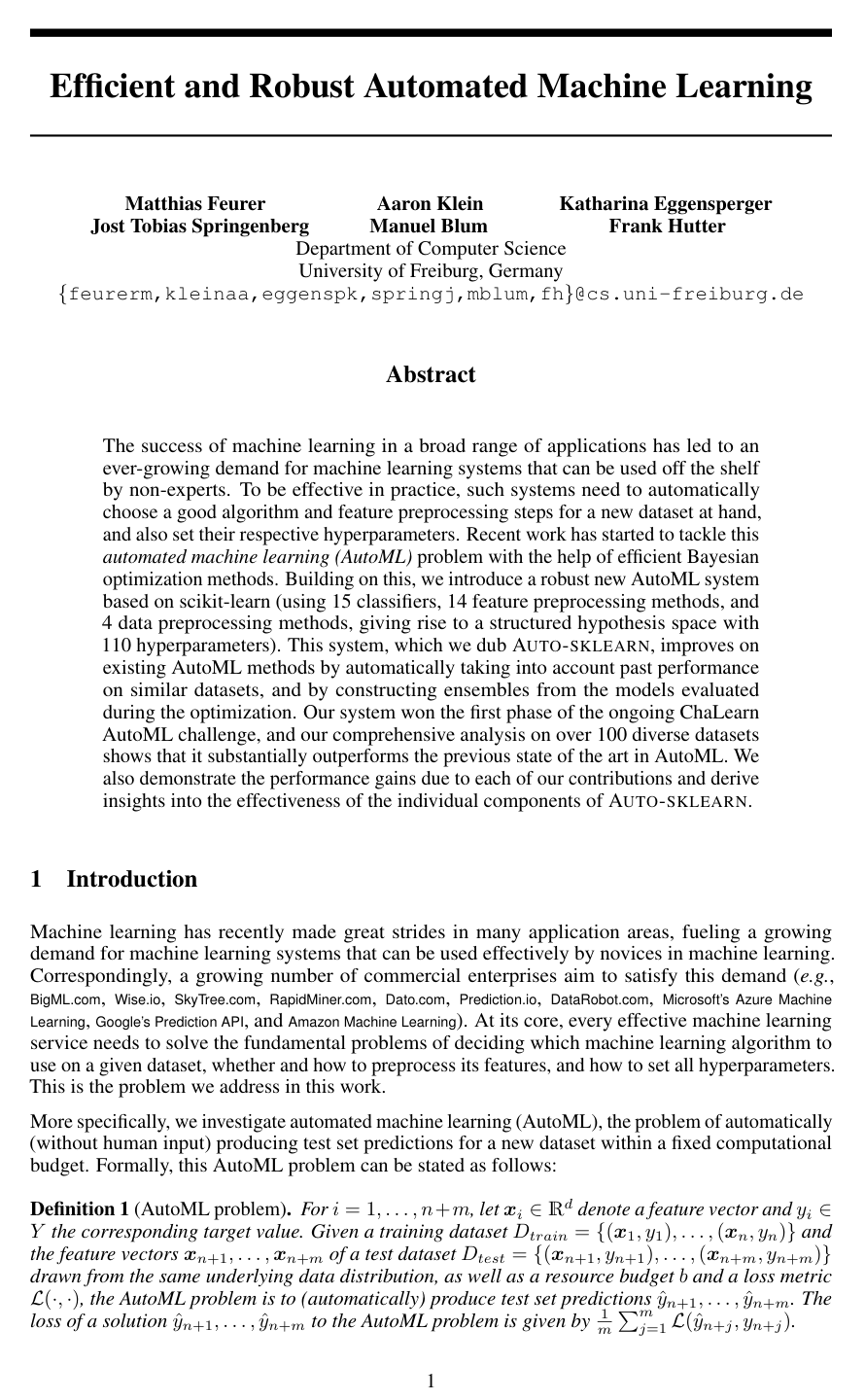
Efficient and Robust Automated Machine Learning
Matthias Feurer, Aaron Klein, Katharina Eggensperger, Jost Tobias Springenberg, Manuel Blum, F. Hutter
Why you should read this
Introduces Auto-sklearn, an automated machine learning framework that significantly accelerates algorithm selection and hyperparameter optimization across scikit-learn pipelines by combining meta-learning warmstarts with post-hoc ensemble construction.
The success of machine learning in a broad range of applications has led to an ever-growing demand for machine learning systems that can be used off the shelf by non-experts. To be effective in practice, such systems need to automatically choose a good algorithm and feature preprocessing steps for a new dataset at hand, and also set their respective hyperparameters. Recent work has started to tackle this automated machine learning (AutoML) problem with the help of efficient Bayesian optimization methods. Building on this, we introduce a robust new AutoML system based on scikit-learn (using 15 classifiers, 14 feature preprocessing methods, and 4 data preprocessing methods, giving rise to a structured hypothesis space with 110 hyperparameters). This system, which we dub AUTO-SKLEARN, improves on existing AutoML methods by automatically taking into account past performance on similar datasets, and by constructing ensembles from the models evaluated during the optimization. Our system won the first phase of the ongoing ChaLearn AutoML challenge, and our comprehensive analysis on over 100 diverse datasets shows that it substantially outperforms the previous state of the art in AutoML. We also demonstrate the performance gains due to each of our contributions and derive insights into the effectiveness of the individual components of AUTO-SKLEARN.
Added
2026-09-18
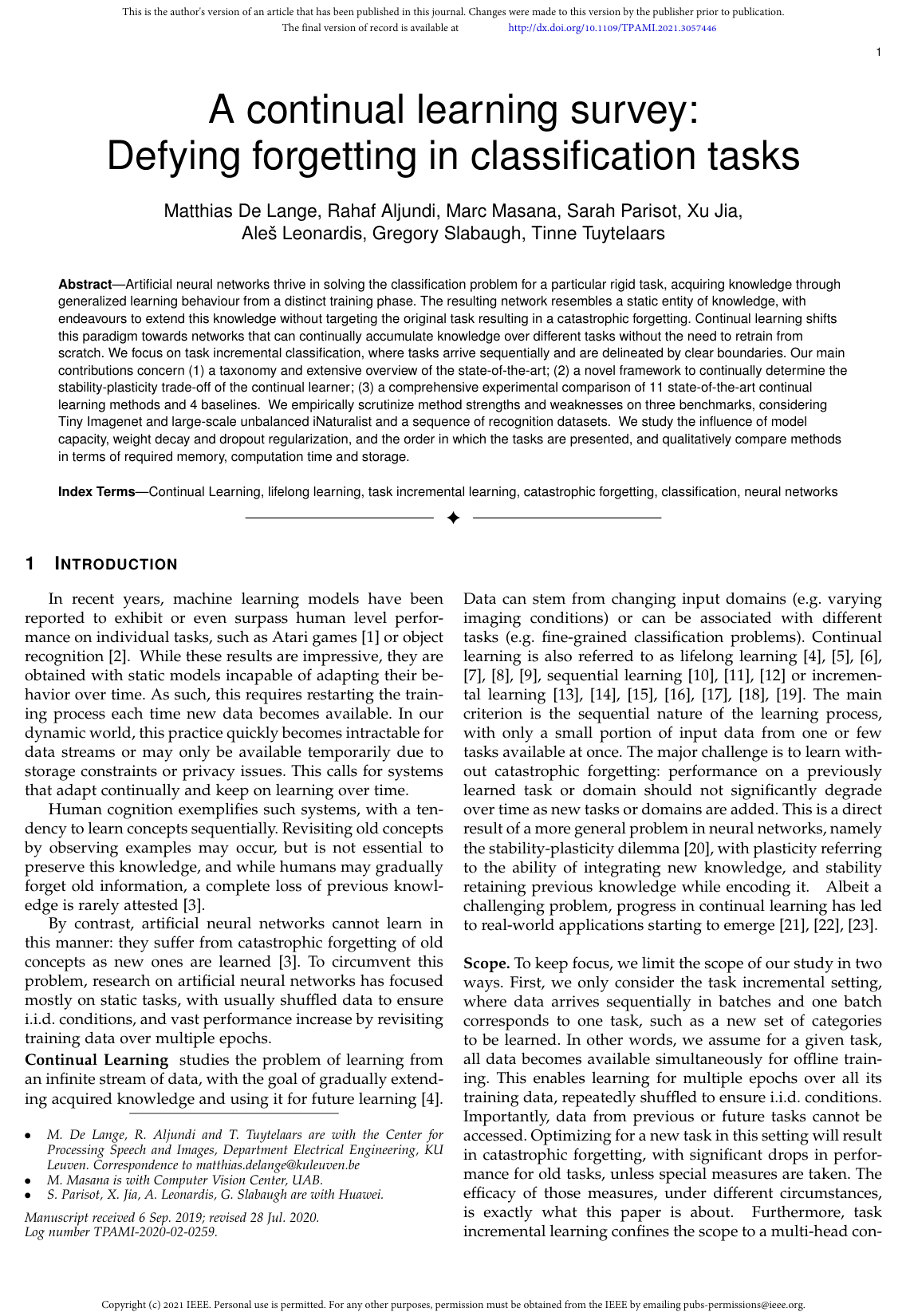
A Continual Learning Survey: Defying Forgetting in Classification Tasks
Matthias De Lange, Rahaf Aljundi, Marc Masana, Sarah Parisot, Xu Jia, A. Leonardis, G. Slabaugh, T. Tuytelaars
Why you should read this
Presents a structured taxonomy and a dynamic hyperparameter selection framework to benchmark eleven continual learning methods across diverse classification datasets, showing how model capacity, regularization, and parameter isolation directly affect catastrophic forgetting.
Artificial neural networks thrive in solving the classification problem for a particular rigid task, acquiring knowledge through generalized learning behaviour from a distinct training phase. The resulting network resembles a static entity of knowledge, with endeavours to extend this knowledge without targeting the original task resulting in a catastrophic forgetting. Continual learning shifts this paradigm towards networks that can continually accumulate knowledge over different tasks without the need to retrain from scratch. We focus on task incremental classification, where tasks arrive sequentially and are delineated by clear boundaries. Our main contributions concern (1) a taxonomy and extensive overview of the state-of-the-art; (2) a novel framework to continually determine the stability-plasticity trade-off of the continual learner; (3) a comprehensive experimental comparison of 11 state-of-the-art continual learning methods and 4 baselines. We empirically scrutinize method strengths and weaknesses on three benchmarks, considering Tiny Imagenet and large-scale unbalanced iNaturalist and a sequence of recognition datasets. We study the influence of model capacity, weight decay and dropout regularization, and the order in which the tasks are presented, and qualitatively compare methods in terms of required memory, computation time and storage.
Added
2026-09-14
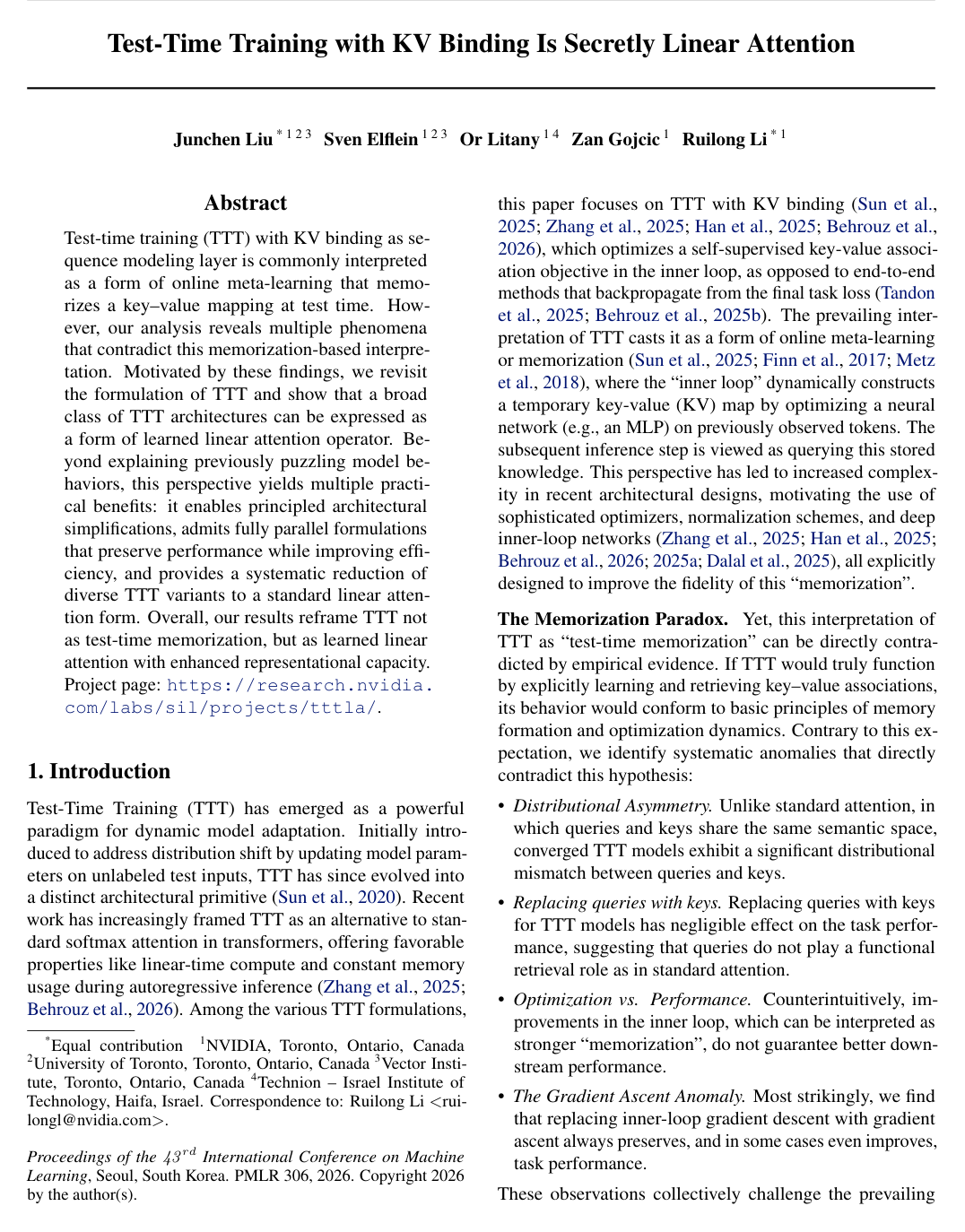
Test-Time Training with KV Binding Is Secretly Linear Attention
Junchen Liu, Sven Elflein, Or Litany, Zan Gojcic, Ruilong Li
Why you should read this
Shows that test-time training with key-value binding functions as learned linear attention rather than online memorization, resolving empirical anomalies while enabling fully parallel, computationally efficient implementations without loss of performance.
Test-time training (TTT) with KV binding as sequence modeling layer is commonly interpreted as a form of online meta-learning that memorizes a key-value mapping at test time. However, our analysis reveals multiple phenomena that contradict this memorization-based interpretation. Motivated by these findings, we revisit the formulation of TTT and show that a broad class of TTT architectures can be expressed as a form of learned linear attention operator. Beyond explaining previously puzzling model behaviors, this perspective yields multiple practical benefits: it enables principled architectural simplifications, admits fully parallel formulations that preserve performance while improving efficiency, and provides a systematic reduction of diverse TTT variants to a standard linear attention form. Overall, our results reframe TTT not as test-time memorization, but as learned linear attention with enhanced representational capacity. Project page: this https URL.
Added
2026-08-30
