
keyword
pre-trained models
Pre-trained models are artificial intelligence and machine learning models that have been previously trained on large, broad datasets to capture general representations and patterns before being applied or adapted to specific tasks. In modern transfer learning workflows, these models serve as robust foundations across domains such as computer vision, natural language processing, and multimodal understanding, eliminating the need to train complex neural networks entirely from scratch. Once pre-trained, their learned parameters can be utilized directly for inference or further customized for specialized downstream objectives through methods like fine-tuning, parameter-efficient adaptation, prompt tuning, or model merging. This paradigm significantly reduces the computational resources, time, and labeled domain-specific data required to achieve high performance on targeted applications.
14 items
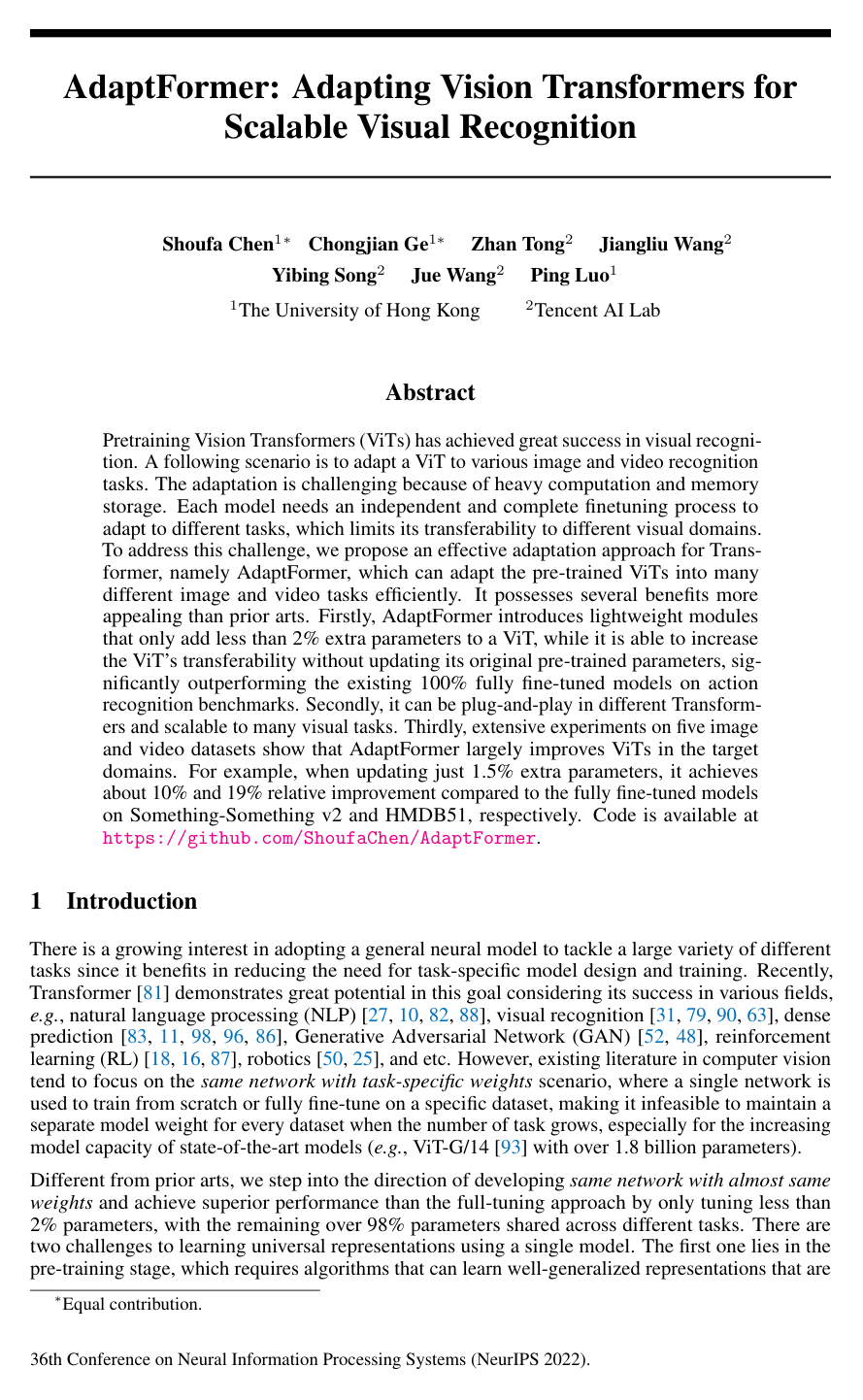
AdaptFormer: Adapting Vision Transformers for Scalable Visual Recognition
Shoufa Chen, Chongjian Ge, Zhan Tong, Jiangliu Wang, Yibing Song, Jue Wang, Ping Luo
Why you should read this
Proposes AdaptFormer, a lightweight plug-and-play module that adapts frozen Vision Transformers to diverse image and video recognition tasks by training under 2% extra parameters while outperforming full fine-tuning.
Pretraining Vision Transformers (ViTs) has achieved great success in visual recognition. A following scenario is to adapt a ViT to various image and video recognition tasks. The adaptation is challenging because of heavy computation and memory storage. Each model needs an independent and complete finetuning process to adapt to different tasks, which limits its transferability to different visual domains. To address this challenge, we propose an effective adaptation approach for Transformer, namely AdaptFormer, which can adapt the pre-trained ViTs into many different image and video tasks efficiently. It possesses several benefits more appealing than prior arts. Firstly, AdaptFormer introduces lightweight modules that only add less than 2% extra parameters to a ViT, while it is able to increase the ViT's transferability without updating its original pre-trained parameters, significantly outperforming the existing 100\% fully fine-tuned models on action recognition benchmarks. Secondly, it can be plug-and-play in different Transformers and scalable to many visual tasks. Thirdly, extensive experiments on five image and video datasets show that AdaptFormer largely improves ViTs in the target domains. For example, when updating just 1.5% extra parameters, it achieves about 10% and 19% relative improvement compared to the fully fine-tuned models on Something-Something~v2 and HMDB51, respectively. Code is available at this https URL.
Added
2026-10-04
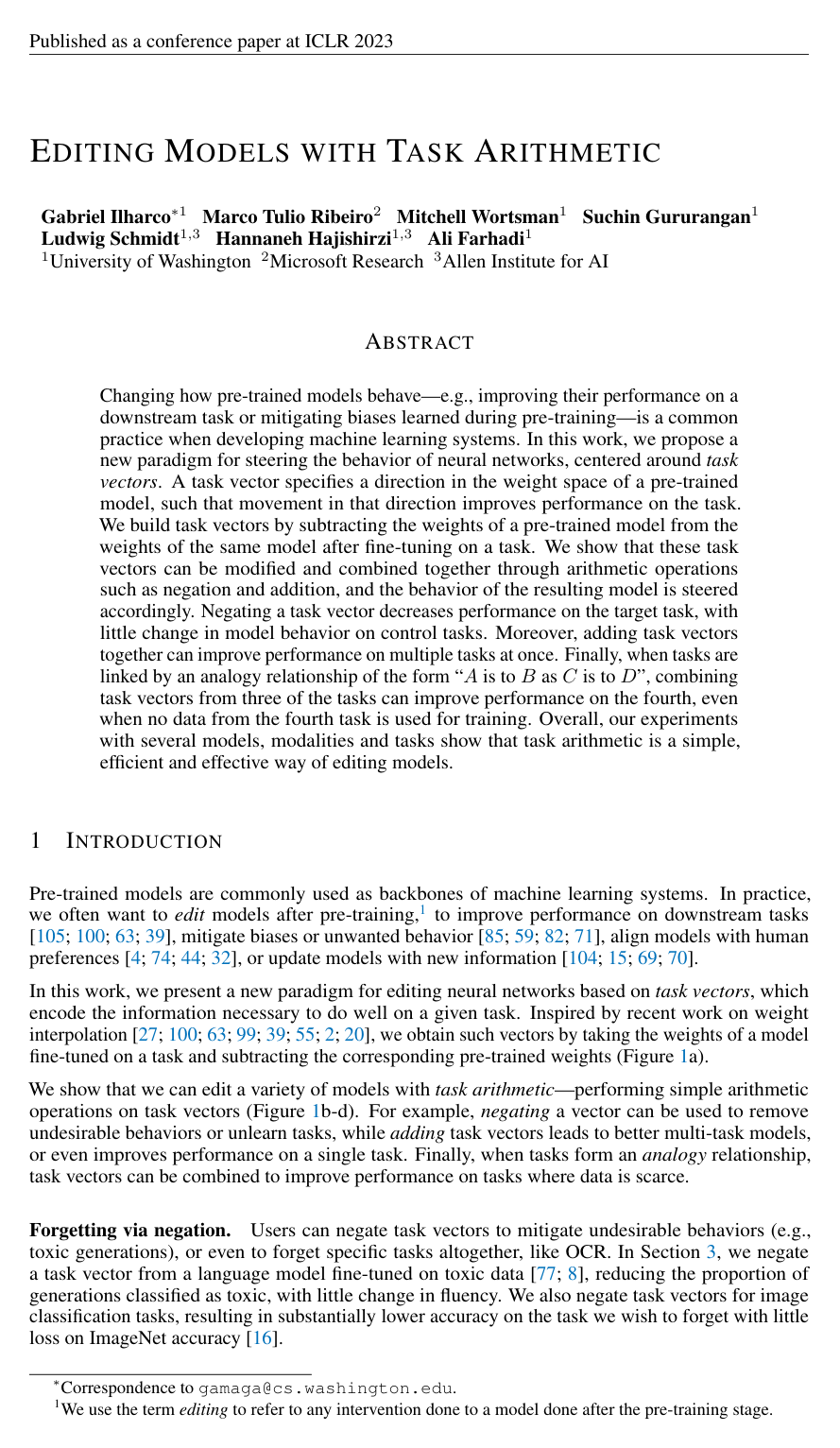
Editing Models with Task Arithmetic
Gabriel Ilharco, Marco Tulio Ribeiro, Mitchell Wortsman, Suchin Gururangan, Ludwig Schmidt, Hannaneh Hajishirzi, Ali Farhadi
Why you should read this
Demonstrates that basic arithmetic operations on task vectors—calculated by subtracting pre-trained weights from fine-tuned weights—enable combining multi-task capabilities, removing targeted behaviors, and solving task analogies without retraining.
Changing how pre-trained models behave -- e.g., improving their performance on a downstream task or mitigating biases learned during pre-training -- is a common practice when developing machine learning systems. In this work, we propose a new paradigm for steering the behavior of neural networks, centered around \textit{task vectors}. A task vector specifies a direction in the weight space of a pre-trained model, such that movement in that direction improves performance on the task. We build task vectors by subtracting the weights of a pre-trained model from the weights of the same model after fine-tuning on a task. We show that these task vectors can be modified and combined together through arithmetic operations such as negation and addition, and the behavior of the resulting model is steered accordingly. Negating a task vector decreases performance on the target task, with little change in model behavior on control tasks. Moreover, adding task vectors together can improve performance on multiple tasks at once. Finally, when tasks are linked by an analogy relationship of the form ``A is to B as C is to D", combining task vectors from three of the tasks can improve performance on the fourth, even when no data from the fourth task is used for training. Overall, our experiments with several models, modalities and tasks show that task arithmetic is a simple, efficient and effective way of editing models.
Added
2026-10-04
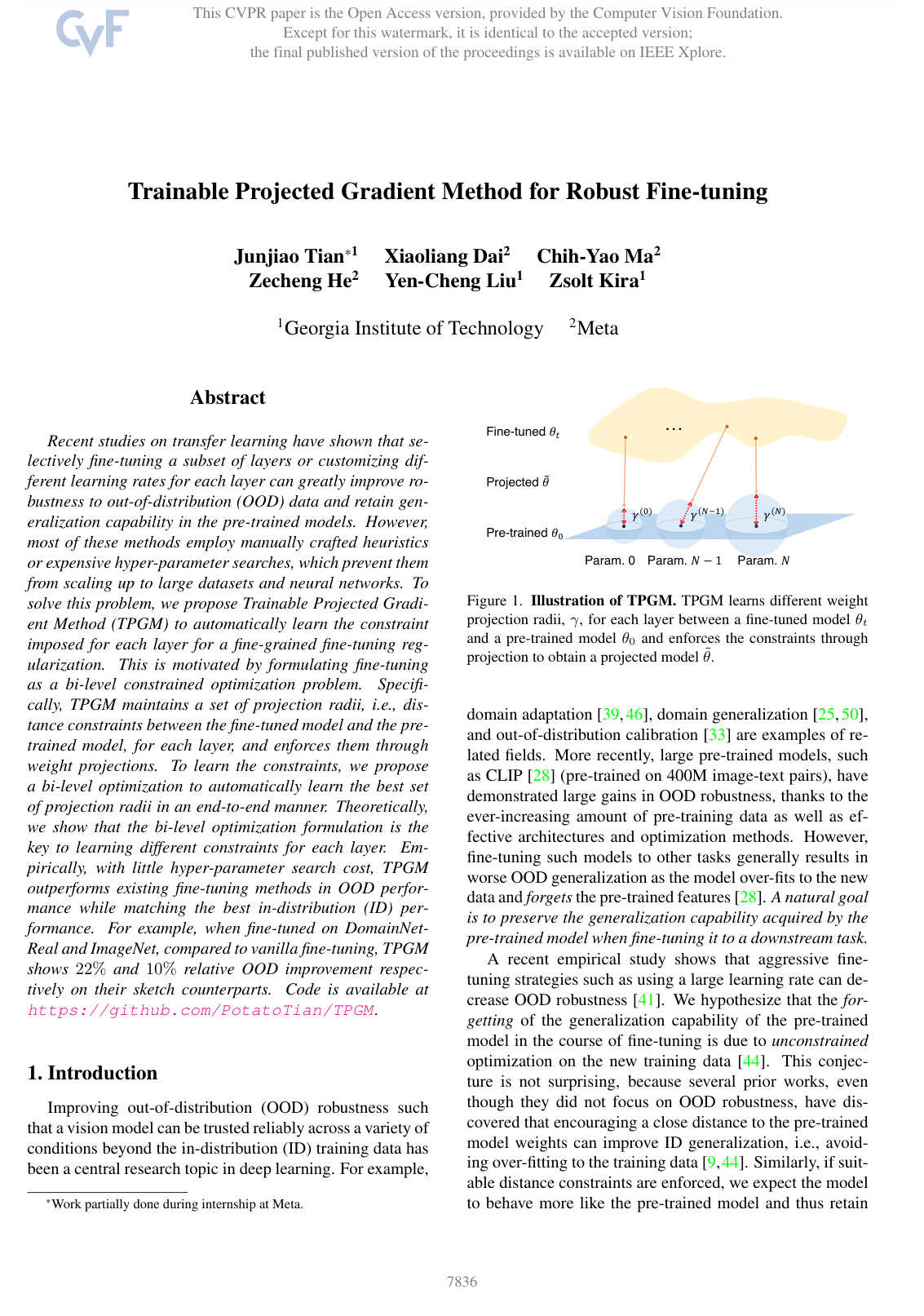
Trainable Projected Gradient Method for Robust Fine-Tuning
Junjiao Tian, Xiaoliang Dai, Chih-Yao Ma, Zecheng He, Yen-Cheng Liu, Zsolt Kira
Why you should read this
Proposes an end-to-end bi-level optimization framework that automatically learns layer-specific weight projection constraints during fine-tuning, significantly boosting out-of-distribution generalization without costly manual hyperparameter searches.
Recent studies on transfer learning have shown that selectively fine-tuning a subset of layers or customizing different learning rates for each layer can greatly improve robustness to out-of-distribution (OOD) data and retain generalization capability in the pre-trained models. However, most of these methods employ manually crafted heuristics or expensive hyper-parameter searches, which prevent them from scaling up to large datasets and neural networks. To solve this problem, we propose Trainable Projected Gradient Method (TPGM) to automatically learn the constraint imposed for each layer for a fine-grained fine-tuning regularization. This is motivated by formulating fine-tuning as a bi-level constrained optimization problem. Specifically, TPGM maintains a set of projection radii, i.e., distance constraints between the fine-tuned model and the pre-trained model, for each layer, and enforces them through weight projections. To learn the constraints, we propose a bi-level optimization to automatically learn the best set of projection radii in an end-to-end manner. Theoretically, we show that the bi-level optimization formulation is the key to learning different constraints for each layer. Empirically, with little hyper-parameter search cost, TPGM outperforms existing fine-tuning methods in OOD performance while matching the best in-distribution (ID) performance. For example, when fine-tuned on DomainNet-Real and ImageNet, compared to vanilla fine-tuning, TPGM shows 22% and 10% relative OOD improvement respectively on their sketch counterparts. Code is available at https://github.com/PotatoTian/TPGM.
Added
2026-09-26
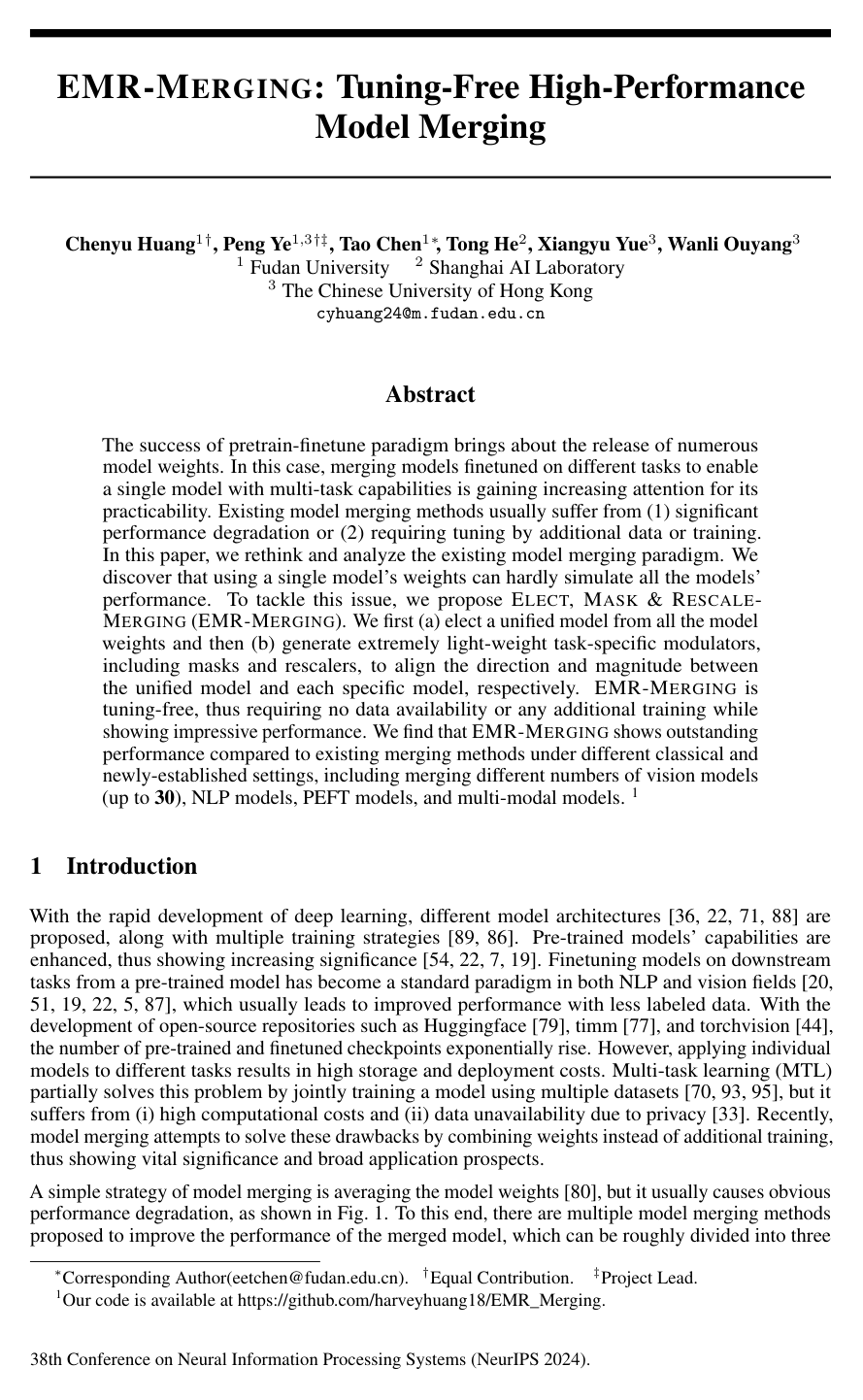
EMR-Merging: Tuning-Free High-Performance Model Merging
Chenyu Huang, Peng Ye, Tao Chen, Tong He, Xiangyu Yue, Wanli Ouyang
Why you should read this
Proposes a tuning-free model merging technique that constructs a unified base model paired with lightweight task-specific masks and scaling factors, matching multi-task training performance across vision, language, and multimodal domains without needing extra data or optimization.
The success of pretrain-finetune paradigm brings about the release of numerous model weights. In this case, merging models finetuned on different tasks to enable a single model with multi-task capabilities is gaining increasing attention for its practicability. Existing model merging methods usually suffer from (1) significant performance degradation or (2) requiring tuning by additional data or training. In this paper, we rethink and analyze the existing model merging paradigm. We discover that using a single model’s weights can hardly simulate all the models’ performance. To tackle this issue, we propose ELECT, MASK & RESCALE-MERGING (EMR-MERGING). We first (a) elect a unified model from all the model weights and then (b) generate extremely light-weight task-specific modulators, including masks and rescalers, to align the direction and magnitude between the unified model and each specific model, respectively. EMR-MERGING is tuning-free, thus requiring no data availability or any additional training while showing impressive performance. We find that EMR-MERGING shows outstanding performance compared to existing merging methods under different classical and newly-established settings, including merging different numbers of vision models (up to 30), NLP models, PEFT models, and multi-modal models.
Added
2026-09-26
Frustratingly Easy Transferability Estimation
Long-Kai Huang, Junzhou Huang, Yu Rong, Qiang Yang, Ying Wei
Why you should read this
Proposes TransRate, an extremely lightweight, training-free metric based on coding rate that accurately estimates transferability and guides optimal layer selection for pre-trained models using only a single forward pass over target examples.
Transferability estimation has been an essential tool in selecting a pre-trained model and the layers in it for transfer learning, so as to maximize the performance on a target task and prevent negative transfer. Existing estimation algorithms either require intensive training on target tasks or have difficulties in evaluating the transferability between layers. To this end, we propose a simple, efficient, and effective transferability measure named TransRate. Through a single pass over examples of a target task, TransRate measures the transferability as the mutual information between features of target examples extracted by a pre-trained model and their labels. We overcome the challenge of efficient mutual information estimation by resorting to coding rate that serves as an effective alternative to entropy. From the perspective of feature representation, the resulting TransRate evaluates both completeness (whether features contain sufficient information of a target task) and compactness (whether features of each class are compact enough for good generalization) of pre-trained features. Theoretically, we have analyzed the close connection of TransRate to the performance after transfer learning. Despite its extraordinary simplicity in 10 lines of codes, TransRate performs remarkably well in extensive evaluations on 32 pre-trained models and 16 downstream tasks.
Added
2026-09-26
Localizing Task Information for Improved Model Merging and Compression
Ke Wang, Nikolaos Dimitriadis, Guillermo Ortiz-Jiménez, François Fleuret, Pascal Frossard
Why you should read this
Reveals that multi-task merged models still preserve single-task information within non-overlapping parameter subsets, introducing TALL-masks and Consensus Merging to dramatically compress multiple fine-tuned checkpoints and boost merging accuracy by filtering out interfering weights.
Model merging and task arithmetic have emerged as promising scalable approaches to merge multiple single-task checkpoints to one multi-task model, but their applicability is reduced by significant performance loss. Previous works have linked these drops to interference in the weight space and erasure of important task-specific features. Instead, in this work we show that the information required to solve each task is still preserved after merging as different tasks mostly use non-overlapping sets of weights. We propose TALL-masks, a method to identify these task supports given a collection of task vectors and show that one can retrieve > 99% of the single task accuracy by applying our masks to the multi-task vector, effectively compressing the individual checkpoints. We study the statistics of intersections among constructed masks and reveal the existence of selfish and catastrophic weights, i.e., parameters that are important exclusively to one task and irrelevant to all tasks but detrimental to multi-task fusion. For this reason, we propose Consensus Merging, an algorithm that eliminates such weights and improves the general performance of existing model merging approaches. Our experiments in vision and NLP benchmarks with up to 20 tasks, show that Consensus Merging consistently improves existing approaches. Furthermore, our proposed compression scheme reduces storage from 57Gb to 8.2Gb while retaining 99.7% of original performance.
Added
2026-09-26
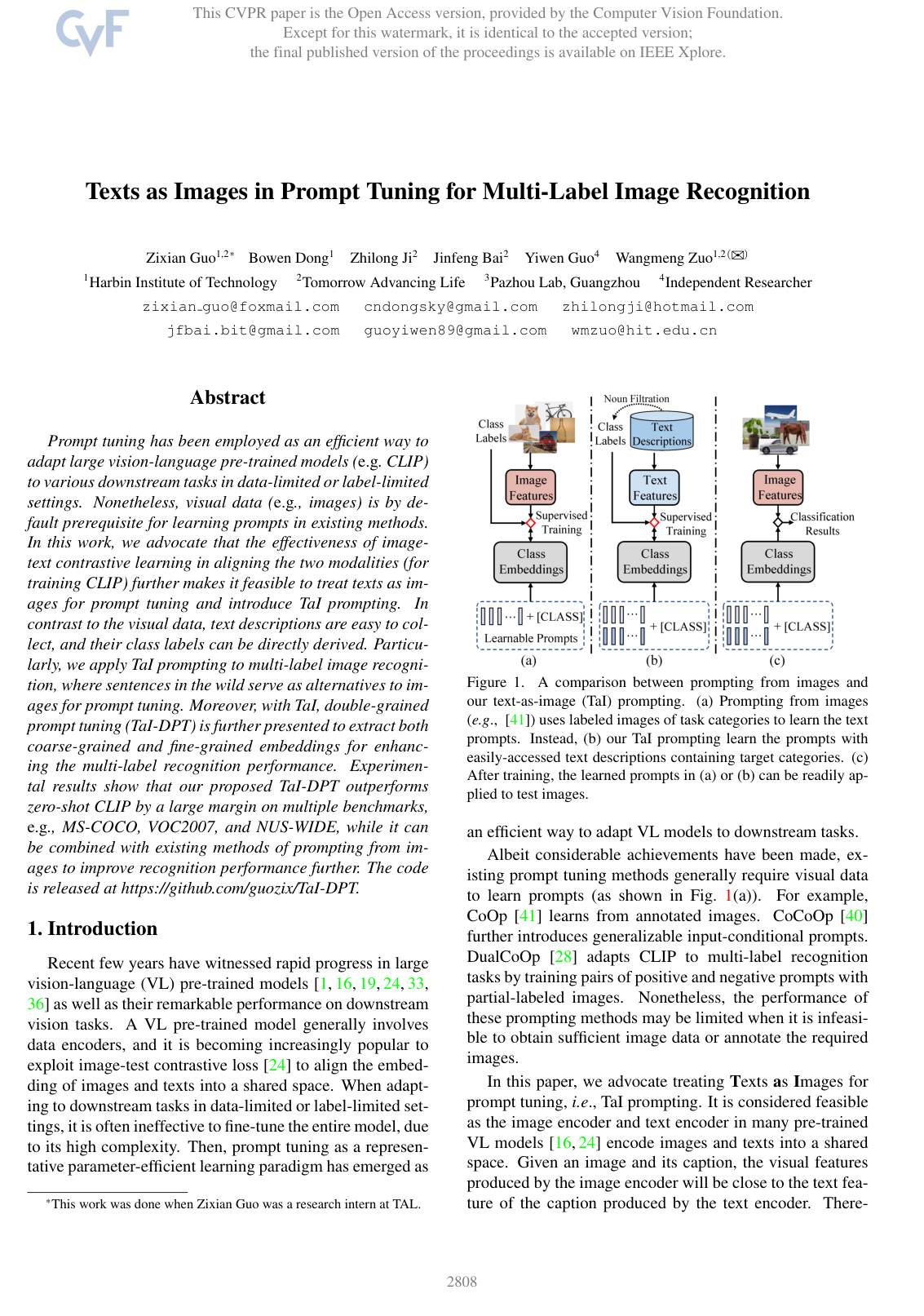
Texts as Images in Prompt Tuning for Multi-Label Image Recognition
Zixian Guo, Bowen Dong, Zhilong Ji, Jinfeng Bai, Yiwen Guo, Wangmeng Zuo
Why you should read this
Proposes a prompt tuning framework that trains vision-language models for multi-label image recognition using easily accessible text descriptions instead of labeled images, achieving strong classification performance without visual training data.
Prompt tuning has been employed as an efficient way to adapt large vision-language pre-trained models (e.g. CLIP) to various downstream tasks in data-limited or label-limited settings. Nonetheless, visual data (e.g., images) is by default prerequisite for learning prompts in existing methods. In this work, we advocate that the effectiveness of image-text contrastive learning in aligning the two modalities (for training CLIP) further makes it feasible to treat texts as images for prompt tuning and introduce TaI prompting. In contrast to the visual data, text descriptions are easy to collect, and their class labels can be directly derived. Particularly, we apply TaI prompting to multi-label image recognition, where sentences in the wild serve as alternatives to images for prompt tuning. Moreover, with TaI, dual-grained prompt tuning (TaI-DPT) is further presented to extract both coarse-grained and fine-grained embeddings for enhancing the multi-label recognition performance. Experimental results show that our proposed TaI-DPT outperforms zero-shot CLIP by a large margin on multiple benchmarks, e.g., MS-COCO, VOC2007, and NUS-WIDE, while it can be combined with existing methods of prompting from images to improve recognition performance further. The code is released at https://github.com/guozix/TaI-DPT.
Added
2026-09-26
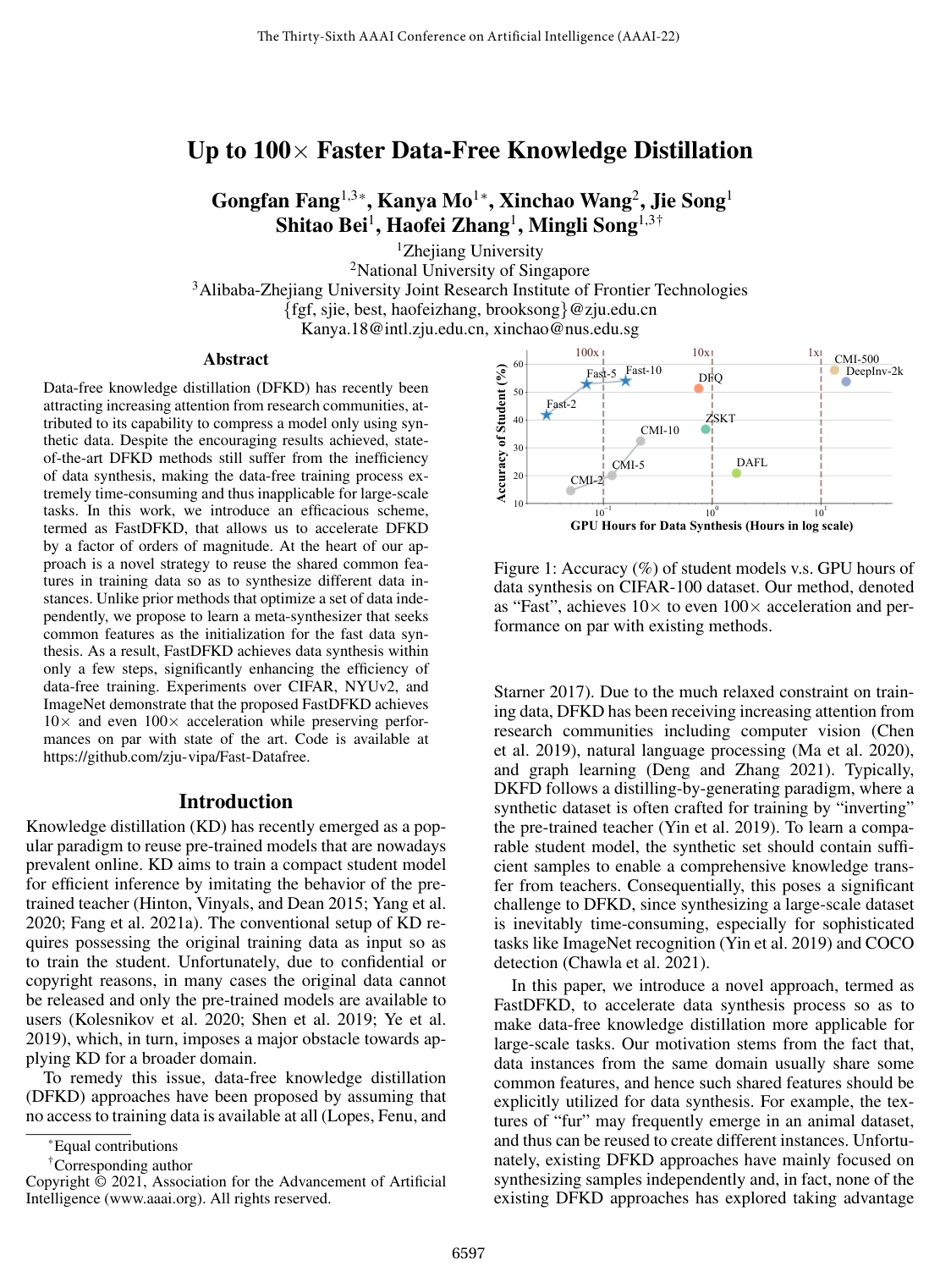
Up to 100x Faster Data-Free Knowledge Distillation
Gongfan Fang, Kanya Mo, Xinchao Wang, Jie Song, Shitao Bei, Haofei Zhang, Mingli Song
Why you should read this
Accelerates data-free knowledge distillation by up to two orders of magnitude by learning a meta-synthesizer that extracts reusable domain features to generate synthetic training data in only a few optimization steps.
Data-free knowledge distillation (DFKD) has recently been attracting increasing attention from research communities, attributed to its capability to compress a model only using synthetic data. Despite the encouraging results achieved, state-of-the-art DFKD methods still suffer from the inefficiency of data synthesis, making the data-free training process extremely time-consuming and thus inapplicable for large-scale tasks. In this work, we introduce an efficacious scheme, termed as FastDFKD, that allows us to accelerate DFKD by a factor of orders of magnitude. At the heart of our approach is a novel strategy to reuse the shared common features in training data so as to synthesize different data instances. Unlike prior methods that optimize a set of data independently, we propose to learn a meta-synthesizer that seeks common features as the initialization for the fast data synthesis. As a result, FastDFKD achieves data synthesis within only a few steps, significantly enhancing the efficiency of data-free training. Experiments over CIFAR, NYUv2, and ImageNet demonstrate that the proposed FastDFKD achieves 10× and even 100× acceleration while preserving performances on par with state of the art. Code is available at https://github.com/zju-vipa/Fast-Datafree.
Added
2026-09-26
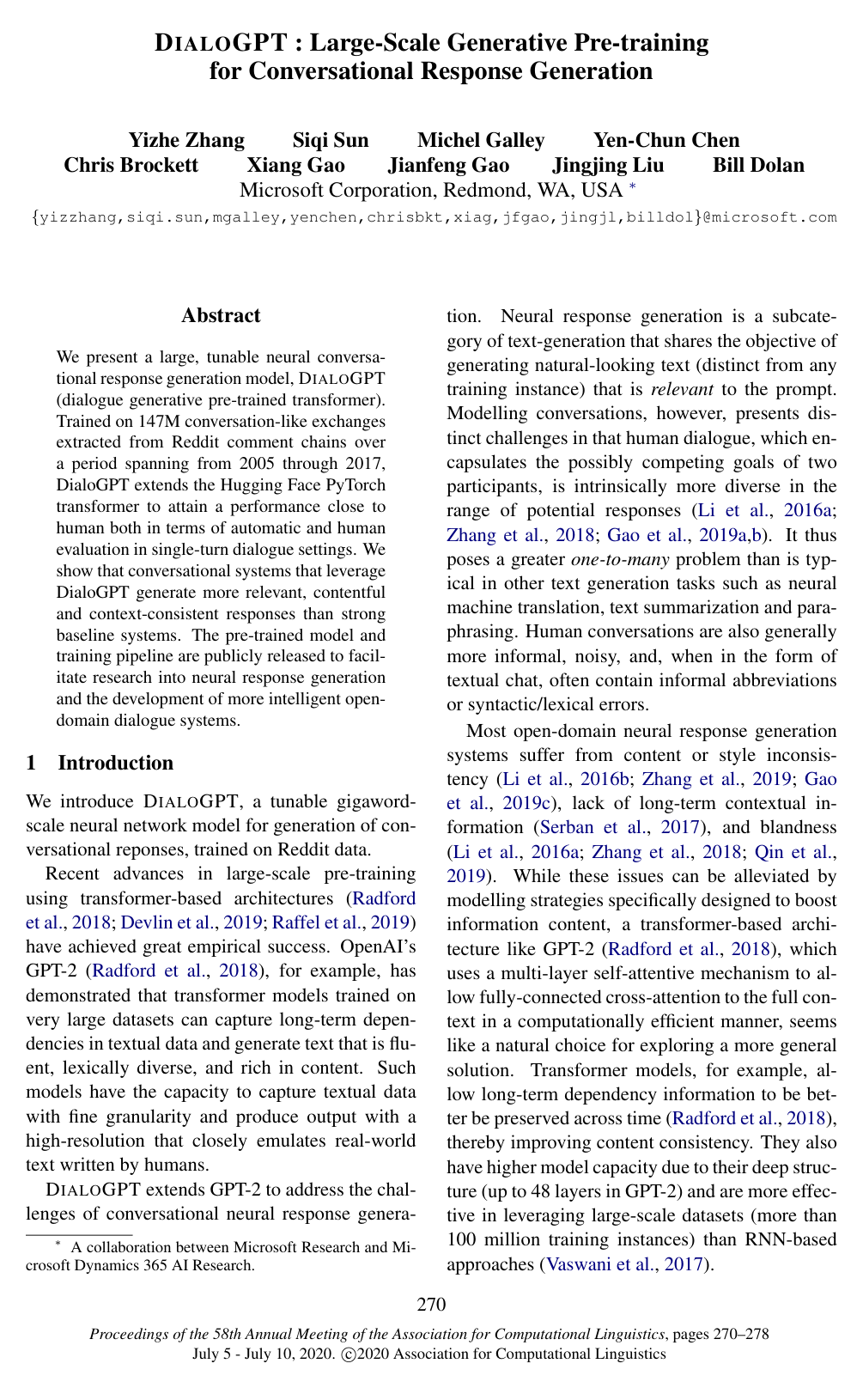
DIALOGPT : Large-Scale Generative Pre-training for Conversational Response Generation
Yizhe Zhang, Siqi Sun, Michel Galley, Yen-Chun Chen, Chris Brockett, Xiang Gao, Jianfeng Gao, Jingjing Liu, Bill Dolan
Why you should read this
Introduces DialoGPT, a conversational response generation model pre-trained on 147 million Reddit dialogue threads to produce contextually consistent, content-rich responses that approach human quality in open-domain settings.
We present a large, tunable neural conversational response generation model, DialoGPT (dialogue generative pre-trained transformer). Trained on 147M conversation-like exchanges extracted from Reddit comment chains over a period spanning from 2005 through 2017, DialoGPT extends the Hugging Face PyTorch transformer to attain a performance close to human both in terms of automatic and human evaluation in single-turn dialogue settings. We show that conversational systems that leverage DialoGPT generate more relevant, contentful and context-consistent responses than strong baseline systems. The pre-trained model and training pipeline are publicly released to facilitate research into neural response generation and the development of more intelligent open-domain dialogue systems.
Added
2026-09-24
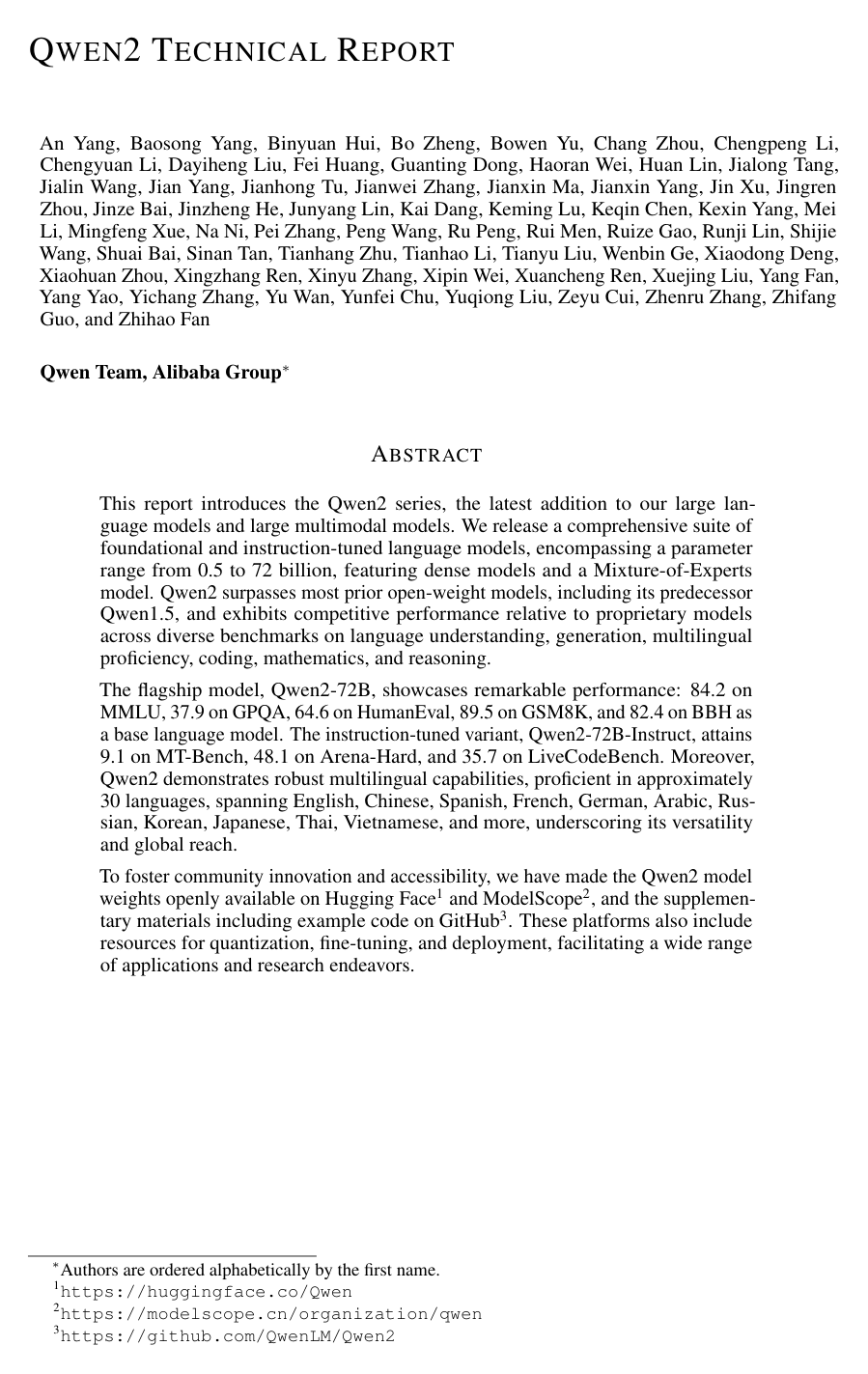
Qwen2 Technical Report
An Yang, Baosong Yang, Binyuan Hui, Bo Zheng, Bowen Yu, Chang Zhou, Chengpeng Li, Chengyuan Li, Dayiheng Liu, Fei Huang, Guanting Dong, Haoran Wei, Huan Lin, Jialong Tang, Jia-Lin Wang, Jian Yang, Jianhong Tu, Jianwei Zhang, Jianxin Ma, Jin Xu, Jingren Zhou, Jinze Bai, Jinzheng He, Junyang Lin, K. Dang, Keming Lu, Ke-Yang Chen, Kexin Yang, Mei Li, Min Xue, Na Ni, Pei Zhang, Peng Wang, Ru Peng, Rui Men, Ruize Gao, Runji Lin, Shijie Wang, Shuai Bai, Sinan Tan, Tianhang Zhu, Tianhao Li, Tianyu Liu, Wenbin Ge, Xiaodong Deng, Xiaohuan Zhou, Xingzhang Ren, Xinyu Zhang, Xipin Wei, Xuancheng Ren, Yang Fan, Yang Yao, Yichang Zhang, Yunyang Wan, Yunfei Chu, Zeyu Cui, Zhen-Ru Zhang, Zhi-Wei Fan
Why you should read this
Presents the Qwen2 family of open-weight dense and Mixture-of-Experts large language models ranging from 0.5B to 72B parameters, detailing training strategies and architectures that achieve performance competitive with leading proprietary systems across coding, mathematics, reasoning, and multilingual benchmarks in approximately 30 languages.
This report introduces the Qwen2 series, the latest addition to our large language models and large multimodal models. We release a comprehensive suite of foundational and instruction-tuned language models, encompassing a parameter range from 0.5 to 72 billion, featuring dense models and a Mixture-of-Experts model. Qwen2 surpasses most prior open-weight models, including its predecessor Qwen1.5, and exhibits competitive performance relative to proprietary models across diverse benchmarks on language understanding, generation, multilingual proficiency, coding, mathematics, and reasoning. The flagship model, Qwen2-72B, showcases remarkable performance: 84.2 on MMLU, 37.9 on GPQA, 64.6 on HumanEval, 89.5 on GSM8K, and 82.4 on BBH as a base language model. The instruction-tuned variant, Qwen2-72B-Instruct, attains 9.1 on MT-Bench, 48.1 on Arena-Hard, and 35.7 on LiveCodeBench. Moreover, Qwen2 demonstrates robust multilingual capabilities, proficient in approximately 30 languages, spanning English, Chinese, Spanish, French, German, Arabic, Russian, Korean, Japanese, Thai, Vietnamese, and more, underscoring its versatility and global reach. To foster community innovation and accessibility, we have made the Qwen2 model weights openly available on Hugging Face and ModelScope, and the supplementary materials including example code on GitHub. These platforms also include resources for quantization, fine-tuning, and deployment, facilitating a wide range of applications and research endeavors.
Added
2026-09-24
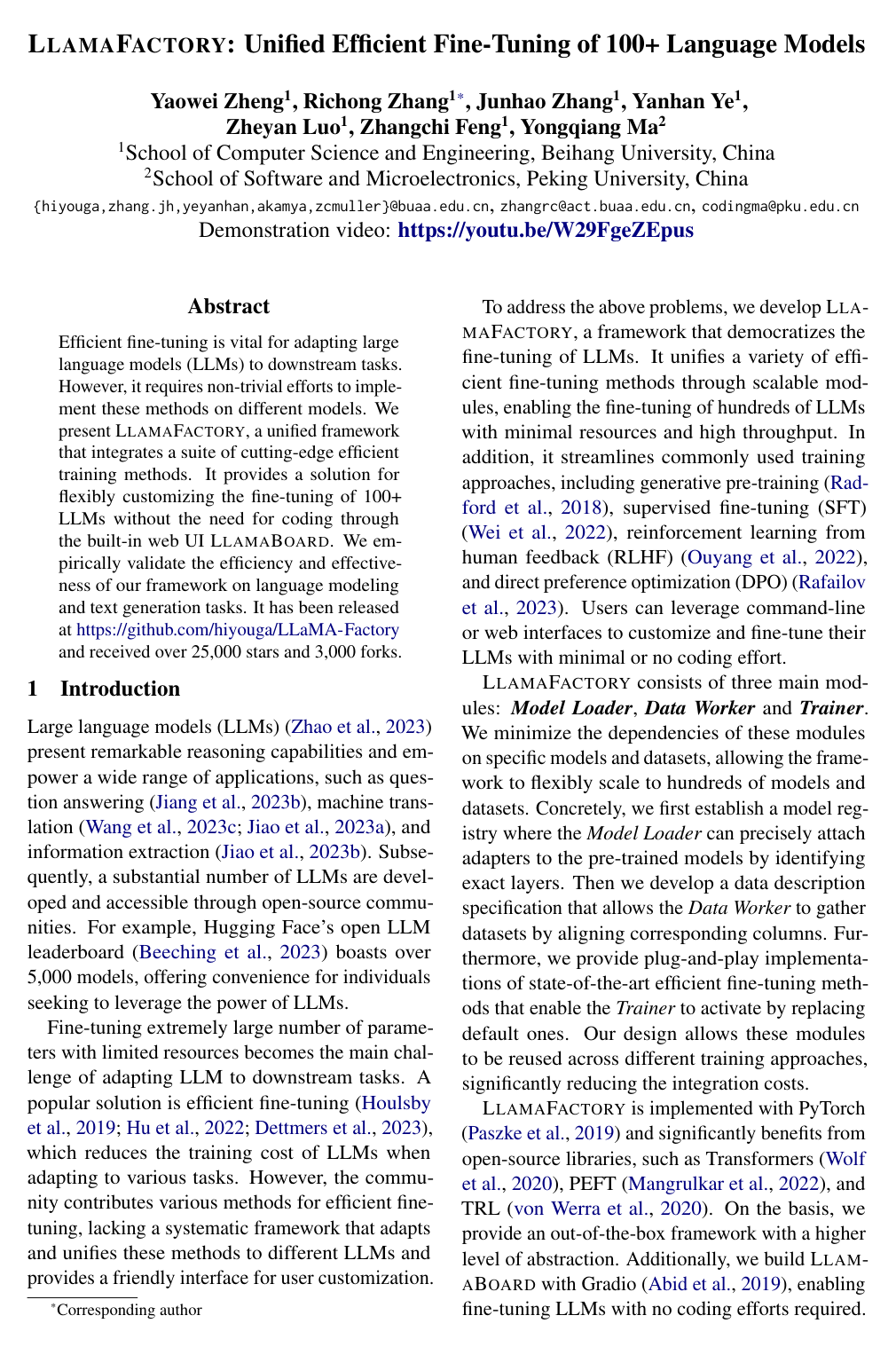
LlamaFactory: Unified Efficient Fine-Tuning of 100+ Language Models
Yaowei Zheng, Richong Zhang, Junhao Zhang, Yanhan Ye, Zheyan Luo, Yongqiang Ma
Why you should read this
Introduces LlamaFactory, a unified framework integrating cutting-edge efficient training methods to enable code-free fine-tuning across more than 100 large language models via an interactive web interface.
Efficient fine-tuning is vital for adapting large language models (LLMs) to downstream tasks. However, it requires non-trivial efforts to implement these methods on different models. We present LlamaFactory, a unified framework that integrates a suite of cutting-edge efficient training methods. It provides a solution for flexibly customizing the fine-tuning of 100+ LLMs without the need for coding through the built-in web UI LlamaBoard. We empirically validate the efficiency and effectiveness of our framework on language modeling and text generation tasks. It has been released at this https URL and received over 25,000 stars and 3,000 forks.
Added
2026-09-18
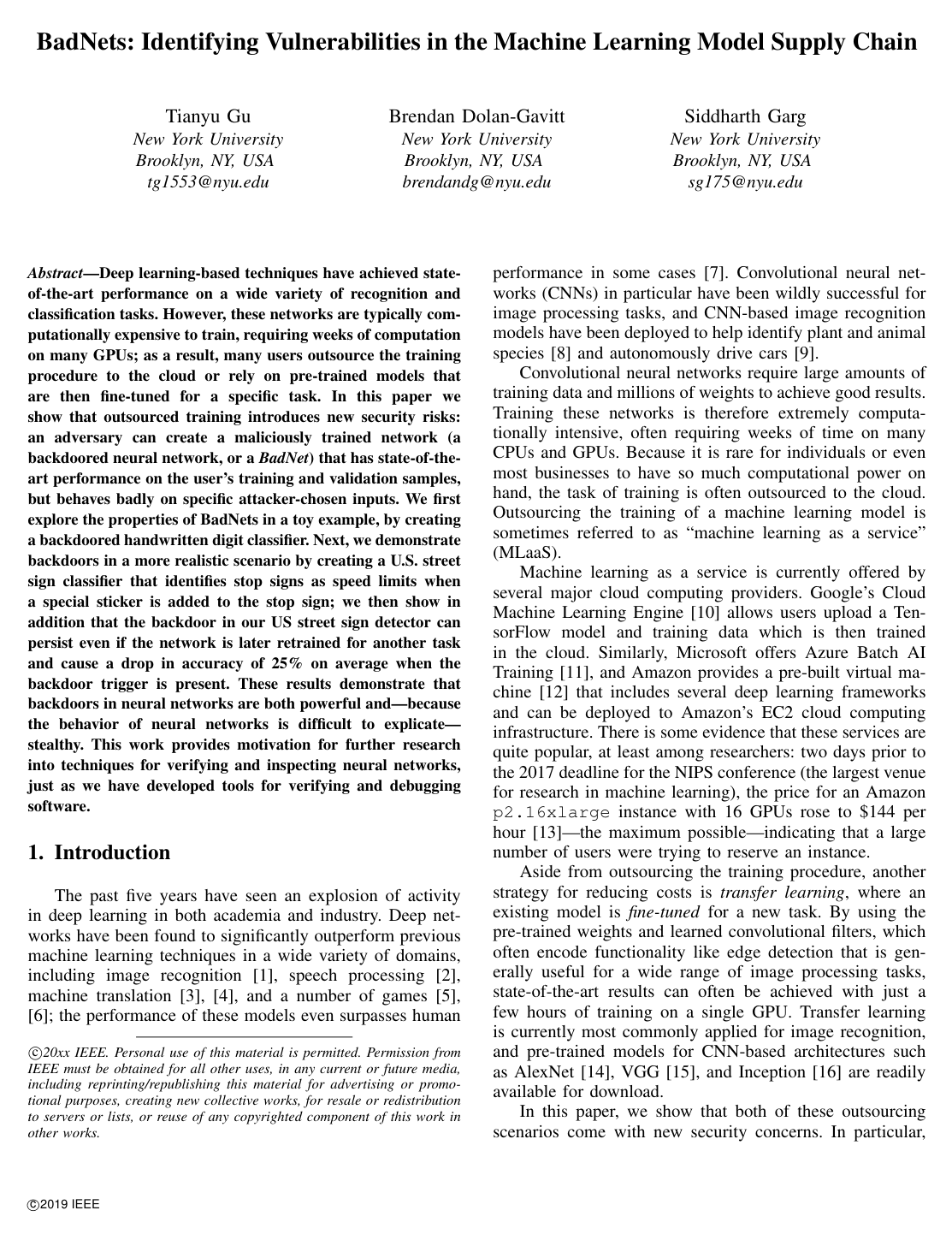
BadNets: Identifying Vulnerabilities in the Machine Learning Model Supply Chain
Tianyu Gu, Brendan Dolan-Gavitt, Siddharth Garg
Why you should read this
Exposes critical security vulnerabilities in outsourced machine learning by demonstrating that poisoned neural networks can achieve standard performance on normal tasks while triggering targeted misclassifications on attacker-manipulated inputs that persist through retraining.
Deep learning-based techniques have achieved state-of-the-art performance on a wide variety of recognition and classification tasks. However, these networks are typically computationally expensive to train, requiring weeks of computation on many GPUs; as a result, many users outsource the training procedure to the cloud or rely on pre-trained models that are then fine-tuned for a specific task. In this paper we show that outsourced training introduces new security risks: an adversary can create a maliciously trained network (a backdoored neural network, or a \emph{BadNet}) that has state-of-the-art performance on the user's training and validation samples, but behaves badly on specific attacker-chosen inputs. We first explore the properties of BadNets in a toy example, by creating a backdoored handwritten digit classifier. Next, we demonstrate backdoors in a more realistic scenario by creating a U.S. street sign classifier that identifies stop signs as speed limits when a special sticker is added to the stop sign; we then show in addition that the backdoor in our US street sign detector can persist even if the network is later retrained for another task and cause a drop in accuracy of {25}\% on average when the backdoor trigger is present. These results demonstrate that backdoors in neural networks are both powerful and---because the behavior of neural networks is difficult to explicate---stealthy. This work provides motivation for further research into techniques for verifying and inspecting neural networks, just as we have developed tools for verifying and debugging software.
Added
2026-09-14
Towards a Unified View of Parameter-Efficient Transfer Learning
Junxian He, Chunting Zhou, Xuezhe Ma, Taylor Berg-Kirkpatrick, Graham Neubig
Why you should read this
Provides a theoretical unification proving that adapters, continuous prompts, and low-rank adaptations are mathematically equivalent under specific reparameterizations.
Fine-tuning large pre-trained language models on downstream tasks has become the de-facto learning paradigm in NLP. However, conventional approaches fine-tune all the parameters of the pre-trained model, which becomes prohibitive as the model size and the number of tasks grow. Recent work has proposed a variety of parameter-efficient transfer learning methods that only fine-tune a small number of (extra) parameters to attain strong performance. While effective, the critical ingredients for success and the connections among the various methods are poorly understood. In this paper, we break down the design of state-of-the-art parameter-efficient transfer learning methods and present a unified framework that establishes connections between them. Specifically, we re-frame them as modifications to specific hidden states in pre-trained models, and define a set of design dimensions along which different methods vary, such as the function to compute the modification and the position to apply the modification. Through comprehensive empirical studies across machine translation, text summarization, language understanding, and text classification benchmarks, we utilize the unified view to identify important design choices in previous methods. Furthermore, our unified framework enables the transfer of design elements across different approaches, and as a result we are able to instantiate new parameter-efficient fine-tuning methods that tune less parameters than previous methods while being more effective, achieving comparable results to fine-tuning all parameters on all four tasks.
Added
2026-06-22
DistilBERT, a distilled version of BERT: smaller, faster, cheaper and lighter
Victor Sanh, Lysandre Debut, Julien Chaumond, Thomas Wolf
Why you should read this
Establishes the industry standard for compressing massive language models by combining masked language modeling with cosine embedding losses to drastically shrink transformer architectures.
As Transfer Learning from large-scale pre-trained models becomes more prevalent in Natural Language Processing (NLP), operating these large models in on-the-edge and/or under constrained computational training or inference budgets remains challenging. In this work, we propose a method to pre-train a smaller general-purpose language representation model, called DistilBERT, which can then be fine-tuned with good performances on a wide range of tasks like its larger counterparts. While most prior work investigated the use of distillation for building task-specific models, we leverage knowledge distillation during the pre-training phase and show that it is possible to reduce the size of a BERT model by 40%, while retaining 97% of its language understanding capabilities and being 60% faster. To leverage the inductive biases learned by larger models during pre-training, we introduce a triple loss combining language modeling, distillation and cosine-distance losses. Our smaller, faster and lighter model is cheaper to pre-train and we demonstrate its capabilities for on-device computations in a proof-of-concept experiment and a comparative on-device study.
Added
2026-06-19