ReconBoost: Boosting Can Achieve Modality Reconcilement
Cong HuaQianqian XuShilong BaoZhiyong YangQingming Huang
Proposes a gradient-boosting-inspired alternating learning framework called ReconBoost that mitigates modality competition by dynamically updating individual modalities sequentially with regularization to reconcile uni-modal exploitation and cross-modal fusion.
Real-world machine learning systems increasingly rely on multi-modal data, combining sources such as audio, video, and text. However, current joint training paradigms suffer from a problem called modality competition, where a faster-converging dominant modality overpowers the learning process. This suppresses the optimization of weaker modalities, leading to suboptimal feature representation and degraded overall performance.
The article introduces and evaluates ReconBoost, a novel multi-modal alternating learning framework designed to achieve reconcilement between extracting single-modality features and exploring cross-modal interactions. The core objective is to prevent dominant modalities from inhibiting weaker ones by updating one modality at a time while dynamically regularizing learning to leverage complementary information.
To address this challenge, the authors design a framework that sequentially updates individual modality learners using a dynamic objective with a divergence-based reconcilement regularization term. Theoretically, this approach functions like gradient boosting by steering each updated modality to correct errors made by historical models. Unlike traditional boosting ensembles that accumulate large sets of learners, ReconBoost retains only the most recent model per modality to prevent overfitting in deep neural networks. It also incorporates a memory consolidation scheme to prevent catastrophic forgetting and a global rectification scheme to prevent models from getting trapped in poor local optima. The framework was evaluated across six public benchmark datasets covering tasks like audio-visual event localization, speech emotion recognition, object classification, and sentiment analysis.
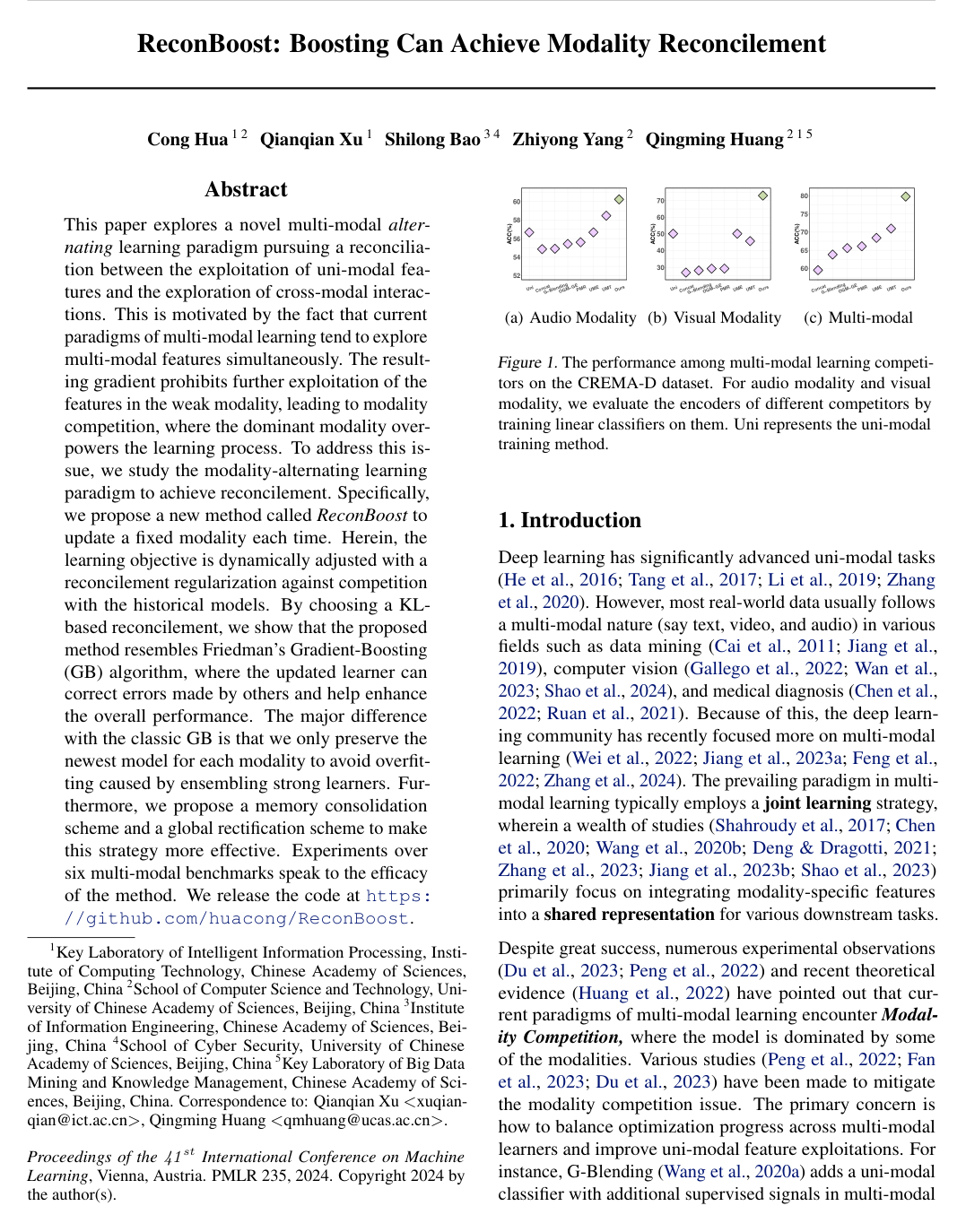
The experimental findings show substantial improvements across all tested tasks. First, ReconBoost consistently outperformed existing joint-learning and modulation baselines on all six benchmarks, reaching 79.82% accuracy on the CREMA-D dataset compared to 59.50% for standard concatenation and 70.97% for the best prior competitor. Second, it markedly revitalized weak modality representations, boosting visual encoder accuracy on CREMA-D to 73.01% compared to 26.81% under standard joint training. Third, ReconBoost significantly reduced the degree of modality competition across benchmarks, achieving the largest relative performance gains on datasets that exhibited the most severe initial modality imbalance. Fourth, the framework maintained superior accuracy in cross-modal retrieval tasks and exhibited strong robustness against substantial Gaussian noise injected into audio and visual inputs.
These results indicate that synchronous joint training is fundamentally limited by gradient interference across modalities. Shifting to an alternating boosting-inspired optimization paradigm resolves this bottleneck without requiring complex architectural redesigns. For organizations deploying multi-modal artificial intelligence systems, this approach can enhance system accuracy, improve reliability in noisy environments, and mitigate unfair biases that arise when models systematically ignore weaker or under-represented data modalities.
Decision-makers should adopt alternating optimization strategies like ReconBoost in multi-modal pipelines where modality imbalance undermines performance. The framework is compatible with various decision-level fusion schemes, allowing practitioners to pair it with uncertainty-aware or learnable weighting mechanisms. Before wide-scale deployment, teams should conduct standard parameter tuning on the reconcilement trade-off factor and memory consolidation terms to suit domain-specific data characteristics.
While the empirical results are robust across multiple domains, the study's evaluations rely on standard academic benchmarks with predefined modalities. Practitioners should exercise caution when deploying the framework in real-time streaming contexts or environments with highly fluctuating modality availability until further pilot validations are completed.
- Paper: Characterizing and Overcoming the Greedy Nature of Learning in Multi-modal Deep Neural Networks, Nan Wu et al. (2022). It characterizes the greedy nature of multimodal neural networks where dominant modalities suppress weaker ones, defining the exact modality competition problem that ReconBoost resolves.
- Paper: Multimodal Machine Learning: A Survey and Taxonomy, Tadas Baltrušaitis et al. (2017). It provides the foundational taxonomy and conceptual framework for multimodal representation, alignment, and fusion upon which subsequent multimodal learning dynamics build.
- Paper: MISA: Modality-Invariant and -Specific Representations for Multimodal Sentiment Analysis, Devamanyu Hazarika et al. (2020). It introduces representation disentanglement into modality-invariant and modality-specific spaces to mitigate inter-modality gaps in multimodal sentiment tasks.
- Paper: Tensor Fusion Network for Multimodal Sentiment Analysis, Amir Zadeh et al. (2017). It establishes early joint multimodal fusion modeling across language, audio, and visual features on benchmark datasets evaluated by ReconBoost.
- Paper: Multimodal Transformer for Unaligned Multimodal Language Sequences, Yao-Hung Hubert Tsai et al. (2019). It introduces cross-modal attention transformers for unaligned multimodal sequences, establishing standard cross-modal interaction benchmarks used to test multimodal balance.
- Paper: Multimodal Deep Learning, Jiquan Ngiam et al. (2011). It lays the groundwork for evaluating whether deep neural networks effectively learn shared versus single-modality representations across multimodal data streams.
- Paper: Qwen3-VL Technical Report, Shuai Bai et al. (2025). It extends the principles of balancing multimodal and unimodal representations to modern, large-scale vision-language architectures across diverse multimodal reasoning benchmarks.
- Paper: InternVL3: Exploring Advanced Training and Test-Time Recipes for Open-Source Multimodal Models, Jinguo Zhu et al. (2025). It investigates advanced unified pre-training and preference optimization paradigms to mitigate language degradation and multimodal imbalance in large-scale models.
- Paper: Expanding Performance Boundaries of Open-Source Multimodal Models with Model, Data, and Test-Time Scaling, Zhe Chen et al. (2024). It studies architectural scaling strategies to expand multimodal capabilities without suffering from modality-specific performance collapse.
- Paper: Show-o: One Single Transformer to Unify Multimodal Understanding and Generation, Jinheng Xie et al. (2025). It advances unified multimodal modeling by integrating both multimodal understanding and generative tasks within a single transformer framework.
- Paper: M-LLM Based Video Frame Selection for Efficient Video Understanding, Kai Hu 0010 et al. (2025). It applies adaptive modality-aware selection techniques to video question answering to efficiently balance visual density and text comprehension.