
keyword
modality competition
Modality competition is a phenomenon in multimodal machine learning where different data modalities compete for model capacity, optimization updates, and representational dominance during joint training. When a system processes multiple types of inputs simultaneously, such as text, audio, or visual data, one modality often converges faster or generates stronger gradient signals, overpowering the learning process. Consequently, the model underutilizes or suppresses the feature representations of less dominant modalities, leading to suboptimal overall performance, modality imbalance, or training instability compared to what the individual modalities could achieve independently.
2 items
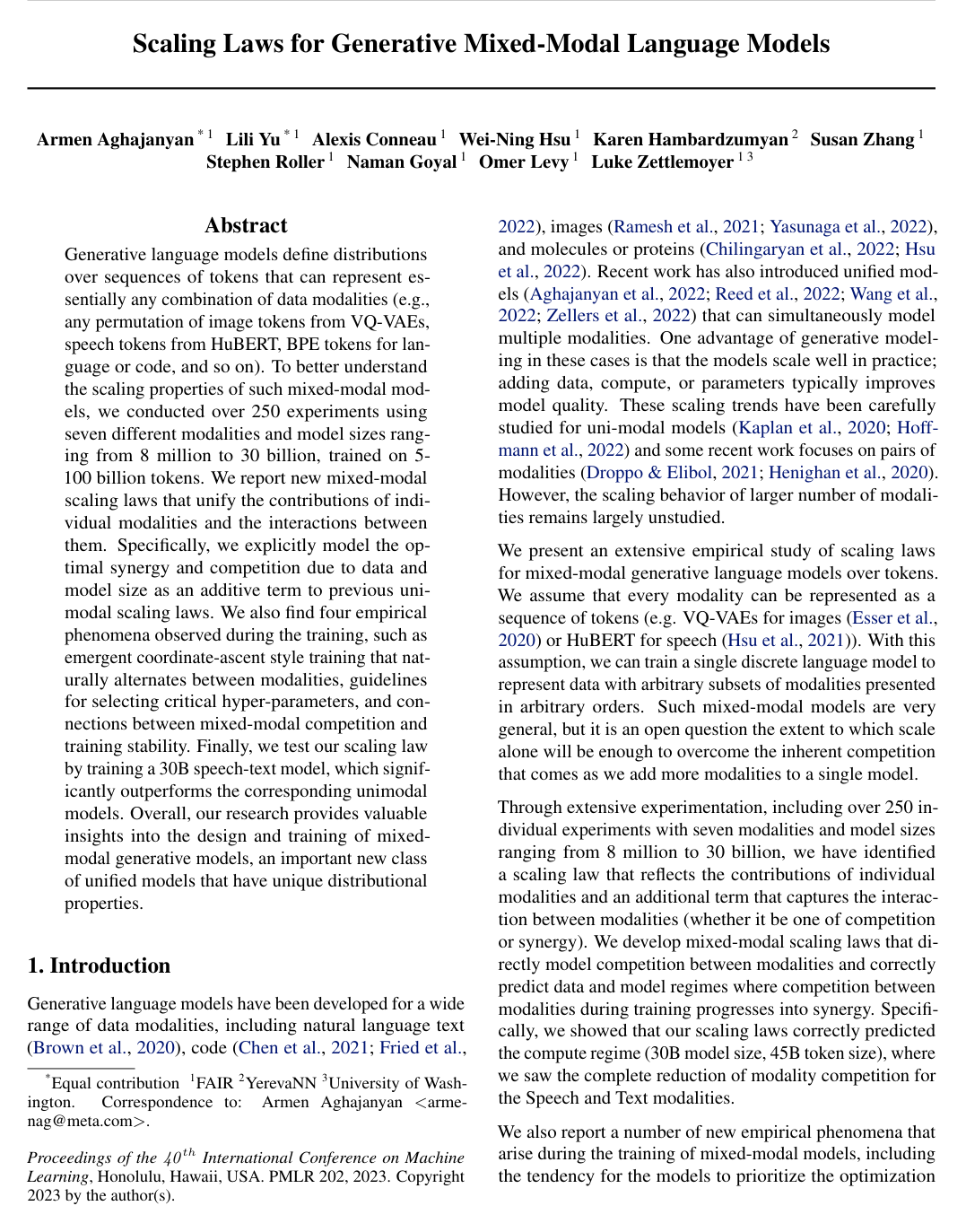
Scaling Laws for Generative Mixed-Modal Language Models
Armen Aghajanyan, Lili Yu, Alexis Conneau, Wei-Ning Hsu, Karen Hambardzumyan, Susan Zhang, Stephen Roller, Naman Goyal, Omer Levy, Luke Zettlemoyer
Why you should read this
Establishes neural scaling laws for mixed-modal generative language models across seven modalities, formalizing how parameter count and dataset size govern cross-modal competition and synergy to optimize training up to 30 billion parameters.
Generative language models define distributions over sequences of tokens that can represent essentially any combination of data modalities (e.g., any permutation of image tokens from VQ-VAEs, speech tokens from HuBERT, BPE tokens for language or code, and so on). To better understand the scaling properties of such mixed-modal models, we conducted over 250 experiments using seven different modalities and model sizes ranging from 8 million to 30 billion, trained on 5-100 billion tokens. We report new mixed-modal scaling laws that unify the contributions of individual modalities and the interactions between them. Specifically, we explicitly model the optimal synergy and competition due to data and model size as an additive term to previous uni-modal scaling laws. We also find four empirical phenomena observed during the training, such as emergent coordinate-ascent style training that naturally alternates between modalities, guidelines for selecting critical hyper-parameters, and connections between mixed-modal competition and training stability. Finally, we test our scaling law by training a 30B speech-text model, which significantly outperforms the corresponding unimodal models. Overall, our research provides valuable insights into the design and training of mixed-modal generative models, an important new class of unified models that have unique distributional properties.
Added
2026-10-01
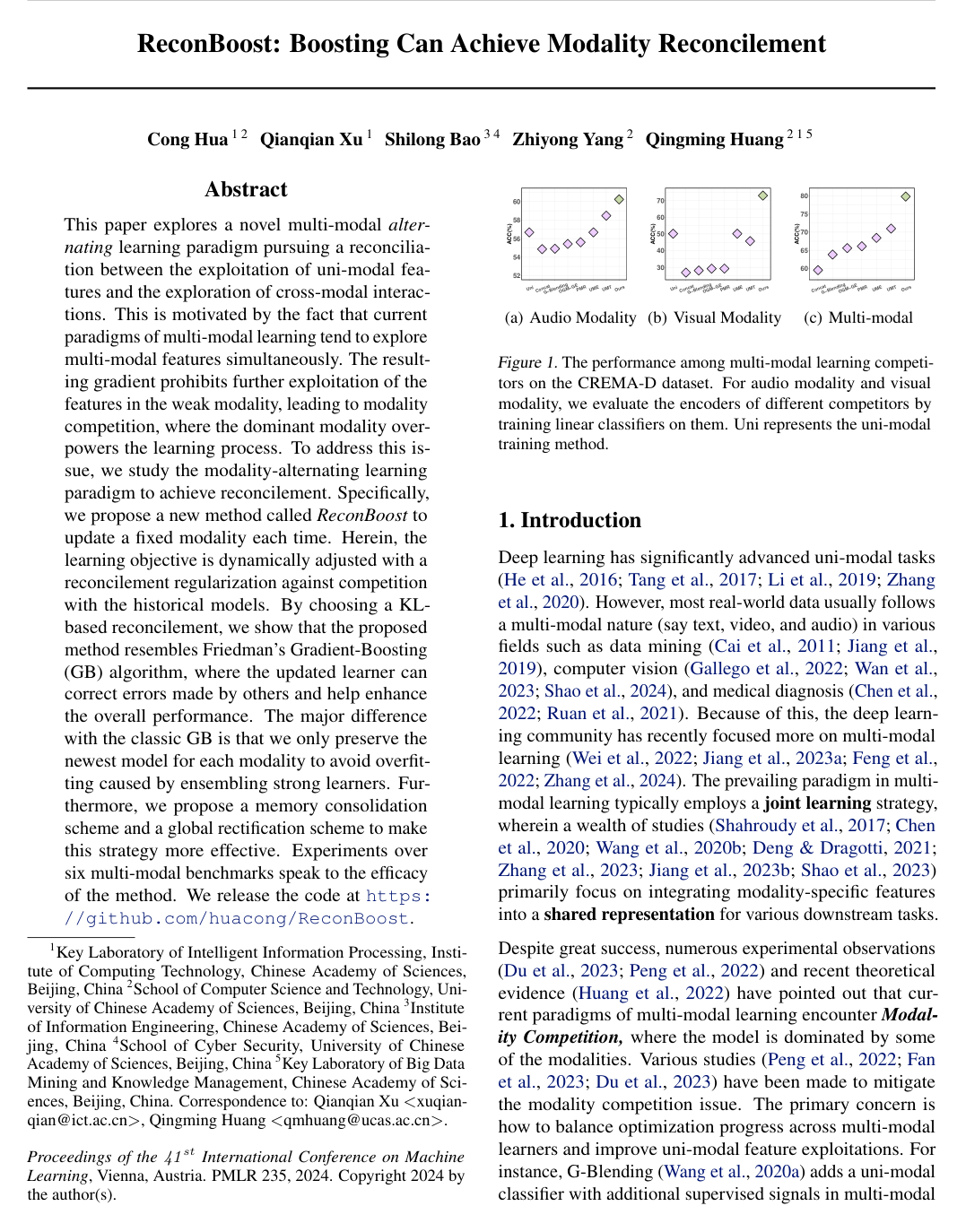
ReconBoost: Boosting Can Achieve Modality Reconcilement
Cong Hua, Qianqian Xu, Shilong Bao, Zhiyong Yang, Qingming Huang
Why you should read this
Proposes a gradient-boosting-inspired alternating learning framework called ReconBoost that mitigates modality competition by dynamically updating individual modalities sequentially with regularization to reconcile uni-modal exploitation and cross-modal fusion.
This paper explores a novel multi-modal alternating learning paradigm pursuing a reconciliation between the exploitation of uni-modal features and the exploration of cross-modal interactions. This is motivated by the fact that current paradigms of multi-modal learning tend to explore multi-modal features simultaneously. The resulting gradient prohibits further exploitation of the features in the weak modality, leading to modality competition, where the dominant modality overpowers the learning process. To address this issue, we study the modality-alternating learning paradigm to achieve reconcilement. Specifically, we propose a new method called ReconBoost to update a fixed modality each time. Herein, the learning objective is dynamically adjusted with a reconcilement regularization against competition with the historical models. By choosing a KL-based reconcilement, we show that the proposed method resembles Friedman’s Gradient-Boosting (GB) algorithm, where the updated learner can correct errors made by others and help enhance the overall performance. The major difference with the classic GB is that we only preserve the newest model for each modality to avoid overfitting caused by ensembling strong learners. Furthermore, we propose a memory consolidation scheme and a global rectification scheme to make this strategy more effective. Experiments over six multi-modal benchmarks speak to the efficacy of the method. We release the code at https://github.com/huacong/ReconBoost.
Added
2026-09-26