
keyword
gradient boosting
Gradient boosting is an ensemble machine learning technique used for regression and classification tasks that constructs a strong predictive model by sequentially combining multiple weak learners, typically decision trees. The algorithm operates iteratively, training each new base model to predict and correct the residual errors produced by the combined existing models. By optimizing an arbitrary differentiable loss function using gradient descent, each successive learner steps in the direction that minimizes the overall prediction error. The individual models are then aggregated additively, often scaled by a shrinkage factor or learning rate to prevent overfitting and improve generalization on unseen data.
5 items
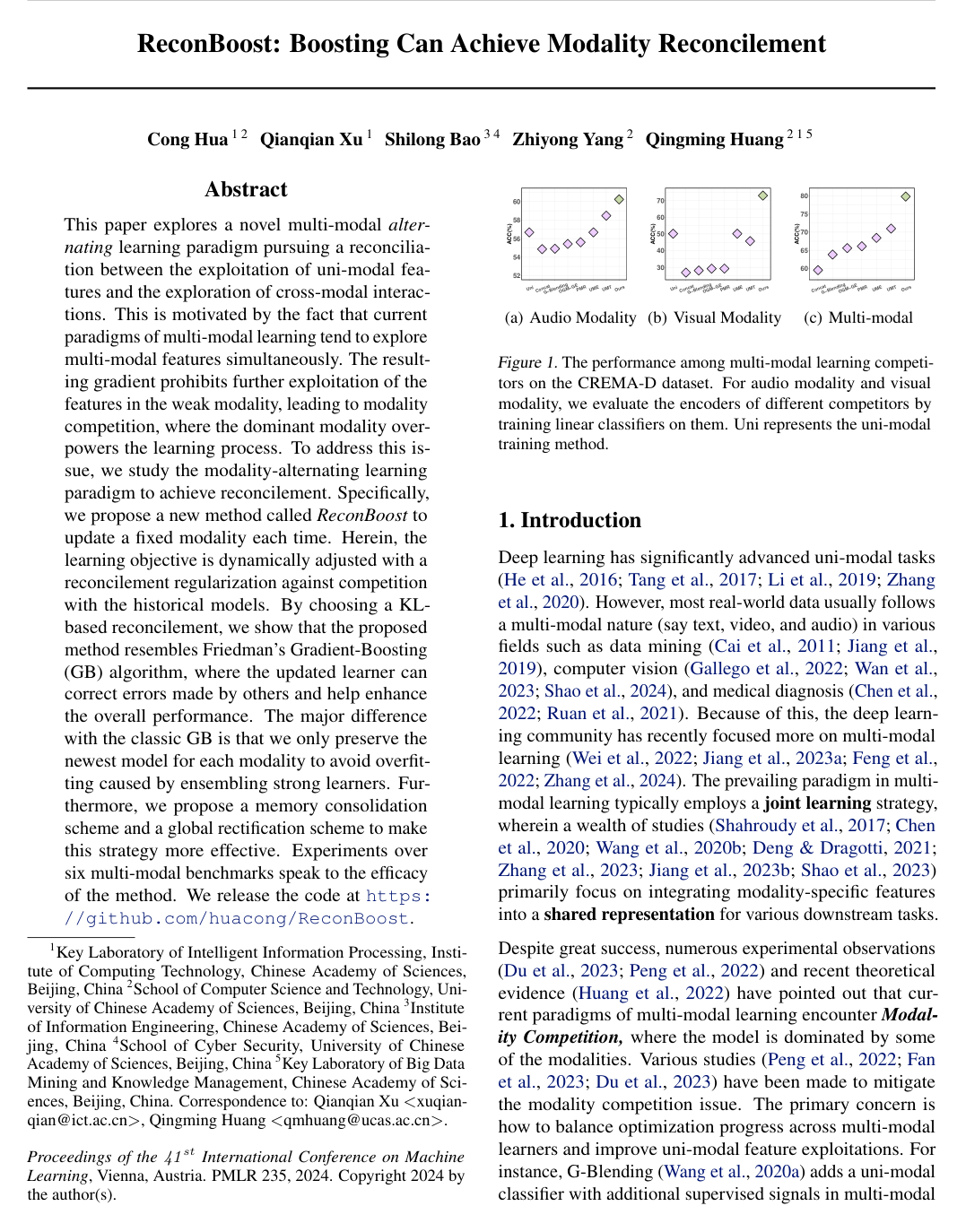
ReconBoost: Boosting Can Achieve Modality Reconcilement
Cong Hua, Qianqian Xu, Shilong Bao, Zhiyong Yang, Qingming Huang
Why you should read this
Proposes a gradient-boosting-inspired alternating learning framework called ReconBoost that mitigates modality competition by dynamically updating individual modalities sequentially with regularization to reconcile uni-modal exploitation and cross-modal fusion.
This paper explores a novel multi-modal alternating learning paradigm pursuing a reconciliation between the exploitation of uni-modal features and the exploration of cross-modal interactions. This is motivated by the fact that current paradigms of multi-modal learning tend to explore multi-modal features simultaneously. The resulting gradient prohibits further exploitation of the features in the weak modality, leading to modality competition, where the dominant modality overpowers the learning process. To address this issue, we study the modality-alternating learning paradigm to achieve reconcilement. Specifically, we propose a new method called ReconBoost to update a fixed modality each time. Herein, the learning objective is dynamically adjusted with a reconcilement regularization against competition with the historical models. By choosing a KL-based reconcilement, we show that the proposed method resembles Friedman’s Gradient-Boosting (GB) algorithm, where the updated learner can correct errors made by others and help enhance the overall performance. The major difference with the classic GB is that we only preserve the newest model for each modality to avoid overfitting caused by ensembling strong learners. Furthermore, we propose a memory consolidation scheme and a global rectification scheme to make this strategy more effective. Experiments over six multi-modal benchmarks speak to the efficacy of the method. We release the code at https://github.com/huacong/ReconBoost.
Added
2026-09-26
CatBoost: gradient boosting with categorical features support
Anna Veronika Dorogush, Vasily Ershov, Andrey Gulin
Why you should read this
Introduces CatBoost, a gradient boosting library that natively processes categorical features to achieve superior predictive accuracy with substantially faster GPU training and CPU inference than existing frameworks.
In this paper we present CatBoost, a new open-sourced gradient boosting library that successfully handles categorical features and outperforms existing publicly available implementations of gradient boosting in terms of quality on a set of popular publicly available datasets. The library has a GPU implementation of learning algorithm and a CPU implementation of scoring algorithm, which are significantly faster than other gradient boosting libraries on ensembles of similar sizes.
Added
2026-09-18
BART: Bayesian Additive Regression Trees
Hugh A. Chipman, Edward I. George, Robert E. McCulloch
Why you should read this
Introduces Bayesian Additive Regression Trees (BART), a nonparametric sum-of-trees model that combines the high predictive accuracy of ensemble learning with full Bayesian uncertainty quantification and variable selection.
We develop a Bayesian "sum-of-trees" model where each tree is constrained by a regularization prior to be a weak learner, and fitting and inference are accomplished via an iterative Bayesian backfitting MCMC algorithm that generates samples from a posterior. Effectively, BART is a nonparametric Bayesian regression approach which uses dimensionally adaptive random basis elements. Motivated by ensemble methods in general, and boosting algorithms in particular, BART is defined by a statistical model: a prior and a likelihood. This approach enables full posterior inference including point and interval estimates of the unknown regression function as well as the marginal effects of potential predictors. By keeping track of predictor inclusion frequencies, BART can also be used for model-free variable selection. BART's many features are illustrated with a bake-off against competing methods on 42 different data sets, with a simulation experiment and on a drug discovery classification problem.
Added
2026-09-16
CatBoost: unbiased boosting with categorical features
Liudmila Prokhorenkova, Gleb Gusev, Aleksandr Vorobev, Anna Veronika Dorogush, Andrey Gulin
Why you should read this
Develops ordered boosting and advanced permutation techniques to algorithmically eliminate the target leakage introduced by traditional categorical target encoding.
This paper presents the key algorithmic techniques behind CatBoost, a new gradient boosting toolkit. Their combination leads to CatBoost outperforming other publicly available boosting implementations in terms of quality on a variety of datasets. Two critical algorithmic advances introduced in CatBoost are the implementation of ordered boosting, a permutation-driven alternative to the classic algorithm, and an innovative algorithm for processing categorical features. Both techniques were created to fight a prediction shift caused by a special kind of target leakage present in all currently existing implementations of gradient boosting algorithms. In this paper, we provide a detailed analysis of this problem and demonstrate that proposed algorithms solve it effectively, leading to excellent empirical results.
Added
2026-04-18
XGBoost: A Scalable Tree Boosting System
Tianqi Chen, Carlos Guestrin
Why you should read this
Explains the algorithmic sparsity-aware innovations that enabled gradient boosting machines to scale exponentially and utterly dominate tabular data processing tasks.
Tree boosting is a highly effective and widely used machine learning method. In this paper, we describe a scalable end-to-end tree boosting system called XGBoost, which is used widely by data scientists to achieve state-of-the-art results on many machine learning challenges. We propose a novel sparsity-aware algorithm for sparse data and weighted quantile sketch for approximate tree learning. More importantly, we provide insights on cache access patterns, data compression and sharding to build a scalable tree boosting system. By combining these insights, XGBoost scales beyond billions of examples using far fewer resources than existing systems.
Added
2026-04-18