
Built independently by an author, for readers. Read the story and support ChapterPal

keyword

ReconBoost framework

The ReconBoost framework is a multimodal machine learning framework designed to resolve modality competition by alternating the optimization of individual data modalities rather than training them simultaneously. In conventional multimodal learning, dominant modalities often overpower weaker ones during joint gradient updates, impeding the feature exploitation of the weaker modality. ReconBoost addresses this issue through an alternating learning scheme inspired by gradient boosting, where single-modality learners are updated sequentially to iteratively correct the predictive errors of other modalities. The framework dynamically guides training using a reconcilement regularization objective based on Kullback-Leibler divergence to balance new updates against historical model states. Unlike classical gradient boosting ensembles that accumulate all previous models, ReconBoost retains only the most recent model per modality to prevent overfitting, utilizing memory consolidation and global rectification mechanisms to enhance stability and joint performance.

1 item
ReconBoost: Boosting Can Achieve Modality Reconcilement

ReconBoost: Boosting Can Achieve Modality Reconcilement

Cong Hua, Qianqian Xu, Shilong Bao, Zhiyong Yang, Qingming Huang

OrganizationsChinese Academy of SciencesInstitute of Computing Technology, Chinese Academy of SciencesInstitute of Information Engineering, Chinese Academy of SciencesUniversity of Chinese Academy of Sciences

Why you should read this

Proposes a gradient-boosting-inspired alternating learning framework called ReconBoost that mitigates modality competition by dynamically updating individual modalities sequentially with regularization to reconcile uni-modal exploitation and cross-modal fusion.

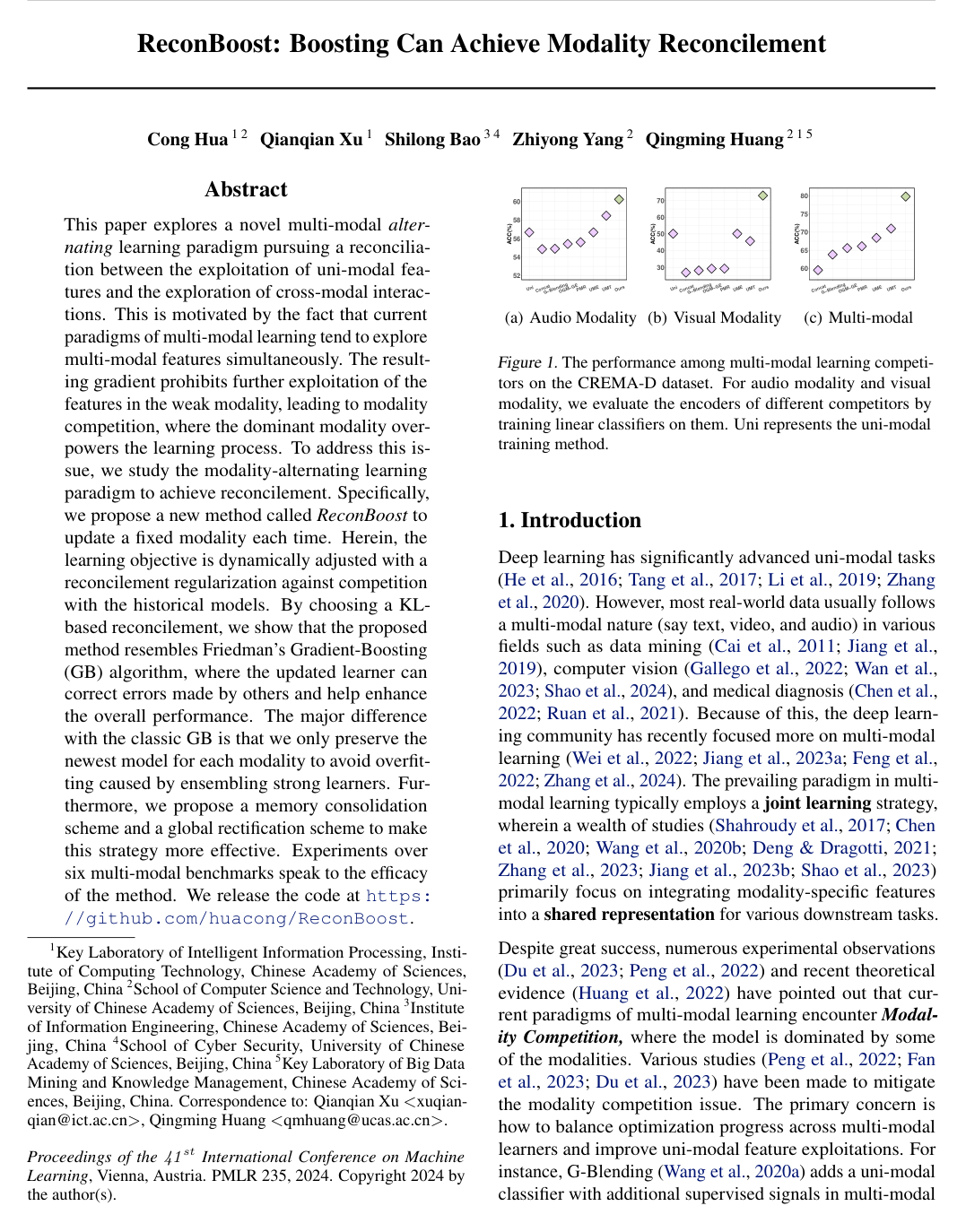
This paper explores a novel multi-modal alternating learning paradigm pursuing a reconciliation between the exploitation of uni-modal features and the exploration of cross-modal interactions. This is motivated by the fact that current paradigms of multi-modal learning tend to explore multi-modal features simultaneously. The resulting gradient prohibits further exploitation of the features in the weak modality, leading to modality competition, where the dominant modality overpowers the learning process. To address this issue, we study the modality-alternating learning paradigm to achieve reconcilement. Specifically, we propose a new method called ReconBoost to update a fixed modality each time. Herein, the learning objective is dynamically adjusted with a reconcilement regularization against competition with the historical models. By choosing a KL-based reconcilement, we show that the proposed method resembles Friedman’s Gradient-Boosting (GB) algorithm, where the updated learner can correct errors made by others and help enhance the overall performance. The major difference with the classic GB is that we only preserve the newest model for each modality to avoid overfitting caused by ensembling strong learners. Furthermore, we propose a memory consolidation scheme and a global rectification scheme to make this strategy more effective. Experiments over six multi-modal benchmarks speak to the efficacy of the method. We release the code at https://github.com/huacong/ReconBoost.

Added

2026-09-26