PermutoSDF: Fast Multi-View Reconstruction with Implicit Surfaces Using Permutohedral Lattices
Radu Alexandru RosuSven Behnke
Proposes a multi-view 3D reconstruction framework that uses permutohedral lattice hash encodings and a specialized regularization scheme to recover fine surface details like pores and wrinkles from RGB images alone while enabling real-time rendering.
Accurately reconstructing high-quality three-dimensional geometry and appearance from multi-view photographs is a core challenge across computer vision, digital mapping, and virtual graphics. While recent neural radiance field techniques render photorealistic views rapidly, they often yield inaccurate surface geometry on untextured or reflective objects. Conversely, implicit surface techniques based on signed distance functions capture better geometry but typically suffer from long computation times and overly smoothed surfaces that erase fine geometric details.
The article demonstrates an implicit surface reconstruction framework called PermutoSDF. The primary objective is to achieve fast, high-fidelity three-dimensional surface reconstruction and real-time novel-view rendering using only standard color images without requiring object masks.
The approach combines implicit surface modeling with a multi-resolution hash encoding based on a permutohedral lattice rather than traditional cubical voxels. Because simplex vertices scale linearly with dimension instead of exponentially, this lattice drastically reduces memory accesses during feature interpolation. The system separates the modeling into two dedicated networks—one for geometry and one for color—and integrates a phased regularization scheme. This scheme initially applies curvature regularization to prevent geometry artifacts in ambiguous regions and subsequently enforces a smoothness constraint on the color network to compel the underlying geometric model to capture fine surface variations.
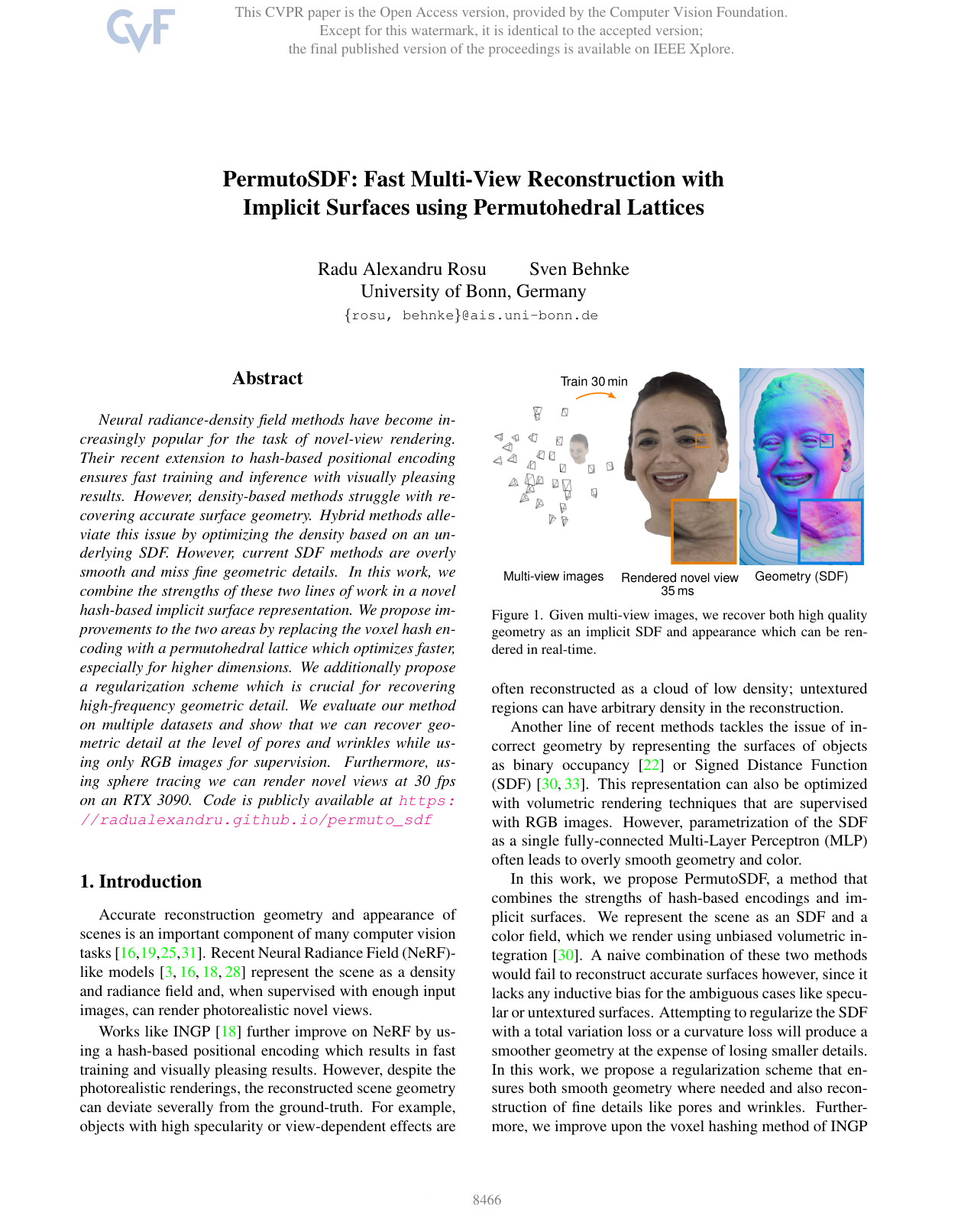
The findings show that the proposed permutohedral lattice accelerates both model training and higher-dimensional inference compared to cubical voxel grids. In quantitative benchmarks on the DTU dataset, the method achieved lower surface error metrics than existing baselines, reducing the mean Chamfer distance to 0.68 without masks compared to 0.84 for NeuS and 1.57 for Instant Neural Graphics Primitives. The system generated higher image fidelity on novel-view synthesis, attaining an average peak signal-to-noise ratio of 33.97 decibels. Qualitative evaluations further demonstrate the framework's ability to recover subtle micro-details such as skin pores and wrinkles while enabling real-time rendering at 30 frames per second on a single commercial graphics processor after approximately 30 minutes of training.
These results establish that organizations can achieve highly detailed, production-grade 3D assets quickly using accessible hardware and standard camera inputs. By eliminating the need for manual foreground masking and cutting training time to half an hour, the framework substantially reduces labor costs and processing overhead for 3D content creation workflows.
Teams developing spatial computing or 3D mapping applications should consider transitioning from cubical voxel hashing to permutohedral lattice representations, particularly when scaling to multi-dimensional data such as spatio-temporal modeling. Practitioners looking to deploy the framework can utilize the public code base to benchmark performance against existing rendering pipelines.
Confidence in the geometric fidelity is high under controlled conditions, though minor limitations persist. The method can struggle with intricate, non-solid geometry such as individual hair strands, and real-world camera artifacts like optical defocus or imperfect color calibration can limit detail extraction relative to ideal synthetic conditions. Additionally, full direct image supervision for four-dimensional dynamic scenes remains an open area requiring further investigation.
- Paper: Instant neural graphics primitives with a multiresolution hash encoding, Thomas Müller et al. (2022). This paper introduces multiresolution hash encodings on regular grids for accelerating neural graphics primitives, which PermutoSDF directly builds upon and adapts to permutohedral lattices.
- Paper: NeuS: Learning Neural Implicit Surfaces by Volume Rendering for Multi-view Reconstruction, Peng Wang et al. (2021). NeuS establishes the foundational volume rendering formulation that maps signed distance functions to density fields for multi-view surface reconstruction without masks, forming the baseline framework accelerated by PermutoSDF.
- Paper: Volume Rendering of Neural Implicit Surfaces, Lior Yariv et al. (2021). VolSDF introduces the theoretical framework for volume rendering of neural implicit surfaces using signed distance functions, underpinning the geometric formulation used in PermutoSDF.
- Paper: DeepSDF: Learning Continuous Signed Distance Functions for Shape Representation, Jeong Joon Park et al. (2019). DeepSDF pioneered the continuous signed distance function representation for 3D shapes, providing the fundamental geometric implicit surface concept utilized throughout PermutoSDF.
- Paper: NeRF: Representing Scenes as Neural Radiance Fields for View Synthesis, Ben Mildenhall et al. (2020). NeRF provides the core differentiable volume rendering foundation from multi-view images that implicit surface reconstruction frameworks adapt for geometry and appearance modeling.
- Paper: Geometry-Consistent Neural Shape Representation with Implicit Displacement Fields, Yifan Wang et al. (2022). This work introduces techniques for recovering fine micro-details in neural implicit surfaces, which PermutoSDF tackles via phased geometric and color regularization.
- Paper: NeuralUDF: Learning Unsigned Distance Fields for Multi-View Reconstruction of Surfaces with Arbitrary Topologies, Xiaoxiao Long et al. (2023). NeuralUDF extends multi-view implicit surface reconstruction beyond the watertight signed distance function assumptions of PermutoSDF by learning unsigned distance fields for open and arbitrary topologies.
- Paper: NeUDF: Leaning Neural Unsigned Distance Fields with Volume Rendering, Yu-Tao Liu et al. (2023). NeUDF builds on multi-view neural volume rendering paradigms to overcome the closed-surface limitation inherent to signed distance representations like PermutoSDF.
- Paper: 2D Gaussian Splatting for Geometrically Accurate Radiance Fields, Binbin Huang et al. (2024). 2D Gaussian Splatting provides an alternative fast surface reconstruction framework that extracts accurate 3D geometry and enables real-time rendering using explicit planar primitives rather than implicit lattice representations.