All in One: Exploring Unified Video-Language Pre-Training
Jinpeng WangYixiao GeRui YanYuying GeKevin Qinghong LinSatoshi TsutsuiXudong LinGuanyu CaiJianping WuYing Shan
Introduces an end-to-end unified video-language framework that processes raw video and text inputs within a single shared transformer backbone via a parameter-free temporal token rolling mechanism, significantly reducing computational cost while matching competitive multi-network models.
Mainstream artificial intelligence systems that connect video and text have grown increasingly complex and resource-intensive. Most standard architectures rely on separate, heavy feature extractors for video and text before combining them in a dedicated fusion network. While effective, this multi-stage approach demands massive computational power, large memory footprints, and slow processing speeds, which creates significant bottlenecks for real-world deployment and large-scale applications.
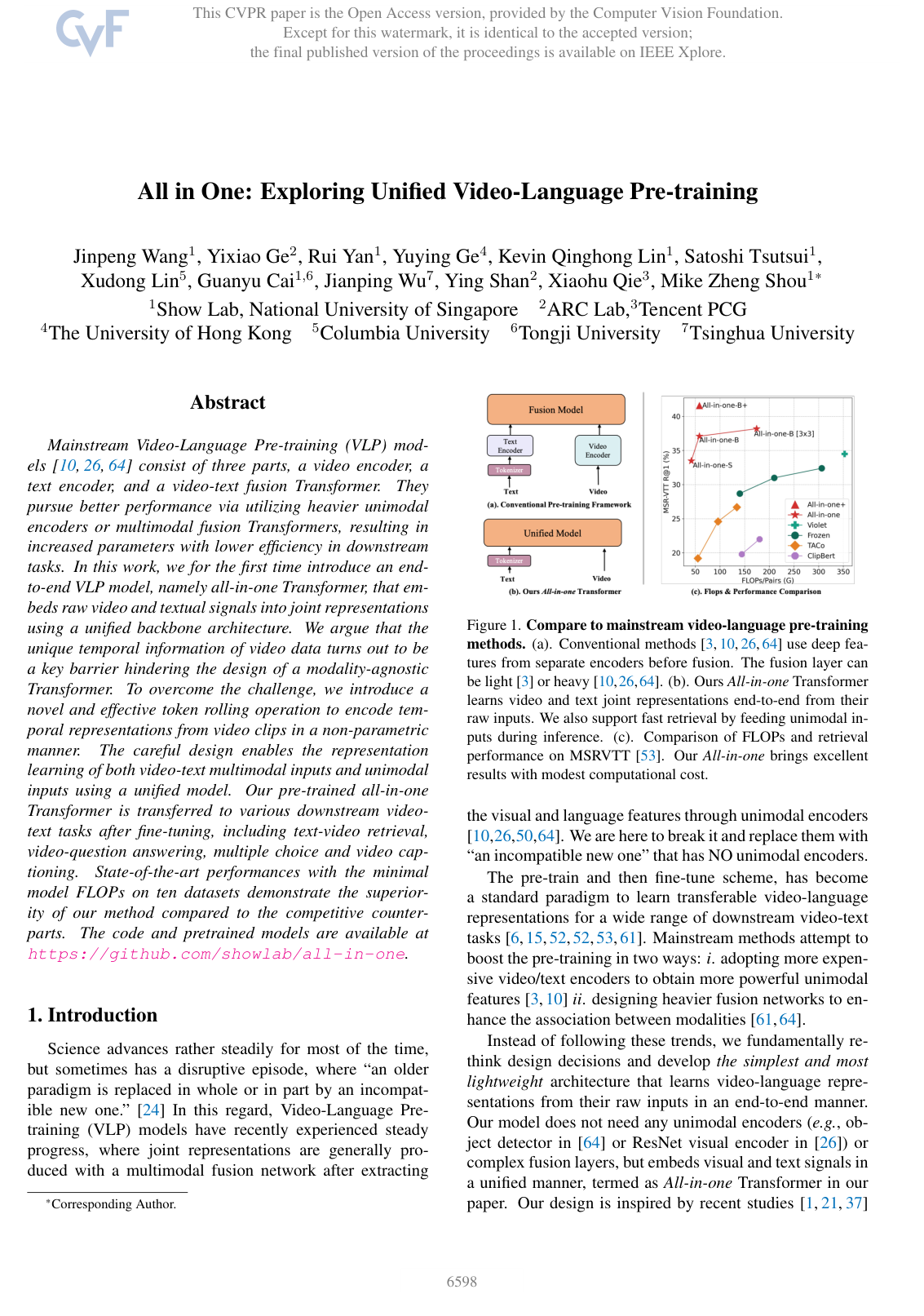
The article introduces and evaluates the All-in-one Transformer, a unified, lightweight framework designed to process raw video pixels and text tokens end-to-end within a single shared neural network. The central objective is to demonstrate that a single, modality-agnostic architecture can achieve state-of-the-art multimodal performance while eliminating the need for dedicated unimodal encoders and complex fusion layers.
To achieve this, the authors developed a parameter-free temporal token rolling technique that exchanges visual information across video frames without adding parameters or computational bloat. Rather than analyzing dozens of frames per video, the approach samples only three frames per clip. The model was pre-trained using standard video-text matching and masked language modeling objectives on large public video and image datasets (including WebVid, HowTo100M, and CC3M) via a balanced co-training strategy. The researchers then evaluated the system across ten benchmark datasets covering video question answering, text-to-video retrieval, multiple-choice reasoning, captioning, and action recognition.
The evaluation produced four primary findings. First, the All-in-one Transformer achieved competitive or state-of-the-art results across downstream tasks while requiring substantially fewer parameters and computational operations—often using less than half the parameters and a fraction of the floating-point operations of leading alternatives. Second, the temporal token rolling module reduced self-attention computational complexity by roughly two-thirds compared to standard flattened token processing while effectively capturing motion cues. Third, on text-to-video retrieval benchmarks such as MSR-VTT, the model achieved a top-1 recall of 41.8%, outperforming specialized multi-component systems. Finally, the unified design successfully supported fast unimodal extraction for retrieval via contrastive learning, reducing matching complexity from multiplicative to additive.
These findings demonstrate that heavyweight unimodal encoders are not essential for high-performance video-language understanding. By unifying modalities in a single backbone, organizations can significantly reduce hardware infrastructure costs, simplify software pipelines, and lower inference latency. This streamlined approach makes multimodal video search and analysis feasible in high-throughput environments where multi-model pipelines are commercially impractical.
Organizations developing or deploying multimodal AI should consider transitioning from fragmented multi-encoder architectures toward unified transformer backbones to capture efficiency and maintenance gains. For future development, engineering teams should evaluate the model on specific domain data and explore extending the architecture to broader single-modality tasks. Further research should focus on refining fine-grained word-region alignment and testing whether performance holds across tasks requiring fine-grained temporal sequence understanding.
- Paper: ViLT: Vision-and-Language Transformer Without Convolution or Region Supervision, Wonjae Kim et al. (2021). ViLT pioneered the convolution-free, patch-based single-stream Transformer architecture for vision-and-language tasks that the source adapts for unified video-language pre-training.
- Paper: Frozen in Time: A Joint Video and Image Encoder for End-to-End Retrieval, Max Bain et al. (2021). Frozen in Time establishes foundational principles and datasets for joint video-and-image pre-training for end-to-end multi-modal retrieval.
- Paper: ViViT: A Video Vision Transformer, Anurag Arnab et al. (2021). ViViT introduces essential spatio-temporal tokenization and factorized Transformer designs for modeling video dynamics with pure self-attention.
- Paper: Is Space-Time Attention All You Need for Video Understanding?, Gedas Bertasius et al. (2021). TimeSformer demonstrates how self-attention architectures alone can effectively capture space-time dynamics across frame sequences.
- Paper: UNITER: UNiversal Image-TExt Representation Learning, Yen-Chun Chen et al. (2020). UNITER establishes the standard multimodal pre-training objectives and cross-modal Transformer representations built upon by subsequent vision-language systems.
- Paper: VisualBERT: A Simple and Performant Baseline for Vision and Language, Liunian Harold Li et al. (2019). VisualBERT introduces the early unified single-stream Transformer paradigm for joint vision-language representation learning.
- Paper: ST-Adapter: Parameter-Efficient Image-to-Video Transfer Learning, Junting Pan et al. (2022). ST-Adapter provides foundational insights into parameter-efficient temporal modeling and transferring image foundation models to dynamic video understanding.
- Paper: SwinBERT: End-to-End Transformers with Sparse Attention for Video Captioning, Kevin Lin et al. (2022). SwinBERT demonstrates end-to-end Transformer modeling from raw video frames to language outputs using sparse attention mechanisms.
- Paper: Video-LaVIT: Unified Video-Language Pre-training with Decoupled Visual-Motional Tokenization, Yang Jin et al. (2024). Video-LaVIT extends unified video-language pre-training by decoupling spatial keyframes and temporal motion tokens for both comprehension and generation.
- Paper: Video-LLaVA: Learning United Visual Representation by Alignment Before Projection, Bin Lin et al. (2023). Video-LLaVA builds upon unified visual-linguistic modeling by aligning image and video representations prior to projecting them into large language models.
- Paper: LLaVA-OneVision: Easy Visual Task Transfer, Bo Li et al. (2024). LLaVA-OneVision generalizes unified multi-modal representations across single-image, multi-image, and video reasoning tasks within an end-to-end framework.
- Paper: Video-LLaMA: An Instruction-tuned Audio-Visual Language Model for Video Understanding, Hang Zhang et al. (2023). Video-LLaMA extends video-language alignment to incorporate auditory streams for conversational instruction tuning.
- Paper: VoP: Text-Video Co-Operative Prompt Tuning for Cross-Modal Retrieval, Siteng Huang et al. (2023). VoP advances downstream adaptation for video-text retrieval by introducing parameter-efficient prompt tuning tailored to dynamic video temporal mechanisms.
- Paper: TimeSuite: Improving MLLMs for Long Video Understanding via Grounded Tuning, Xiangyu Zeng 0004 et al. (2025). TimeSuite enhances video-language models by incorporating token compression and temporal grounding techniques tailored for long-form video comprehension.
- Paper: MVBench: A Comprehensive Multi-modal Video Understanding Benchmark, Kunchang Li et al. (2023). MVBench develops comprehensive evaluation suites and advanced baseline models to benchmark temporal comprehension across multimodal video models.
- Paper: Video-MME: The First-Ever Comprehensive Evaluation Benchmark of Multi-modal LLMs in Video Analysis, Chaoyou Fu et al. (2025). Video-MME provides a broad, multi-duration benchmark to evaluate modern multimodal video-language architectures across varied temporal scenarios.