
keyword
multimodal fusion
Multimodal fusion is the process in machine learning of combining information, signals, or learned feature representations from multiple distinct modalities—such as text, vision, audio, and sensor data—into a unified framework to perform a prediction, classification, or perception task. By synthesizing heterogeneous data streams, multimodal fusion enables models to capture complementary interactions and shared semantic patterns across modalities that cannot be derived from a single data source alone. This integration is typically implemented at various architectural stages, including early fusion of raw data, intermediate fusion where deep neural network representations interact through mechanisms such as cross-modal attention or tensor operations, and late fusion where individual modality predictions are aggregated to reach a final decision.
20 items
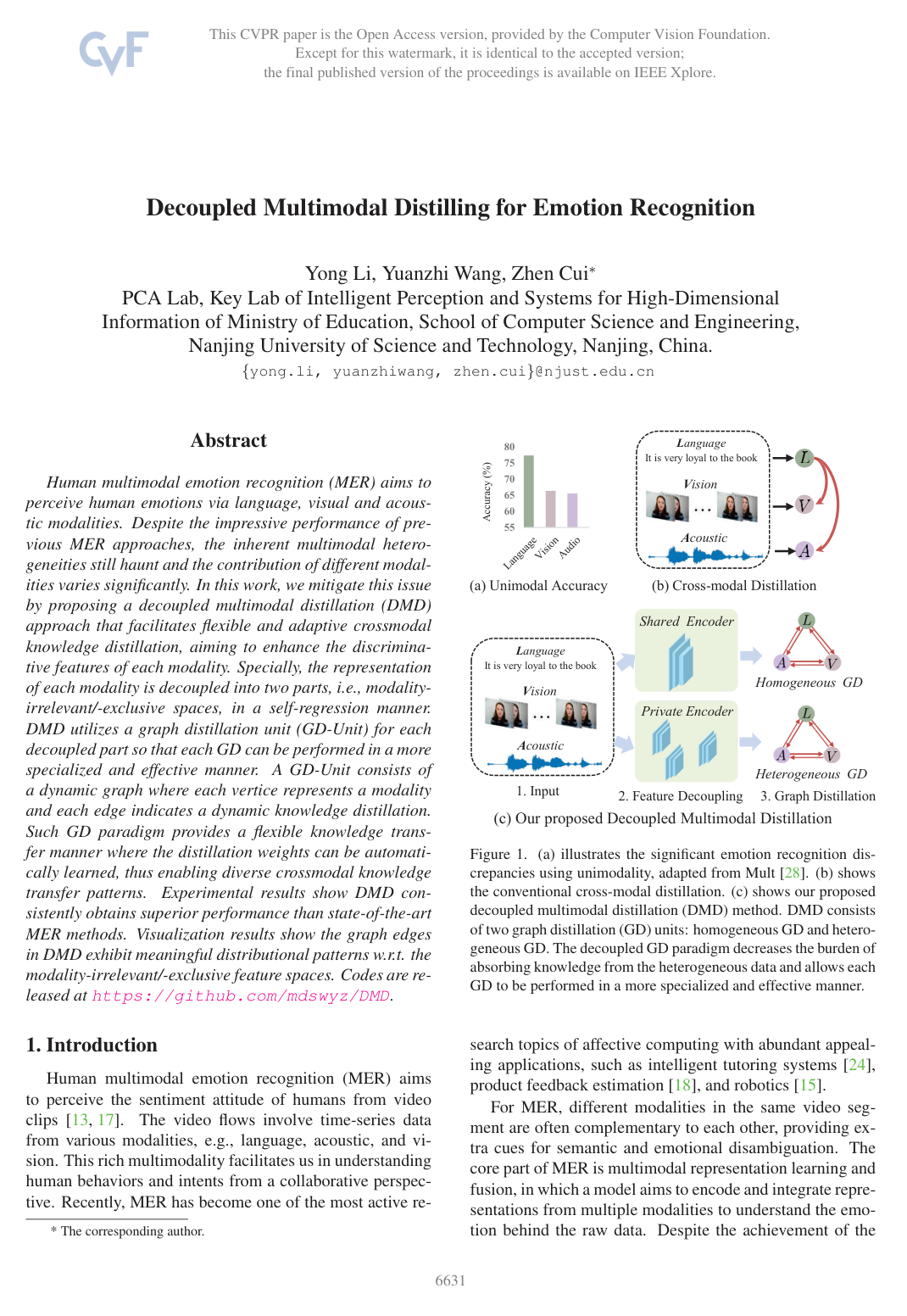
Decoupled Multimodal Distilling for Emotion Recognition
Yong Li, Yuanzhi Wang, Zhen Cui
Why you should read this
Proposes a decoupled multimodal distillation framework that separates representations into shared and modality-exclusive spaces and applies dynamic graph distillation to adaptively transfer knowledge across language, visual, and acoustic streams for more accurate emotion recognition.
Human multimodal emotion recognition (MER) aims to perceive human emotions via language, visual and acoustic modalities. Despite the impressive performance of previous MER approaches, the inherent multimodal heterogeneities still haunt and the contribution of different modalities varies significantly. In this work, we mitigate this issue by proposing a decoupled multimodal distillation (DMD) approach that facilitates flexible and adaptive crossmodal knowledge distillation, aiming to enhance the discriminative features of each modality. Specially, the representation of each modality is decoupled into two parts, i.e., modality-irrelevant/-exclusive spaces, in a self-regression manner. DMD utilizes a graph distillation unit (GD-Unit) for each decoupled part so that each GD can be performed in a more specialized and effective manner. A GD-Unit consists of a dynamic graph where each vertex represents a modality and each edge indicates a dynamic knowledge distillation. Such GD paradigm provides a flexible knowledge transfer manner where the distillation weights can be automatically learned, thus enabling diverse crossmodal knowledge transfer patterns. Experimental results show DMD consistently obtains superior performance than state-of-the-art MER methods. Visualization results show the graph edges in DMD exhibit meaningful distributional patterns w.r.t. the modality-irrelevant/-exclusive feature spaces. Codes are released at https://github.com/mdszwyz/DMD.
Added
2026-10-05
ConFEDE: Contrastive Feature Decomposition for Multimodal Sentiment Analysis
Jiuding Yang, Yakun Yu, Di Niu, Weidong Guo, Yu Xu
Why you should read this
Proposes a multimodal sentiment analysis framework that combines inter-sample contrastive learning with text-centered feature decomposition to isolate shared and modality-specific information, achieving state-of-the-art results across standard video benchmarks.
Multimodal Sentiment Analysis aims to predict the sentiment of video content. Recent research suggests that multimodal sentiment analysis critically depends on learning a good representation of multimodal information, which should contain both modality-invariant representations that are consistent across modalities as well as modality-specific representations. In this paper, we propose ConFEDE, a unified learning framework that jointly performs contrastive representation learning and contrastive feature decomposition to enhance representation of multimodal information. It decomposes each of the three modalities of a video sample, including text, video frames, and audio, into a similarity feature and a dissimilarity feature, which are learned by a contrastive relation centered around text. We conducted extensive experiments on CH-SIMS, MOSI and MOSEI to evaluate various state-of-the-art multimodal sentiment analysis methods. Experimental results show that ConFEDE outperforms all baselines on these datasets on a range of metrics.
Added
2026-10-01
Edge-Aware Guidance Fusion Network for RGB-Thermal Scene Parsing
Wujie Zhou, Shaohua Dong, Caie Xu, Yaguan Qian
Why you should read this
Proposes an edge-aware guidance fusion network that incorporates prior edge maps, specialized cross-modal fusion modules, and multitask deep supervision to significantly improve object boundary localization in RGB-thermal scene parsing.
RGB–thermal scene parsing has recently attracted increasing research interest in the field of computer vision. However, most existing methods fail to perform good boundary extraction for prediction maps and cannot fully use high-level features. In addition, these methods simply fuse the features from RGB and thermal modalities but are unable to obtain comprehensive fused features. To address these problems, we propose an edge-aware guidance fusion network (EGFNet) for RGB–thermal scene parsing. First, we introduce a prior edge map generated using the RGB and thermal images to capture detailed information in the prediction map and then embed the prior edge information in the feature maps. To effectively fuse the RGB and thermal information, we propose a multimodal fusion module that guarantees adequate cross-modal fusion. Considering the importance of high-level semantic information, we propose a global information module and a semantic information module to extract rich semantic information from the high-level features. For decoding, we use simple elementwise addition for cascaded feature fusion. Finally, to improve the parsing accuracy, we apply multitask deep supervision to the semantic and boundary maps. Extensive experiments were performed on benchmark datasets to demonstrate the effectiveness of the proposed EGFNet and its superior performance compared with state-of-the-art methods. The code and results can be found at https://github.com/ShaohuaDong2021/EGFNet.
Added
2026-09-26
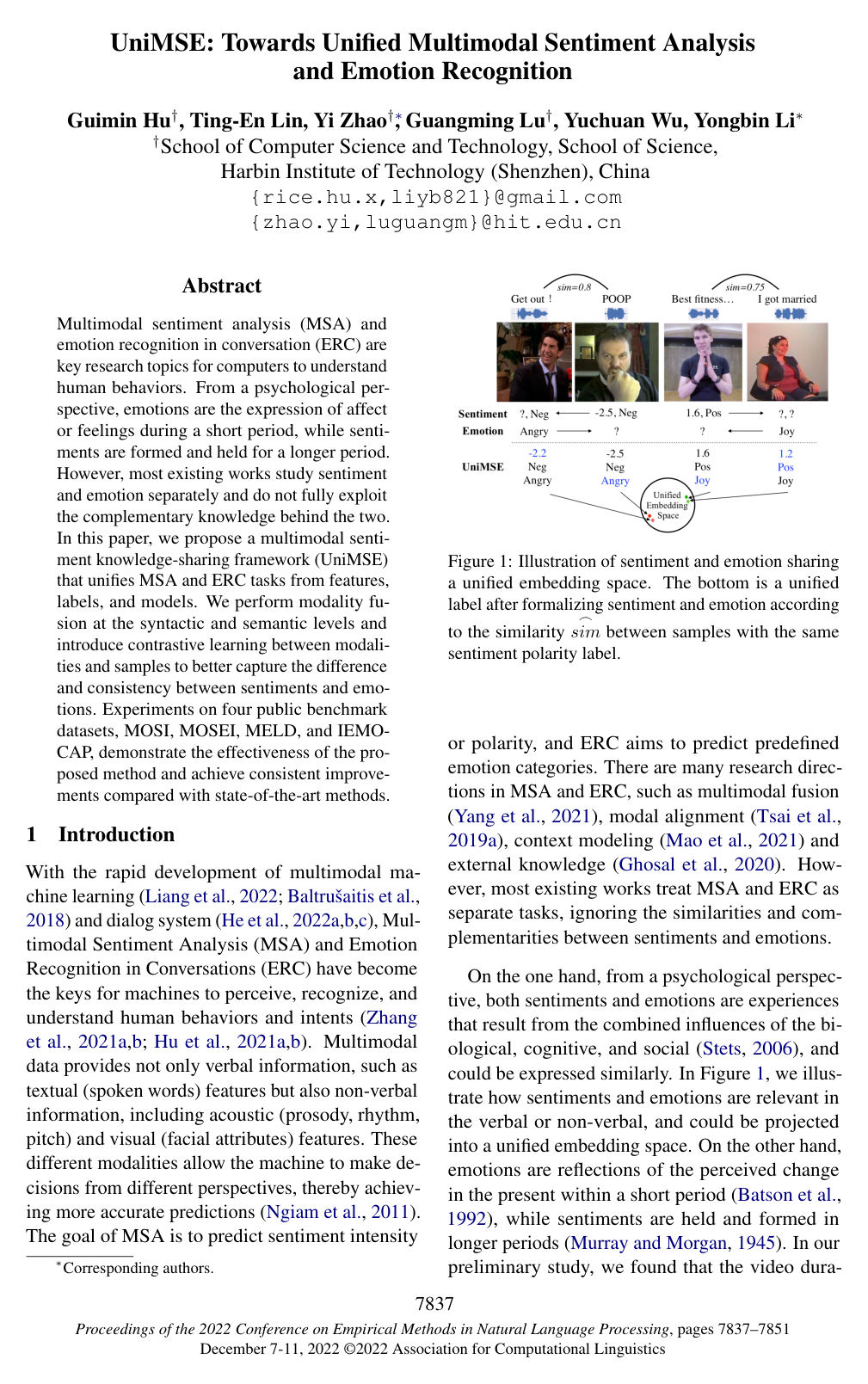
UniMSE: Towards Unified Multimodal Sentiment Analysis and Emotion Recognition
Guimin Hu, Ting-En Lin, Yi Zhao, Guangming Lu, Yuchuan Wu, Yongbin Li
Why you should read this
Proposes UniMSE, a generative framework that unifies multimodal sentiment analysis and emotion recognition in conversation by combining label spaces, integrating acoustic and visual signals directly into a T5 backbone, and applying inter-modality contrastive learning.
Multimodal sentiment analysis (MSA) and emotion recognition in conversation (ERC) are key research topics for computers to understand human behaviors. From a psychological perspective, emotions are the expression of affect or feelings during a short period, while sentiments are formed and held for a longer period. However, most existing works study sentiment and emotion separately and do not fully exploit the complementary knowledge behind the two. In this paper, we propose a multimodal sentiment knowledge-sharing framework (UniMSE) that unifies MSA and ERC tasks from features, labels, and models. We perform modality fusion at the syntactic and semantic levels and introduce contrastive learning between modalities and samples to better capture the difference and consistency between sentiments and emotions. Experiments on four public benchmark datasets, MOSI, MOSEI, MELD, and IEMOCAP, demonstrate the effectiveness of the proposed method and achieve consistent improvements compared with state-of-the-art methods.
Added
2026-09-26
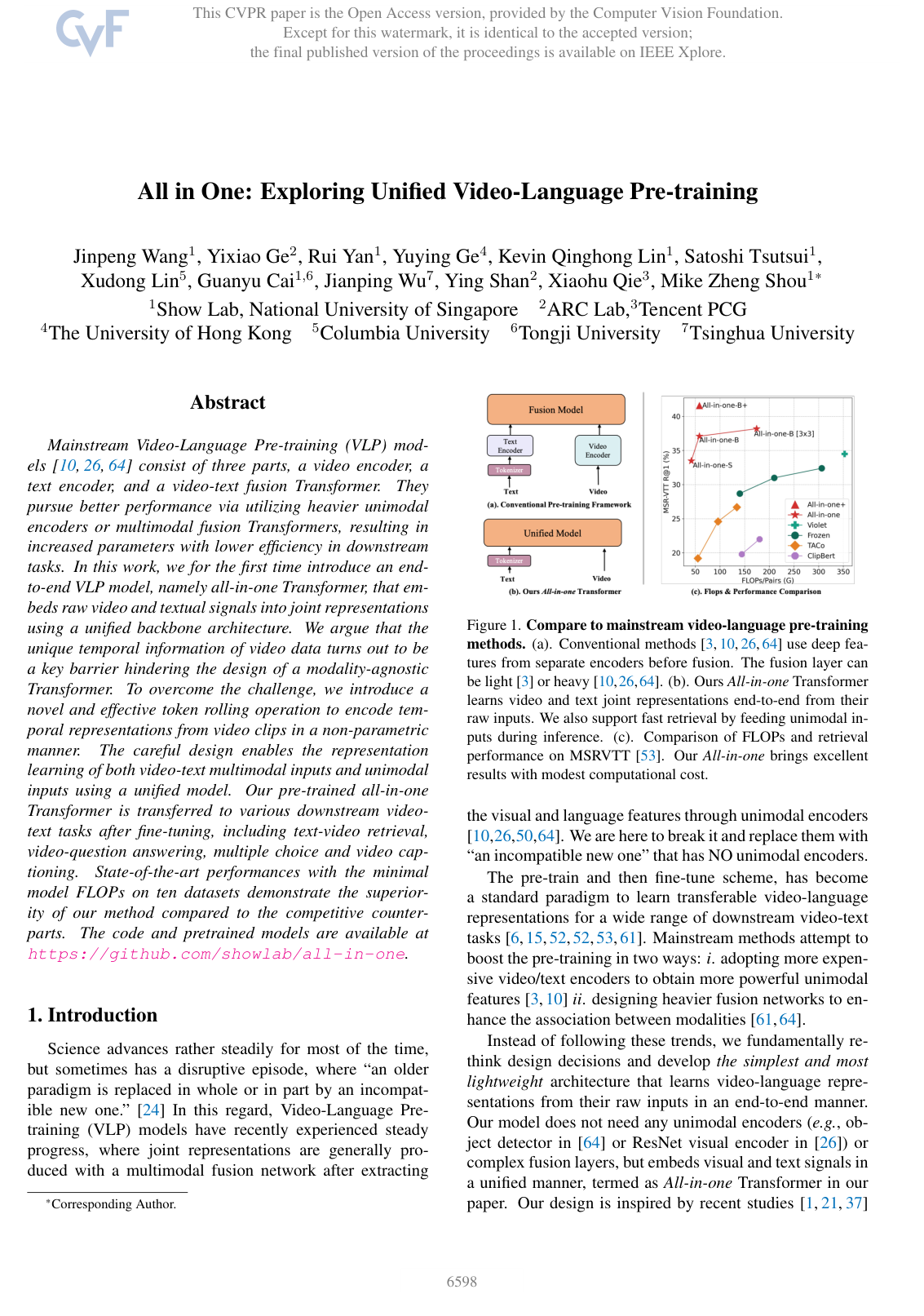
All in One: Exploring Unified Video-Language Pre-Training
Jinpeng Wang, Yixiao Ge, Rui Yan, Yuying Ge, Kevin Qinghong Lin, Satoshi Tsutsui, Xudong Lin, Guanyu Cai, Jianping Wu, Ying Shan, Xiaohu Qie, Mike Zheng Shou
Why you should read this
Introduces an end-to-end unified video-language framework that processes raw video and text inputs within a single shared transformer backbone via a parameter-free temporal token rolling mechanism, significantly reducing computational cost while matching competitive multi-network models.
Mainstream Video-Language Pre-training (VLP) models [10, 26, 64] consist of three parts, a video encoder, a text encoder, and a video-text fusion Transformer. They pursue better performance via utilizing heavier unimodal encoders or multimodal fusion Transformers, resulting in increased parameters with lower efficiency in downstream tasks. In this work, we for the first time introduce an end-to-end VLP model, namely all-in-one Transformer, that embeds raw video and textual signals into joint representations using a unified backbone architecture. We argue that the unique temporal information of video data turns out to be a key barrier hindering the design of a modality-agnostic Transformer. To overcome the challenge, we introduce a novel and effective token rolling operation to encode temporal representations from video clips in a non-parametric manner. The careful design enables the representation learning of both video-text multimodal inputs and unimodal inputs using a unified model. Our pre-trained all-in-one Transformer is transferred to various downstream video-text tasks after fine-tuning, including text-video retrieval, video-question answering, multiple choice and video captioning. State-of-the-art performances with the minimal model FLOPs on ten datasets demonstrate the superiority of our method compared to the competitive counterparts. The code and pretrained models are available at https://github.com/showlab/all-in-one.
Added
2026-09-26
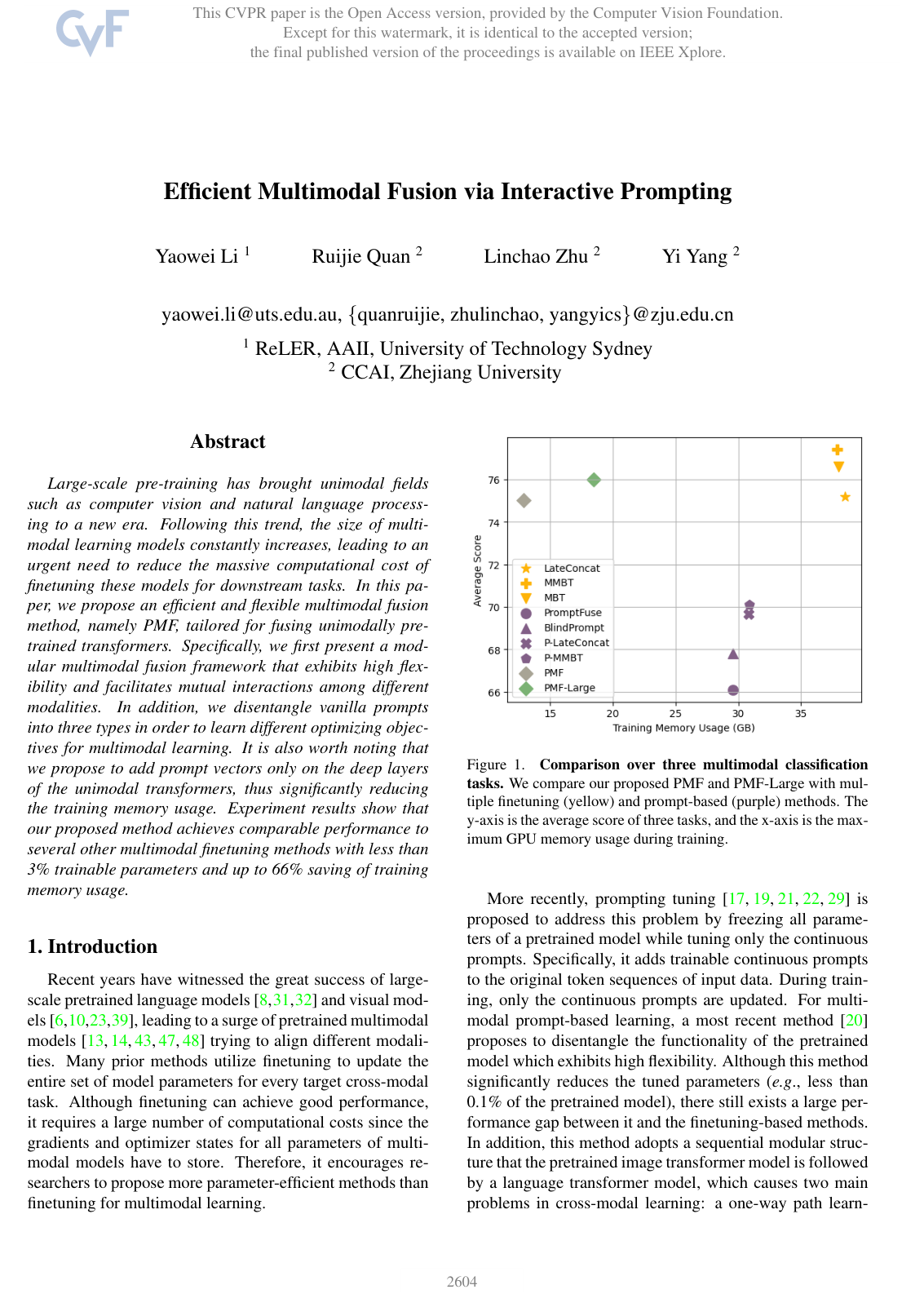
Efficient Multimodal Fusion via Interactive Prompting
Yaowei Li, Ruijie Quan, Linchao Zhu, Yi Yang
Why you should read this
Proposes a parameter- and memory-efficient multimodal fusion framework that uses interactive deep-layer prompts across frozen unimodal transformers, matching full fine-tuning performance while cutting training memory usage by up to 66% and updating fewer than 3% of parameters.
Large-scale pre-training has brought unimodal fields such as computer vision and natural language processing to a new era. Following this trend, the size of multimodal learning models constantly increases, leading to an urgent need to reduce the massive computational cost of finetuning these models for downstream tasks. In this paper, we propose an efficient and flexible multimodal fusion method, namely PMF, tailored for fusing unimodally pretrained transformers. Specifically, we first present a modular multimodal fusion framework that exhibits high flexibility and facilitates mutual interactions among different modalities. In addition, we disentangle vanilla prompts into three types in order to learn different optimizing objectives for multimodal learning. It is also worth noting that we propose to add prompt vectors only on the deep layers of the unimodal transformers, thus significantly reducing the training memory usage. Experiment results show that our proposed method achieves comparable performance to several other multimodal finetuning methods with less than 3% trainable parameters and up to 66% saving of training memory usage.
Added
2026-09-26
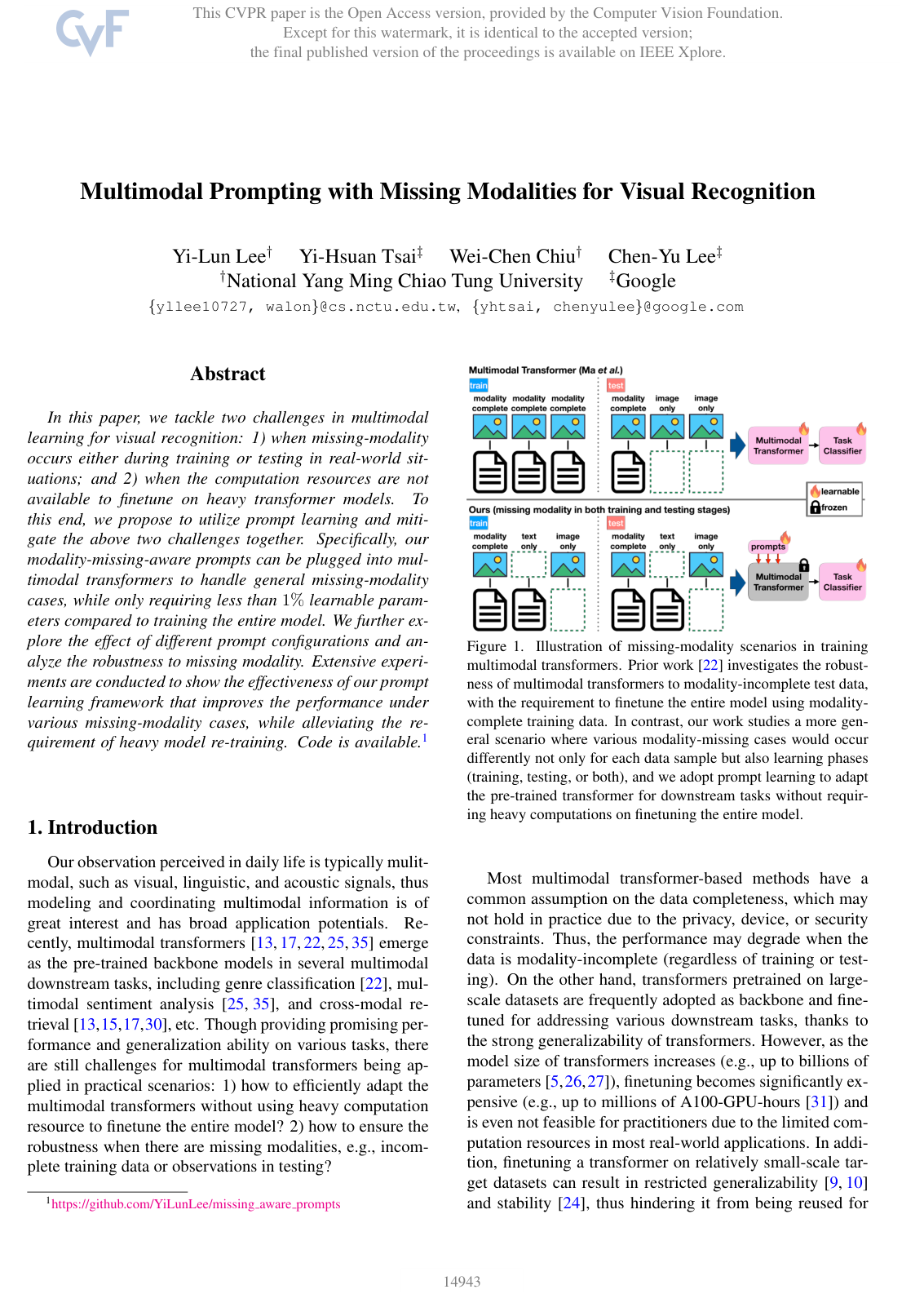
Multimodal Prompting with Missing Modalities for Visual Recognition
Yi-Lun Lee, Yi-Hsuan Tsai, Wei-Chen Chiu, Chen-Yu Lee
Why you should read this
Proposes a parameter-efficient prompt learning framework that adapts frozen multimodal transformers to arbitrary missing-modality scenarios in training or testing by tuning less than 1% of the model's parameters.
In this paper, we tackle two challenges in multimodal learning for visual recognition: 1) when missing-modality occurs either during training or testing in real-world situations; and 2) when the computation resources are not available to finetune on heavy transformer models. To this end, we propose to utilize prompt learning and mitigate the above two challenges together. Specifically, our modality-missing-aware prompts can be plugged into multimodal transformers to handle general missing-modality cases, while only requiring less than 1% learnable parameters compared to training the entire model. We further explore the effect of different prompt configurations and analyze the robustness to missing modality. Extensive experiments are conducted to show the effectiveness of our prompt learning framework that improves the performance under various missing-modality cases, while alleviating the requirement of heavy model re-training. Code is available.1
Added
2026-09-26
AV-NeRF: Learning Neural Fields for Real-World Audio-Visual Scene Synthesis
Susan Liang, Chao Huang, Yapeng Tian, Anurag Kumar, Chenliang Xu
Why you should read this
Presents a multimodal Neural Radiance Field framework that synthesizes synchronized novel-view video frames and binaural spatial audio along arbitrary camera trajectories by integrating sound propagation physics and 3D visual geometry.
Can machines recording an audio-visual scene produce realistic, matching audio-visual experiences at novel positions and novel view directions? We answer it by studying a new task—real-world audio-visual scene synthesis—and a first-of-its-kind NeRF-based approach for multimodal learning. Concretely, given a video recording of an audio-visual scene, the task is to synthesize new videos with spatial audios along arbitrary novel camera trajectories in that scene. We propose an acoustic-aware audio generation module that integrates prior knowledge of audio propagation into NeRF, in which we implicitly associate audio generation with the 3D geometry and material properties of a visual environment. Furthermore, we present a coordinate transformation module that expresses a view direction relative to the sound source, enabling the model to learn sound source-centric acoustic fields. To facilitate the study of this new task, we collect a high-quality Real-World Audio-Visual Scene (RWAVS) dataset. We demonstrate the advantages of our method on this real-world dataset and the simulation-based SoundSpaces dataset. We recommend that readers visit our project page for convincing comparisons: https://liangsusan-git.github.io/project/avnerf/.
Added
2026-09-26
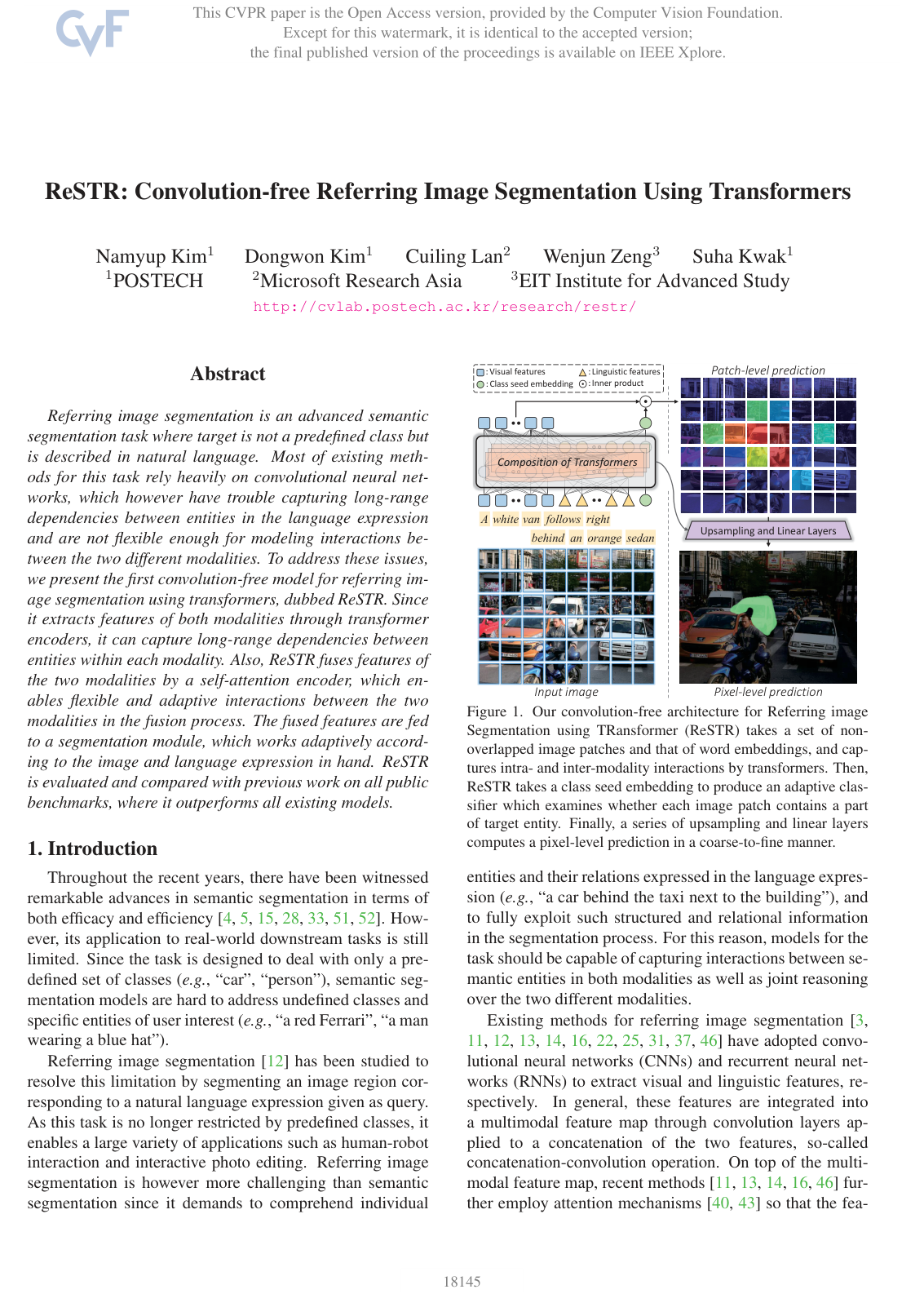
ReSTR: Convolution-free Referring Image Segmentation Using Transformers
Namyup Kim, Dongwon Kim, Suha Kwak, Cuiling Lan, Wenjun Zeng
Why you should read this
Proposes ReSTR, the first purely transformer-based, convolution-free model for referring image segmentation that unifies vision and language processing through self-attention to capture long-range cross-modal dependencies and achieve state-of-the-art performance across major benchmarks.
Referring image segmentation is an advanced semantic segmentation task where target is not a predefined class but is described in natural language. Most of existing methods for this task rely heavily on convolutional neural networks, which however have trouble capturing long-range dependencies between entities in the language expression and are not flexible enough for modeling interactions between the two different modalities. To address these issues, we present the first convolution-free model for referring image segmentation using transformers, dubbed ReSTR. Since it extracts features of both modalities through transformer encoders, it can capture long-range dependencies between entities within each modality. Also, ReSTR fuses features of the two modalities by a self-attention encoder, which enables flexible and adaptive interactions between the two modalities in the fusion process. The fused features are fed to a segmentation module, which works adaptively according to the image and language expression in hand. ReSTR is evaluated and compared with previous work on all public benchmarks, where it outperforms all existing models.
Added
2026-09-26
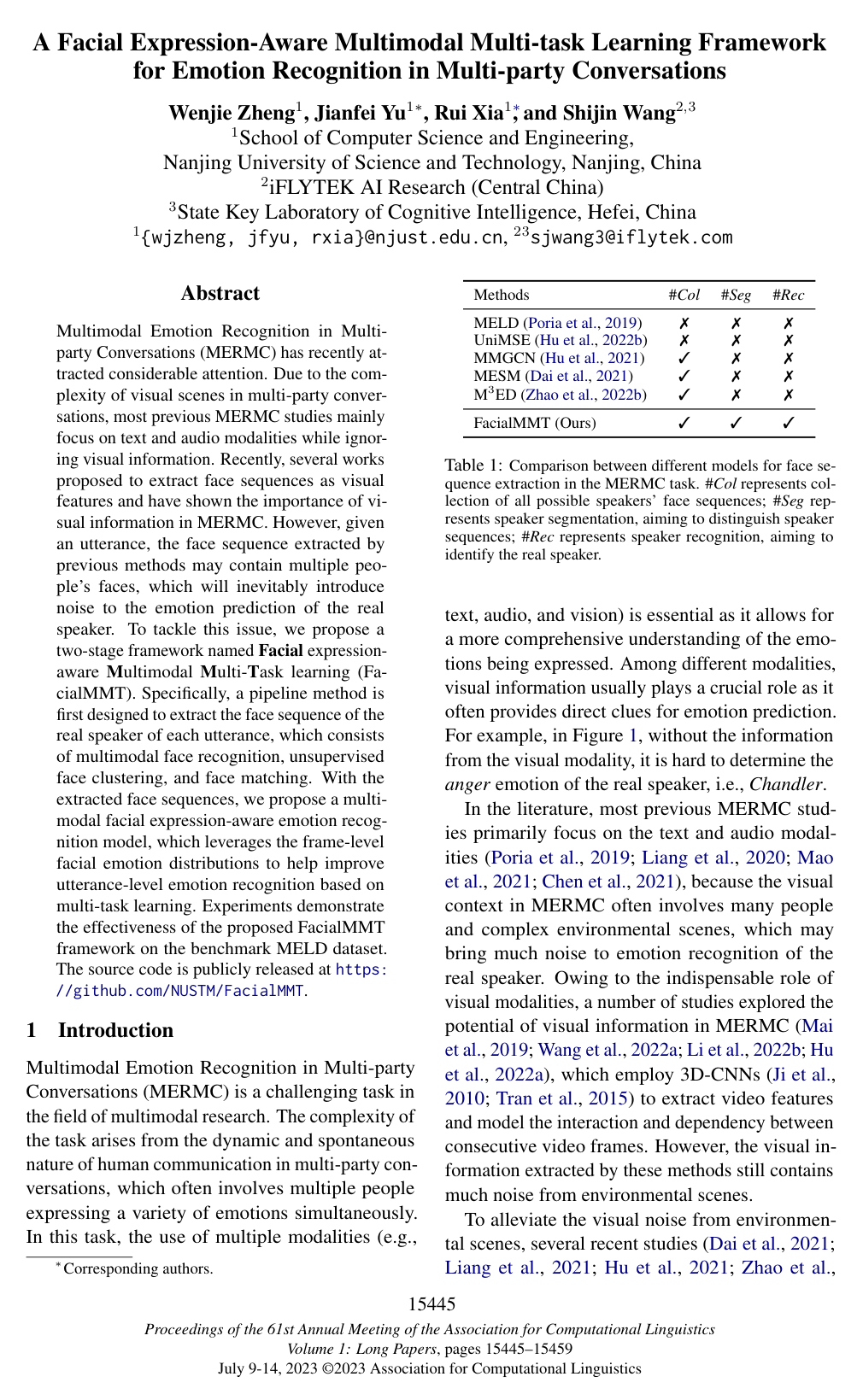
A Facial Expression-Aware Multimodal Multi-task Learning Framework for Emotion Recognition in Multi-party Conversations
Wenjie Zheng, Jianfei Yu, Rui Xia, Shijin Wang
Why you should read this
Proposes a two-stage multimodal framework that isolates the true speaker's face sequence from complex multi-party video scenes to accurately guide conversational emotion recognition via multi-task learning.
Multimodal Emotion Recognition in Multi-party Conversations (MERMC) has recently attracted considerable attention. Due to the complexity of visual scenes in multi-party conversations, most previous MERMC studies mainly focus on text and audio modalities while ignoring visual information. Recently, several works proposed to extract face sequences as visual features and have shown the importance of visual information in MERMC. However, given an utterance, the face sequence extracted by previous methods may contain multiple people’s faces, which will inevitably introduce noise to the emotion prediction of the real speaker. To tackle this issue, we propose a two-stage framework named Facial expression-aware Multimodal Multi-Task learning (FacialMMT). Specifically, a pipeline method is first designed to extract the face sequence of the real speaker of each utterance, which consists of multimodal face recognition, unsupervised face clustering, and face matching. With the extracted face sequences, we propose a multimodal facial expression-aware emotion recognition model, which leverages the frame-level facial emotion distributions to help improve utterance-level emotion recognition based on multi-task learning. Experiments demonstrate the effectiveness of the proposed FacialMMT framework on the benchmark MELD dataset. The source code is publicly released at https://github.com/NUSTM/FacialMMT.
Added
2026-09-26
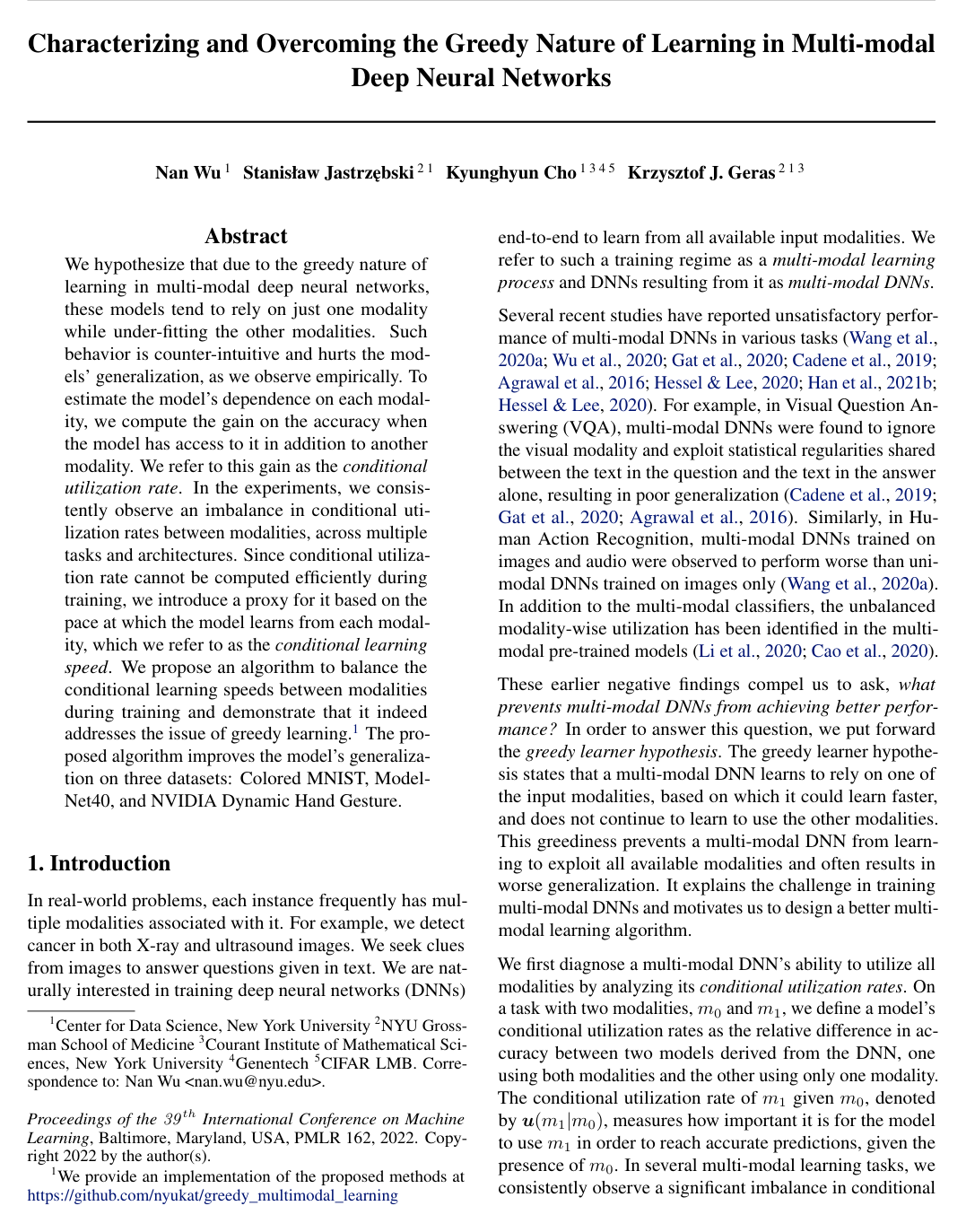
Characterizing and Overcoming the Greedy Nature of Learning in Multi-modal Deep Neural Networks
Nan Wu, Stanislaw Jastrzebski, Kyunghyun Cho, Krzysztof J. Geras
Why you should read this
Explains why multi-modal neural networks often over-rely on a single modality and introduces a training algorithm that balances learning speeds across modalities to improve overall generalization.
We hypothesize that due to the greedy nature of learning in multi-modal deep neural networks, these models tend to rely on just one modality while under-fitting the other modalities. Such behavior is counter-intuitive and hurts the models’ generalization, as we observe empirically. To estimate the model’s dependence on each modality, we compute the gain on the accuracy when the model has access to it in addition to another modality. We refer to this gain as the conditional utilization rate. In the experiments, we consistently observe an imbalance in conditional utilization rates between modalities, across multiple tasks and architectures. Since conditional utilization rate cannot be computed efficiently during training, we introduce a proxy for it based on the pace at which the model learns from each modality, which we refer to as the conditional learning speed. We propose an algorithm to balance the conditional learning speeds between modalities during training and demonstrate that it indeed addresses the issue of greedy learning.1 The proposed algorithm improves the model’s generalization on three datasets: Colored MNIST, ModelNet40, and NVIDIA Dynamic Hand Gesture.
Added
2026-09-26
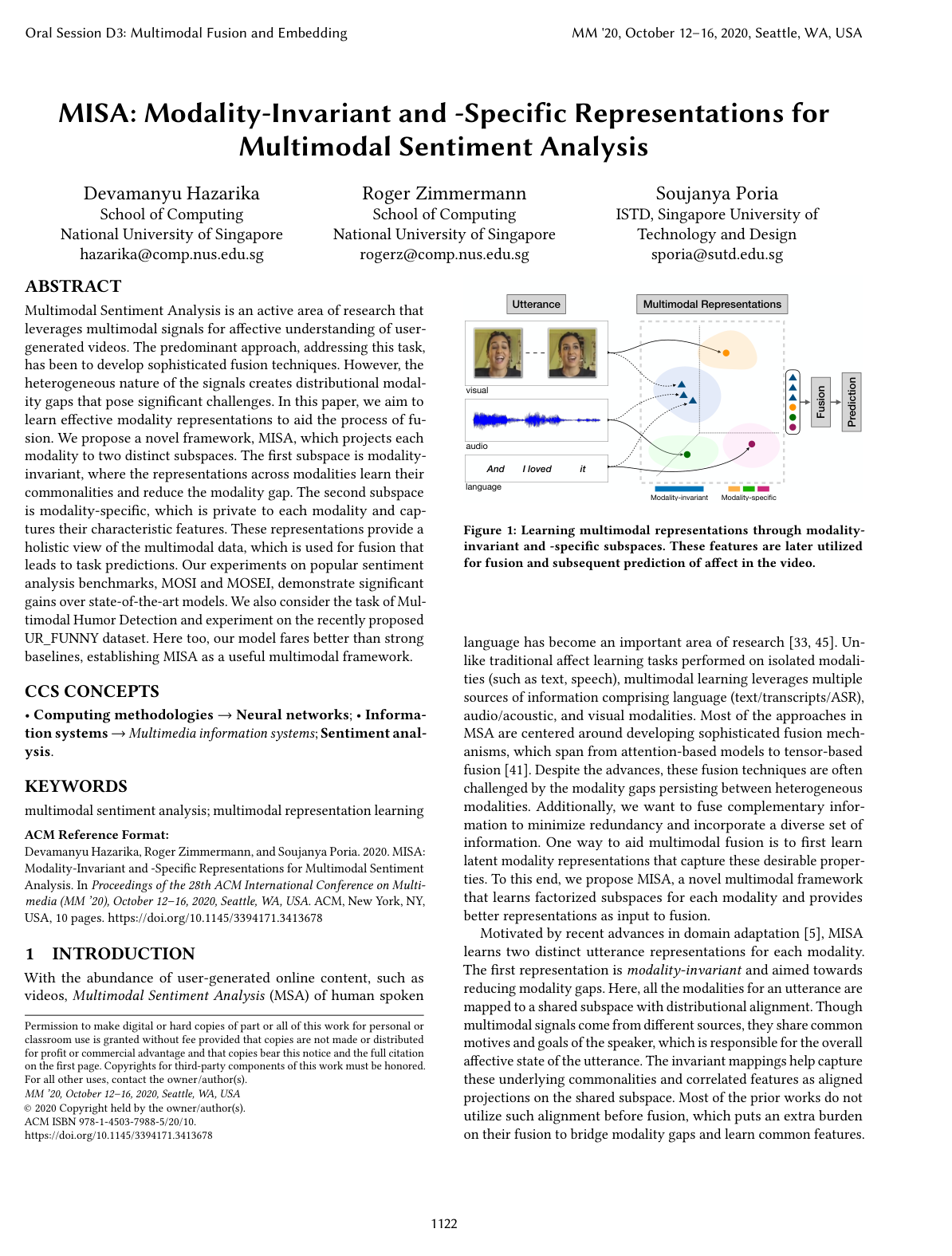
MISA: Modality-Invariant and -Specific Representations for Multimodal Sentiment Analysis
Devamanyu Hazarika, Roger Zimmermann, Soujanya Poria
Why you should read this
Proposes a multimodal representation framework, MISA, that factorizes signals into invariant and modality-specific subspaces, effectively resolving heterogeneous modality gaps to achieve state-of-the-art performance in sentiment analysis and humor detection.
Multimodal Sentiment Analysis is an active area of research that leverages multimodal signals for affective understanding of user-generated videos. The predominant approach, addressing this task, has been to develop sophisticated fusion techniques. However, the heterogeneous nature of the signals creates distributional modality gaps that pose significant challenges. In this paper, we aim to learn effective modality representations to aid the process of fusion. We propose a novel framework, MISA, which projects each modality to two distinct subspaces. The first subspace is modality-invariant, where the representations across modalities learn their commonalities and reduce the modality gap. The second subspace is modality-specific, which is private to each modality and captures their characteristic features. These representations provide a holistic view of the multimodal data, which is used for fusion that leads to task predictions. Our experiments on popular sentiment analysis benchmarks, MOSI and MOSEI, demonstrate significant gains over state-of-the-art models. We also consider the task of Multimodal Humor Detection and experiment on the recently proposed UR_FUNNY dataset. Here too, our model fares better than strong baselines, establishing MISA as a useful multimodal framework.
Added
2026-09-25
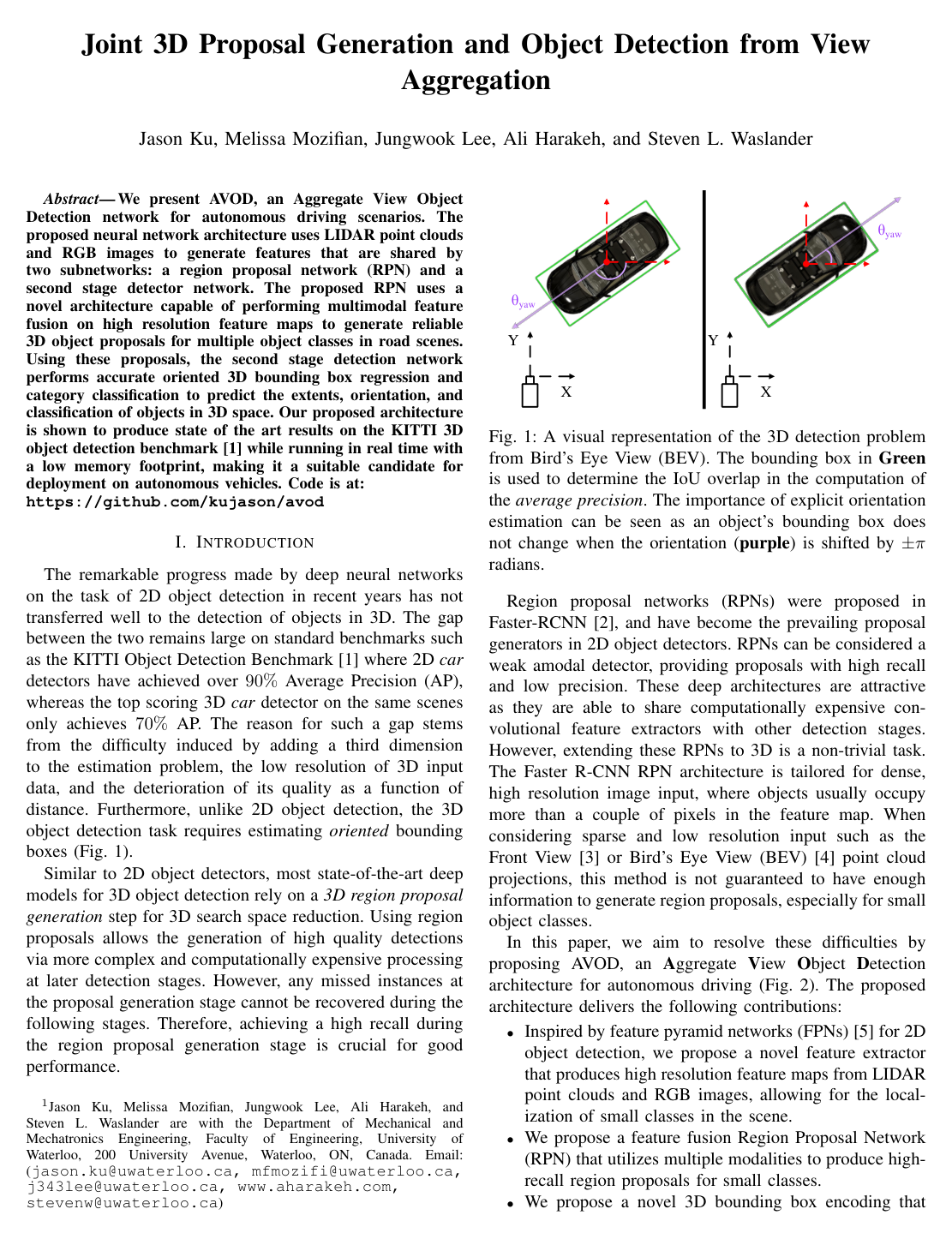
Joint 3D Proposal Generation and Object Detection from View Aggregation
Jason Ku, Melissa Mozifian, Jungwook Lee, Ali Harakeh, Steven L. Waslander
Why you should read this
Introduces AVOD, a real-time neural network that fuses high-resolution LiDAR and RGB features across shared proposal and detection stages to achieve accurate 3D bounding box estimation for autonomous driving.
We present AVOD, an Aggregate View Object Detection network for autonomous driving scenarios. The proposed neural network architecture uses LIDAR point clouds and RGB images to generate features that are shared by two subnetworks: a region proposal network (RPN) and a second stage detector network. The proposed RPN uses a novel architecture capable of performing multimodal feature fusion on high resolution feature maps to generate reliable 3D object proposals for multiple object classes in road scenes. Using these proposals, the second stage detection network performs accurate oriented 3D bounding box regression and category classification to predict the extents, orientation, and classification of objects in 3D space. Our proposed architecture is shown to produce state of the art results on the KITTI 3D object detection benchmark while running in real time with a low memory footprint, making it a suitable candidate for deployment on autonomous vehicles. Code is at: this https URL
Added
2026-09-24
MELD: A Multimodal Multi-Party Dataset for Emotion Recognition in Conversations
Soujanya Poria, Devamanyu Hazarika, Navonil Majumder, Gautam Naik, Erik Cambria, Rada Mihalcea
Why you should read this
Introduces MELD, a large-scale benchmark containing over 13,000 text, audio, and visual utterances designed to advance emotion and sentiment recognition in multi-party conversations.
Emotion recognition in conversations is a challenging task that has recently gained popularity due to its potential applications. Until now, however, a large-scale multimodal multi-party emotional conversational database containing more than two speakers per dialogue was missing. Thus, we propose the Multimodal EmotionLines Dataset (MELD), an extension and enhancement of EmotionLines. MELD contains about 13,000 utterances from 1,433 dialogues from the TV-series Friends. Each utterance is annotated with emotion and sentiment labels, and encompasses audio, visual and textual modalities. We propose several strong multimodal baselines and show the importance of contextual and multimodal information for emotion recognition in conversations. The full dataset is available for use at http:// this http URL.
Added
2026-09-24
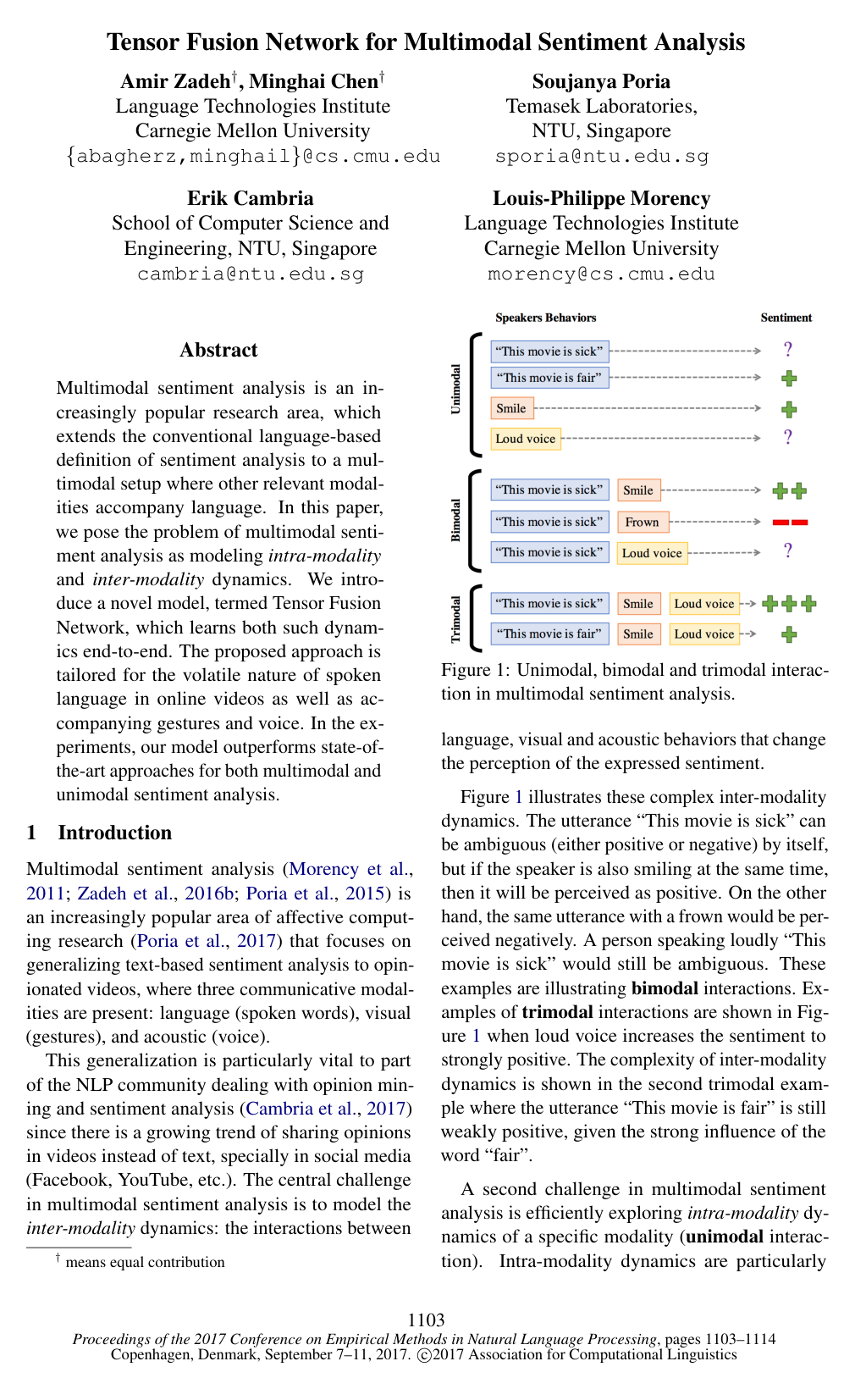
Tensor Fusion Network for Multimodal Sentiment Analysis
Amir Zadeh, Minghai Chen, Soujanya Poria, Erik Cambria, Louis-Philippe Morency
Why you should read this
Introduces the Tensor Fusion Network, an end-to-end model that integrates intra-modality and inter-modality dynamics across language, acoustic, and visual streams to advance multimodal sentiment analysis.
Multimodal sentiment analysis is an increasingly popular research area, which extends the conventional language-based definition of sentiment analysis to a multimodal setup where other relevant modalities accompany language. In this paper, we pose the problem of multimodal sentiment analysis as modeling intra-modality and inter-modality dynamics. We introduce a novel model, termed Tensor Fusion Network, which learns both such dynamics end-to-end. The proposed approach is tailored for the volatile nature of spoken language in online videos as well as accompanying gestures and voice. In the experiments, our model outperforms state-of-the-art approaches for both multimodal and unimodal sentiment analysis.
Added
2026-09-18
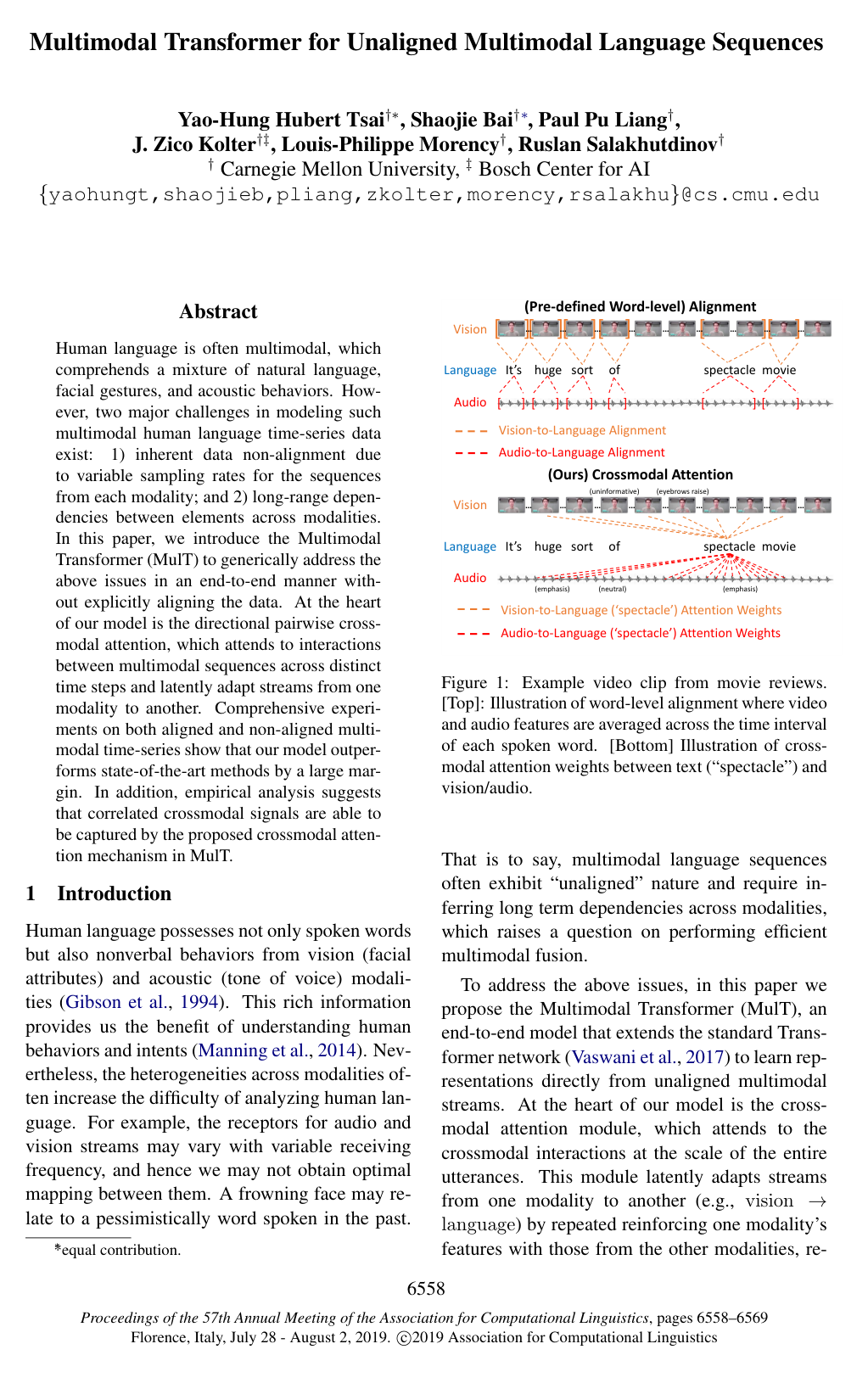
Multimodal Transformer for Unaligned Multimodal Language Sequences
Yao-Hung Hubert Tsai, Shaojie Bai, Paul Pu Liang, J. Zico Kolter, Louis-Philippe Morency, Ruslan Salakhutdinov
Why you should read this
Introduces the Multimodal Transformer to model asynchronous language, audio, and visual streams end-to-end via directional crossmodal attention without requiring explicit word-level alignment preprocessing.
Human language is often multimodal, which comprehends a mixture of natural language, facial gestures, and acoustic behaviors. However, two major challenges in modeling such multimodal human language time-series data exist: 1) inherent data non-alignment due to variable sampling rates for the sequences from each modality; and 2) long-range dependencies between elements across modalities. In this paper, we introduce the Multimodal Transformer (MulT) to generically address the above issues in an end-to-end manner without explicitly aligning the data. At the heart of our model is the directional pairwise crossmodal attention, which attends to interactions between multimodal sequences across distinct time steps and latently adapt streams from one modality to another. Comprehensive experiments on both aligned and non-aligned multimodal time-series show that our model outperforms state-of-the-art methods by a large margin. In addition, empirical analysis suggests that correlated crossmodal signals are able to be captured by the proposed crossmodal attention mechanism in MulT.
Added
2026-09-15
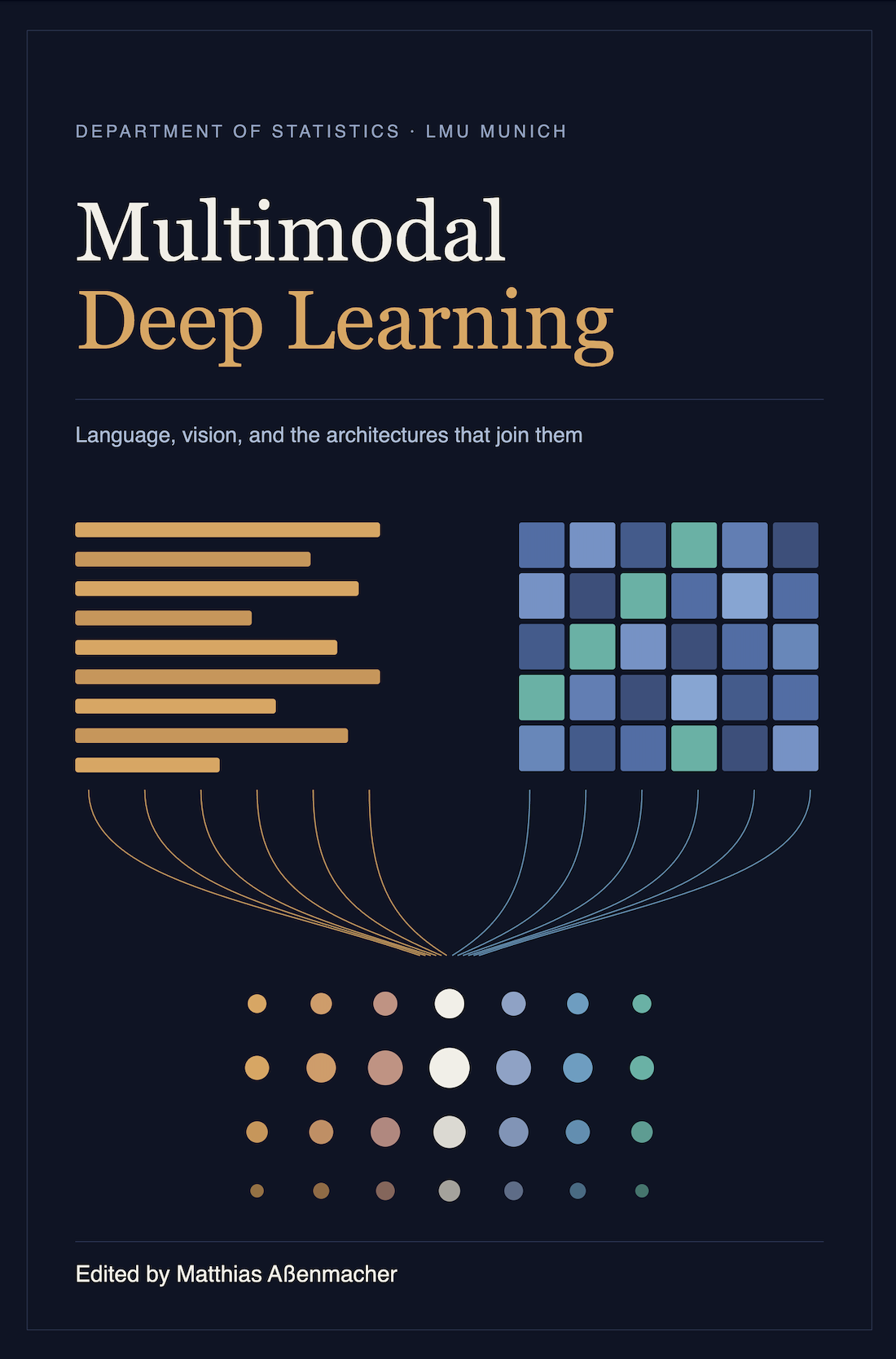
Multimodal Deep Learning
Cem Akkus, Luyang Chu, Vladana Djakovic, Steffen Jauch-Walser, Philipp Koch, Giacomo Loss, Christopher Marquardt, Marco Moldovan, Nadja Sauter, Maximilian Schneider, Rickmer Schulte, Karol Urbanczyk, Jann Goschenhofer, Christian Heumann, Rasmus Hvingelby, Daniel Schalk, Matthias Aßenmacher
This book is the result of a seminar in which we reviewed multimodal approaches and attempted to create a solid overview of the field, starting with the current state-of-the-art approaches in the two subfields of Deep Learning individually. Further, modeling frameworks are discussed where one modality is transformed into the other, as well as models in which one modality is utilized to enhance representation learning for the other. To conclude the second part, architectures with a focus on handling both modalities simultaneously are introduced. Finally, we also cover other modalities as well as general-purpose multi-modal models, which are able to handle different tasks on different modalities within one unified architecture. One interesting application (Generative Art) eventually caps off this booklet.
Added
2026-09-12

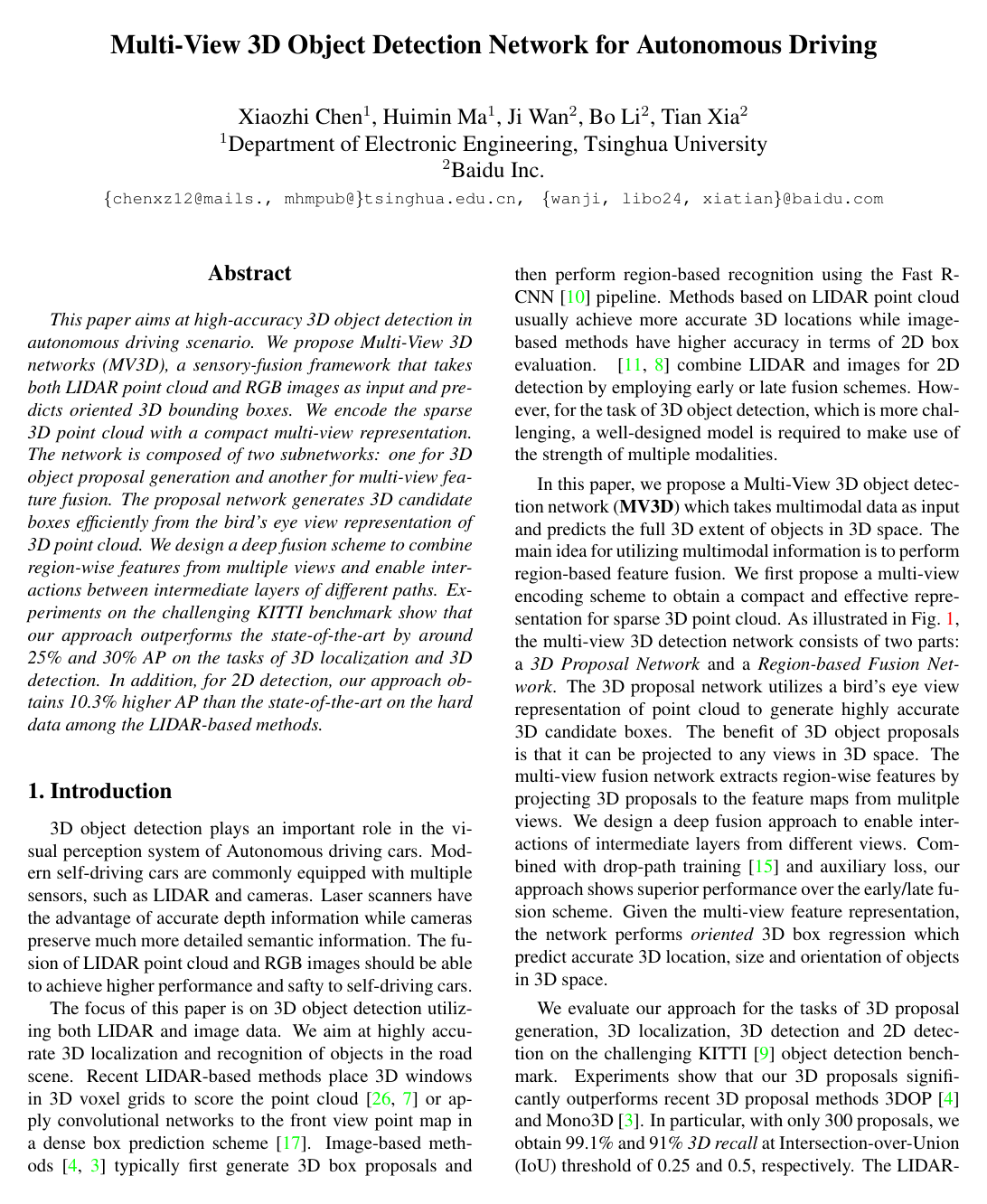
Multi-view 3D Object Detection Network for Autonomous Driving
Xiaozhi Chen, Huimin Ma, Ji Wan, Bo Li, Tian Xia
Why you should read this
Proposes MV3D, a sensory fusion framework that combines multi-view LiDAR representations with RGB images to generate precise 3D bounding boxes, outperforming prior autonomous driving detection methods on the KITTI benchmark by up to 30% average precision.
This paper aims at high-accuracy 3D object detection in autonomous driving scenario. We propose Multi-View 3D networks (MV3D), a sensory-fusion framework that takes both LIDAR point cloud and RGB images as input and predicts oriented 3D bounding boxes. We encode the sparse 3D point cloud with a compact multi-view representation. The network is composed of two subnetworks: one for 3D object proposal generation and another for multi-view feature fusion. The proposal network generates 3D candidate boxes efficiently from the bird's eye view representation of 3D point cloud. We design a deep fusion scheme to combine region-wise features from multiple views and enable interactions between intermediate layers of different paths. Experiments on the challenging KITTI benchmark show that our approach outperforms the state-of-the-art by around 25% and 30% AP on the tasks of 3D localization and 3D detection. In addition, for 2D detection, our approach obtains 10.3% higher AP than the state-of-the-art on the hard data among the LIDAR-based methods.
Added
2026-09-12
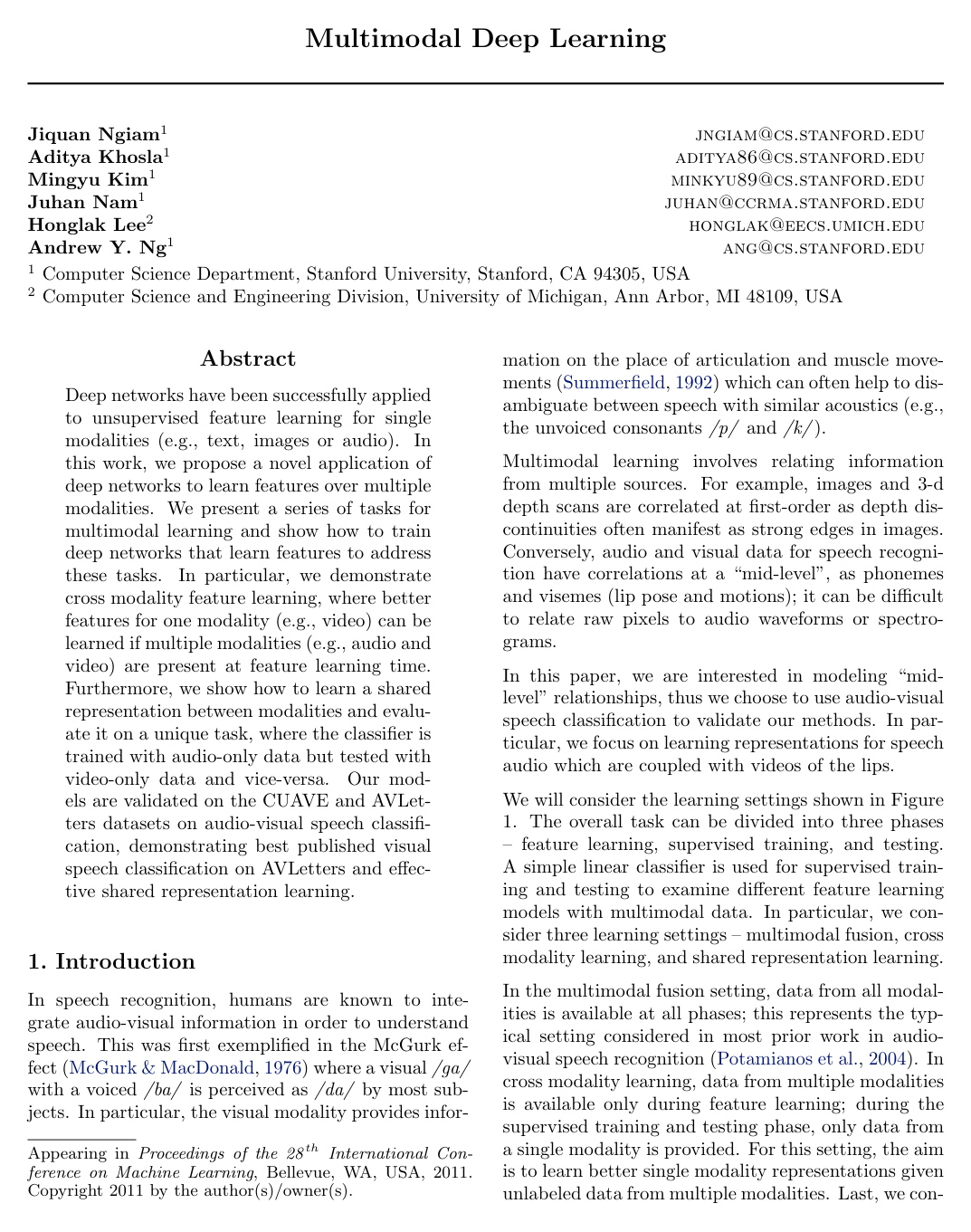
Multimodal Deep Learning
Jiquan Ngiam, A. Khosla, Mingyu Kim, Juhan Nam, Honglak Lee, A. Ng
Why you should read this
Proposes a deep autoencoder framework for multimodal feature learning that captures non-linear relationships across audio and video data, boosting visual speech recognition performance and enabling classification across unseen modalities.
Deep networks have been successfully applied to unsupervised feature learning for single modalities (e.g., text, images or audio). In this work, we propose a novel application of deep networks to learn features over multiple modalities. We present a series of tasks for multimodal learning and show how to train deep networks that learn features to address these tasks. In particular, we demonstrate cross modality feature learning, where better features for one modality (e.g., video) can be learned if multiple modalities (e.g., audio and video) are present at feature learning time. Furthermore, we show how to learn a shared representation between modalities and evaluate it on a unique task, where the classifier is trained with audio-only data but tested with video-only data and vice-versa. Our models are validated on the CUAVE and AVLetters datasets on audio-visual speech classification, demonstrating best published visual speech classification on AVLetters and effective shared representation learning. mation on the place of articulation and muscle movements (Summerfield, 1992) which can often help to disambiguate between speech with similar acoustics (e.g., the unvoiced consonants /p/ and /k/). Multimodal learning involves relating information from multiple sources. For example, images and 3-d depth scans are correlated at first-order as depth discontinuities often manifest as strong edges in images. Conversely, audio and visual data for speech recognition have correlations at a “mid-level”, as phonemes and visemes (lip pose and motions); it can be difficult to relate raw pixels to audio waveforms or spectrograms. In this paper, we are interested in modeling “mid-level” relationships, thus we choose to use audio-visual speech classification to validate our methods. In particular, we focus on learning representations for speech audio which are coupled with videos of the lips. We will consider the learning settings shown in Figure 1. The overall task can be divided into three phases – feature learning, supervised training, and testing. A simple linear classifier is used for supervised training and testing to examine different feature learning models with multimodal data. In particular, we consider three learning settings – multimodal fusion, cross modality learning, and shared representation learning. In the multimodal fusion setting, data from all modalities is available at all phases; this represents the typical setting considered in most prior work in audio-visual speech recognition (Potamianos et al., 2004). In cross modality learning, data from multiple modalities is available only during feature learning; during the supervised training and testing phase, only data from a single modality is provided. For this setting, the aim is to learn better single modality representations given unlabeled data from multiple modalities. Last, we con-
Added
2026-09-11
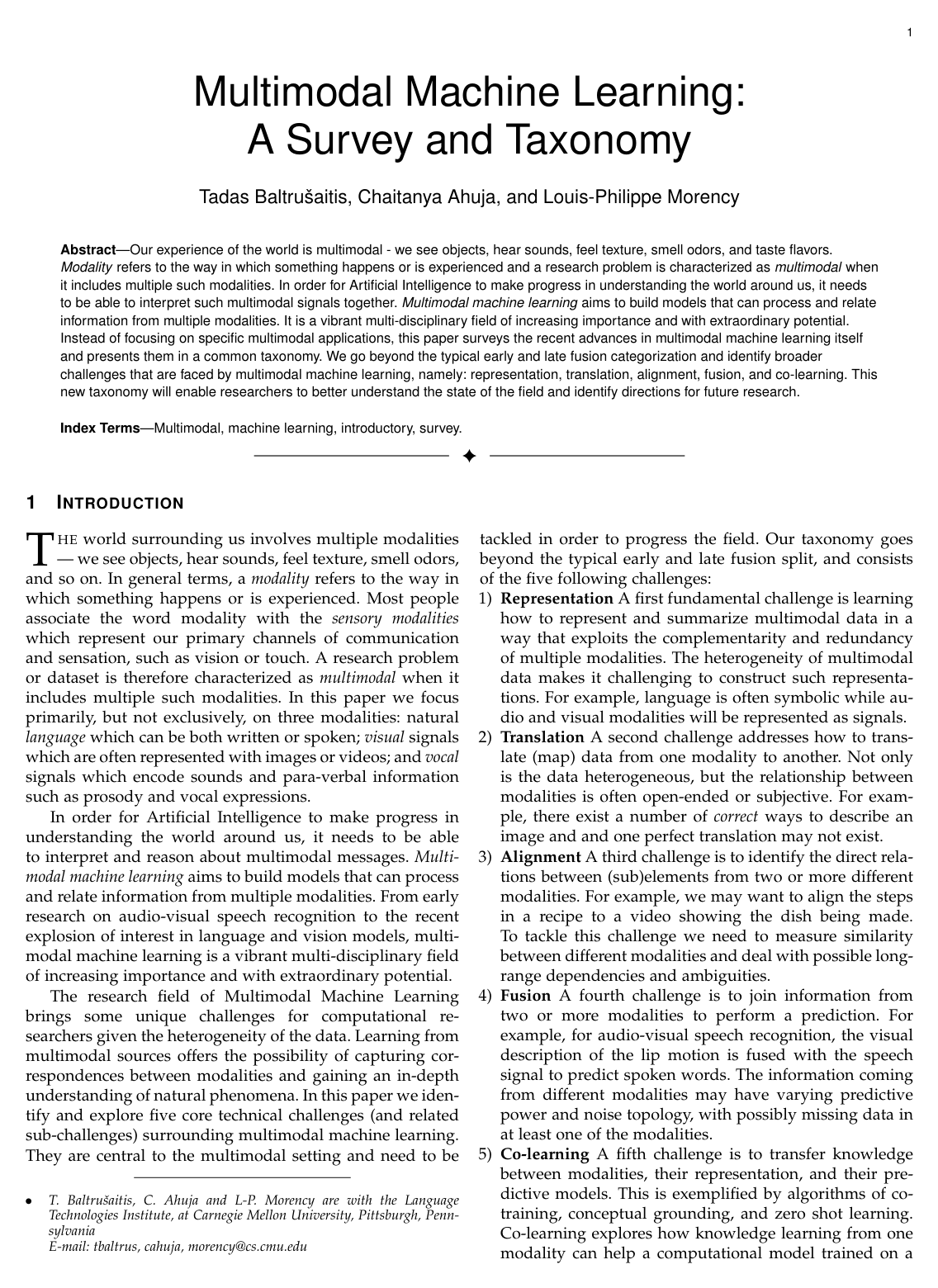
Multimodal Machine Learning: A Survey and Taxonomy
Tadas Baltrušaitis, Chaitanya Ahuja, Louis-Philippe Morency
Why you should read this
Establishes a comprehensive taxonomy for multimodal machine learning by structuring the field around five fundamental technical challenges: representation, translation, alignment, fusion, and co-learning.
Our experience of the world is multimodal - we see objects, hear sounds, feel texture, smell odors, and taste flavors. Modality refers to the way in which something happens or is experienced and a research problem is characterized as multimodal when it includes multiple such modalities. In order for Artificial Intelligence to make progress in understanding the world around us, it needs to be able to interpret such multimodal signals together. Multimodal machine learning aims to build models that can process and relate information from multiple modalities. It is a vibrant multi-disciplinary field of increasing importance and with extraordinary potential. Instead of focusing on specific multimodal applications, this paper surveys the recent advances in multimodal machine learning itself and presents them in a common taxonomy. We go beyond the typical early and late fusion categorization and identify broader challenges that are faced by multimodal machine learning, namely: representation, translation, alignment, fusion, and co-learning. This new taxonomy will enable researchers to better understand the state of the field and identify directions for future research.
Added
2026-09-10