
keyword
temporal attention
Temporal attention is an attention mechanism in machine learning that dynamically calculates importance weights across different points in time within sequential data, such as video frames or time series steps. By operating along the time dimension, this mechanism allows neural network models to selectively prioritize the most relevant temporal features, capture long-range dependencies, and track dynamic changes across a sequence. In applications such as video understanding, video generation, and temporal forecasting, temporal attention is often paired with spatial or channel-wise operations to preserve continuity, enforce temporal consistency, and model complex spatio-temporal interactions across time steps.
12 items
FreeNoise: Tuning-Free Longer Video Diffusion via Noise Rescheduling
Haonan Qiu, Menghan Xia, Yong Zhang, Yingqing He, Xintao Wang, Ying Shan, Ziwei Liu
Why you should read this
Introduces FreeNoise, a tuning-free method that enables pretrained video diffusion models to generate consistent, extended-length videos across multiple text prompts by rescheduling initial noise sequences with minimal computational overhead.
With the availability of large-scale video datasets and the advances of diffusion models, text-driven video generation has achieved substantial progress. However, existing video generation models are typically trained on a limited number of frames, resulting in the inability to generate high-fidelity long videos during inference. Furthermore, these models only support single-text conditions, whereas real-life scenarios often require multi-text conditions as the video content changes over time. To tackle these challenges, this study explores the potential of extending the text-driven capability to generate longer videos conditioned on multiple texts. 1) We first analyze the impact of initial noise in video diffusion models. Then building upon the observation of noise, we propose FreeNoise, a tuning-free and time-efficient paradigm to enhance the generative capabilities of pretrained video diffusion models while preserving content consistency. Specifically, instead of initializing noises for all frames, we reschedule a sequence of noises for long-range correlation and perform temporal attention over them by window-based function. 2) Additionally, we design a novel motion injection method to support the generation of videos conditioned on multiple text prompts. Extensive experiments validate the superiority of our paradigm in extending the generative capabilities of video diffusion models. It is noteworthy that compared with the previous best-performing method which brought about 255% extra time cost, our method incurs only negligible time cost of approximately 17%. Generated video samples are available at our website: this http URL.
Added
2026-10-06
SAMformer: Unlocking the Potential of Transformers in Time Series Forecasting with Sharpness-Aware Minimization and Channel-Wise Attention
Romain Ilbert, Ambroise Odonnat, Vasilii Feofanov, Aladin Virmaux, Giuseppe Paolo, Themis Palpanas, Ievgen Redko
Why you should read this
Demonstrates why standard attention mechanisms cause transformers to fail at multivariate time series forecasting and introduces SAMformer, a lightweight channel-wise architecture trained with sharpness-aware minimization that matches large foundation models using substantially fewer parameters.
Transformer-based architectures achieved breakthrough performance in natural language processing and computer vision, yet they remain inferior to simpler linear baselines in multivariate long-term forecasting. To better understand this phenomenon, we start by studying a toy linear forecasting problem for which we show that transformers are incapable of converging to their true solution despite their high expressive power. We further identify the attention of transformers as being responsible for this low generalization capacity. Building upon this insight, we propose a shallow lightweight transformer model that successfully escapes bad local minima when optimized with sharpness-aware optimization. We empirically demonstrate that this result extends to all commonly used real-world multivariate time series datasets. In particular, SAMformer surpasses current state-of-the-art methods and is on par with the biggest foundation model MOIRAI while having significantly fewer parameters. The code is available at https://github.com/romilbert/samformer.
Added
2026-10-03
XL-LEXEME: WiC Pretrained Model for Cross-Lingual LEXical sEMantic changE
Pierluigi Cassotti, Lucia Siciliani, Marco de Gemmis, Giovanni Semeraro, Pierpaolo Basile
Why you should read this
Presents XL-LEXEME, a bi-encoder model that adapts Sentence-BERT to the Word-in-Context task with target-word highlighting to generate scalable, comparable lexical representations that achieve state-of-the-art semantic change detection across multiple languages.
The recent introduction of large-scale datasets for the WiC (Word in Context) task enables the creation of more reliable and meaningful contextualized word embeddings. However, most of the approaches to the WiC task use cross-encoders, which prevent the possibility of deriving comparable word embeddings. In this work, we introduce XL-LEXEME, a Lexical Semantic Change Detection model. XL-LEXEME extends SBERT, highlighting the target word in the sentence. We evaluate XL-LEXEME on the multilingual benchmarks for SemEval-2020 Task 1 - Lexical Semantic Change (LSC) Detection and the RuShiftEval shared task involving five languages: English, German, Swedish, Latin, and Russian. XL-LEXEME outperforms the state-of-the-art in English, German and Swedish with statistically significant differences from the baseline results and obtains state-of-the-art performance in the RuShiftEval shared task.
Added
2026-10-02
All in One: Exploring Unified Video-Language Pre-Training
Jinpeng Wang, Yixiao Ge, Rui Yan, Yuying Ge, Kevin Qinghong Lin, Satoshi Tsutsui, Xudong Lin, Guanyu Cai, Jianping Wu, Ying Shan, Xiaohu Qie, Mike Zheng Shou
Why you should read this
Introduces an end-to-end unified video-language framework that processes raw video and text inputs within a single shared transformer backbone via a parameter-free temporal token rolling mechanism, significantly reducing computational cost while matching competitive multi-network models.
Mainstream Video-Language Pre-training (VLP) models [10, 26, 64] consist of three parts, a video encoder, a text encoder, and a video-text fusion Transformer. They pursue better performance via utilizing heavier unimodal encoders or multimodal fusion Transformers, resulting in increased parameters with lower efficiency in downstream tasks. In this work, we for the first time introduce an end-to-end VLP model, namely all-in-one Transformer, that embeds raw video and textual signals into joint representations using a unified backbone architecture. We argue that the unique temporal information of video data turns out to be a key barrier hindering the design of a modality-agnostic Transformer. To overcome the challenge, we introduce a novel and effective token rolling operation to encode temporal representations from video clips in a non-parametric manner. The careful design enables the representation learning of both video-text multimodal inputs and unimodal inputs using a unified model. Our pre-trained all-in-one Transformer is transferred to various downstream video-text tasks after fine-tuning, including text-video retrieval, video-question answering, multiple choice and video captioning. State-of-the-art performances with the minimal model FLOPs on ten datasets demonstrate the superiority of our method compared to the competitive counterparts. The code and pretrained models are available at https://github.com/showlab/all-in-one.
Added
2026-09-26
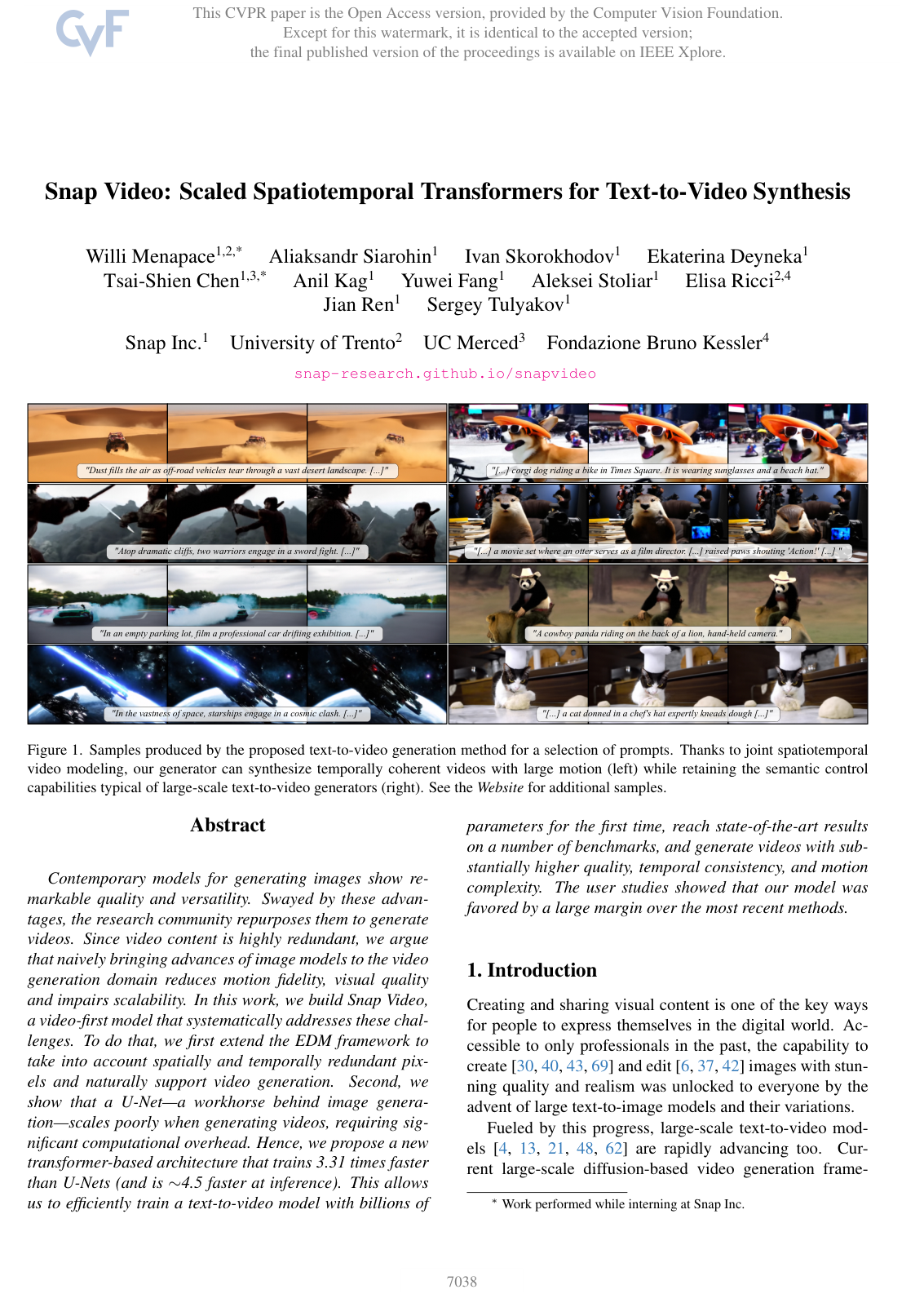
Snap Video: Scaled Spatiotemporal Transformers for Text-to-Video Synthesis
Willi Menapace, Aliaksandr Siarohin, Ivan Skorokhodov, Ekaterina Deyneka, Tsai-Shien Chen, Anil Kag, Yuwei Fang, Aleksei Stoliar, Elisa Ricci, Jian Ren, Sergey Tulyakov
Why you should read this
Presents Snap Video, a video-first diffusion model that replaces standard U-Nets with a scalable spatiotemporal transformer architecture, achieving up to 4.5 times faster inference alongside state-of-the-art motion quality and temporal consistency in text-to-video generation.
Contemporary models for generating images show remarkable quality and versatility. Swayed by these advantages, the research community repurposes them to generate videos. Since video content is highly redundant, we argue that naively bringing advances of image models to the video generation domain reduces motion fidelity, visual quality and impairs scalability. In this work, we build Snap Video, a video-first model that systematically addresses these challenges. To do that, we first extend the EDM framework to take into account spatially and temporally redundant pixels and naturally support video generation. Second, we show that a U-Net—a workhorse behind image generation—scales poorly when generating videos, requiring significant computational overhead. Hence, we propose a new transformer-based architecture that trains 3.31 times faster than U-Nets (and is ∼4.5 faster at inference). This allows us to efficiently train a text-to-video model with billions of parameters for the first time, reach state-of-the-art results on a number of benchmarks, and generate videos with substantially higher quality, temporal consistency, and motion complexity. The user studies showed that our model was favored by a large margin over the most recent methods.
Added
2026-09-26
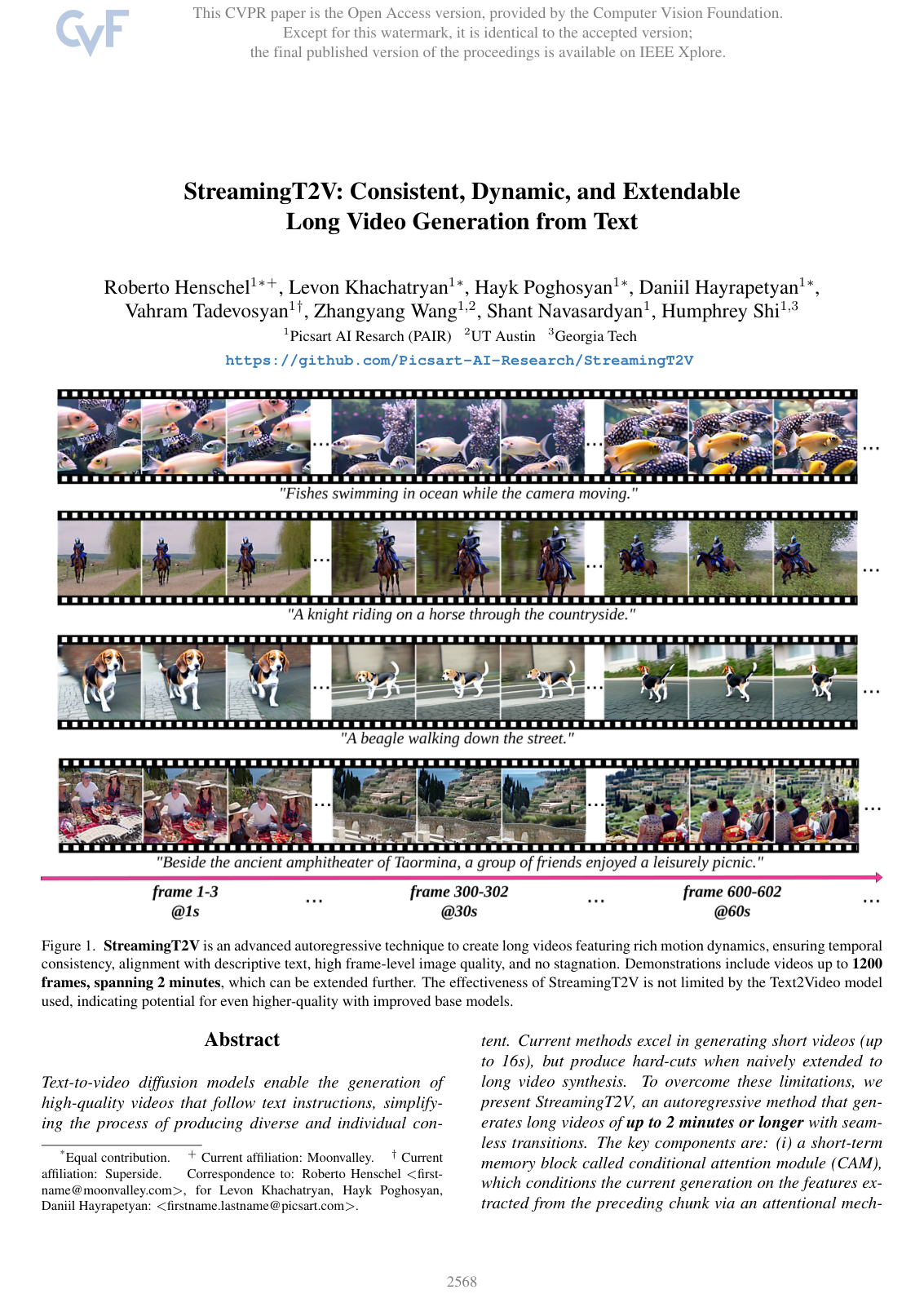
StreamingT2V: Consistent, Dynamic, and Extendable Long Video Generation from Text
Roberto Henschel, Levon Khachatryan, Hayk Poghosyan, Daniil Hayrapetyan, Vahram Tadevosyan, Zhangyang Wang, Shant Navasardyan, Humphrey Shi
Why you should read this
Proposes an autoregressive text-to-video framework that combines short- and long-term memory modules with randomized blending to generate temporally consistent, high-motion videos of extended length without visual stagnation or frame degradation.
Text-to-video diffusion models enable the generation of high-quality videos that follow text instructions, simplifying the process of producing diverse and individual content. Current methods excel in generating short videos (up to 16s), but produce hard-cuts when naively extended to long video synthesis. To overcome these limitations, we present StreamingT2V, an autoregressive method that generates long videos of up to 2 minutes or longer with seamless transitions. The key components are: (i) a short-term memory block called conditional attention module (CAM), which conditions the current generation on the features extracted from the preceding chunk via an attentional mech-
Added
2026-09-26
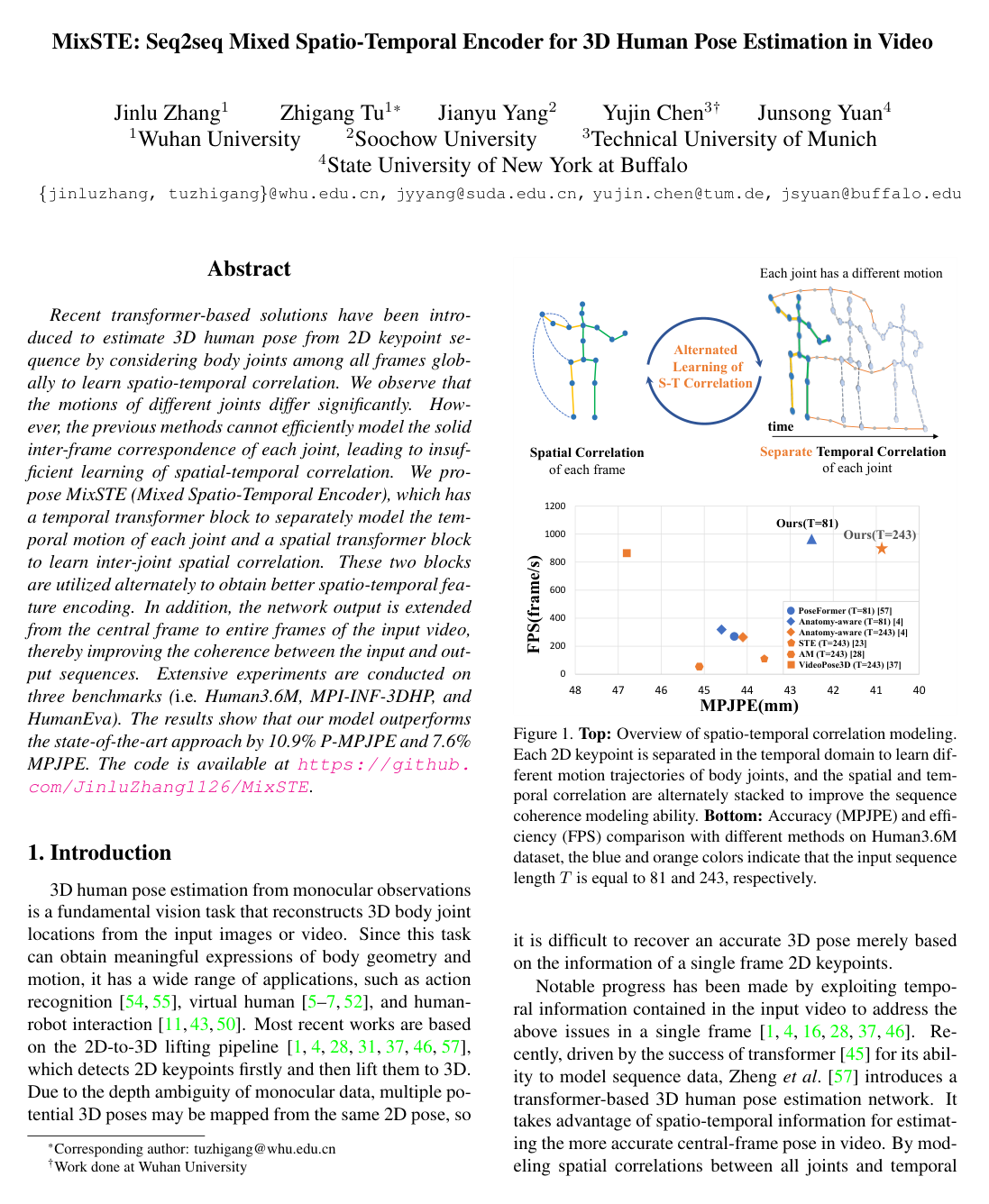
MixSTE: Seq2seq Mixed Spatio-Temporal Encoder for 3D Human Pose Estimation in Video
Jinlu Zhang, Zhigang Tu, Jianyu Yang, Yujin Chen, Junsong Yuan
Why you should read this
Proposes MixSTE, a sequence-to-sequence transformer architecture that alternates between modeling individual joint trajectories over time and spatial joint dependencies within frames to achieve state-of-the-art accuracy in video-based 3D human pose estimation.
Recent transformer-based solutions have been introduced to estimate 3D human pose from 2D keypoint sequence by considering body joints among all frames globally to learn spatio-temporal correlation. We observe that the motions of different joints differ significantly. However, the previous methods cannot efficiently model the solid inter-frame correspondence of each joint, leading to insufficient learning of spatial-temporal correlation. We propose MixSTE (Mixed Spatio-Temporal Encoder), which has a temporal transformer block to separately model the temporal motion of each joint and a spatial transformer block to learn inter-joint spatial correlation. These two blocks are utilized alternately to obtain better spatio-temporal feature encoding. In addition, the network output is extended from the central frame to entire frames of the input video, thereby improving the coherence between the input and output sequences. Extensive experiments are conducted on three benchmarks (Human3.6M, MPI-INF-3DHP, and HumanEva). The results show that our model outperforms the state-of-the-art approach by 10.9% P-MPJPE and 7.6% MPJPE. The code is available at this https URL.
Added
2026-09-26
A Dual-Stage Attention-Based Recurrent Neural Network for Time Series Prediction
Yao Qin, Dongjin Song, Haifeng Chen, Wei Cheng, Guofei Jiang, G. Cottrell
Why you should read this
Proposes a dual-stage attention-based recurrent neural network (DA-RNN) that adaptively selects relevant exogenous driving series and long-term temporal dependencies to improve both prediction accuracy and model interpretability in time series forecasting.
The Nonlinear autoregressive exogenous (NARX) model, which predicts the current value of a time series based on its previous values as well as the current and past values of multiple driving (exogenous) series, has been studied for decades. Despite the fact that various NARX models have been developed, few of them can capture the long-term temporal dependencies appropriately and select the relevant driving series to make predictions. In this paper, we propose a dual-stage attention-based recurrent neural network (DA-RNN) to address these two issues. In the first stage, we introduce an input attention mechanism to adaptively extract relevant driving series (a.k.a., input features) at each time step by referring to the previous encoder hidden state. In the second stage, we use a temporal attention mechanism to select relevant encoder hidden states across all time steps. With this dual-stage attention scheme, our model can not only make predictions effectively, but can also be easily interpreted. Thorough empirical studies based upon the SML 2010 dataset and the NASDAQ 100 Stock dataset demonstrate that the DA-RNN can outperform state-of-the-art methods for time series prediction.
Added
2026-09-24
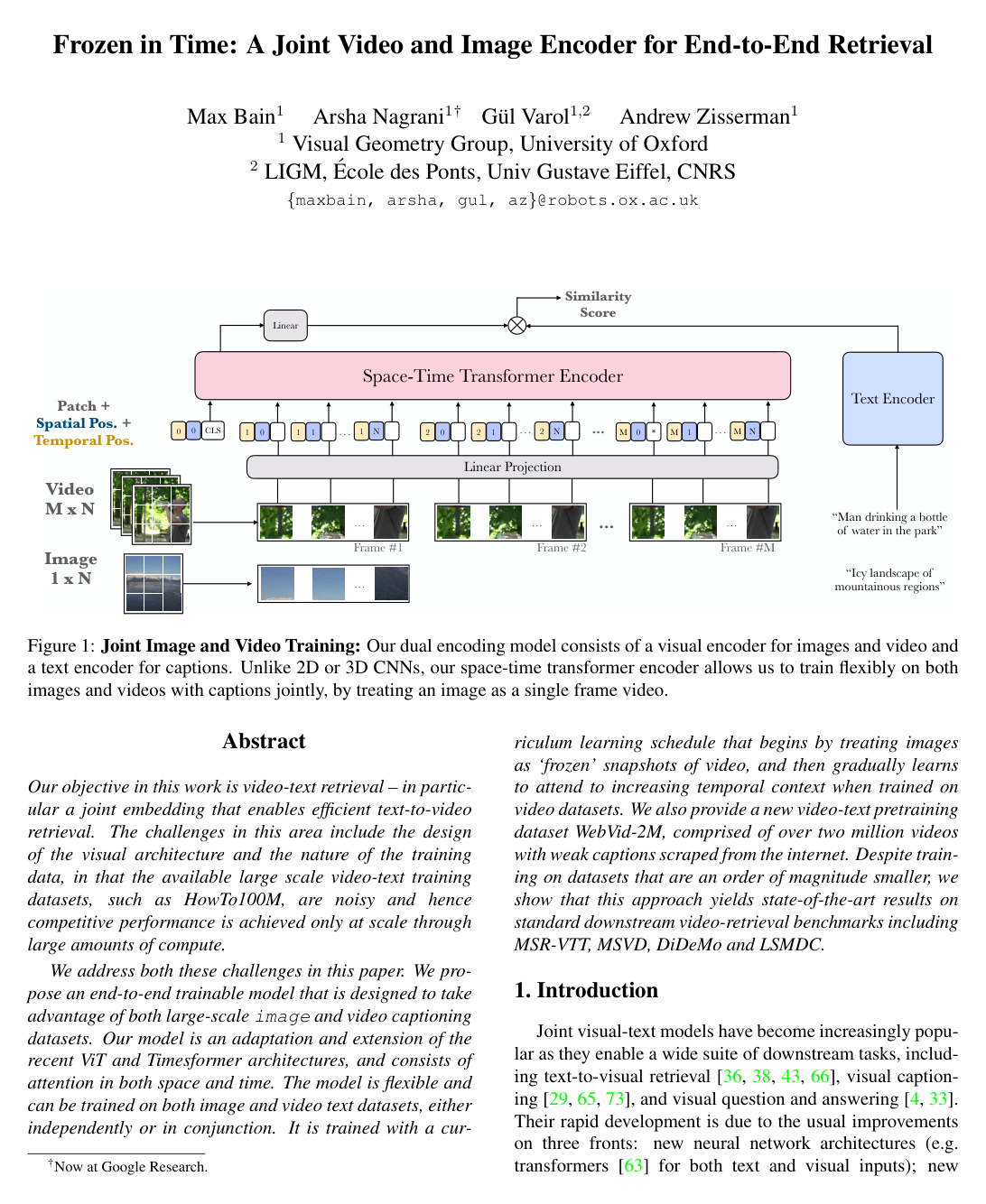
Frozen in Time: A Joint Video and Image Encoder for End-to-End Retrieval
Max Bain, Arsha Nagrani, Gül Varol, Andrew Zisserman
Why you should read this
Proposes an end-to-end spatiotemporal visual architecture trained jointly on static images and video captions alongside the WebVid-2M dataset, achieving state-of-the-art text-to-video retrieval performance with an order of magnitude less training data.
Our objective in this work is video-text retrieval - in particular a joint embedding that enables efficient text-to-video retrieval. The challenges in this area include the design of the visual architecture and the nature of the training data, in that the available large scale video-text training datasets, such as HowTo100M, are noisy and hence competitive performance is achieved only at scale through large amounts of compute. We address both these challenges in this paper. We propose an end-to-end trainable model that is designed to take advantage of both large-scale image and video captioning datasets. Our model is an adaptation and extension of the recent ViT and Timesformer architectures, and consists of attention in both space and time. The model is flexible and can be trained on both image and video text datasets, either independently or in conjunction. It is trained with a curriculum learning schedule that begins by treating images as 'frozen' snapshots of video, and then gradually learns to attend to increasing temporal context when trained on video datasets. We also provide a new video-text pretraining dataset WebVid-2M, comprised of over two million videos with weak captions scraped from the internet. Despite training on datasets that are an order of magnitude smaller, we show that this approach yields state-of-the-art results on standard downstream video-retrieval benchmarks including MSR-VTT, MSVD, DiDeMo and LSMDC.
Added
2026-09-24
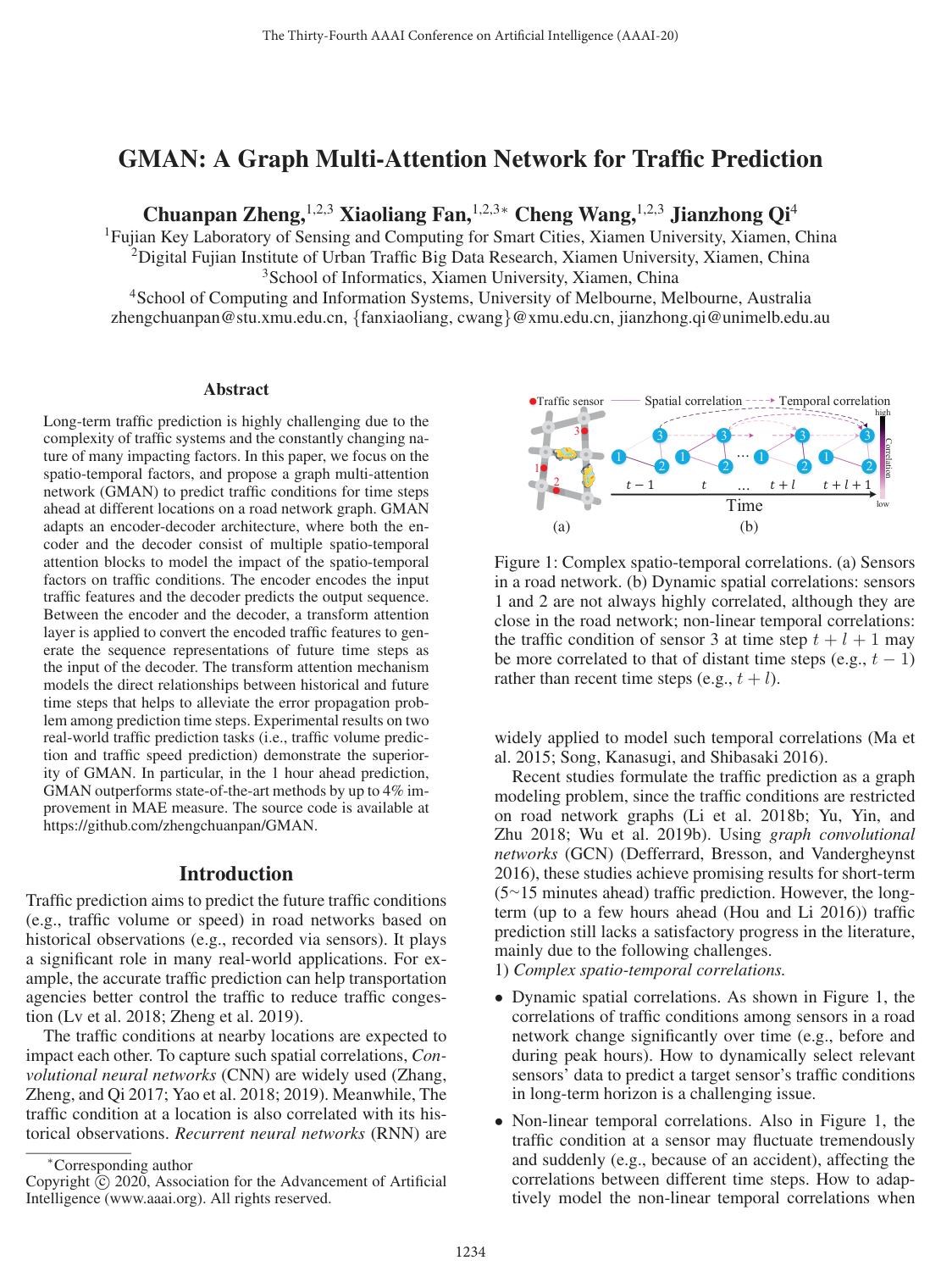
GMAN: A Graph Multi-Attention Network for Traffic Prediction
Chuanpan Zheng, Xiaoliang Fan, Cheng Wang, Jianzhong Qi
Why you should read this
Proposes a graph multi-attention network that integrates spatio-temporal and transform attention mechanisms to prevent multi-step error propagation and improve long-term traffic forecasting across complex road networks.
Long-term traffic prediction is highly challenging due to the complexity of traffic systems and the constantly changing nature of many impacting factors. In this paper, we focus on the spatio-temporal factors, and propose a graph multi-attention network (GMAN) to predict traffic conditions for time steps ahead at different locations on a road network graph. GMAN adapts an encoder-decoder architecture, where both the encoder and the decoder consist of multiple spatio-temporal attention blocks to model the impact of the spatio-temporal factors on traffic conditions. The encoder encodes the input traffic features and the decoder predicts the output sequence. Between the encoder and the decoder, a transform attention layer is applied to convert the encoded traffic features to generate the sequence representations of future time steps as the input of the decoder. The transform attention mechanism models the direct relationships between historical and future time steps that helps to alleviate the error propagation problem among prediction time steps. Experimental results on two real-world traffic prediction tasks (i.e., traffic volume prediction and traffic speed prediction) demonstrate the superiority of GMAN. In particular, in the 1 hour ahead prediction, GMAN outperforms state-of-the-art methods by up to 4% improvement in MAE measure. The source code is available at this https URL.
Added
2026-09-16
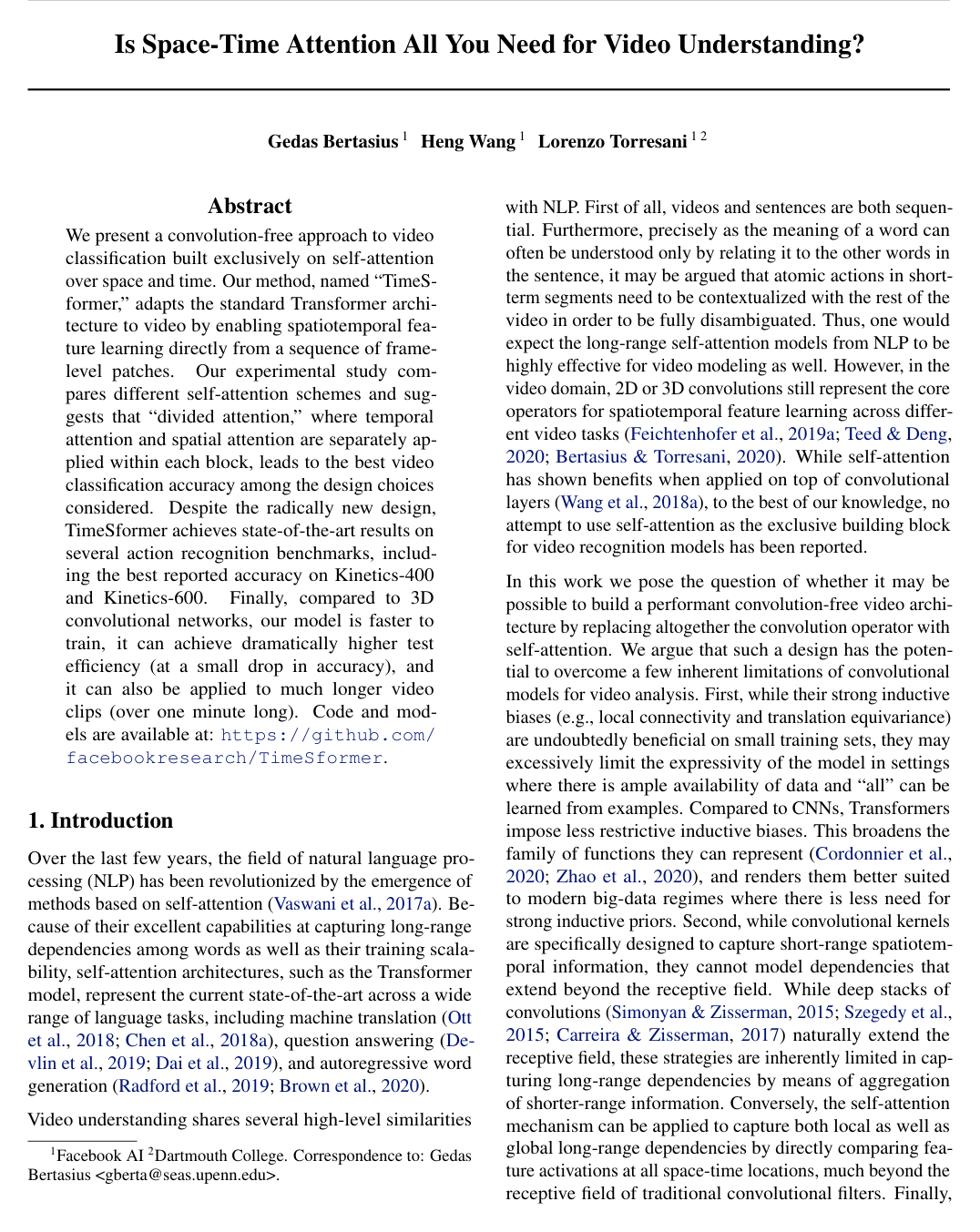
Is Space-Time Attention All You Need for Video Understanding?
Gedas Bertasius, Heng Wang, Lorenzo Torresani
Why you should read this
Introduces TimeSformer, a pure transformer architecture using divided space-time self-attention that achieves state-of-the-art video action recognition while training faster and processing much longer clips than standard 3D convolutional networks.
We present a convolution-free approach to video classification built exclusively on self-attention over space and time. Our method, named "TimeSformer," adapts the standard Transformer architecture to video by enabling spatiotemporal feature learning directly from a sequence of frame-level patches. Our experimental study compares different self-attention schemes and suggests that "divided attention," where temporal attention and spatial attention are separately applied within each block, leads to the best video classification accuracy among the design choices considered. Despite the radically new design, TimeSformer achieves state-of-the-art results on several action recognition benchmarks, including the best reported accuracy on Kinetics-400 and Kinetics-600. Finally, compared to 3D convolutional networks, our model is faster to train, it can achieve dramatically higher test efficiency (at a small drop in accuracy), and it can also be applied to much longer video clips (over one minute long). Code and models are available at: this https URL.
Added
2026-09-11

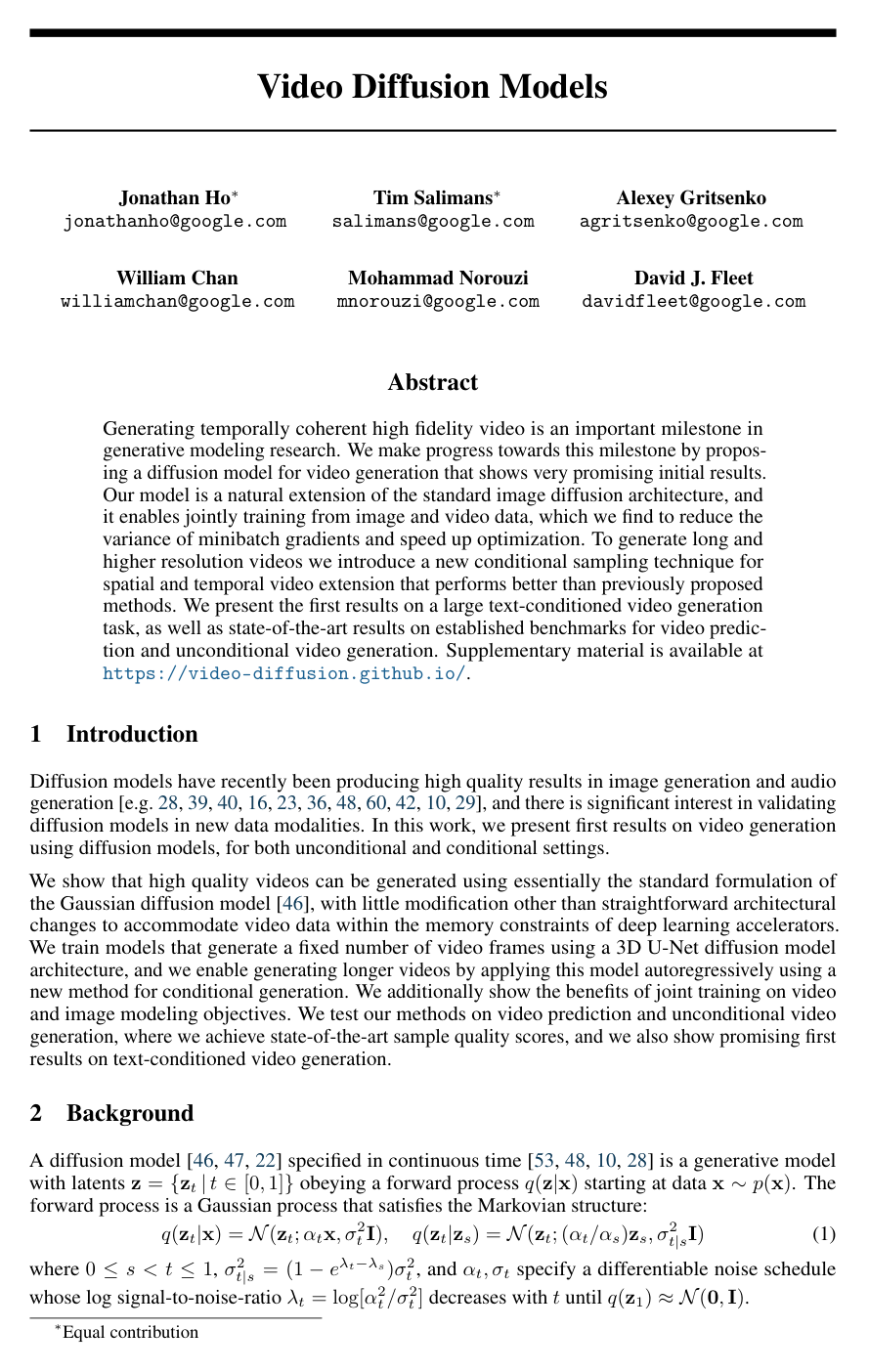
Video Diffusion Models
Jonathan Ho, Tim Salimans, Alexey Gritsenko, William Chan, Mohammad Norouzi, David J. Fleet
Why you should read this
Formulates video synthesis as a denoising diffusion process using a 3D U-Net architecture, providing the mathematical and algorithmic foundation for modern high-fidelity video generation.
Generating temporally coherent high fidelity video is an important milestone in generative modeling research. We make progress towards this milestone by proposing a diffusion model for video generation that shows very promising initial results. Our model is a natural extension of the standard image diffusion architecture, and it enables jointly training from image and video data, which we find to reduce the variance of minibatch gradients and speed up optimization. To generate long and higher resolution videos we introduce a new conditional sampling technique for spatial and temporal video extension that performs better than previously proposed methods. We present the first results on a large text-conditioned video generation task, as well as state-of-the-art results on established benchmarks for video prediction and unconditional video generation. Supplementary material is available at https://video-diffusion.github.io/.
Added
2026-02-25