Video-LaVIT: Unified Video-Language Pre-training with Decoupled Visual-Motional Tokenization
Yang JinZhicheng SunKun XuKun XuLiwei ChenHao JiangQuzhe HuangChengru SongYuliang LiuDi Zhang
Introduces an efficient multimodal framework that decomposes videos into keyframes and discrete motion vectors, enabling large language models to jointly comprehend and generate video content with significantly fewer tokens.
Multimodal artificial intelligence models have achieved remarkable success in processing text and static images, but extending these models to dynamic video remains a significant hurdle. Video contains complex temporal dynamics such as moving objects and camera transitions. Existing artificial intelligence approaches either process frames as isolated images, which ignores motion, or use heavy three-dimensional processing that produces an overwhelming number of data tokens. This creates an unsustainable computational burden that severely restricts the model's ability to handle longer videos efficiently.
The article introduces and evaluates Video-LaVIT, a unified multimodal pre-training framework that allows a single large language model to comprehend and generate text, images, and videos. The primary objective is to demonstrate that decomposing videos into keyframes and temporal motion representations allows efficient, large-scale multimodal learning without compromising visual or temporal understanding.
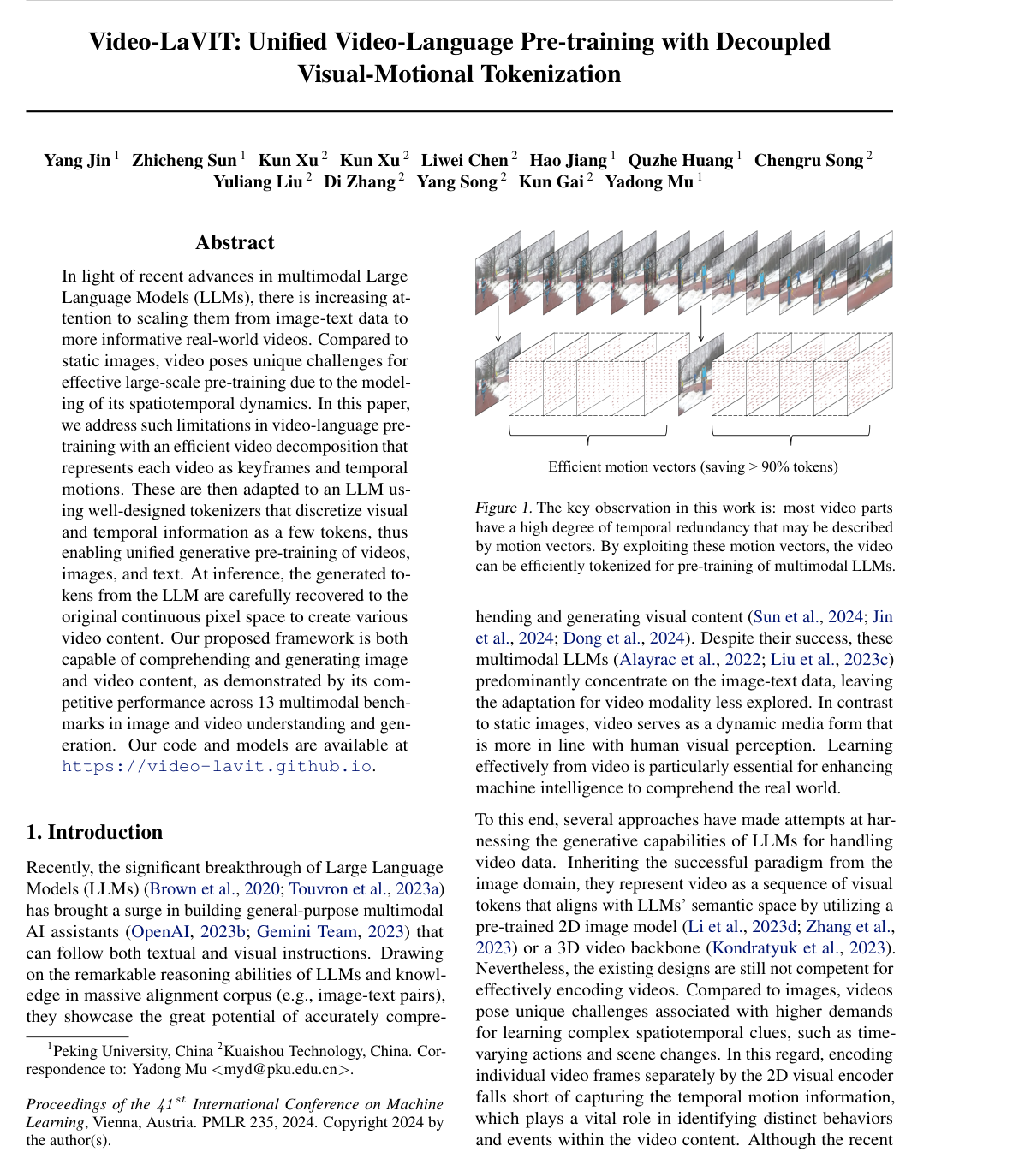
To achieve this, the approach breaks video shots into static keyframes, which capture core visual semantics, and lightweight motion vectors, which capture temporal movement. The keyframes are converted into discrete tokens using an existing image model, while motion vectors are extracted during standard video decompression and transformed into discrete motion tokens via a dedicated spatiotemporal encoder. During training, video is represented as an alternating sequence of visual and motion tokens, optimized under a unified next-token prediction objective alongside text and images. For generation, a sequential detokenizer uses a conditional diffusion network to reconstruct the keyframe and subsequent video frames. The authors evaluated the system across 13 multimodal benchmarks using public datasets including WebVid-10M, MSVD, MSRVTT, and UCF-101.
The findings show that this decoupled representation achieves state-of-the-art results across both understanding and generation tasks. On zero-shot video question answering, Video-LaVIT outperformed existing baselines, achieving 73.2% accuracy on MSVD-QA and 50.1% on ActivityNet-QA. In long video understanding on the EgoSchema benchmark, the model scored 37.3%, surpassing the 32.1% achieved by prior models that consumed far more frames. In video generation, the model produced high-quality outputs on UCF-101 and MSR-VTT, matching or exceeding systems trained on massive proprietary datasets while requiring far fewer motion tokens. Ablation experiments confirmed that adding explicit motion tokens improved question-answering accuracy by roughly 3 to 6 percentage points compared to frame-only models, while reducing the motion token count from 256 to 135 actually improved benchmark performance.
These results demonstrate that organizations can train high-performing, dual-capability video understanding and generation systems with substantially reduced computational requirements. By inheriting knowledge from pre-trained image models and encoding only incremental motion, developers avoid the high financial and hardware costs of training massive video architectures from scratch. Furthermore, relying entirely on open, publicly available training datasets provides transparency and simplifies copyright and compliance governance compared to black-box proprietary pipelines.
Stakeholders and engineering teams aiming to deploy multimodal artificial intelligence should adopt decoupled visual-motion architectures to scale video applications efficiently. Before scaling to enterprise production, development teams should run pilot evaluations on domain-specific video streams to assess prompt fidelity and motion stability. Further work is recommended to explore more sophisticated, adaptive keyframe selection methods and to extend context windows for ultra-long video sequences.
Confidence in these findings is high given the consistent performance across standard public benchmarks. However, key limitations remain. The model's context window of 4,096 tokens and the short average duration of the WebVid-10M training data constrain its ability to synthesize very long, scene-shifting videos without repetitive keyframe generation. Decision-makers should also remain cautious regarding typical foundation model risks, including hallucination during comprehension and potential misuse in generating synthetic video content.
- Paper: Video-LLaVA: Learning United Visual Representation by Alignment Before Projection, Bin Lin et al. (2023). Video-LLaVA establishes the core foundation of unifying image and video representations prior to LLM projection, which Video-LaVIT directly builds upon with decoupled visual-motional tokenization.
- Paper: Video-LLaMA: An Instruction-tuned Audio-Visual Language Model for Video Understanding, Hang Zhang et al. (2023). Video-LLaMA demonstrates how to adapt frozen LLMs to dynamic video inputs via specialized temporal adapter modules, serving as an architectural precursor to Video-LaVIT's video-language pre-training.
- Paper: Video-ChatGPT: Towards Detailed Video Understanding via Large Vision and Language Models, Muhammad Maaz et al. (2023). Video-ChatGPT introduces spatiotemporal feature pooling to connect visual representations to LLM decoders, motivating the more advanced tokenization strategies formulated in Video-LaVIT.
- Paper: VideoGPT: Video Generation using VQ-VAE and Transformers, Wilson Yan et al. (2021). VideoGPT provides essential background on using discrete tokenizers (VQ-VAE) and autoregressive transformers for generative video modeling, a paradigm unified with language in Video-LaVIT.
- Paper: MoCoGAN: Decomposing Motion and Content for Video Generation, Sergey Tulyakov et al. (2018). MoCoGAN introduces the fundamental concept of explicitly decomposing video into static visual content and temporal dynamics, which Video-LaVIT adapts into its visual-motional tokenization.
- Paper: Phenaki: Variable Length Video Generation From Open Domain Textual Description, Ruben Villegas et al. (2023). Phenaki presents causal spatiotemporal tokenization for autoregressive video generation, preconditioning the reader for Video-LaVIT's discrete token decoding framework.
- Paper: Frozen in Time: A Joint Video and Image Encoder for End-to-End Retrieval, Max Bain et al. (2021). Frozen in Time establishes the methodology of jointly training vision-language models on both static images and video sequences that Video-LaVIT extends to unified generation.
- Paper: ViViT: A Video Vision Transformer, Anurag Arnab et al. (2021). ViViT lays the architectural groundwork for factorizing spatial and temporal attention over video tokens in transformer models.
- Paper: LLaVA-OneVision: Easy Visual Task Transfer, Bo Li et al. (2024). LLaVA-OneVision extends unified visual representations across single-image, multi-image, and video understanding within open multimodal foundation models.
- Paper: Video-MME: The First-Ever Comprehensive Evaluation Benchmark of Multi-modal LLMs in Video Analysis, Chaoyou Fu et al. (2025). Video-MME provides a comprehensive evaluation benchmark to rigorously test the multimodal comprehension capabilities of models like Video-LaVIT across diverse temporal scenarios.
- Paper: TimeSuite: Improving MLLMs for Long Video Understanding via Grounded Tuning, Xiangyu Zeng 0004 et al. (2025). TimeSuite builds upon short-form video MLLM architectures by introducing grounded tuning and token compression to scale video-language understanding to long sequences.
- Paper: Qwen3-VL Technical Report, Shuai Bai et al. (2025). Qwen3-VL scales multimodal large language models using advanced spatiotemporal positional embeddings and visual token routing across extensive contexts.
- Paper: TRACE: Temporal Grounding Video LLM via Causal Event Modeling, Yongxin Guo 0001 et al. (2025). TRACE advances video LLM temporal reasoning by replacing unstructured generation with explicit causal event sequence modeling.
- Paper: InternVL3: Exploring Advanced Training and Test-Time Recipes for Open-Source Multimodal Models, Jinguo Zhu et al. (2025). InternVL3 develops native pre-training paradigms and variable visual position encoding to advance open-source multimodal understanding across images and videos.
- Paper: Planning with Reasoning using Vision Language World Model, Delong Chen et al. (2025). VLWM applies vision-language modeling to predict hierarchical world states and action trajectories from video for embodied AI planning.