
keyword
video question answering
Video question answering is a multimodal artificial intelligence task in which a computational model processes a video along with a natural language question about its content to generate or select the correct answer. Unlike static image question answering, this task requires systems to comprehend both spatial visual information, such as objects, scenes, and visual attributes, and dynamic temporal dependencies across consecutive frames, such as action sequences, event ordering, state transitions, and causal relationships. Video question answering spans diverse problem formulations, ranging from straightforward factoid retrieval of visible entities to complex reasoning that demands multi-frame temporal modeling, cross-modal integration with speech or subtitles, and external commonsense knowledge.
12 items
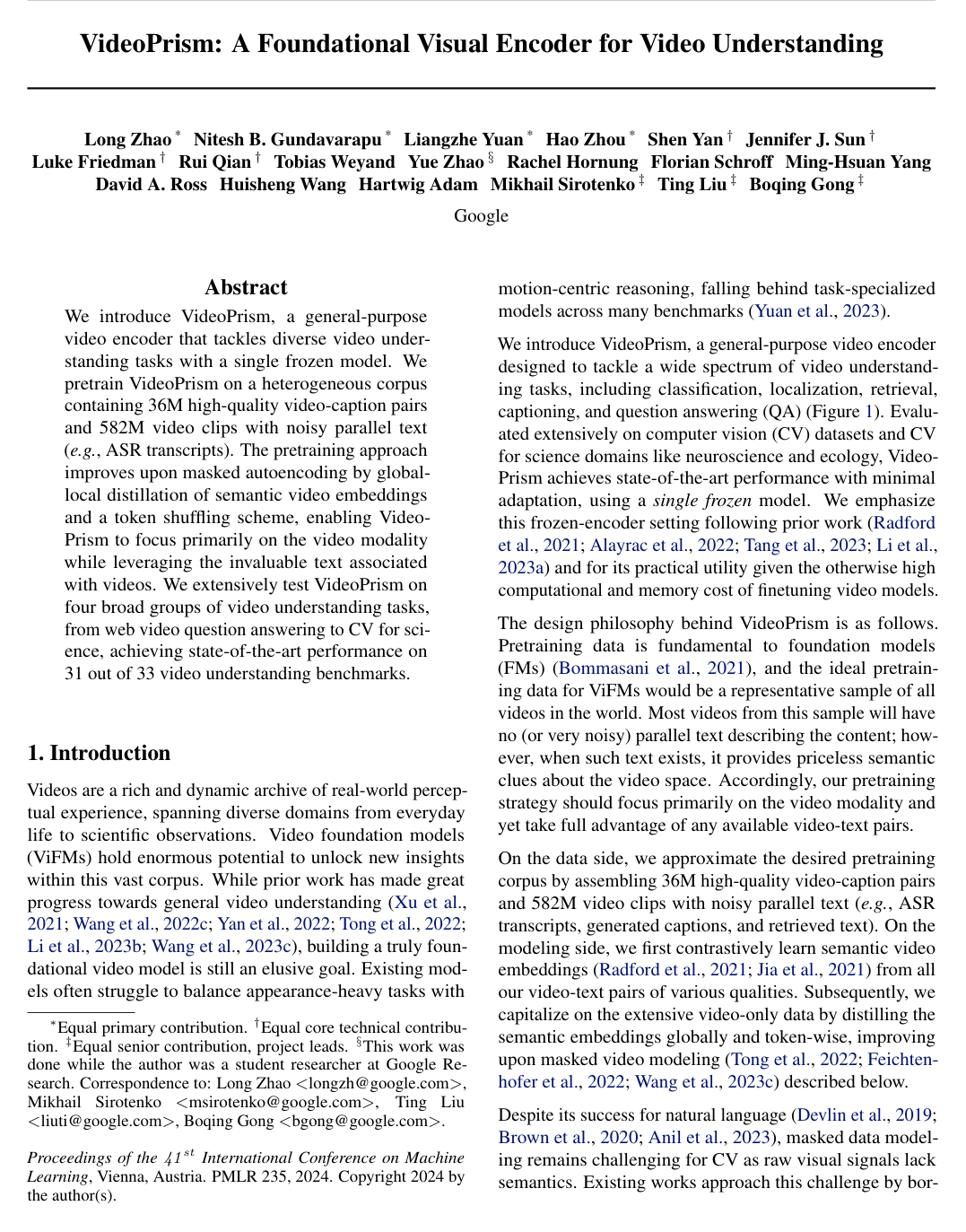
VideoPrism: A Foundational Visual Encoder for Video Understanding
Long Zhao, Nitesh Bharadwaj Gundavarapu, Liangzhe Yuan, Hao Zhou, Shen Yan, Jennifer J. Sun, Luke Friedman, Rui Qian, Tobias Weyand, Yue Zhao, Rachel Hornung, Florian Schroff, Ming-Hsuan Yang, David A. Ross, Huisheng Wang, Hartwig Adam, Mikhail Sirotenko, Ting Liu, Boqing Gong
Why you should read this
Presents VideoPrism, a foundational visual encoder pretrained via a two-stage contrastive and masked modeling pipeline that achieves state-of-the-art results across 31 video understanding benchmarks using a single frozen model.
Added
2026-10-02
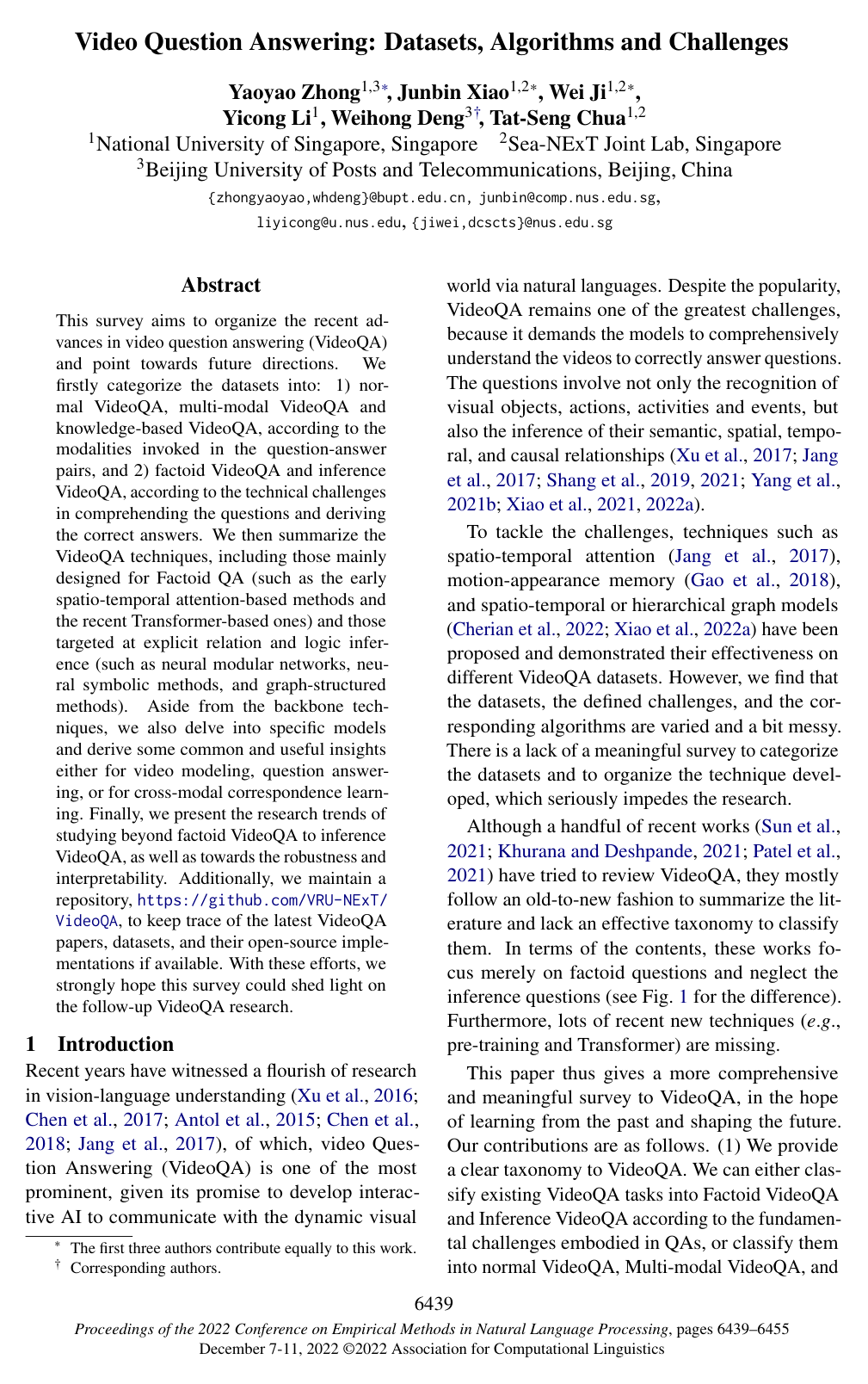
Video Question Answering: Datasets, Algorithms and Challenges
Yaoyao Zhong, Wei Ji, Junbin Xiao, Yicong Li, Weihong Deng, Tat-Seng Chua
Why you should read this
Presents a comprehensive taxonomy of video question answering that classifies benchmarks by modality and reasoning difficulty while systematically evaluating architectural techniques from spatio-temporal attention to neuro-symbolic reasoning.
This survey aims to organize the recent advances in video question answering (VideoQA) and point towards future directions. We firstly categorize the datasets into: 1) normal VideoQA, multi-modal VideoQA and knowledge-based VideoQA, according to the modalities invoked in the question-answer pairs, and 2) factoid VideoQA and inference VideoQA, according to the technical challenges in comprehending the questions and deriving the correct answers. We then summarize the VideoQA techniques, including those mainly designed for Factoid QA (such as the early spatio-temporal attention-based methods and the recent Transformer-based ones) and those targeted at explicit relation and logic inference (such as neural modular networks, neural symbolic methods, and graph-structured methods). Aside from the backbone techniques, we also delve into specific models and derive some common and useful insights either for video modeling, question answering, or for cross-modal correspondence learning. Finally, we present the research trends of studying beyond factoid VideoQA to inference VideoQA, as well as towards the robustness and interpretability. Additionally, we maintain a repository, https://github.com/VRU-NExT/VideoQA, to keep trace of the latest VideoQA papers, datasets, and their open-source implementations if available. With these efforts, we strongly hope this survey could shed light on the follow-up VideoQA research.
Added
2026-10-01
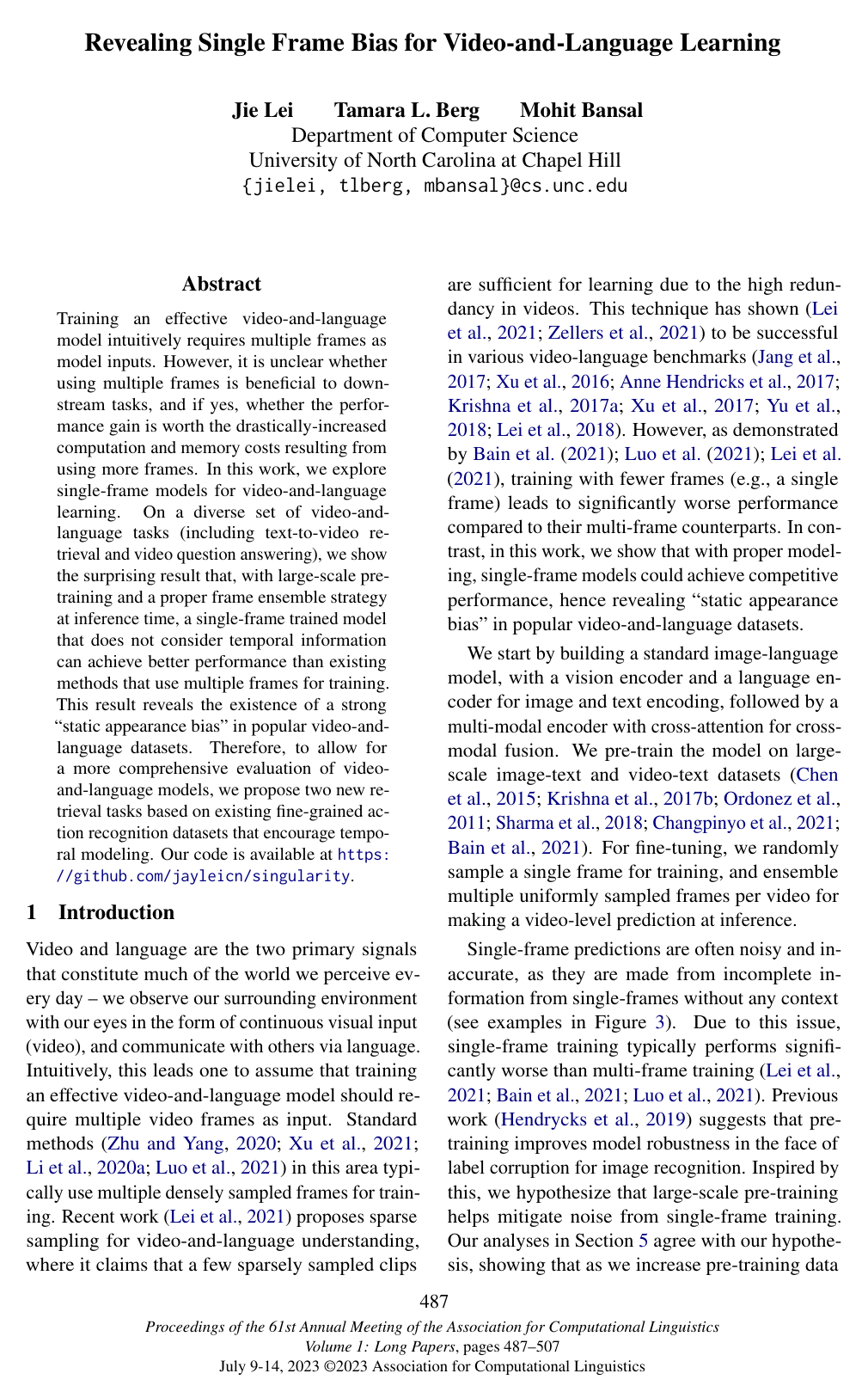
Revealing Single Frame Bias for Video-and-Language Learning
Jie Lei, Tamara L. Berg, Mohit Bansal
Why you should read this
Reveals a pervasive static appearance bias in standard video-and-language benchmarks by showing that single-frame training paired with inference-time frame ensembling outperforms multi-frame methods, while proposing two new action-focused retrieval tasks to properly evaluate temporal reasoning.
Training an effective video-and-language model intuitively requires multiple frames as model inputs. However, it is unclear whether using multiple frames is beneficial to downstream tasks, and if yes, whether the performance gain is worth the drastically-increased computation and memory costs resulting from using more frames. In this work, we explore single-frame models for video-and-language learning. On a diverse set of video-and-language tasks (including text-to-video retrieval and video question answering), we show the surprising result that, with large-scale pre-training and a proper frame ensemble strategy at inference time, a single-frame trained model that does not consider temporal information can achieve better performance than existing methods that use multiple frames for training. This result reveals the existence of a strong “static appearance bias” in popular video-and-language datasets. Therefore, to allow for a more comprehensive evaluation of video-and-language models, we propose two new retrieval tasks based on existing fine-grained action recognition datasets that encourage temporal modeling. Our code is available at https://github.com/jayleicn/singularity.
Added
2026-10-01
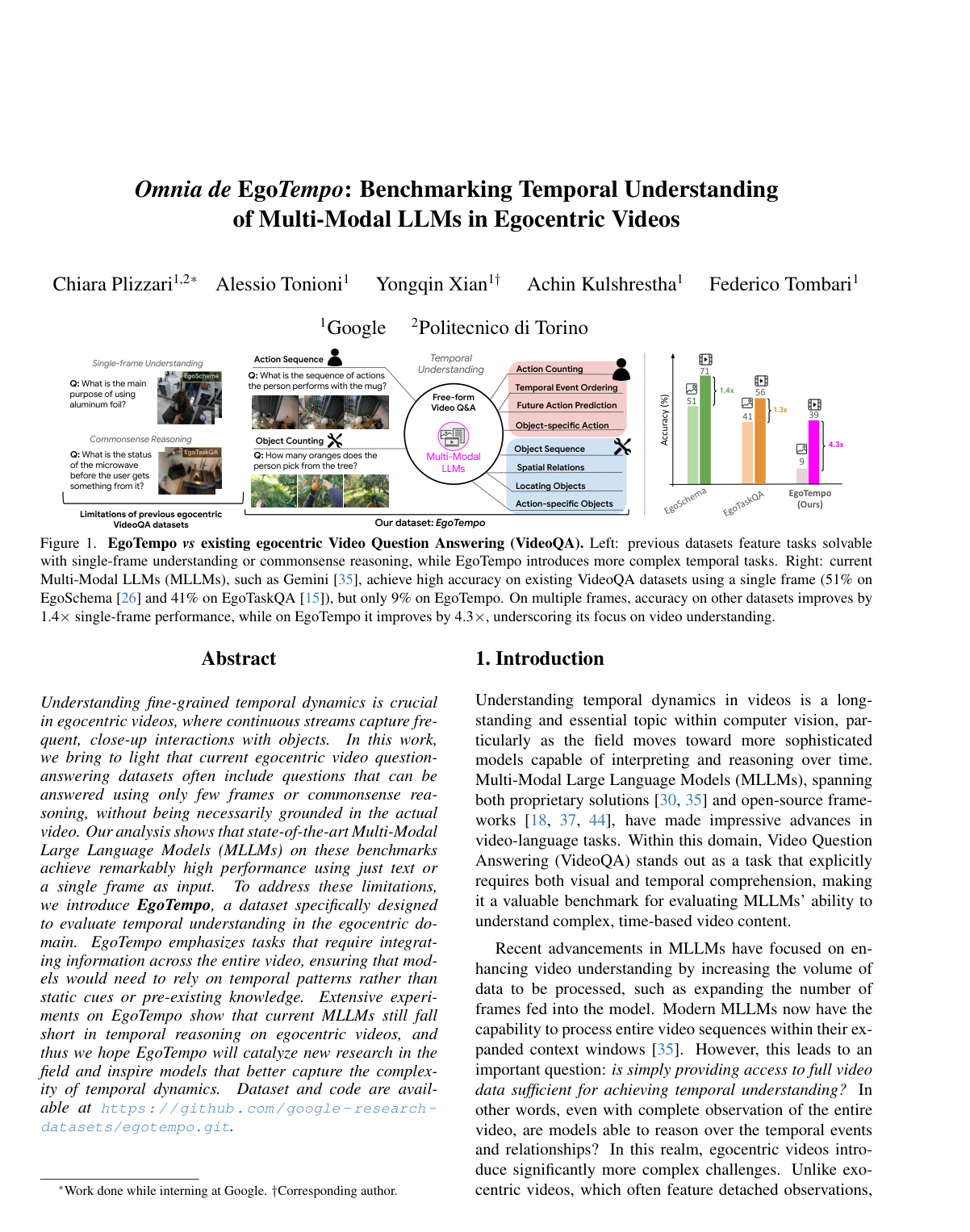
Omnia de EgoTempo: Benchmarking Temporal Understanding of Multi-Modal LLMs in Egocentric Videos
Chiara Plizzari, Alessio Tonioni, Yongqin Xian, Ace Kulshrestha, Federico Tombari
Why you should read this
Introduces EgoTempo, a benchmark designed to expose static frame and language shortcuts in egocentric video question answering and rigorously evaluate whether multimodal models can reason across full video sequences.
Understanding fine-grained temporal dynamics is crucial in egocentric videos, where continuous streams capture frequent, close-up interactions with objects. In this work, we bring to light that current egocentric video question-answering datasets often include questions that can be answered using only few frames or commonsense reasoning, without being necessarily grounded in the actual video. Our analysis shows that state-of-the-art Multi-Modal Large Language Models (MLLMs) on these benchmarks achieve remarkably high performance using just text or a single frame as input. To address these limitations, we introduce EgoTempo, a dataset specifically designed to evaluate temporal understanding in the egocentric domain. EgoTempo emphasizes tasks that require integrating information across the entire video, ensuring that models would need to rely on temporal patterns rather than static cues or pre-existing knowledge. Extensive experiments on EgoTempo show that current MLLMs still fall short in temporal reasoning on egocentric videos, and thus we hope EgoTempo will catalyze new research in the field and inspire models that better capture the complexity of temporal dynamics. Dataset and code are available at this https URL.
Added
2026-09-30
STRIVE: Structured Spatiotemporal Exploration for Reinforcement Learning in Video Question Answering
Emad Bahrami, Olga Zatsarynna, Parth Pathak, Sunando Sengupta, Juergen Gall, Mohsen Fayyaz
Why you should read this
Introduces STRIVE, a reinforcement learning framework that resolves weak policy optimization in video question answering by jointly evaluating generated text alongside importance-sampled visual variants to enrich reward signals across multimodal reasoning benchmarks.
We introduce STRIVE (SpatioTemporal Reinforcement with Importance-aware Variant Exploration), a structured reinforcement learning framework for video question answering. While group-based policy optimization methods have shown promise in large multimodal models, they often suffer from low reward variance when responses exhibit similar correctness, leading to weak or unstable advantage estimates. STRIVE addresses this limitation by constructing multiple spatiotemporal variants of each input video and performing joint normalization across both textual generations and visual variants. By expanding group comparisons beyond linguistic diversity to structured visual perturbations, STRIVE enriches reward signals and promotes more stable and informative policy updates. To ensure exploration remains semantically grounded, we introduce an importance-aware sampling mechanism that prioritizes frames most relevant to the input question while preserving temporal coverage. This design encourages robust reasoning across complementary visual perspectives rather than overfitting to a single spatiotemporal configuration. Experiments on six challenging video reasoning benchmarks including VideoMME, TempCompass, VideoMMMU, MMVU, VSI-Bench, and PerceptionTest demonstrate consistent improvements over strong reinforcement learning baselines across multiple large multimodal models. Our results highlight the role of structured spatiotemporal exploration as a principled mechanism for stabilizing multimodal reinforcement learning and improving video reasoning performance.
Added
2026-09-29
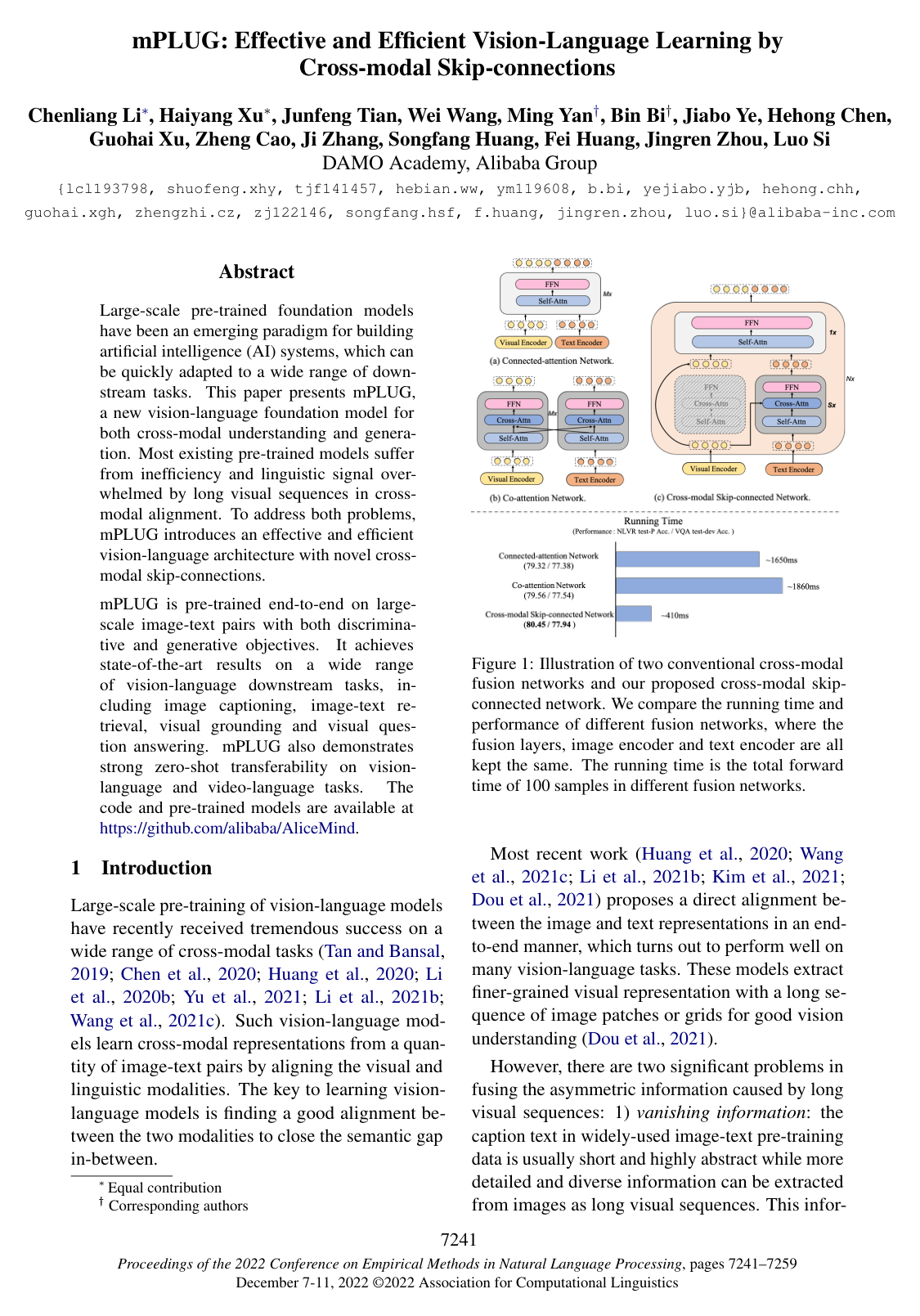
mPLUG: Effective and Efficient Vision-Language Learning by Cross-modal Skip-connections
Chenliang Li, Haiyang Xu, Junfeng Tian, Wei Wang, Ming Yan, Bin Bi, Jiabo Ye, He Chen, Guohai Xu, Zheng Cao, Ji Zhang, Songfang Huang, Fei Huang, Jingren Zhou, Luo Si
Why you should read this
Introduces a vision-language foundation model that uses cross-modal skip-connections to eliminate computational bottlenecks on long visual sequences and prevent image features from overwhelming linguistic signals during multi-modal fusion.
Large-scale pre-trained foundation models have been an emerging paradigm for building artificial intelligence (AI) systems, which can be quickly adapted to a wide range of downstream tasks. This paper presents mPLUG, a new vision-language foundation model for both cross-modal understanding and generation. Most existing pre-trained models suffer from inefficiency and linguistic signal overwhelmed by long visual sequences in cross-modal alignment. To address both problems, mPLUG introduces an effective and efficient vision-language architecture with novel cross-modal skip-connections. mPLUG is pre-trained end-to-end on large-scale image-text pairs with both discriminative and generative objectives. It achieves state-of-the-art results on a wide range of vision-language downstream tasks, including image captioning, image-text retrieval, visual grounding and visual question answering. mPLUG also demonstrates strong zero-shot transferability on vision-language and video-language tasks. The code and pre-trained models are available at https://github.com/alibaba/AliceMind.
Added
2026-09-28
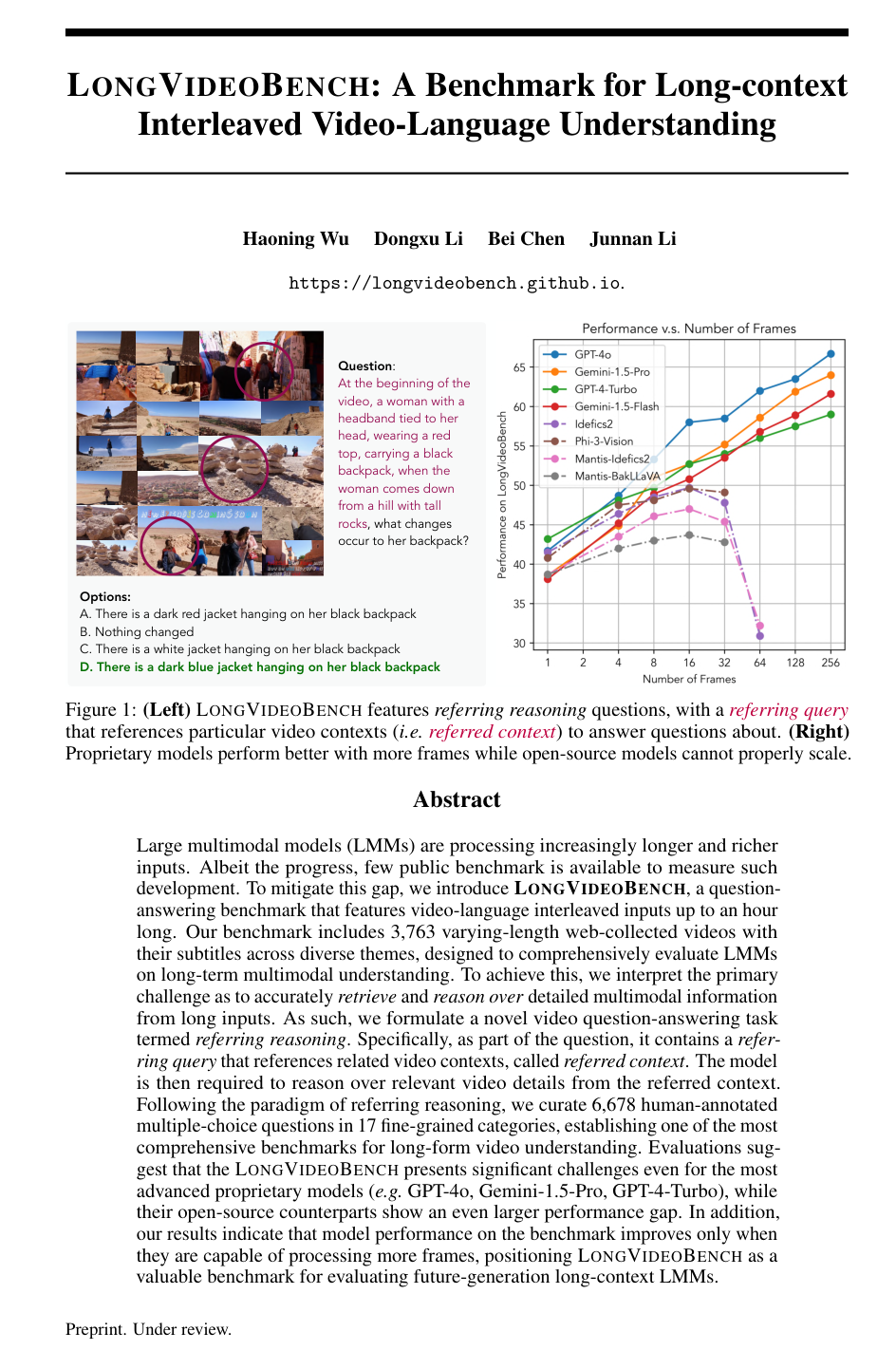
LongVideoBench: A Benchmark for Long-context Interleaved Video-Language Understanding
Haoning Wu, Dongxu Li, Bei Chen, Junnan Li
Why you should read this
Establishes LongVideoBench, a challenging benchmark of hour-long interleaved video-subtitle inputs and a novel referring reasoning task that exposes substantial performance gaps in leading large multimodal models.
Large multimodal models (LMMs) are processing increasingly longer and richer inputs. Albeit the progress, few public benchmark is available to measure such development. To mitigate this gap, we introduce LongVideoBench, a question-answering benchmark that features video-language interleaved inputs up to an hour long. Our benchmark includes 3,763 varying-length web-collected videos with their subtitles across diverse themes, designed to comprehensively evaluate LMMs on long-term multimodal understanding. To achieve this, we interpret the primary challenge as to accurately retrieve and reason over detailed multimodal information from long inputs. As such, we formulate a novel video question-answering task termed referring reasoning. Specifically, as part of the question, it contains a referring query that references related video contexts, called referred context. The model is then required to reason over relevant video details from the referred context. Following the paradigm of referring reasoning, we curate 6,678 human-annotated multiple-choice questions in 17 fine-grained categories, establishing one of the most comprehensive benchmarks for long-form video understanding. Evaluations suggest that the LongVideoBench presents significant challenges even for the most advanced proprietary models (e.g. GPT-4o, Gemini-1.5-Pro, GPT-4-Turbo), while their open-source counterparts show an even larger performance gap. In addition, our results indicate that model performance on the benchmark improves only when they are capable of processing more frames, positioning LongVideoBench as a valuable benchmark for evaluating future-generation long-context LMMs.
Added
2026-09-27
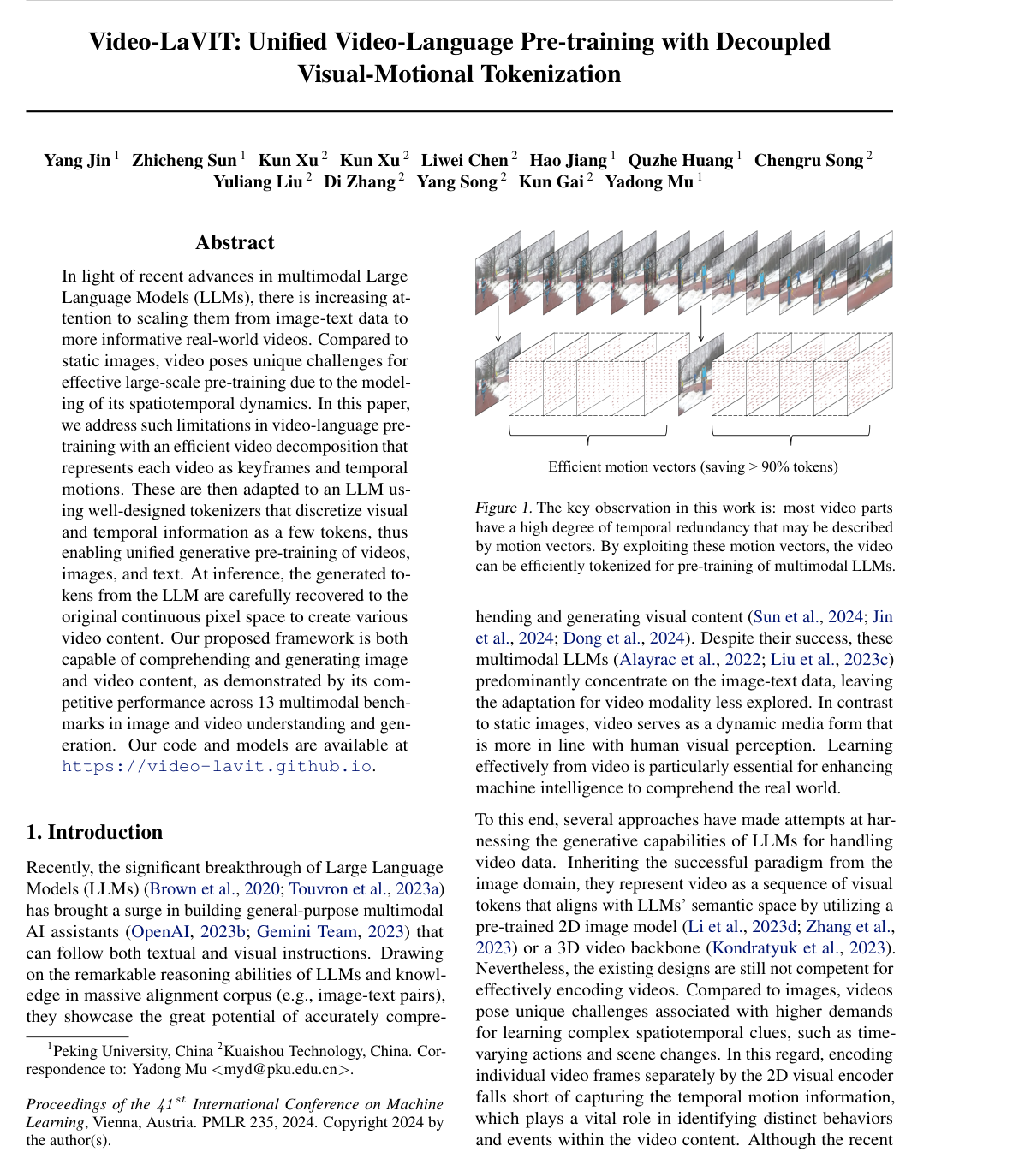
Video-LaVIT: Unified Video-Language Pre-training with Decoupled Visual-Motional Tokenization
Yang Jin, Zhicheng Sun, Kun Xu, Kun Xu, Liwei Chen, Hao Jiang, Quzhe Huang, Chengru Song, Yuliang Liu, Di Zhang, Yang Song, Kun Gai, Yadong Mu
Why you should read this
Introduces an efficient multimodal framework that decomposes videos into keyframes and discrete motion vectors, enabling large language models to jointly comprehend and generate video content with significantly fewer tokens.
In light of recent advances in multimodal Large Language Models (LLMs), there is increasing attention to scaling them from image-text data to more informative real-world videos. Compared to static images, video poses unique challenges for effective large-scale pre-training due to the modeling of its spatiotemporal dynamics. In this paper, we address such limitations in video-language pre-training with an efficient video decomposition that represents each video as keyframes and temporal motions. These are then adapted to an LLM using well-designed tokenizers that discretize visual and temporal information as a few tokens, thus enabling unified generative pre-training of videos, images, and text. At inference, the generated tokens from the LLM are carefully recovered to the original continuous pixel space to create various video content. Our proposed framework is both capable of comprehending and generating image and video content, as demonstrated by its competitive performance across 13 multimodal benchmarks in image and video understanding and generation. Our code and models are available at https://video-lavit.github.io.
Added
2026-09-26
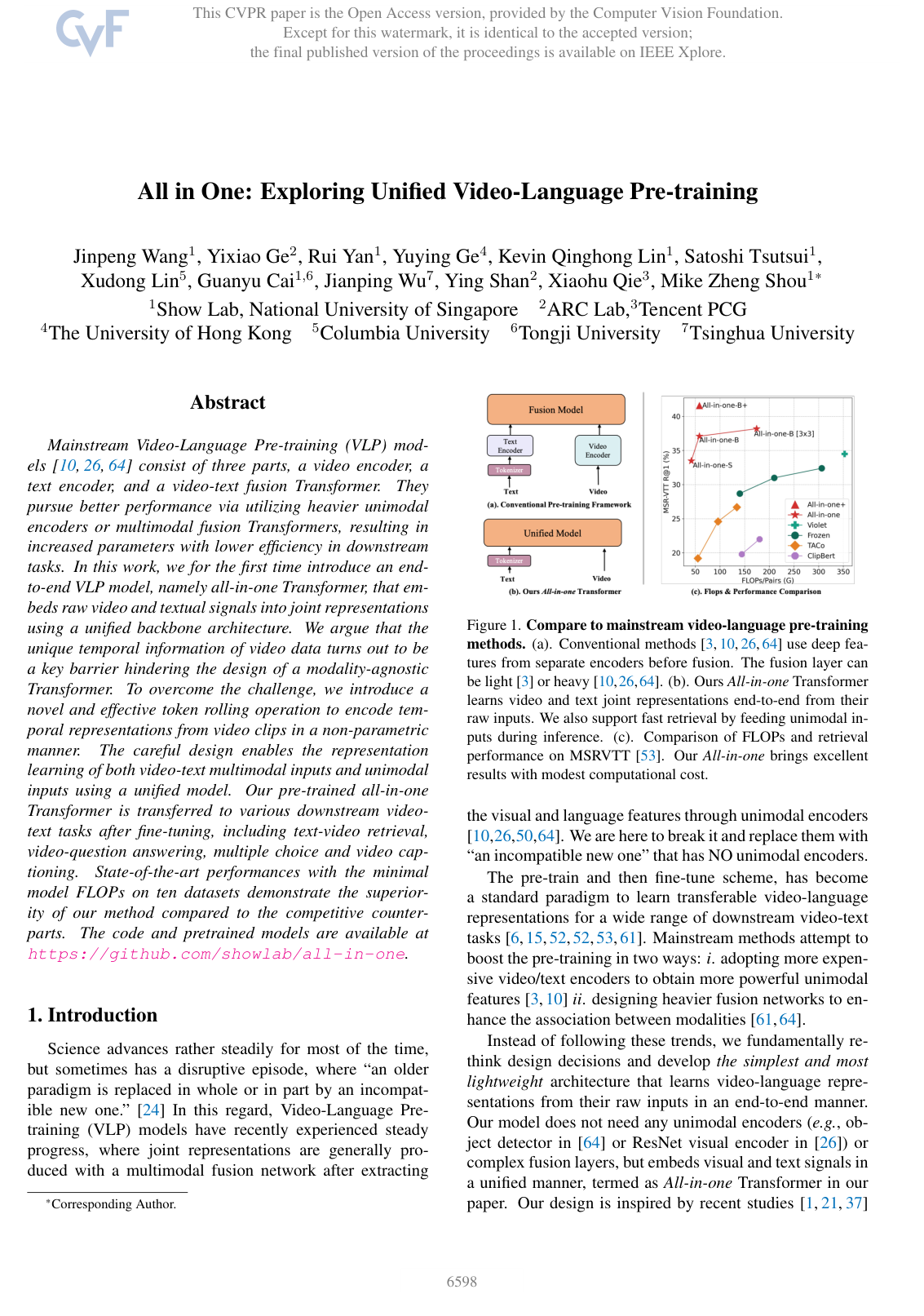
All in One: Exploring Unified Video-Language Pre-Training
Jinpeng Wang, Yixiao Ge, Rui Yan, Yuying Ge, Kevin Qinghong Lin, Satoshi Tsutsui, Xudong Lin, Guanyu Cai, Jianping Wu, Ying Shan, Xiaohu Qie, Mike Zheng Shou
Why you should read this
Introduces an end-to-end unified video-language framework that processes raw video and text inputs within a single shared transformer backbone via a parameter-free temporal token rolling mechanism, significantly reducing computational cost while matching competitive multi-network models.
Mainstream Video-Language Pre-training (VLP) models [10, 26, 64] consist of three parts, a video encoder, a text encoder, and a video-text fusion Transformer. They pursue better performance via utilizing heavier unimodal encoders or multimodal fusion Transformers, resulting in increased parameters with lower efficiency in downstream tasks. In this work, we for the first time introduce an end-to-end VLP model, namely all-in-one Transformer, that embeds raw video and textual signals into joint representations using a unified backbone architecture. We argue that the unique temporal information of video data turns out to be a key barrier hindering the design of a modality-agnostic Transformer. To overcome the challenge, we introduce a novel and effective token rolling operation to encode temporal representations from video clips in a non-parametric manner. The careful design enables the representation learning of both video-text multimodal inputs and unimodal inputs using a unified model. Our pre-trained all-in-one Transformer is transferred to various downstream video-text tasks after fine-tuning, including text-video retrieval, video-question answering, multiple choice and video captioning. State-of-the-art performances with the minimal model FLOPs on ten datasets demonstrate the superiority of our method compared to the competitive counterparts. The code and pretrained models are available at https://github.com/showlab/all-in-one.
Added
2026-09-26
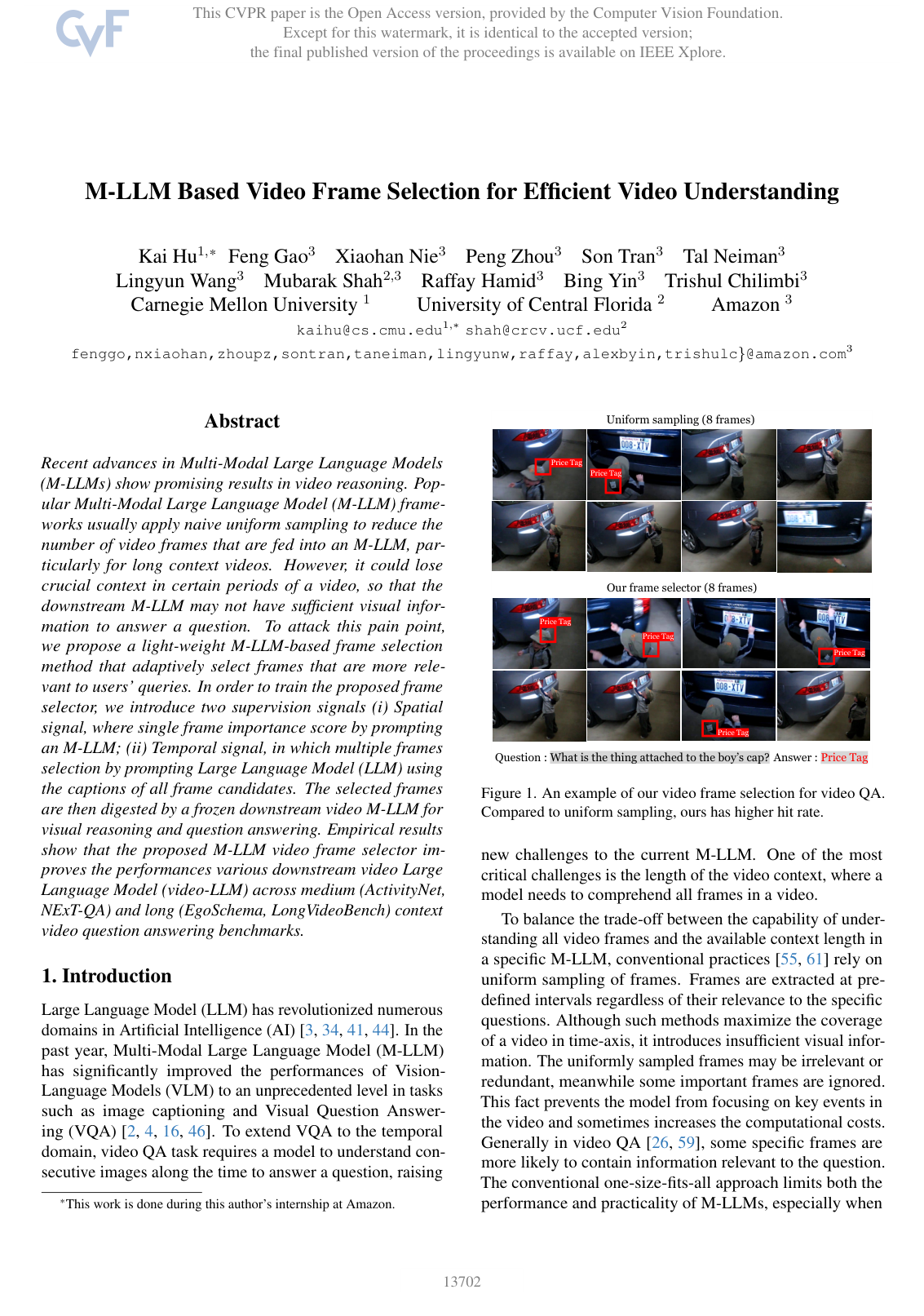
M-LLM Based Video Frame Selection for Efficient Video Understanding
Kai Hu, Feng Gao, Xiaohan Nie, Peng Zhou, Son Tran, Tal Neiman, Lingyun Wang, Mubarak Shah, Raffay Hamid, Bing Yin, Trishul Chilimbi
Why you should read this
Develops a lightweight, plug-and-play video frame selector trained with spatial and temporal pseudo-labels to replace uniform sampling, boosting question-answering accuracy and efficiency for frozen multimodal LLMs on long- and medium-context video benchmarks.
Recent advances in Multi-Modal Large Language Models (M-LLMs) show promising results in video reasoning. Popular Multi-Modal Large Language Model (M-LLM) frameworks usually apply naive uniform sampling to reduce the number of video frames that are fed into an M-LLM, particularly for long context videos. However, it could lose crucial context in certain periods of a video, so that the downstream M-LLM may not have sufficient visual information to answer a question. To attack this pain point, we propose a light-weight M-LLM-based frame selection method that adaptively select frames that are more relevant to users' queries. In order to train the proposed frame selector, we introduce two supervision signals (i) Spatial signal, where single frame importance score by prompting an M-LLM; (ii) Temporal signal, in which multiple frames selection by prompting Large Language Model (LLM) using the captions of all frame candidates. The selected frames are then digested by a frozen downstream video M-LLM for visual reasoning and question answering. Empirical results show that the proposed M-LLM video frame selector improves the performances various downstream video Large Language Model (video-LLM) across medium (ActivityNet, NExT-QA) and long (EgoSchema, LongVideoBench) context video question answering benchmarks.
Added
2026-09-26
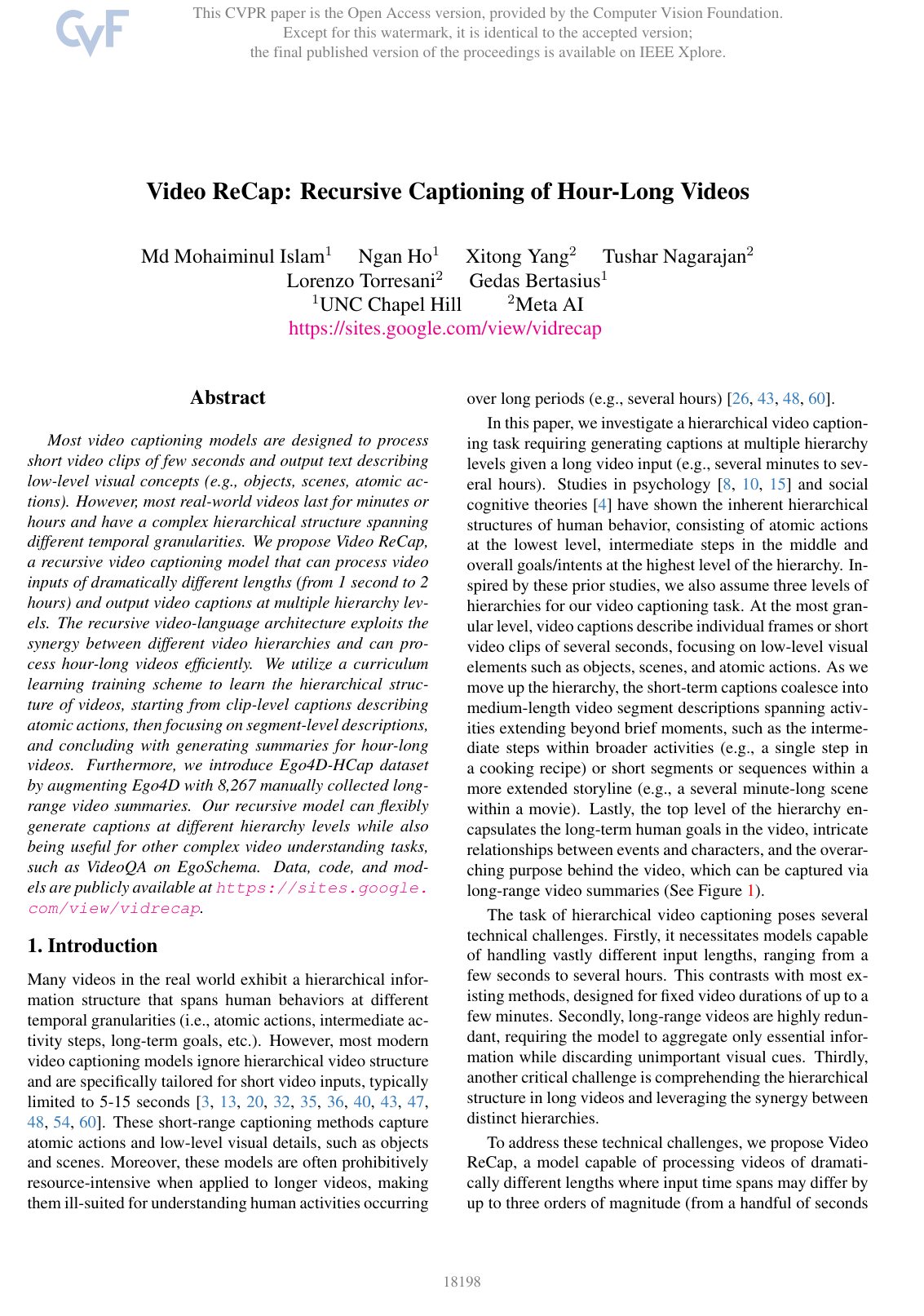
Video ReCap: Recursive Captioning of Hour-Long Videos
Md Mohaiminul Islam, Ngan Ho, Xitong Yang, Tushar Nagarajan, Lorenzo Torresani, Gedas Bertasius
Why you should read this
Presents a recursive video-language model and benchmark dataset that efficiently generate hierarchical captions across multiple temporal granularities for hour-long untrimmed videos.
Most video captioning models are designed to process short video clips of few seconds and output text describing low-level visual concepts (e.g., objects, scenes, atomic actions). However, most real-world videos last for minutes or hours and have a complex hierarchical structure spanning different temporal granularities. We propose Video ReCap, a recursive video captioning model that can process video inputs of dramatically different lengths (from 1 second to 2 hours) and output video captions at multiple hierarchy levels. The recursive video-language architecture exploits the synergy between different video hierarchies and can process hour-long videos efficiently. We utilize a curriculum learning training scheme to learn the hierarchical structure of videos, starting from clip-level captions describing atomic actions, then focusing on segment-level descriptions, and concluding with generating summaries for hour-long videos. Furthermore, we introduce Ego4D-HCap dataset by augmenting Ego4D with 8,267 manually collected long-range video summaries. Our recursive model can flexibly generate captions at different hierarchy levels while also being useful for other complex video understanding tasks, such as VideoQA on EgoSchema. Data, code, and models are publicly available at https://sites.google.com/view/vidrecap.
Added
2026-09-26
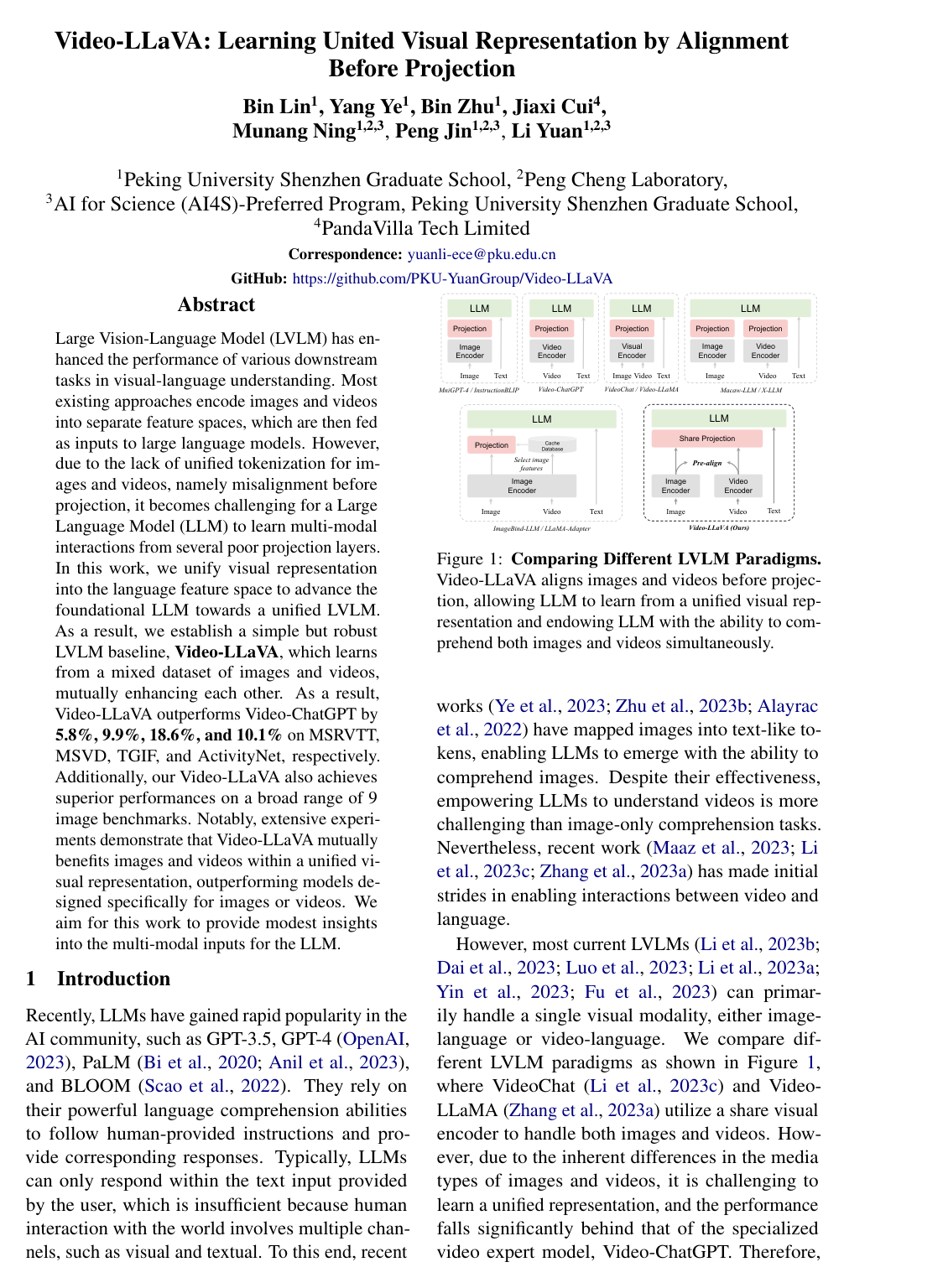
Video-LLaVA: Learning United Visual Representation by Alignment Before Projection
Bin Lin, Yang Ye, Bin Zhu, Jiaxi Cui, Munan Ning, Peng Jin, Li Yuan
Why you should read this
Introduces Video-LLaVA, a vision-language model that aligns image and video features into a single representation before projecting them to a large language model, demonstrating that joint multimodal training outperforms specialized single-modality systems across major image and video benchmarks.
The Large Vision-Language Model (LVLM) has enhanced the performance of various downstream tasks in visual-language understanding. Most existing approaches encode images and videos into separate feature spaces, which are then fed as inputs to large language models. However, due to the lack of unified tokenization for images and videos, namely misalignment before projection, it becomes challenging for a Large Language Model (LLM) to learn multi-modal interactions from several poor projection layers. In this work, we unify visual representation into the language feature space to advance the foundational LLM towards a unified LVLM. As a result, we establish a simple but robust LVLM baseline, Video-LLaVA, which learns from a mixed dataset of images and videos, mutually enhancing each other. Video-LLaVA achieves superior performances on a broad range of 9 image benchmarks across 5 image question-answering datasets and 4 image benchmark toolkits. Additionally, our Video-LLaVA also outperforms Video-ChatGPT by 5.8%, 9.9%, 18.6%, and 10.1% on MSRVTT, MSVD, TGIF, and ActivityNet, respectively. Notably, extensive experiments demonstrate that Video-LLaVA mutually benefits images and videos within a unified visual representation, outperforming models designed specifically for images or videos. We aim for this work to provide modest insights into the multi-modal inputs for the LLM. Code address: \href{this https URL}
Added
2026-09-24