Domain Adaptation for Time Series Under Feature and Label Shifts
Huan HeOwen QueenTeddy KokerConsuelo CuevasTheodoros TsiligkaridisMarinka Zitnik
Presents RAINCOAT, an align-and-correct domain adaptation framework that jointly models time and frequency features to handle both distribution shifts and unseen target labels across diverse time series applications.
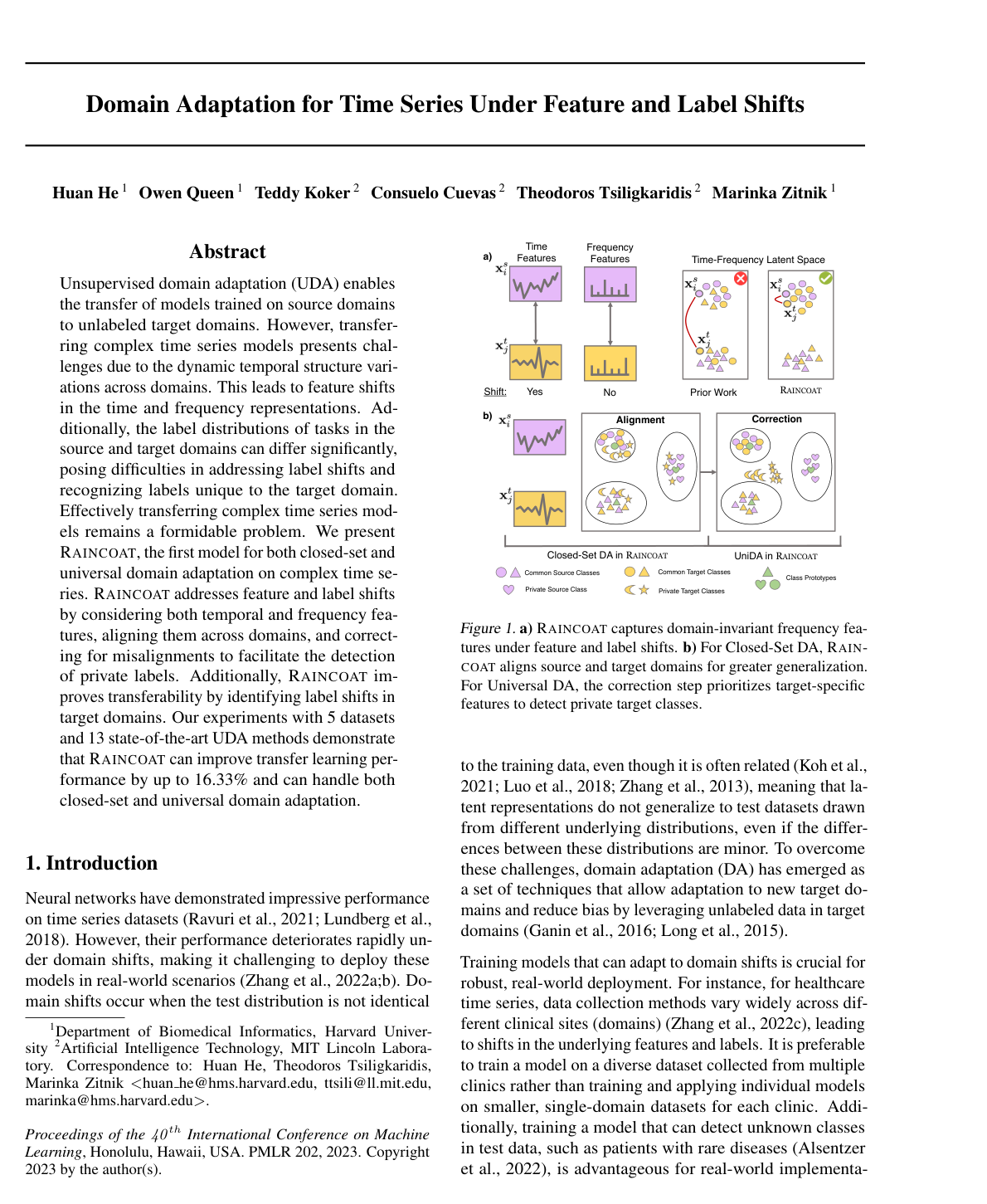
Deploying machine learning models on time series data across different real-world settings presents severe challenges due to domain shifts. Variations in sensor hardware, user behavior, and recording environments alter underlying data features across both the time and frequency domains. Furthermore, target deployment environments frequently contain category shifts—such as novel clinical diagnoses or unseen user activities—where target categories do not fully match the training data. Standard adaptation techniques fail in these scenarios because they ignore frequency-based shifts and cannot reliably detect novel, unobserved categories without labeled target data.
The article develops and evaluates RAINCOAT, an unsupervised domain adaptation framework tailored for complex time series that handles both feature shifts and label shifts. The primary objective is to demonstrate that aligning both temporal and frequency features while correcting for target-specific misalignments enables superior cross-domain generalization and robust identification of previously unseen categories across both closed-set and universal domain adaptation scenarios.
To accomplish this, the authors implemented an "align-then-correct" pipeline. The model first extracts joint temporal and frequency representations (using smoothing and Fourier transforms) and aligns them across domains using Sinkhorn divergence, an optimal transport metric well-suited for disjoint frequency supports. The model is then retrained on a target reconstruction task to adjust feature embeddings. If novel target categories exist, their embeddings drift significantly further from source reference points than common categories do. The framework was evaluated across five benchmark datasets encompassing human activity recognition, mechanical fault detection in industrial boilers, and sleep stage classification from brainwave recordings, comparing performance against 13 baseline domain adaptation methods using standardized convolutional backbones.
The experimental findings show that RAINCOAT consistently outperforms existing methods. In closed-set scenarios where classes match exactly, RAINCOAT achieved an average accuracy improvement of 6.77% and a macro-F1 improvement of 9.00% over the strongest baselines across all datasets, including absolute accuracy gains of up to 10.43% on industrial boiler fault detection and 8.65% on human activity recognition. In universal adaptation settings where target datasets contain novel categories, RAINCOAT improved harmonic mean accuracy by 16.33% over top baselines. Ablation analyses confirmed that adding the frequency encoder alone improved closed-set accuracy by 9.44%, while Sinkhorn alignment provided superior mathematical stability over traditional discrepancy measures without degrading performance when no label shifts were present.
These results demonstrate that explicitly modeling frequency features is vital for time series transfer learning, mitigating shortcut learning where models overfit to surface-level temporal patterns. For decision-makers and system architects, adopting this approach reduces operational risk, maintenance costs, and false predictions when deploying automated monitoring tools to new clinical sites or hardware configurations. Furthermore, the framework automatically identifies novel classes without manual threshold tuning, enabling reliable alerting when unexpected data patterns appear in production.
Organizations deploying automated time series monitoring should integrate dual-domain temporal and frequency alignment and adopt align-then-correct validation workflows to safely flag novel data. Future efforts should test this approach within source-free environments where source training data cannot be shared due to privacy regulations, as well as explore advanced transformer backbones and video adaptation.
While the findings demonstrate high reliability across diverse time series domains, stakeholders should note that frequency modeling offers the most substantial benefit on structured or periodic signals and may provide less leverage on highly irregular or non-stationary patterns. Overall confidence in the method's effectiveness is strongly supported by consistent empirical gains across multiple real-world benchmark tasks and baseline comparisons.
- Paper: Unsupervised Time-Series Representation Learning with Iterative Bilinear Temporal-Spectral Fusion, Ling Yang et al. (2022). Its temporal–spectral fusion provides a useful precursor to RAINCOAT’s use of both time- and frequency-domain representations.
- Paper: Transfer Feature Learning with Joint Distribution Adaptation, Mingsheng Long et al. (2013). Its joint alignment of feature and class-conditional distributions prepares you for RAINCOAT’s treatment of feature and label shifts together.
- Book: Domain-Adversarial Training of Neural Networks, Yaroslav Ganin et al. (2016). Its domain-adversarial training framework establishes the feature-alignment approach that helps contextualize RAINCOAT’s cross-domain alignment.
No sufficiently relevant recommendations were found.