
keyword
time-series classification
Time-series classification is a machine learning and data mining task that involves assigning a discrete categorical label to an entire sequence of data points ordered chronologically over time. Unlike standard classification tasks where inputs are treated as unordered, independent feature vectors, time-series classification explicitly analyzes the temporal dependencies, shapes, and dynamic patterns inherent in univariate or multivariate sequential data. Approaches to solving this problem include distance-based measures, feature-extraction algorithms, ensemble methods, and deep learning architectures such as convolutional and recurrent neural networks, which capture temporal and frequency-based characteristics to identify patterns in real-world domains such as health monitoring, sensor signal analysis, and activity recognition.
12 items
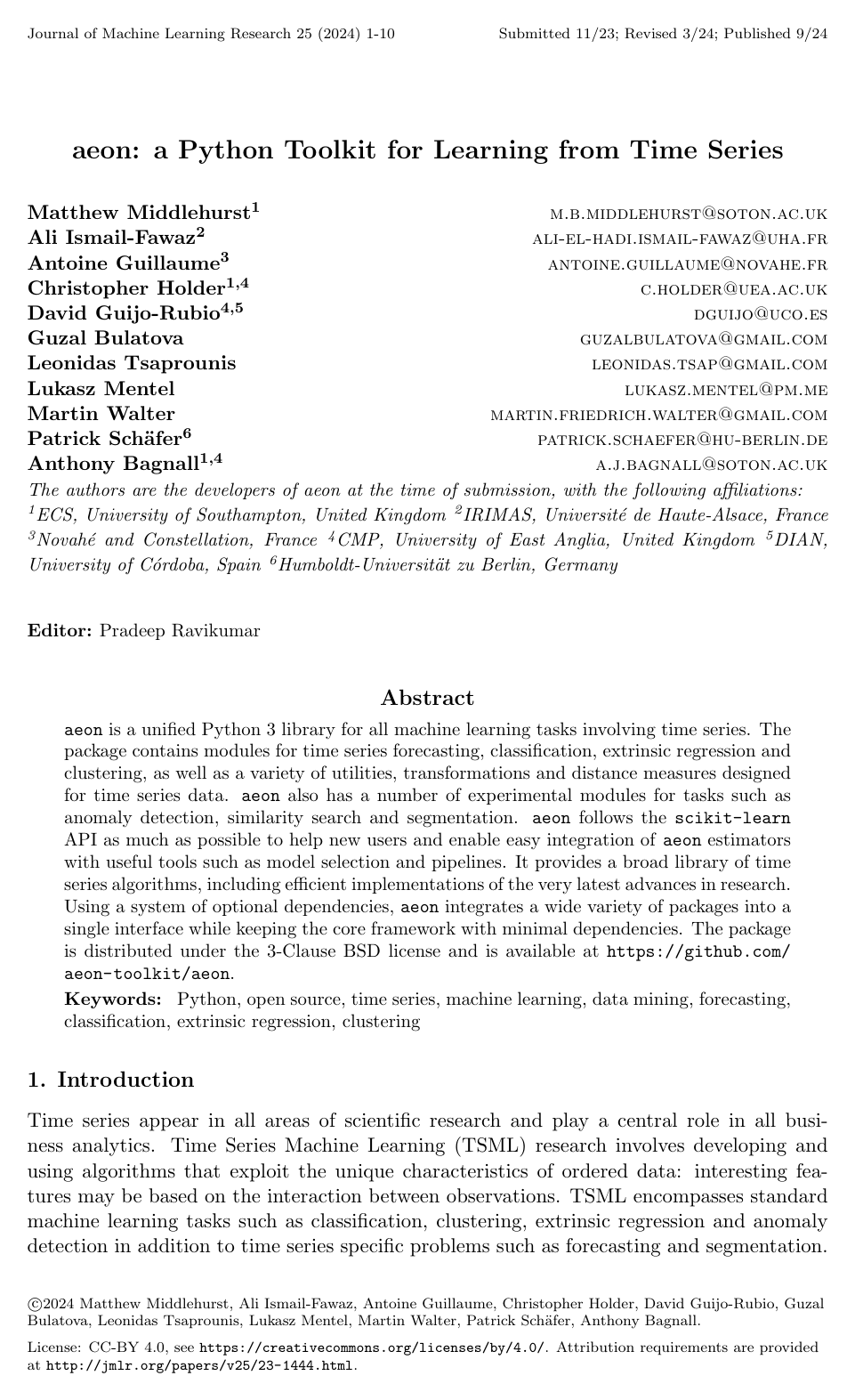
aeon: a Python Toolkit for Learning from Time Series
Matthew Middlehurst, Ali Ismail-Fawaz, Antoine Guillaume, Christopher Holder, David Guijo-Rubio, Guzal Bulatova, Leonidas Tsaprounis, Lukasz Mentel, Martin Walter, Patrick Schäfer, Anthony J. Bagnall
Why you should read this
Presents aeon, a unified, scikit-learn-compatible Python library that standardizes forecasting, classification, regression, and clustering algorithms for time series machine learning within a single, modular framework.
aeon is a unified Python 3 library for all machine learning tasks involving time series. The package contains modules for time series forecasting, classification, extrinsic regression and clustering, as well as a variety of utilities, transformations and distance measures designed for time series data. aeon also has a number of experimental modules for tasks such as anomaly detection, similarity search and segmentation. aeon follows the scikit-learn API as much as possible to help new users and enable easy integration of aeon estimators with useful tools such as model selection and pipelines. It provides a broad library of time series algorithms, including efficient implementations of the very latest advances in research. Using a system of optional dependencies, aeon integrates a wide variety of packages into a single interface while keeping the core framework with minimal dependencies. The package is distributed under the 3-Clause BSD license and is available at https://github.com/aeon-toolkit/aeon.
Added
2026-10-02
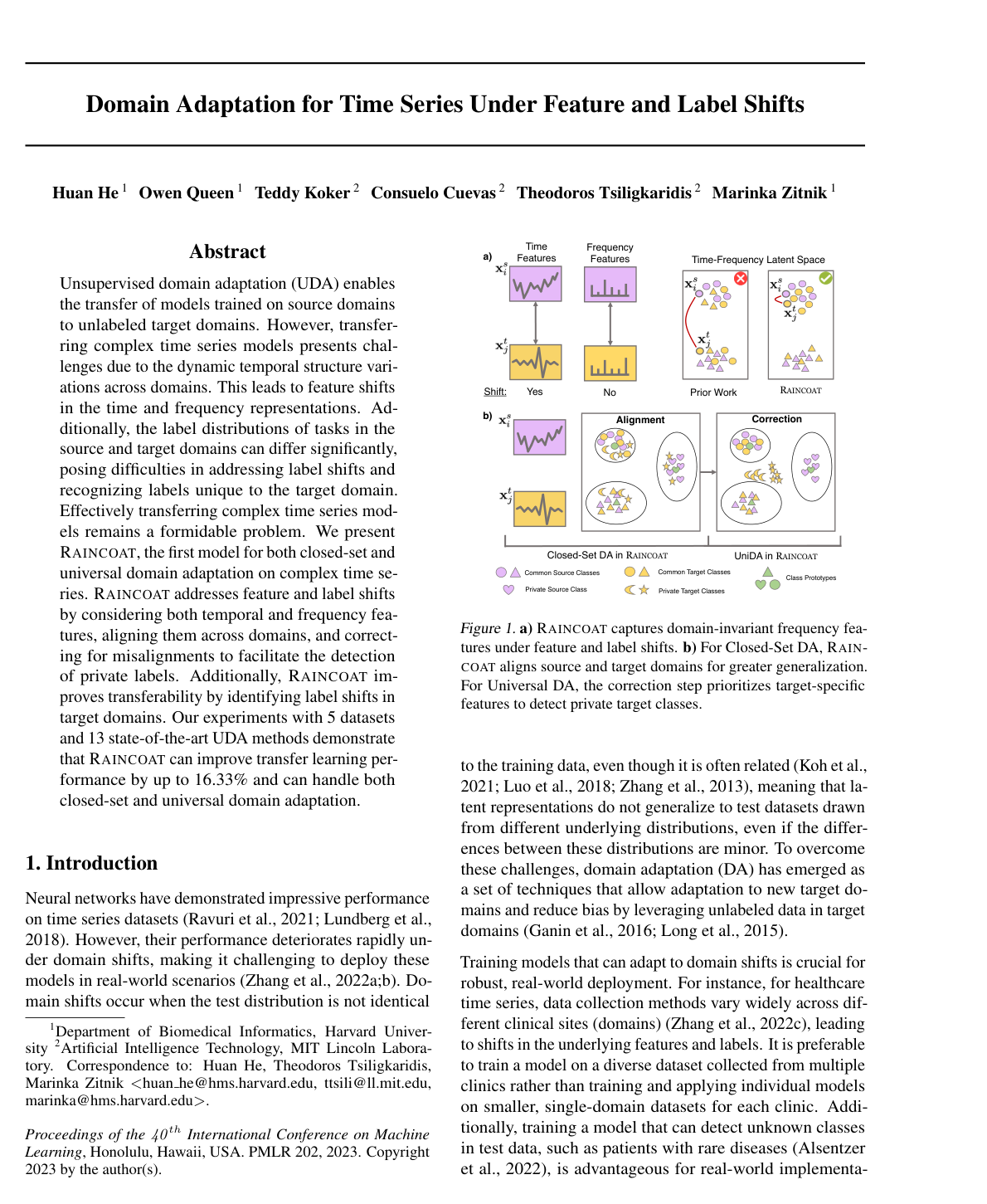
Domain Adaptation for Time Series Under Feature and Label Shifts
Huan He, Owen Queen, Teddy Koker, Consuelo Cuevas, Theodoros Tsiligkaridis, Marinka Zitnik
Why you should read this
Presents RAINCOAT, an align-and-correct domain adaptation framework that jointly models time and frequency features to handle both distribution shifts and unseen target labels across diverse time series applications.
Unsupervised domain adaptation (UDA) enables the transfer of models trained on source domains to unlabeled target domains. However, transferring complex time series models presents challenges due to the dynamic temporal structure variations across domains. This leads to feature shifts in the time and frequency representations. Additionally, the label distributions of tasks in the source and target domains can differ significantly, posing difficulties in addressing label shifts and recognizing labels unique to the target domain. Effectively transferring complex time series models remains a formidable problem. We present RAINCOAT, the first model for both closed-set and universal domain adaptation on complex time series. RAINCOAT addresses feature and label shifts by considering both temporal and frequency features, aligning them across domains, and correcting for misalignments to facilitate the detection of private labels. Additionally, RAINCOAT improves transferability by identifying label shifts in target domains. Our experiments with 5 datasets and 13 state-of-the-art UDA methods demonstrate that RAINCOAT can improve transfer learning performance by up to 16.33% and can handle both closed-set and universal domain adaptation.
Added
2026-10-01
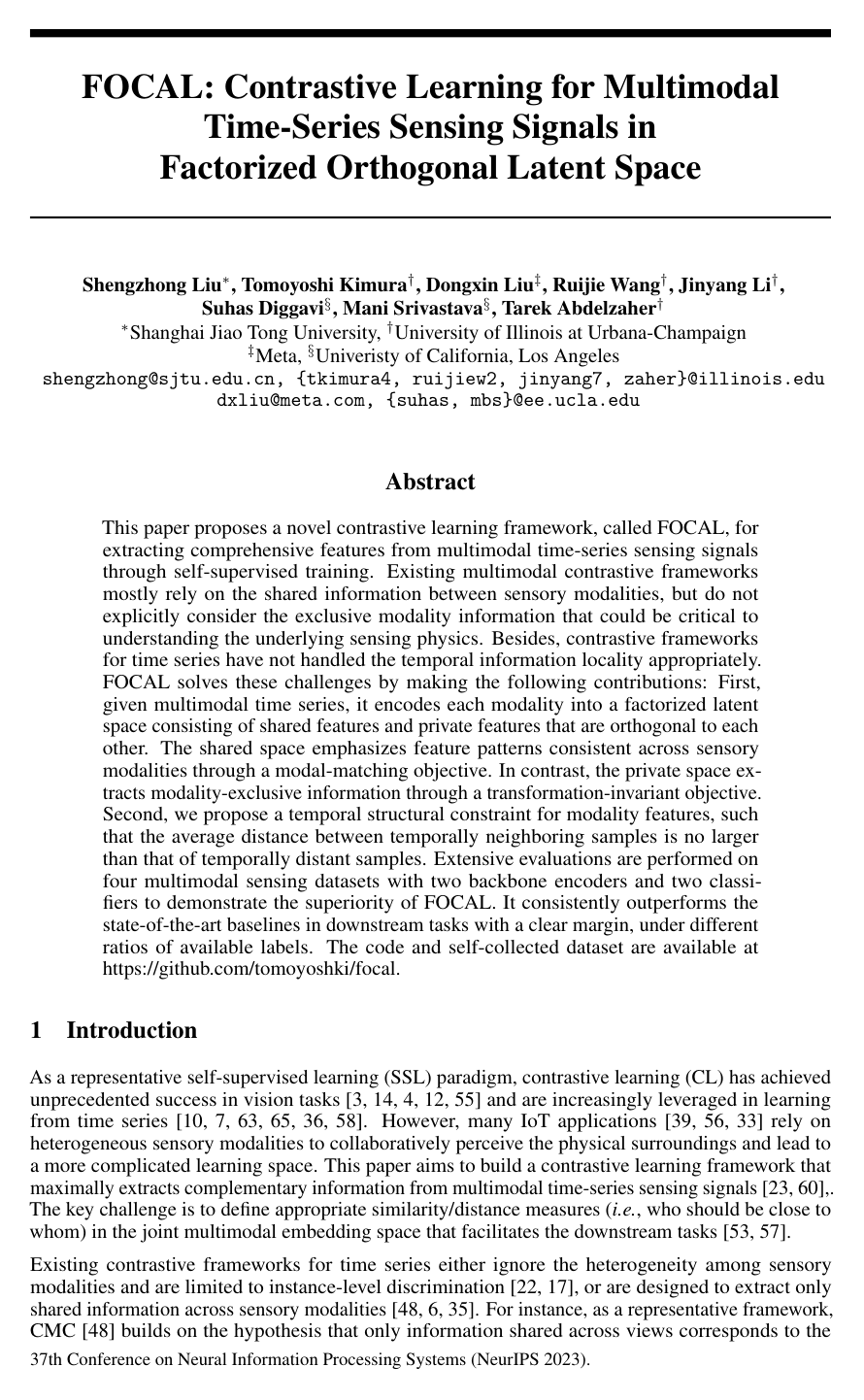
FOCAL: Contrastive Learning for Multimodal Time-Series Sensing Signals in Factorized Orthogonal Latent Space
Shengzhong Liu, Tomoyoshi Kimura, Dongxin Liu, Ruijie Wang, Jinyang Li, Suhas N. Diggavi, Mani B. Srivastava, Tarek F. Abdelzaher
Why you should read this
Proposes a self-supervised contrastive learning framework that factorizes multimodal time-series signals into orthogonal shared and private latent spaces alongside statistical temporal constraints to achieve state-of-the-art representation quality across diverse sensing datasets.
This paper proposes a novel contrastive learning framework, called FOCAL, for extracting comprehensive features from multimodal time-series sensing signals through self-supervised training. Existing multimodal contrastive frameworks mostly rely on the shared information between sensory modalities, but do not explicitly consider the exclusive modality information that could be critical to understanding the underlying sensing physics. Besides, contrastive frameworks for time series have not handled the temporal information locality appropriately. FOCAL solves these challenges by making the following contributions: First, given multimodal time series, it encodes each modality into a factorized latent space consisting of shared features and private features that are orthogonal to each other. The shared space emphasizes feature patterns consistent across sensory modalities through a modal-matching objective. In contrast, the private space extracts modality-exclusive information through a transformation-invariant objective. Second, we propose a temporal structural constraint for modality features, such that the average distance between temporally neighboring samples is no larger than that of temporally distant samples. Extensive evaluations are performed on four multimodal sensing datasets with two backbone encoders and two classifiers to demonstrate the superiority of FOCAL. It consistently outperforms the state-of-the-art baselines in downstream tasks with a clear margin, under different ratios of available labels. The code and self-collected dataset are available at https://github.com/tomoyoshki/focal.
Added
2026-09-26
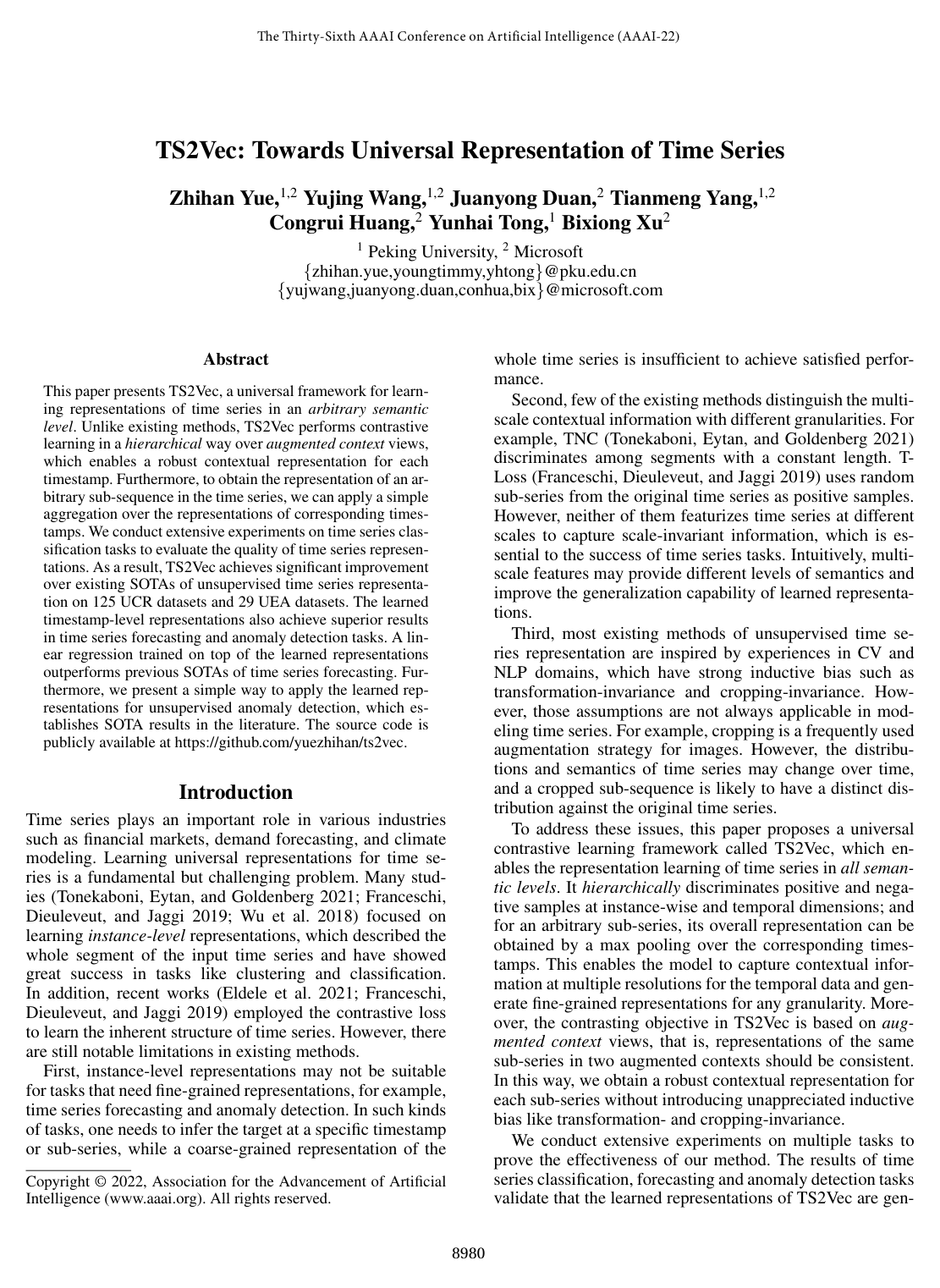
TS2Vec: Towards Universal Representation of Time Series
Zhihan Yue, Yujing Wang, Juanyong Duan, Tianmeng Yang, Congrui Huang, Yunhai Tong, Bixiong Xu
Why you should read this
Proposes a universal contrastive learning framework that uses hierarchical contrasting and contextual consistency to learn multiscale time series representations, achieving state-of-the-art results across classification, forecasting, and anomaly detection benchmarks.
This paper presents TS2Vec, a universal framework for learning representations of time series in an arbitrary semantic level. Unlike existing methods, TS2Vec performs contrastive learning in a hierarchical way over augmented context views, which enables a robust contextual representation for each timestamp. Furthermore, to obtain the representation of an arbitrary sub-sequence in the time series, we can apply a simple aggregation over the representations of corresponding timestamps. We conduct extensive experiments on time series classification tasks to evaluate the quality of time series representations. As a result, TS2Vec achieves significant improvement over existing SOTAs of unsupervised time series representation on 125 UCR datasets and 29 UEA datasets. The learned timestamp-level representations also achieve superior results in time series forecasting and anomaly detection tasks. A linear regression trained on top of the learned representations outperforms previous SOTAs of time series forecasting. Furthermore, we present a simple way to apply the learned representations for unsupervised anomaly detection, which establishes SOTA results in the literature. The source code is publicly available at https://github.com/yuezhihan/ts2vec.
Added
2026-09-26
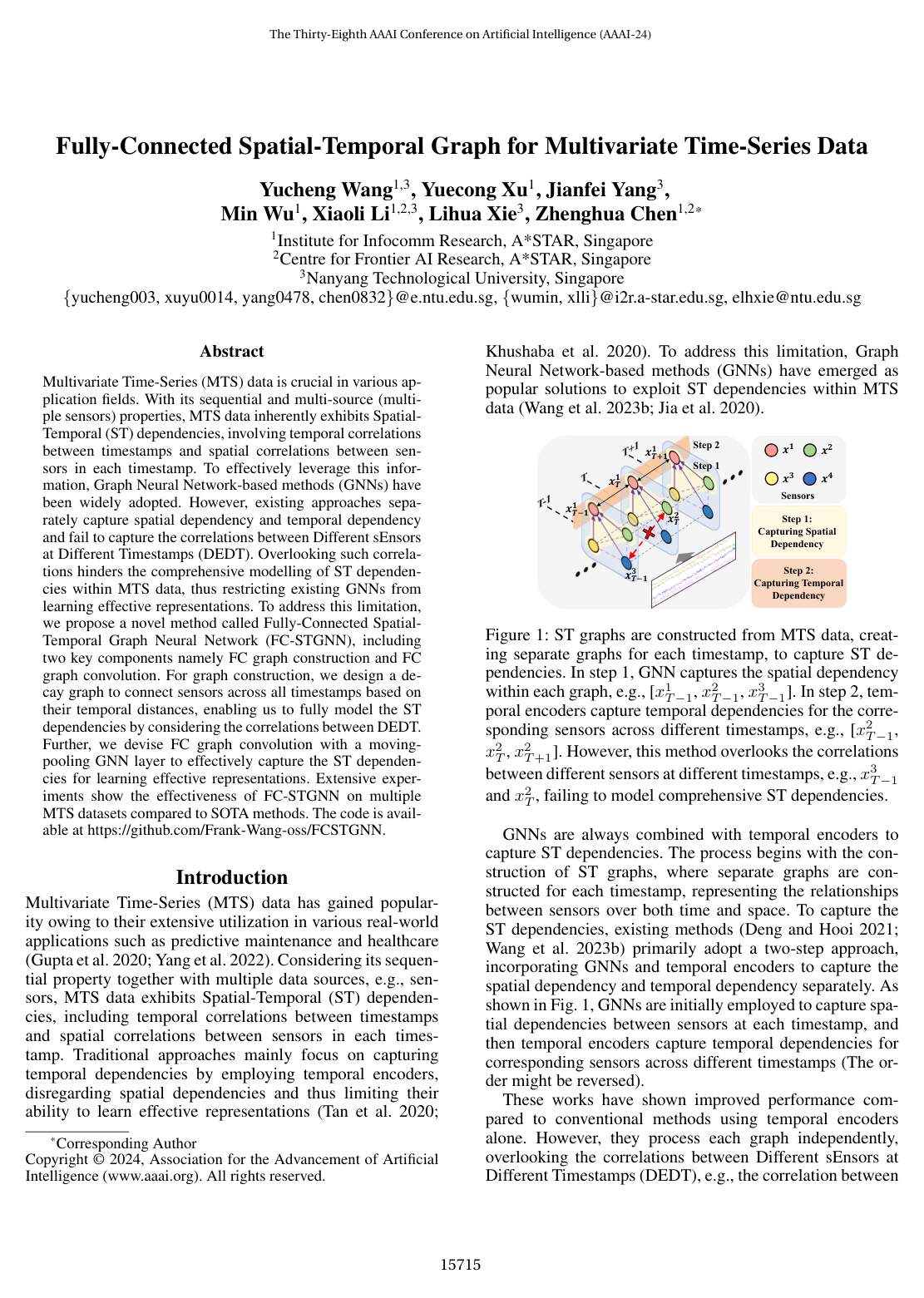
Fully-Connected Spatial-Temporal Graph for Multivariate Time-Series Data
Yucheng Wang, Yuecong Xu, Jianfei Yang, Min Wu, Xiaoli Li, Lihua Xie, Zhenghua Chen
Why you should read this
Proposes a fully-connected spatial-temporal graph neural network that models cross-sensor correlations across different timestamps using distance-based decay graphs and moving-pooling convolutions for improved multivariate time-series representation learning.
Added
2026-09-26
TimesURL: Self-Supervised Contrastive Learning for Universal Time Series Representation Learning
Jiexi Liu, Songcan Chen
Why you should read this
Proposes TimesURL, a self-supervised framework combining frequency-temporal data augmentations, synthesized Universum hard negatives, and a joint reconstruction objective to learn universal time series representations that achieve state-of-the-art results across six distinct downstream tasks.
Learning universal time series representations applicable to various types of downstream tasks is challenging but valuable in real applications. Recently, researchers have attempted to leverage the success of self-supervised contrastive learning (SSCL) in Computer Vision(CV) and Natural Language Processing(NLP) to tackle time series representation. Nevertheless, due to the special temporal characteristics, relying solely on empirical guidance from other domains may be ineffective for time series and difficult to adapt to multiple downstream tasks. To this end, we review three parts involved in SSCL including 1) designing augmentation methods for positive pairs, 2) constructing (hard) negative pairs, and 3) designing SSCL loss. For 1) and 2), we find that unsuitable positive and negative pair construction may introduce inappropriate inductive biases, which neither preserve temporal properties nor provide sufficient discriminative features. For 3), just exploring segment- or instance-level semantics information is not enough for learning universal representation. To remedy the above issues, we propose a novel self-supervised framework named TimesURL. Specifically, we first introduce a frequency-temporal-based augmentation to keep the temporal property unchanged. And then, we construct double Universums as a special kind of hard negative to guide better contrastive learning. Additionally, we introduce time reconstruction as a joint optimization objective with contrastive learning to capture both segment-level and instance-level information. As a result, TimesURL can learn high-quality universal representations and achieve state-of-the-art performance in 6 different downstream tasks, including short- and long-term forecasting, imputation, classification, anomaly detection and transfer learning.
Added
2026-09-26
LSTM Fully Convolutional Networks for Time Series Classification
Fazle Karim, Somshubra Majumdar, Houshang Darabi, Shun Chen
Why you should read this
Introduces LSTM-augmented fully convolutional neural networks that achieve state-of-the-art time series classification performance with minimal data preprocessing while enabling model decision visualization through attention mechanisms.
Fully convolutional neural networks (FCN) have been shown to achieve state-of-the-art performance on the task of classifying time series sequences. We propose the augmentation of fully convolutional networks with long short term memory recurrent neural network (LSTM RNN) sub-modules for time series classification. Our proposed models significantly enhance the performance of fully convolutional networks with a nominal increase in model size and require minimal preprocessing of the dataset. The proposed Long Short Term Memory Fully Convolutional Network (LSTM-FCN) achieves state-of-the-art performance compared to others. We also explore the usage of attention mechanism to improve time series classification with the Attention Long Short Term Memory Fully Convolutional Network (ALSTM-FCN). Utilization of the attention mechanism allows one to visualize the decision process of the LSTM cell. Furthermore, we propose fine-tuning as a method to enhance the performance of trained models. An overall analysis of the performance of our model is provided and compared to other techniques.
Added
2026-09-25
A Transformer-based Framework for Multivariate Time Series Representation Learning
George Zerveas, Srideepika Jayaraman, Dhaval Patel, Anuradha Bhamidipaty, Carsten Eickhoff
Why you should read this
Proposes an unsupervised transformer-based representation learning framework for multivariate time series that outperforms state-of-the-art supervised methods on downstream classification and regression tasks, even under limited training data settings.
In this work we propose for the first time a transformer-based framework for unsupervised representation learning of multivariate time series. Pre-trained models can be potentially used for downstream tasks such as regression and classification, forecasting and missing value imputation. By evaluating our models on several benchmark datasets for multivariate time series regression and classification, we show that not only does our modeling approach represent the most successful method employing unsupervised learning of multivariate time series presented to date, but also that it exceeds the current state-of-the-art performance of supervised methods; it does so even when the number of training samples is very limited, while offering computational efficiency. Finally, we demonstrate that unsupervised pre-training of our transformer models offers a substantial performance benefit over fully supervised learning, even without leveraging additional unlabeled data, i.e., by reusing the same data samples through the unsupervised objective.
Added
2026-09-24
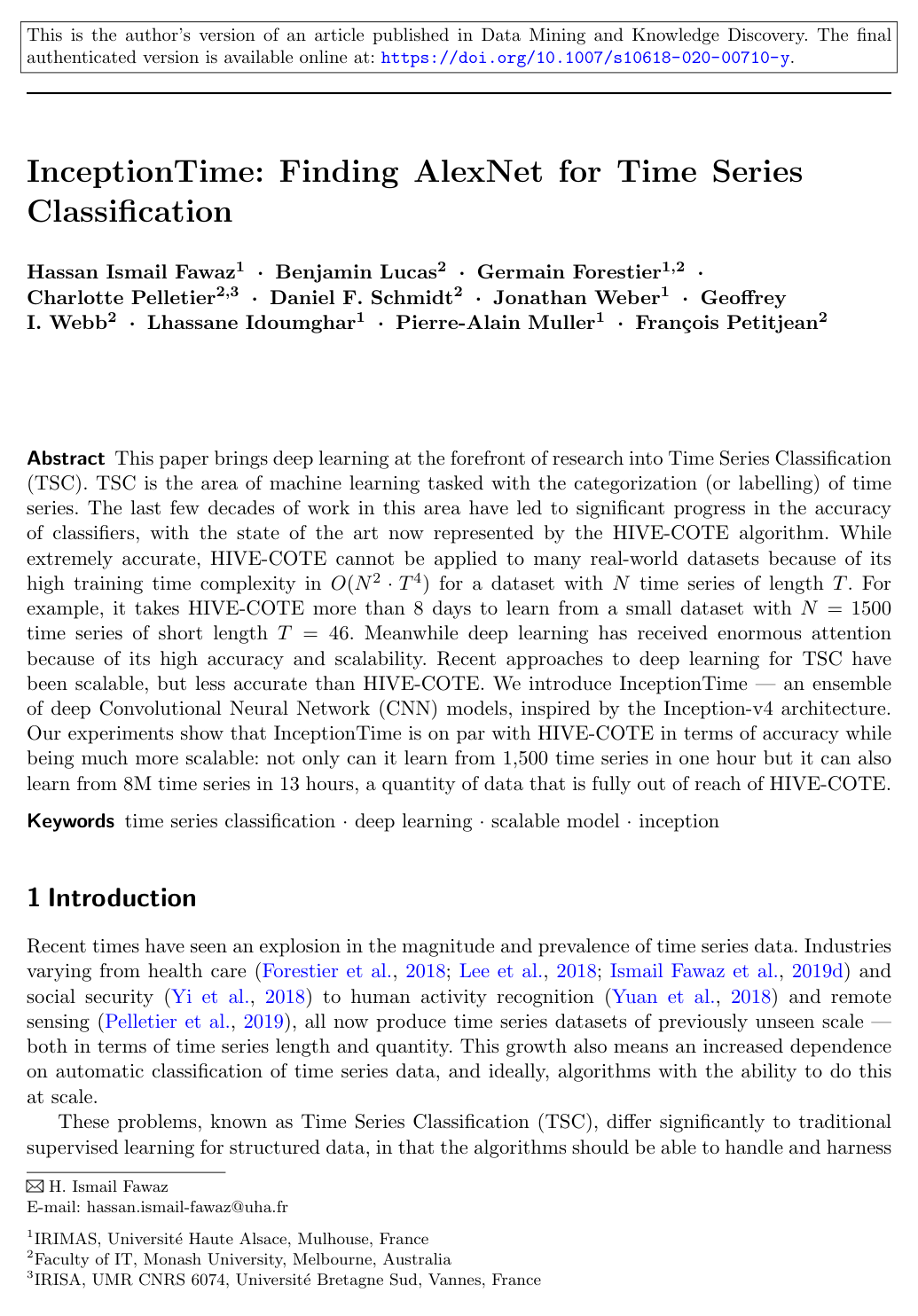
InceptionTime: Finding AlexNet for time series classification
Hassan Ismail Fawaz, Benjamin Lucas, Germain Forestier, Charlotte Pelletier, Daniel F. Schmidt, Jonathan Weber, Geoffrey I. Webb, Lhassane Idoumghar, Pierre-Alain Muller, François Petitjean
Why you should read this
Introduces InceptionTime, an ensemble of deep convolutional neural networks that matches the state-of-the-art accuracy of HIVE-COTE for time series classification while training orders of magnitude faster and scaling to millions of sequences.
This paper brings deep learning at the forefront of research into Time Series Classification (TSC). TSC is the area of machine learning tasked with the categorization (or labelling) of time series. The last few decades of work in this area have led to significant progress in the accuracy of classifiers, with the state of the art now represented by the HIVE-COTE algorithm. While extremely accurate, HIVE-COTE cannot be applied to many real-world datasets because of its high training time complexity in O(N2 * T4) for a dataset with N time series of length T. For example, it takes HIVE-COTE more than 8 days to learn from a small dataset with N = 1500 time series of short length T = 46. Meanwhile deep learning has received enormous attention because of its high accuracy and scalability. Recent approaches to deep learning for TSC have been scalable, but less accurate than HIVE-COTE. We introduce InceptionTime - an ensemble of deep Convolutional Neural Network (CNN) models, inspired by the Inception-v4 architecture. Our experiments show that InceptionTime is on par with HIVE-COTE in terms of accuracy while being much more scalable: not only can it learn from 1,500 time series in one hour but it can also learn from 8M time series in 13 hours, a quantity of data that is fully out of reach of HIVE-COTE.
Added
2026-09-24
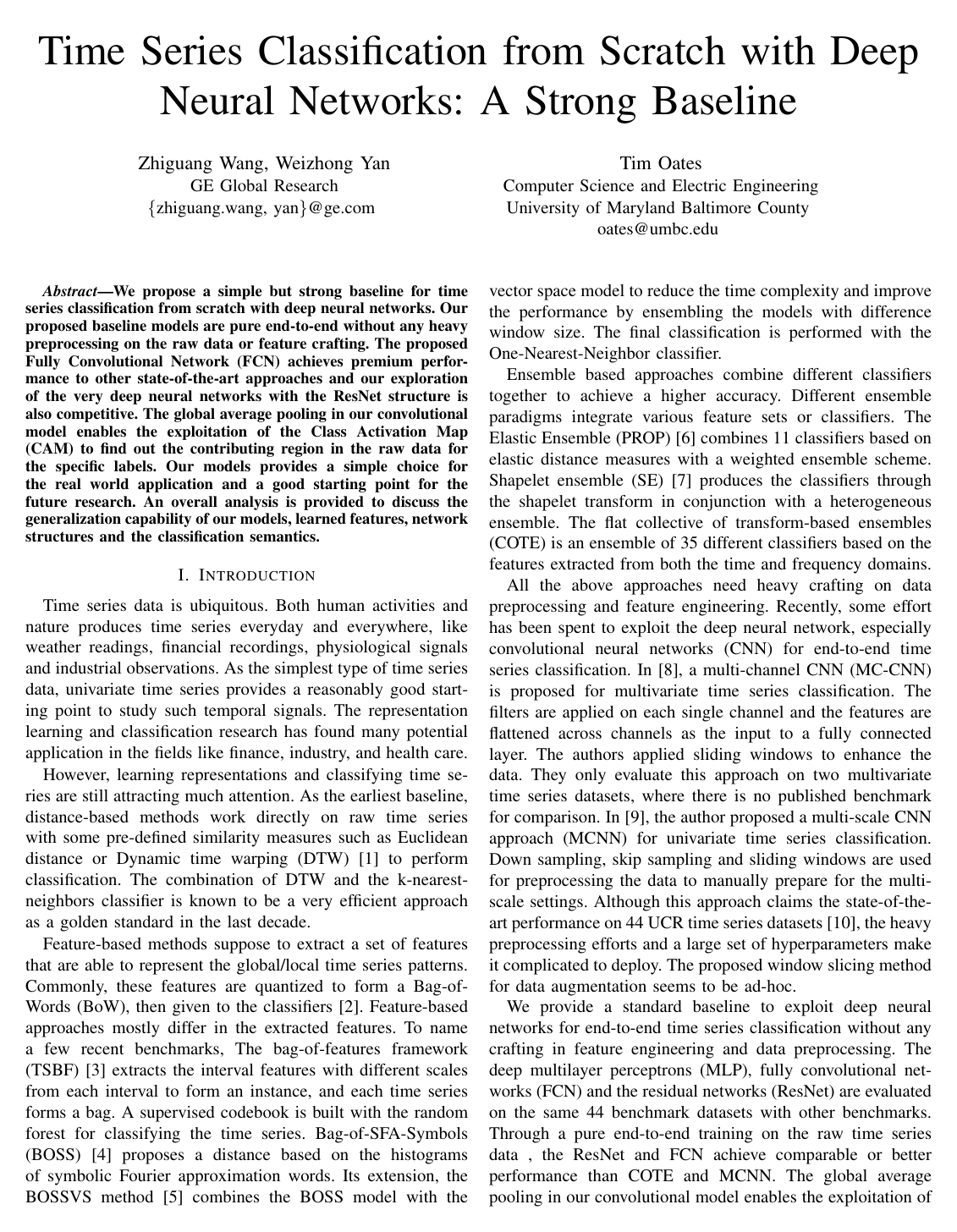
Time series classification from scratch with deep neural networks: A strong baseline
Zhiguang Wang, Weizhong Yan, Tim Oates
Why you should read this
Establishes Fully Convolutional Networks and Residual Networks as standard end-to-end baselines for raw time series classification, eliminating manual feature engineering while providing visual interpretability through Class Activation Maps.
We propose a simple but strong baseline for time series classification from scratch with deep neural networks. Our proposed baseline models are pure end-to-end without any heavy preprocessing on the raw data or feature crafting. The proposed Fully Convolutional Network (FCN) achieves premium performance to other state-of-the-art approaches and our exploration of the very deep neural networks with the ResNet structure is also competitive. The global average pooling in our convolutional model enables the exploitation of the Class Activation Map (CAM) to find out the contributing region in the raw data for the specific labels. Our models provides a simple choice for the real world application and a good starting point for the future research. An overall analysis is provided to discuss the generalization capability of our models, learned features, network structures and the classification semantics.
Added
2026-09-18
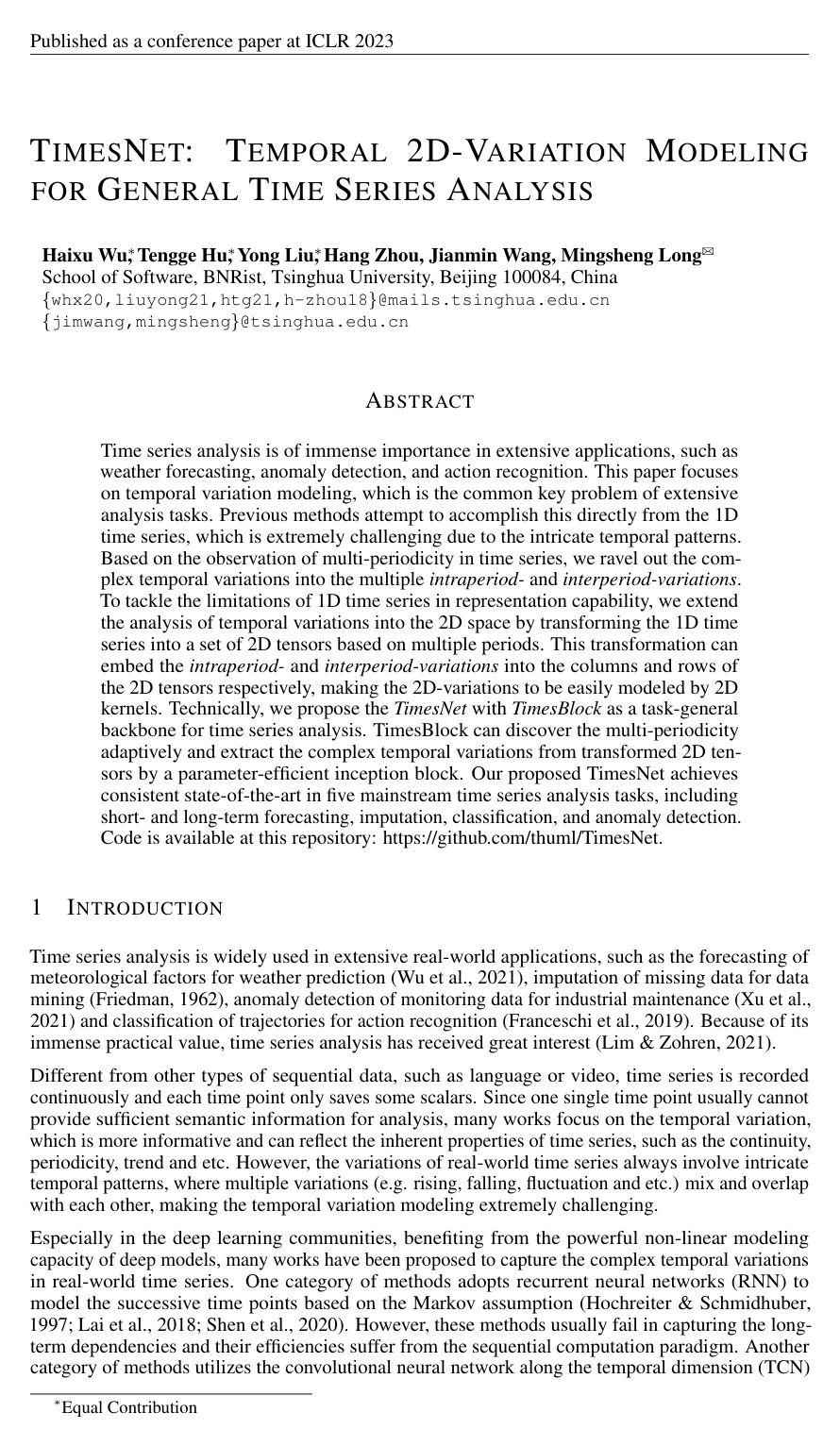
TimesNet: Temporal 2D-Variation Modeling for General Time Series Analysis
Haixu Wu, Teng Hu, Yong Liu, Hang Zhou, Jianmin Wang, Mingsheng Long
Why you should read this
Proposes TimesNet, a general time series backbone that transforms 1D signals into multi-periodic 2D tensors to capture intra- and inter-period variations using 2D kernels, achieving state-of-the-art performance across forecasting, imputation, classification, and anomaly detection.
Time series analysis is of immense importance in extensive applications, such as weather forecasting, anomaly detection, and action recognition. This paper focuses on temporal variation modeling, which is the common key problem of extensive analysis tasks. Previous methods attempt to accomplish this directly from the 1D time series, which is extremely challenging due to the intricate temporal patterns. Based on the observation of multi-periodicity in time series, we ravel out the complex temporal variations into the multiple intraperiod- and interperiod-variations. To tackle the limitations of 1D time series in representation capability, we extend the analysis of temporal variations into the 2D space by transforming the 1D time series into a set of 2D tensors based on multiple periods. This transformation can embed the intraperiod- and interperiod-variations into the columns and rows of the 2D tensors respectively, making the 2D-variations to be easily modeled by 2D kernels. Technically, we propose the TimesNet with TimesBlock as a task-general backbone for time series analysis. TimesBlock can discover the multi-periodicity adaptively and extract the complex temporal variations from transformed 2D tensors by a parameter-efficient inception block. Our proposed TimesNet achieves consistent state-of-the-art in five mainstream time series analysis tasks, including short- and long-term forecasting, imputation, classification, and anomaly detection. Code is available at this repository: this https URL.
Added
2026-09-14
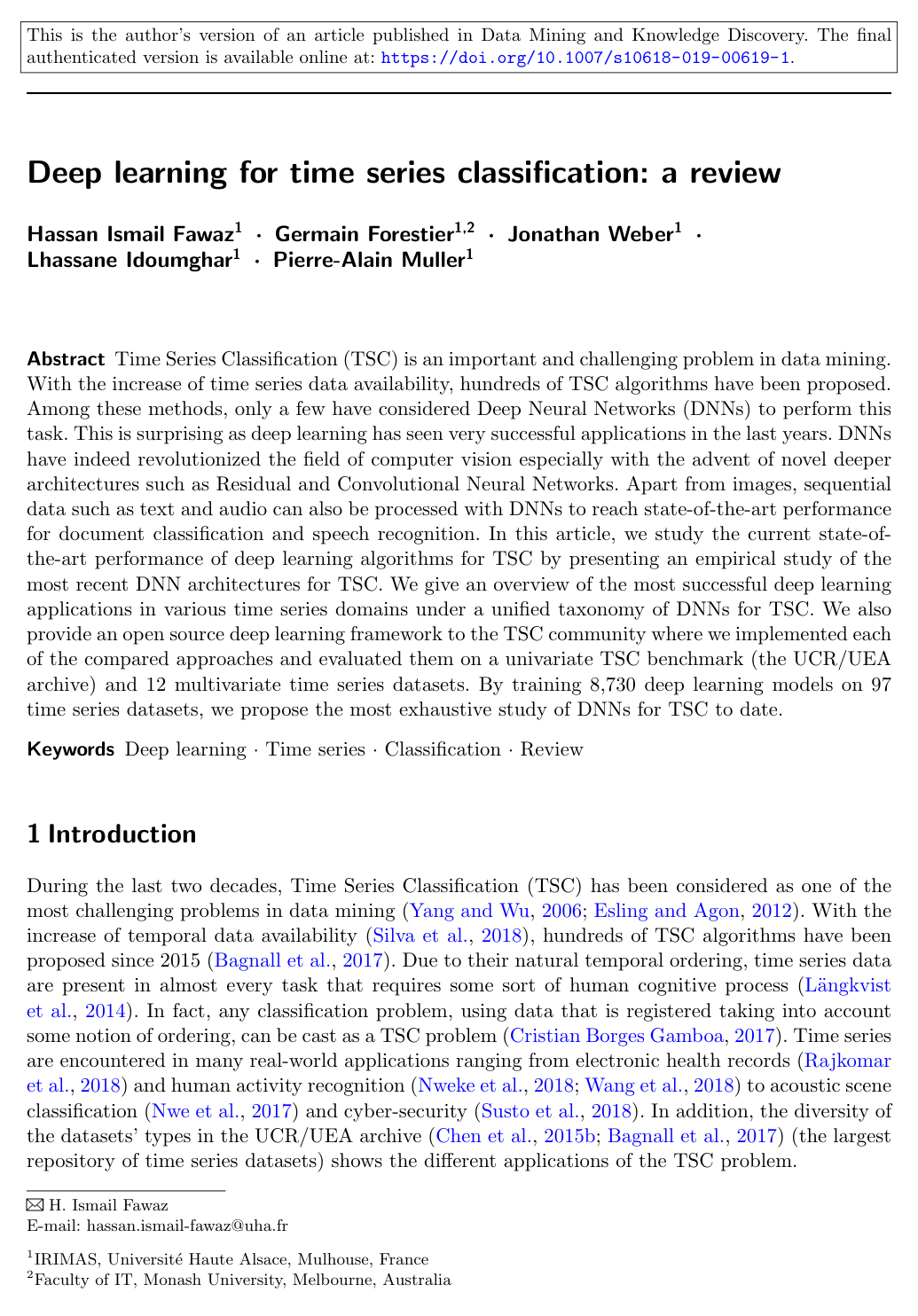
Deep learning for time series classification: a review
Hassan Ismail Fawaz, Germain Forestier, Jonathan Weber, Lhassane Idoumghar, Pierre-Alain Muller
Why you should read this
Establishes an empirical benchmark for deep learning in time series classification by evaluating 8,730 neural network models across 97 univariate and multivariate datasets, providing a unified taxonomy and an open-source framework.
Time Series Classification (TSC) is an important and challenging problem in data mining. With the increase of time series data availability, hundreds of TSC algorithms have been proposed. Among these methods, only a few have considered Deep Neural Networks (DNNs) to perform this task. This is surprising as deep learning has seen very successful applications in the last years. DNNs have indeed revolutionized the field of computer vision especially with the advent of novel deeper architectures such as Residual and Convolutional Neural Networks. Apart from images, sequential data such as text and audio can also be processed with DNNs to reach state-of-the-art performance for document classification and speech recognition. In this article, we study the current state-of-the-art performance of deep learning algorithms for TSC by presenting an empirical study of the most recent DNN architectures for TSC. We give an overview of the most successful deep learning applications in various time series domains under a unified taxonomy of DNNs for TSC. We also provide an open source deep learning framework to the TSC community where we implemented each of the compared approaches and evaluated them on a univariate TSC benchmark (the UCR/UEA archive) and 12 multivariate time series datasets. By training 8,730 deep learning models on 97 time series datasets, we propose the most exhaustive study of DNNs for TSC to date.
Added
2026-09-11