Multi-View Consistent Generative Adversarial Networks for 3D-aware Image Synthesis
Xuanmeng ZhangZhedong ZhengDaiheng GaoBang ZhangPan PanYi Yang
Proposes a 3D-aware generative adversarial network that enforces explicit multi-view geometric and photometric consistency constraints during training to prevent visual artifacts and synthesize high-resolution, view-consistent images across wide pose variations.
Generating realistic 3D images with precise camera viewpoint control is essential for modern computer vision and graphics applications. Traditional approaches typically model 2D image collections without internal 3D structural awareness, while existing 3D-aware generative models often optimize camera views independently. This lack of explicit multi-view geometric constraints frequently leads to collapsed shapes or noticeable visual inconsistencies, such as shifting facial features, when viewing angles change significantly.
The article introduces and evaluates Multi-View Consistent Generative Adversarial Networks (MVCGAN), a framework designed to synthesize high-resolution, photorealistic images from unposed 2D datasets while strictly preserving 3D structural consistency across various viewpoints.
The researchers established geometric correspondence between different camera views using projective warping based on rendered depth maps. They optimized pairs of views jointly during training by enforcing photometric consistency and applying a stereo mixing technique to maintain realistic image properties. To overcome the high computational cost of full-resolution 3D rendering, the authors developed a two-stage hybrid architecture: the model first establishes underlying 3D geometry at a lower resolution and subsequently refines fine 2D visual details at higher resolutions up to 512x512 pixels. The approach was evaluated on three standard benchmark datasets: CELEBA-HQ, FFHQ, and AFHQv2.
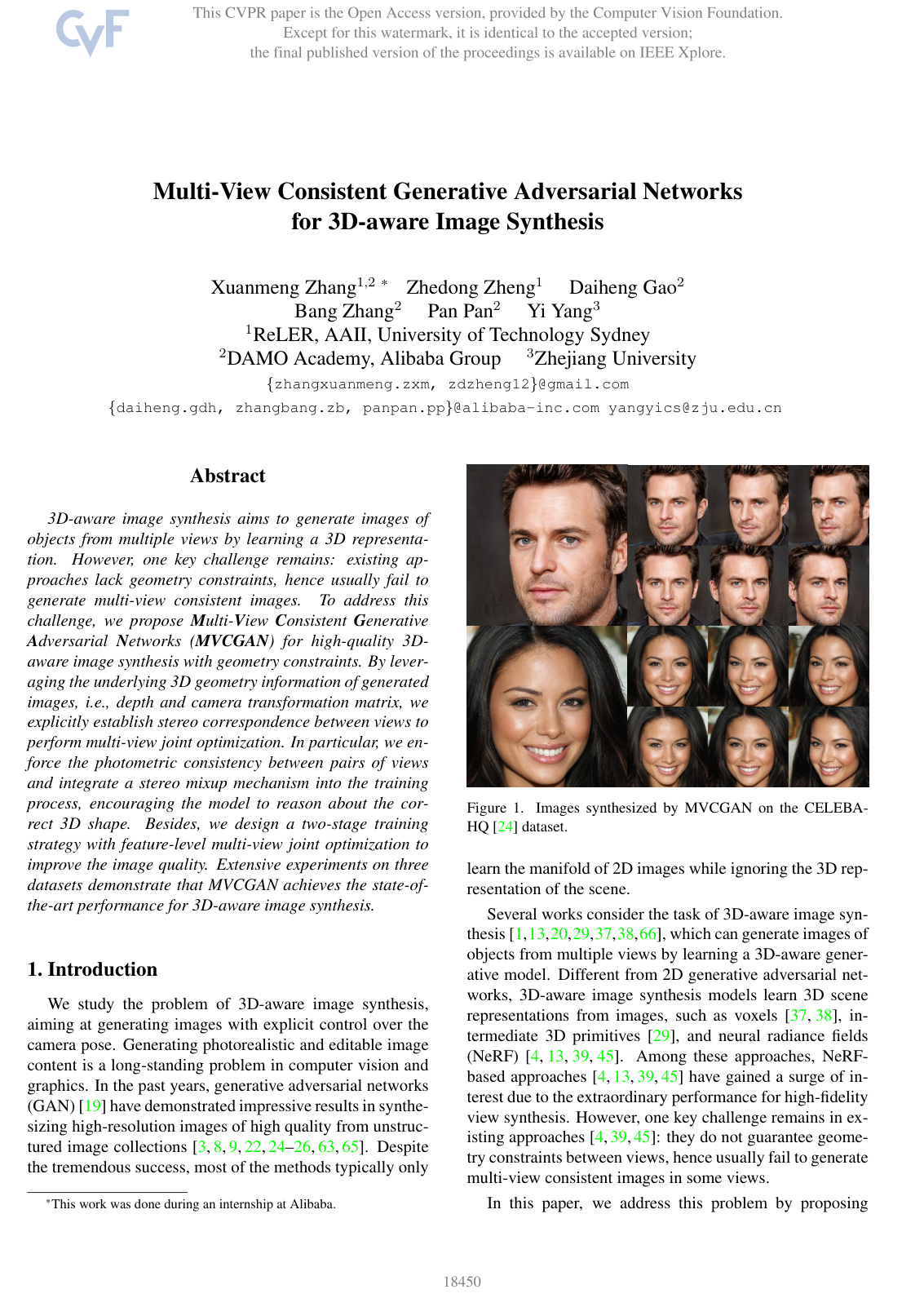
The experimental findings show substantial improvements over previous state-of-the-art methods across all tested benchmarks. For instance, at 512x512 resolution on the FFHQ dataset, the proposed method reduced the standard image quality error metric (Frechet Inception Distance) to 13.4, compared to scores ranging between 37.7 and 71.2 for competing models, representing an improvement of roughly 64% to 81%. On CELEBA-HQ at the same resolution, the error decreased from over 36.0 in existing methods to 12.9. Qualitative evaluations confirmed that synthesized images maintained coherent identity and structural integrity under wide camera pose variations, successfully separating 3D shape control from 2D texture details.
These results demonstrate that enforcing explicit multi-view geometric constraints resolves the trade-off between 3D viewpoint consistency and computational rendering efficiency. For technical stakeholders, this offers a practical method to generate controllable, high-fidelity visual assets from standard 2D image libraries without requiring expensive 3D scans or multi-camera setups.
Organizations developing 3D generative pipelines should consider incorporating multi-view warping constraints and hybrid rendering strategies into their model architectures. However, the current model is specifically designed for single-object subjects with uncluttered backgrounds and struggles with complex multi-object scenes. Future work should focus on developing compositional radiance fields to segment complex backgrounds and foreground objects before applying this framework in unconstrained real-world environments.
- Paper: GIRAFFE: Representing Scenes as Compositional Generative Neural Feature Fields, Michael Niemeyer et al. (2021). GIRAFFE established the foundational paradigm of combining neural feature fields with 2D upsampling networks for 3D-aware generative image synthesis from unposed image collections.
- Paper: Efficient Geometry-aware 3D Generative Adversarial Networks, Eric R. Chan et al. (2022). EG3D introduces the tri-plane hybrid 3D GAN architecture and dual discrimination setup that modern 3D-aware GANs build upon and seek to make geometrically consistent.
- Paper: Unsupervised Learning of Depth and Ego-Motion from Video, Tinghui Zhou et al. (2017). This paper presents the essential photometric warping consistency formulation between novel camera views using estimated depth and poses.
- Paper: Volume Rendering of Neural Implicit Surfaces, Lior Yariv et al. (2021). VolSDF provides the geometric formulation linking volume rendering with surface implicit functions, directly informing the depth and geometry extraction mechanisms used in 3D-aware models.
- Paper: A Style-Based Generator Architecture for Generative Adversarial Networks, Tero Karras et al. (2019). StyleGAN introduces the style-based generator backbone and modulation techniques that underpin modern neural 3D generator architectures.
- Paper: MVSNet: Depth Inference for Unstructured Multi-view Stereo, Yao Yao et al. (2018). MVSNet establishes deep feature warping and differentiable cost volumes for multi-view stereo, underpinning the multi-view correspondence principles used in MVCGAN.
- Paper: DisCoScene: Spatially Disentangled Generative Radiance Fields for Controllable 3D-aware Scene Synthesis, Yinghao Xu et al. (2023). DisCoScene expands single-object 3D-aware generative radiance fields into controllable multi-object scene synthesis using abstract spatial bounding layout priors.
- Paper: Zero-1-to-3: Zero-shot One Image to 3D Object, Ruoshi Liu et al. (2023). Zero-1-to-3 shifts the paradigm from GAN-based multi-view synthesis to zero-shot novel view synthesis and 3D reconstruction powered by diffusion models.
- Paper: SyncDreamer: Generating Multiview-consistent Images from a Single-view Image, Yuan Liu et al. (2024). SyncDreamer extends multi-view consistent generation from single images by replacing adversarial training with synchronized multi-view diffusion attention.
- Paper: Free3D: Consistent Novel View Synthesis Without 3D Representation, Chuanxia Zheng et al. (2024). Free3D advances consistent novel view synthesis by demonstrating multi-view coherence without building an explicit 3D volume representation.
- Paper: Magic123: One Image to High-Quality 3D Object Generation Using Both 2D and 3D Diffusion Priors, Guocheng Qian et al. (2024). Magic123 builds on the goal of high-fidelity single-image 3D generation by uniting 2D and 3D diffusion priors across coarse-to-fine geometry stages.
- Paper: DiffRF: Rendering-Guided 3D Radiance Field Diffusion, Norman Müller et al. (2023). DiffRF explores generative radiance field synthesis by employing explicit 3D voxel diffusion guided by 2D rendering losses.