
keyword
implicit neural representations
Implicit neural representations, also referred to as neural fields or coordinate-based representations, are a framework for parameterizing continuous signals by encoding them directly into the weights of a neural network. Rather than storing data in conventional discrete formats such as pixel grids, voxel arrays, point clouds, or polygonal meshes, an implicit neural representation uses a neural network—typically a multi-layer perceptron—as a continuous function that maps input coordinates, such as spatial positions or timestamps, to their corresponding signal values, such as color, signed distance, density, or amplitude. Because this mapping is continuous and mathematically differentiable, implicit neural representations are inherently resolution-independent, compact, and capable of capturing high-fidelity geometry and complex physical properties across domains such as 3D shape reconstruction, computer graphics, and continuous signal processing.
5 items
Signal Processing for Implicit Neural Representations
Dejia Xu, Peihao Wang, Yifan Jiang, Zhiwen Fan, Zhangyang Wang
Why you should read this
Develops an implicit signal processing framework that uses analytical high-order differential operators to perform continuous convolutions, low-level filtering, and high-level classification directly on coordinate-based neural representations without requiring explicit decoding.
Implicit Neural Representations (INRs) encoding continuous multi-media data via multi-layer perceptrons has shown undebatable promise in various computer vision tasks. Despite many successful applications, editing and processing an INR remains intractable as signals are represented by latent parameters of a neural network. Existing works manipulate such continuous representations via processing on their discretized instance, which breaks down the compactness and continuous nature of INR. In this work, we present a pilot study on the question: how to directly modify an INR without explicit decoding? We answer this question by proposing an implicit neural signal processing network, dubbed INSP-Net, via differential operators on INR. Our key insight is that spatial gradients of neural networks can be computed analytically and are invariant to translation, while mathematically we show that any continuous convolution filter can be uniformly approximated by a linear combination of high-order differential operators. With these two knobs, INSP-Net instantiates the signal processing operator as a weighted composition of computational graphs corresponding to the high-order derivatives of INRs, where the weighting parameters can be data-driven learned. Based on our proposed INSP-Net, we further build the first Convolutional Neural Network (CNN) that implicitly runs on INRs, named INSP-ConvNet. Our experiments validate the expressiveness of INSP-Net and INSP-ConvNet in fitting low-level image and geometry processing kernels (e.g. blurring, deblurring, denoising, inpainting, and smoothening) as well as for high-level tasks on implicit fields such as image classification.
Added
2026-09-26
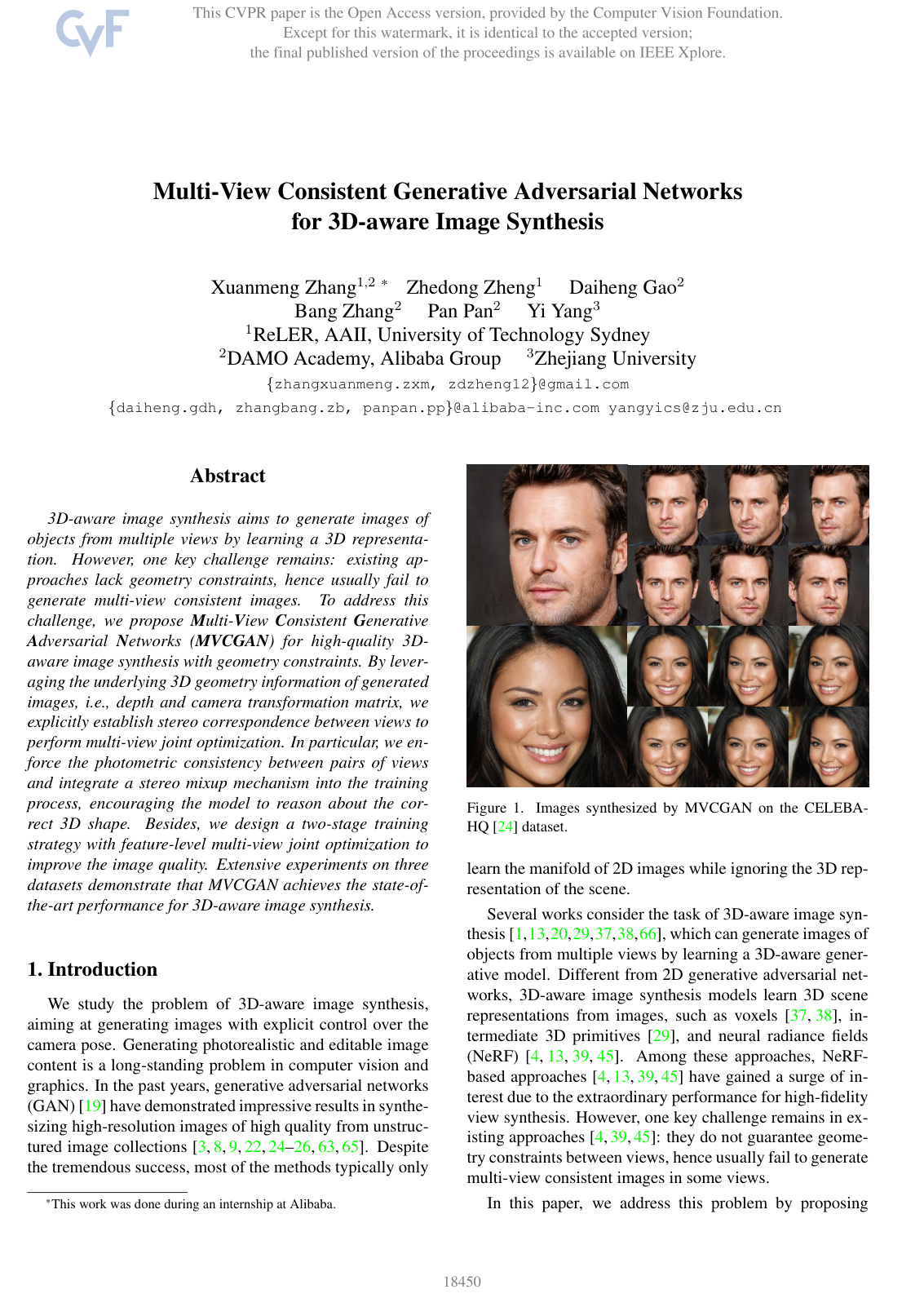
Multi-View Consistent Generative Adversarial Networks for 3D-aware Image Synthesis
Xuanmeng Zhang, Zhedong Zheng, Daiheng Gao, Bang Zhang, Pan Pan, Yi Yang
Why you should read this
Proposes a 3D-aware generative adversarial network that enforces explicit multi-view geometric and photometric consistency constraints during training to prevent visual artifacts and synthesize high-resolution, view-consistent images across wide pose variations.
3D-aware image synthesis aims to generate images of objects from multiple views by learning a 3D representation. However, one key challenge remains: existing approaches lack geometry constraints, hence usually fail to generate multi-view consistent images. To address this challenge, we propose Multi-View Consistent Generative Adversarial Networks (MVCGAN) for high-quality 3D-aware image synthesis with geometry constraints. By leveraging the underlying 3D geometry information of generated images, i.e., depth and camera transformation matrix, we explicitly establish stereo correspondence between views to perform multi-view joint optimization. In particular, we enforce the photometric consistency between pairs of views and integrate a stereo mixup mechanism into the training process, encouraging the model to reason about the correct 3D shape. Besides, we design a two-stage training strategy with feature-level multi-view joint optimization to improve the image quality. Extensive experiments on three datasets demonstrate that MVCGAN achieves the state-of-the-art performance for 3D-aware image synthesis.
Added
2026-09-26
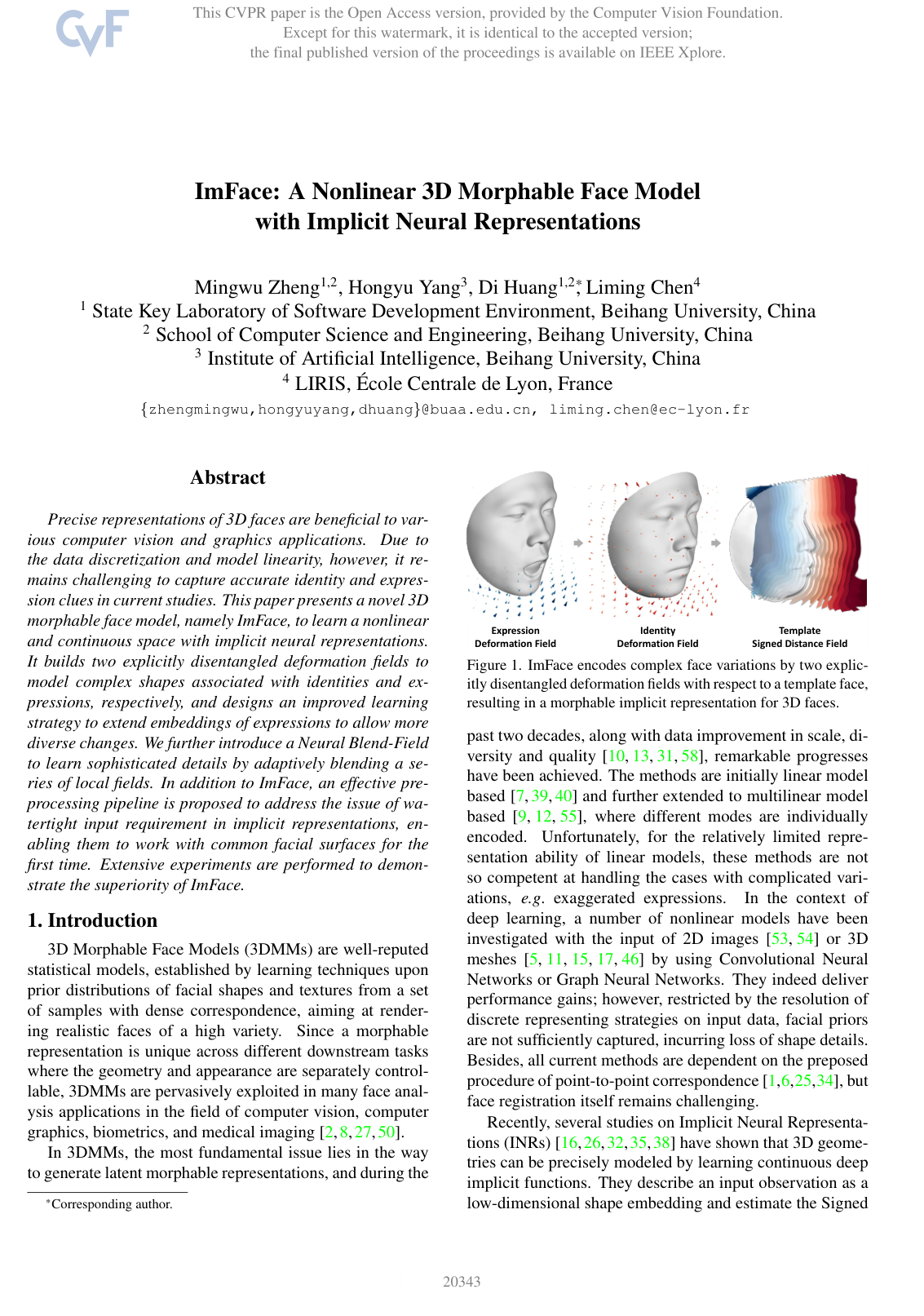
ImFace: A Nonlinear 3D Morphable Face Model with Implicit Neural Representations
Mingwu Zheng, Hongyu Yang, Di Huang, Liming Chen
Why you should read this
Proposes a nonlinear 3D morphable face model based on implicit neural representations that explicitly disentangles identity and expression deformation fields, enabling high-fidelity face reconstruction and synthesis directly from non-watertight surfaces.
Precise representations of 3D faces are beneficial to various computer vision and graphics applications. Due to the data discretization and model linearity, however, it remains challenging to capture accurate identity and expression clues in current studies. This paper presents a novel 3D morphable face model, namely ImFace, to learn a nonlinear and continuous space with implicit neural representations. It builds two explicitly disentangled deformation fields to model complex shapes associated with identities and expressions, respectively, and designs an improved learning strategy to extend embeddings of expressions to allow more diverse changes. We further introduce a Neural Blend-Field to learn sophisticated details by adaptively blending a series of local fields. In addition to ImFace, an effective preprocessing pipeline is proposed to address the issue of watertight input requirement in implicit representations, enabling them to work with common facial surfaces for the first time. Extensive experiments are performed to demonstrate the superiority of ImFace.
Added
2026-09-26
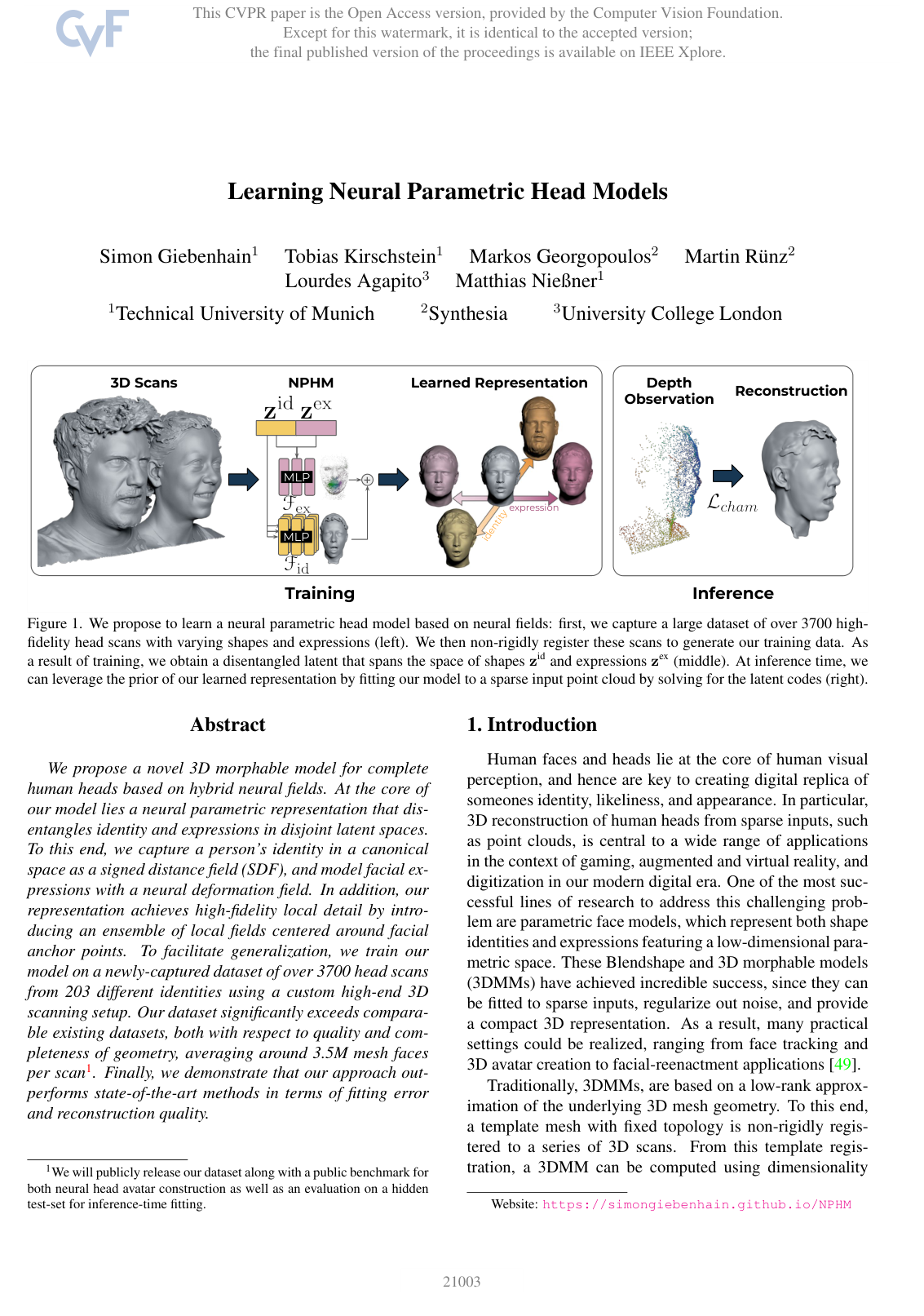
Learning Neural Parametric Head Models
Simon Giebenhain, Tobias Kirschstein, Markos Georgopoulos, Martin Rünz, Lourdes Agapito, Matthias Nießner
Why you should read this
Proposes a neural parametric head model using local signed distance fields and forward deformation fields trained on high-resolution full-head scans to achieve fine geometry reconstruction with disentangled identity and expression controls.
We propose a novel 3D morphable model for complete human heads based on hybrid neural fields. At the core of our model lies a neural parametric representation that disentangles identity and expressions in disjoint latent spaces. To this end, we capture a person’s identity in a canonical space as a signed distance field (SDF), and model facial expressions with a neural deformation field. In addition, our representation achieves high-fidelity local detail by introducing an ensemble of local fields centered around facial anchor points. To facilitate generalization, we train our model on a newly-captured dataset of over 3700 head scans from 203 different identities using a custom high-end 3D scanning setup. Our dataset significantly exceeds comparable existing datasets, both with respect to quality and completeness of geometry, averaging around 3.5M mesh faces per scan1. Finally, we demonstrate that our approach outperforms state-of-the-art methods in terms of fitting error and reconstruction quality.
Added
2026-09-26
Implicit Neural Representations with Periodic Activation Functions
Vincent Sitzmann, Julien N. P. Martel, Alexander W. Bergman, David B. Lindell, Gordon Wetzstein
Why you should read this
Introduces sinusoidal representation networks with periodic activation functions to model complex continuous signals and their derivatives, enabling high-fidelity representation of audio, video, and 3D shapes as well as direct solutions to partial differential equations.
Implicitly defined, continuous, differentiable signal representations parameterized by neural networks have emerged as a powerful paradigm, offering many possible benefits over conventional representations. However, current network architectures for such implicit neural representations are incapable of modeling signals with fine detail, and fail to represent a signal's spatial and temporal derivatives, despite the fact that these are essential to many physical signals defined implicitly as the solution to partial differential equations. We propose to leverage periodic activation functions for implicit neural representations and demonstrate that these networks, dubbed sinusoidal representation networks or Sirens, are ideally suited for representing complex natural signals and their derivatives. We analyze Siren activation statistics to propose a principled initialization scheme and demonstrate the representation of images, wavefields, video, sound, and their derivatives. Further, we show how Sirens can be leveraged to solve challenging boundary value problems, such as particular Eikonal equations (yielding signed distance functions), the Poisson equation, and the Helmholtz and wave equations. Lastly, we combine Sirens with hypernetworks to learn priors over the space of Siren functions.
Added
2026-09-16
License
Published with permission