Energy-based Latent Aligner for Incremental Learning
K. J. JosephSalman KhanFahad Shahbaz KhanRao Muhammad AnwerVineeth N. Balasubramanian
Presents a plug-and-play energy-based model that counteracts feature drift in incremental learning by mapping shifted representations back to lower-energy regions of earlier tasks, boosting performance across standard image classification and object detection benchmarks.
Modern artificial intelligence deployments frequently encounter dynamic environments where models must acquire new capabilities sequentially. When deep learning models are updated on new tasks without retaining access to previous data—often restricted due to privacy, storage, or computing limitations—they suffer from catastrophic forgetting. This degradation occurs because parameter updates optimized for new tasks cause internal feature representations to drift, disrupting the model's ability to recall earlier knowledge.
The article introduces and evaluates an Energy-based Latent Aligner for Incremental Learning (ELI). The primary objective is to demonstrate that an energy-based model can measure and undo the internal representational shifts that cause forgetting, functioning as a modular, plug-and-play component for existing continual learning architectures.
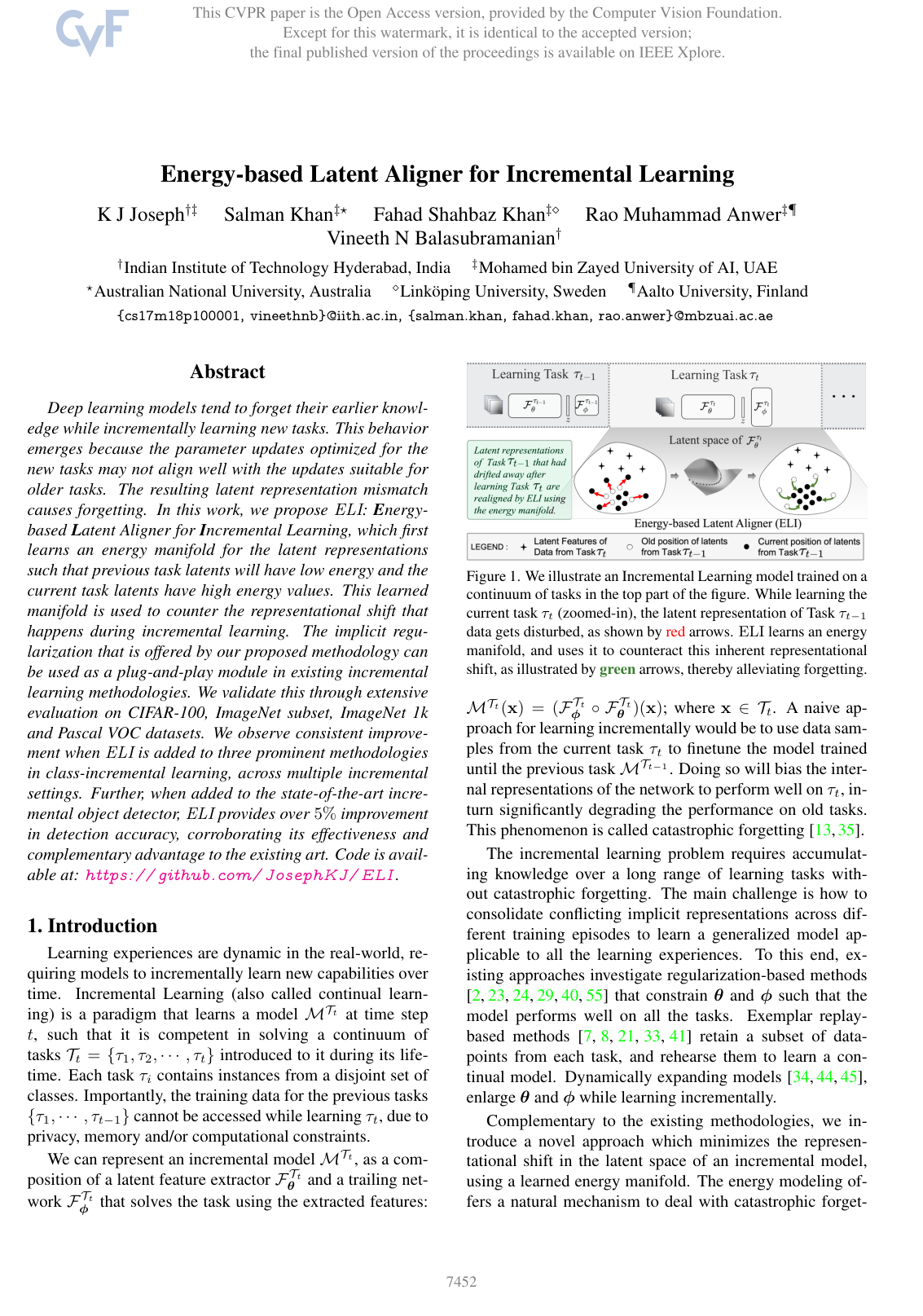
The authors develop a framework that models energy distributions directly within the intermediate feature space rather than the high-dimensional input image space. The system trains a lightweight energy function to assign lower energy values to representations produced by the previous model and higher energy values to those produced by the updated model, using only current task data as a proxy. During inference, sampling techniques adjust shifted features toward lower energy states, thereby realigning them to preserve past knowledge. This approach was evaluated across extensive image classification and object detection benchmarks, including CIFAR-100, ImageNet subsets, the full 1,000-class ImageNet dataset, and Pascal VOC.
The experimental findings show consistent, substantial performance gains across all evaluated settings. First, integrating ELI into leading incremental classification frameworks improved average accuracy across the board, yielding average gains of 8.17% on iCaRL, 3.05% on LUCIR, and 2.53% on AANet on the challenging ImageNet-1k benchmark. Second, ELI enhanced state-of-the-art incremental object detection by 3.0% to 7.0% in mean average precision across various task configurations on Pascal VOC. Third, aligning intermediate latent features proved significantly more effective than attempting to align final output classification scores. Finally, the energy aligner proved computationally lightweight, requiring only a small neural network that converged rapidly and introduced minimal sampling latency during inference.
These results indicate that internal representation alignment provides effective implicit regularization without requiring complex modifications to underlying learning algorithms or storing vast exemplar datasets. For engineering and product leaders, this translates to reduced memory footprints, enhanced data privacy compliance, and higher accuracy when deploying continuously updating vision systems in production.
Organizations maintaining vision models in evolving environments should consider adopting latent energy alignment as an add-on to their existing continual learning pipelines. The primary limitation noted in the article is that the aligner assumes high-level task knowledge is available during inference to determine whether a given sample belongs to the current task or a prior one. Despite this operational boundary condition, confidence in the reported performance gains is high given the rigorous evaluation across more than 45 experiments spanning diverse architectures and datasets.
- Paper: iCaRL: Incremental Classifier and Representation Learning, Sylvestre-Alvise Rebuffi et al. (2016). iCaRL establishes the foundational class-incremental learning framework combining representation learning, exemplar management, and distillation that ELI directly builds upon and regularizes.
- Paper: Learning without Forgetting, Zhizhong Li et al. (2016). Learning without Forgetting introduces the core distillation loss for preserving prior capabilities in sequential neural network adaptation, which ELI enhances by aligning latent representations.
- Paper: End-to-End Incremental Learning, Francisco M. Castro et al. (2018). This work establishes end-to-end class-incremental learning via cross-distillation and balanced fine-tuning, providing essential context for representation drift mitigation.
- Paper: Learning a Unified Classifier Incrementally via Rebalancing, Saihui Hou et al. (2019). This paper analyzes the representational imbalance and boundary confusion between old and new classes, motivating ELI's latent-space manifold alignment approach.
- Paper: Large Scale Incremental Learning, Yue Wu et al. (2019). Bias Correction identifies how prediction and feature biases degrade large-scale incremental learning, providing key background for ELI's plug-and-play latent aligner.
- Paper: Gradient Episodic Memory for Continual Learning, David Lopez-Paz et al. (2017). GEM defines gradient-alignment constraints across sequential tasks, formulating the fundamental optimization tension that ELI addresses via energy manifolds.
- Paper: Dark Experience for General Continual Learning: a Strong, Simple Baseline, Pietro Buzzega et al. (2020). Dark Experience Replay demonstrates how preserving continuous logit dynamics counters forgetting, offering a relevant baseline for latent-level regularization techniques.
- Paper: Overcoming catastrophic forgetting in neural networks, James Kirkpatrick et al. (2017). EWC introduces the seminal parameter-regularization approach for continual learning, laying the foundational concepts of implicit regularization against catastrophic forgetting.
- Paper: FeCAM: Exploiting the Heterogeneity of Class Distributions in Exemplar-Free Continual Learning, Dipam Goswami et al. (2023). FeCAM explores the geometry and distribution heterogeneity of latent features in continual learning, extending the analysis of feature drift addressed by ELI's energy manifolds.
- Paper: Class-Incremental Exemplar Compression for Class-Incremental Learning, Zilin Luo et al. (2023). This paper presents adaptive exemplar compression to maintain representation quality under strict memory limits, continuing the study of feature alignment in class-incremental pipelines.
- Paper: A Comprehensive Survey of Continual Learning: Theory, Method and Application, Liyuan Wang et al. (2023). This comprehensive survey categorizes the continual learning landscape, providing a broader taxonomy to contextualize energy-based and representation-level regularization methods like ELI.
- Paper: New Insights on Reducing Abrupt Representation Change in Online Continual Learning, Lucas Caccia et al. (2022). This work investigates abrupt representation shifts when novel classes appear in data streams, building upon the representational mismatch dynamics targeted by ELI.
- Paper: Improving Task-free Continual Learning by Distributionally Robust Memory Evolution, Zhenyi Wang et al. (2022). This work applies continuous dynamics and gradient flows to evolve replay buffers, advancing dynamic distribution matching in continual learning settings.