
keyword
incremental learning
Incremental learning is a machine learning paradigm where an algorithm continuously acquires, updates, and integrates new knowledge from a sequential stream of data or tasks over time without requiring full retraining from scratch on all previously observed information. Unlike conventional batch learning that processes complete datasets simultaneously, incremental systems update their internal representations and decision boundaries as new instances, classes, or conditions emerge, often operating under resource, memory, or privacy constraints that prevent storing all historical data. A central challenge in this approach is overcoming catastrophic forgetting, the tendency of neural networks and statistical models to overwrite prior knowledge when learning new patterns, which necessitates maintaining a balance between plasticity to adapt to novel information and stability to preserve existing capabilities.
19 items
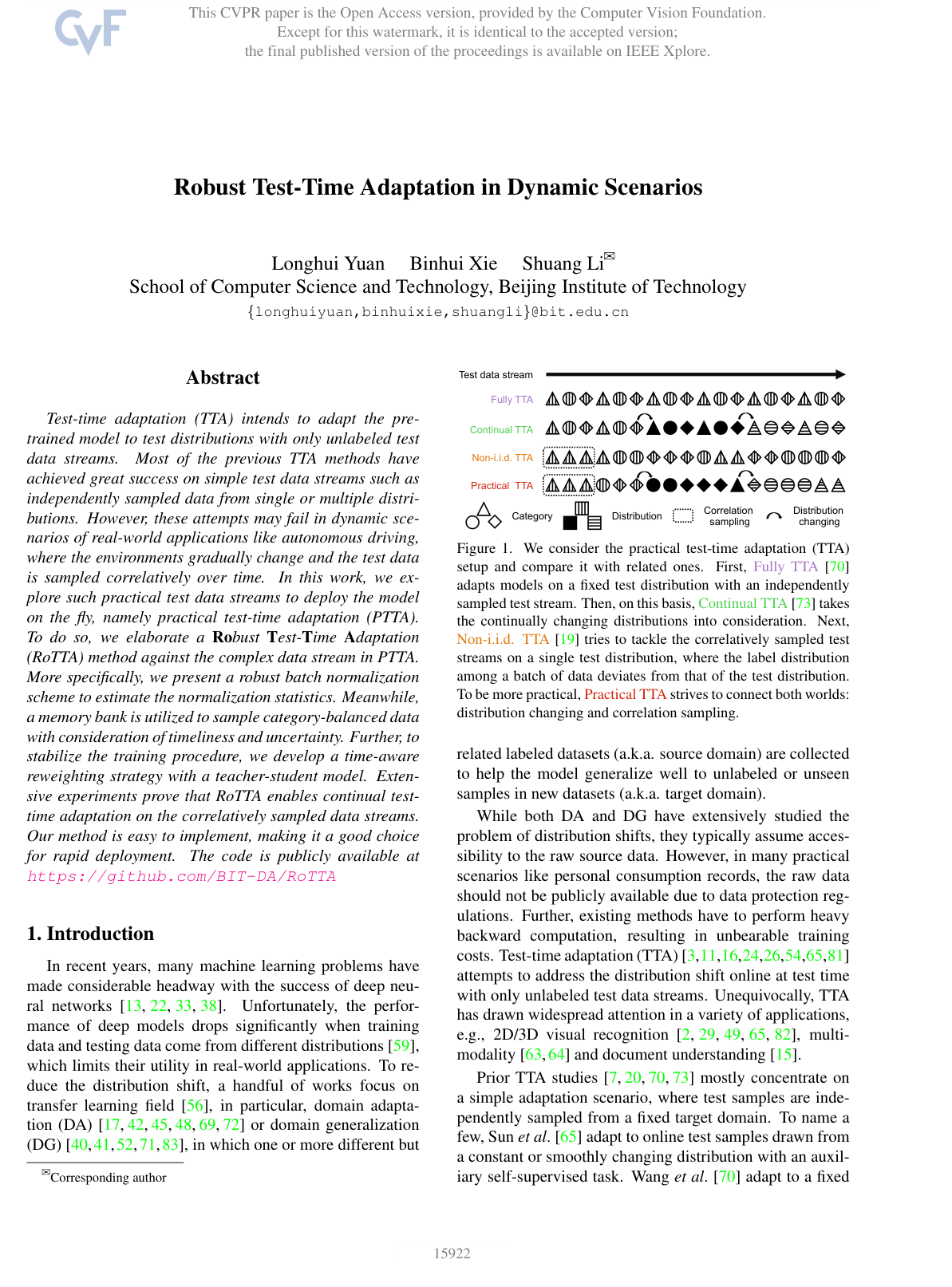
Robust Test-Time Adaptation in Dynamic Scenarios
Longhui Yuan, Binhui Xie, Shuang Li
Why you should read this
Proposes a practical test-time adaptation framework that combines an exponential moving average normalization scheme, a timeliness- and uncertainty-aware memory bank, and a teacher-student model to prevent model collapse on continually shifting, temporally correlated test streams.
Test-time adaptation (TTA) intends to adapt the pre-trained model to test distributions with only unlabeled test data streams. Most of the previous TTA methods have achieved great success on simple test data streams such as independently sampled data from single or multiple distributions. However, these attempts may fail in dynamic scenarios of real-world applications like autonomous driving, where the environments gradually change and the test data is sampled correlatively over time. In this work, we explore such practical test data streams to deploy the model on the fly, namely practical test-time adaptation (PTTA). To do so, we elaborate a Robust Test-Time Adaptation (RoTTA) method against the complex data stream in PTTA. More specifically, we present a robust batch normalization scheme to estimate the normalization statistics. Meanwhile, a memory bank is utilized to sample category-balanced data with consideration of timeliness and uncertainty. Further, to stabilize the training procedure, we develop a time-aware reweighting strategy with a teacher-student model. Extensive experiments prove that RoTTA enables continual test-time adaptation on the correlatively sampled data streams. Our method is easy to implement, making it a good choice for rapid deployment. The code is publicly available at https://github.com/BIT-DA/RoTTA
Added
2026-10-05
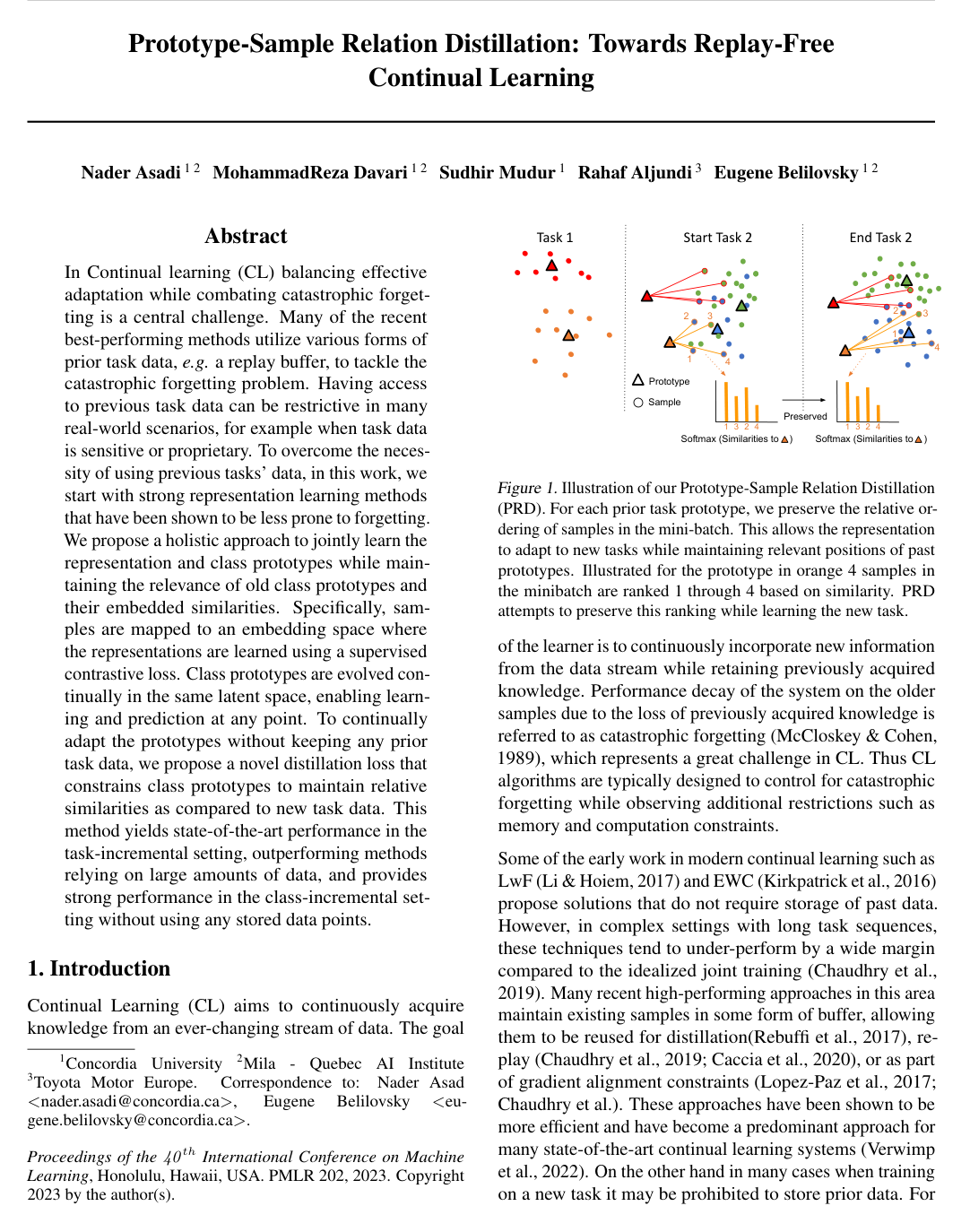
Prototype-Sample Relation Distillation: Towards Replay-Free Continual Learning
Nader Asadi, MohammadReza Davari, Sudhir P. Mudur, Rahaf Aljundi, Eugene Belilovsky
Why you should read this
Proposes a replay-free continual learning framework that prevents catastrophic forgetting by distilling the relative similarities between incoming samples and past class prototypes, outperforming memory-buffer methods without storing historical data.
In Continual learning (CL) balancing effective adaptation while combating catastrophic forgetting is a central challenge. Many of the recent best-performing methods utilize various forms of prior task data, e.g. a replay buffer, to tackle the catastrophic forgetting problem. Having access to previous task data can be restrictive in many real-world scenarios, for example when task data is sensitive or proprietary. To overcome the necessity of using previous tasks' data, in this work, we start with strong representation learning methods that have been shown to be less prone to forgetting. We propose a holistic approach to jointly learn the representation and class prototypes while maintaining the relevance of old class prototypes and their embedded similarities. Specifically, samples are mapped to an embedding space where the representations are learned using a supervised contrastive loss. Class prototypes are evolved continually in the same latent space, enabling learning and prediction at any point. To continually adapt the prototypes without keeping any prior task data, we propose a novel distillation loss that constrains class prototypes to maintain relative similarities as compared to new task data. This method yields state-of-the-art performance in the task-incremental setting, outperforming methods relying on large amounts of data, and provides strong performance in the class-incremental setting without using any stored data points.
Added
2026-10-03
An Empirical Investigation of the Role of Pre-training in Lifelong Learning
Sanket Vaibhav Mehta, Darshan Patil, Sarath Chandar, Emma Strubell
Why you should read this
Reveals that pre-trained initializations naturally reduce catastrophic forgetting in sequential task learning by converging to wider loss basins, and introduces a sharpness-aware optimization method to explicitly promote flat minima during fine-tuning.
The lifelong learning paradigm in machine learning is an attractive alternative to the more prominent isolated learning scheme not only due to its resemblance to biological learning but also its potential to reduce energy waste by obviating excessive model re-training. A key challenge to this paradigm is the phenomenon of catastrophic forgetting. With the increasing popularity and success of pre-trained models in machine learning, we pose the question: What role does pre-training play in lifelong learning, specifically with respect to catastrophic forgetting? We investigate existing methods in the context of large, pre-trained models and evaluate their performance on a variety of text and image classification tasks, including a large-scale study using a novel data set of 15 diverse NLP tasks. Across all settings, we observe that generic pre-training implicitly alleviates the effects of catastrophic forgetting when learning multiple tasks sequentially compared to randomly initialized models. We then further investigate why pre-training alleviates forgetting in this setting. We study this phenomenon by analyzing the loss landscape, finding that pre-trained weights appear to ease forgetting by leading to wider minima. Based on this insight, we propose jointly optimizing for current task loss and loss basin sharpness to explicitly encourage wider basins during sequential fine-tuning. We show that this optimization approach outperforms several state-of-the-art task-sequential continual learning algorithms across multiple settings, occasionally even without retaining a memory that scales in size with the number of tasks.
Added
2026-09-26
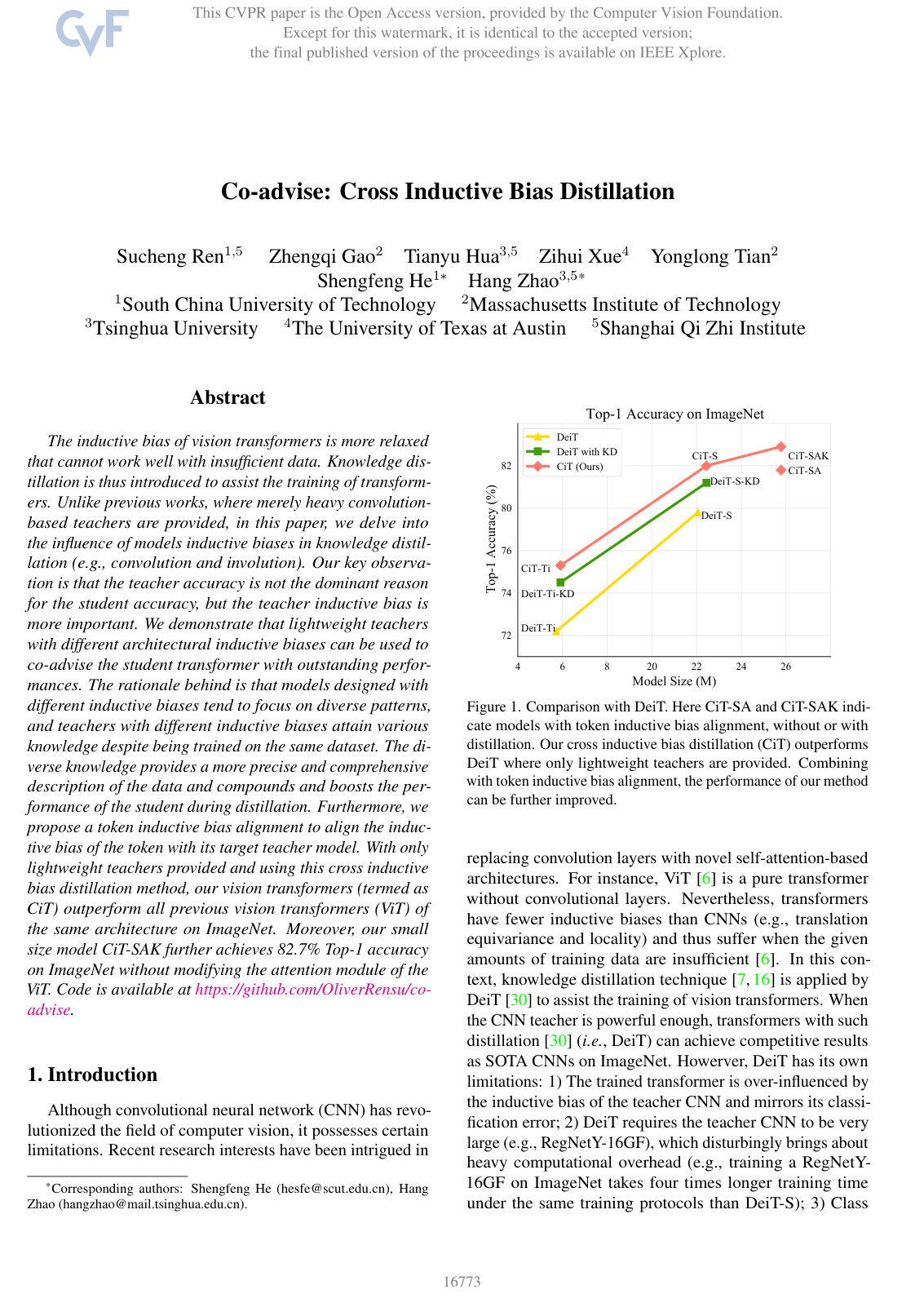
Co-advise: Cross Inductive Bias Distillation
Sucheng Ren, Zhengqi Gao, Tianyu Hua, Zihui Xue, Yonglong Tian, Shengfeng He, Hang Zhao
Why you should read this
Demonstrates that distilling knowledge from multiple lightweight teachers with complementary inductive biases, such as convolution and involution, boosts vision transformer performance beyond traditional heavy-teacher distillation while reducing computational costs.
The inductive bias of vision transformers is more relaxed that cannot work well with insufficient data. Knowledge distillation is thus introduced to assist the training of transformers. Unlike previous works, where merely heavy convolution-based teachers are provided, in this paper, we delve into the influence of models inductive biases in knowledge distillation (e.g., convolution and involution). Our key observation is that the teacher accuracy is not the dominant reason for the student accuracy, but the teacher inductive bias is more important. We demonstrate that lightweight teachers with different architectural inductive biases can be used to co-advise the student transformer with outstanding performances. The rationale behind is that models designed with different inductive biases tend to focus on diverse patterns, and teachers with different inductive biases attain various knowledge despite being trained on the same dataset. The diverse knowledge provides a more precise and comprehensive description of the data and compounds and boosts the performance of the student during distillation. Furthermore, we propose a token inductive bias alignment to align the inductive bias of the token with its target teacher model. With only lightweight teachers provided and using this cross inductive bias distillation method, our vision transformers (termed as CiT) outperform all previous vision transformers (ViT) of the same architecture on ImageNet. Moreover, our small size model CiT-SAK further achieves 82.7% Top-1 accuracy on ImageNet without modifying the attention module of the ViT. Code is available at https://github.com/OliverRensu/co-advise.
Added
2026-09-26
Energy-based Latent Aligner for Incremental Learning
K. J. Joseph, Salman Khan, Fahad Shahbaz Khan, Rao Muhammad Anwer, Vineeth N. Balasubramanian
Why you should read this
Presents a plug-and-play energy-based model that counteracts feature drift in incremental learning by mapping shifted representations back to lower-energy regions of earlier tasks, boosting performance across standard image classification and object detection benchmarks.
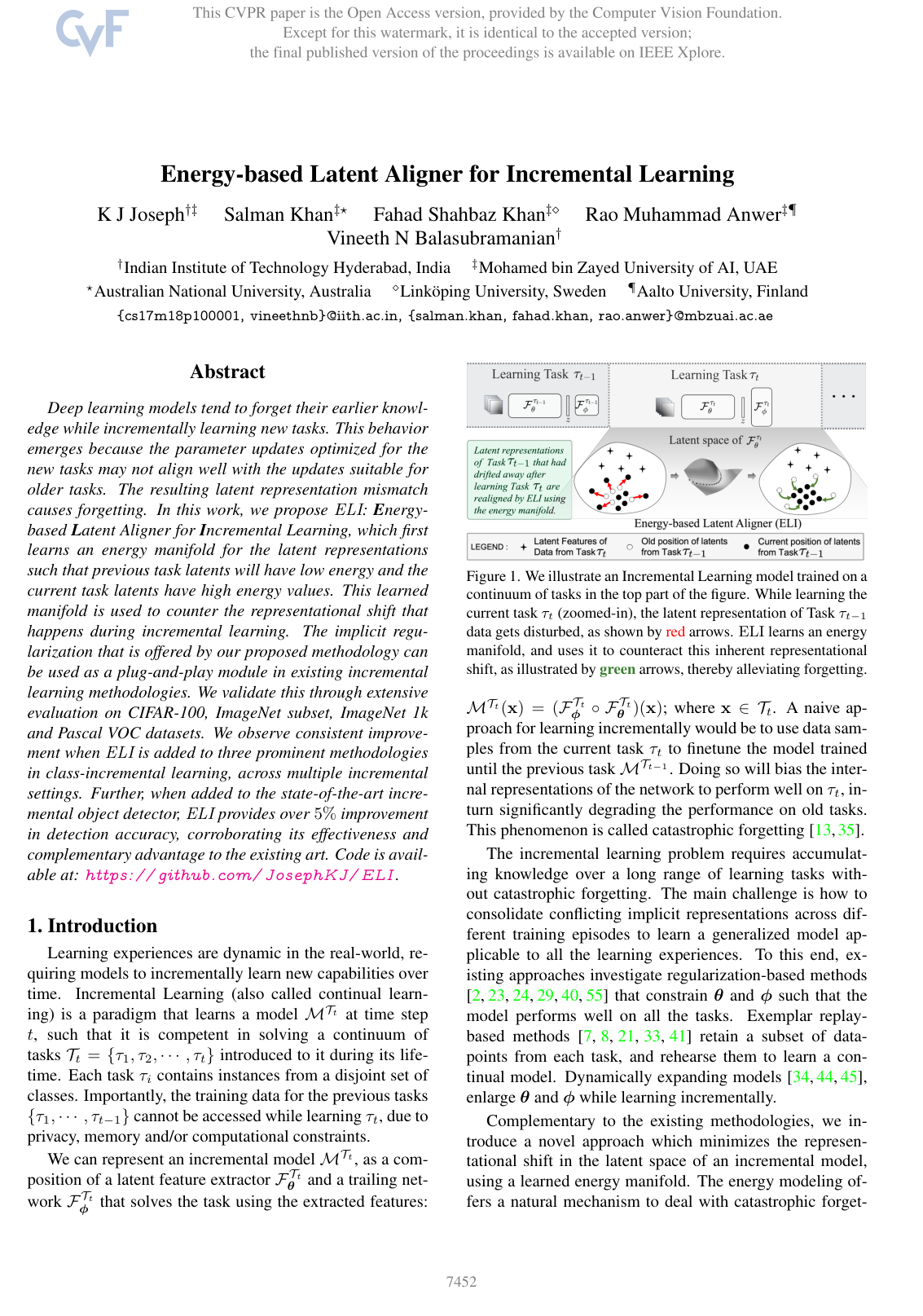
Deep learning models tend to forget their earlier knowledge while incrementally learning new tasks. This behavior emerges because the parameter updates optimized for the new tasks may not align well with the updates suitable for older tasks. The resulting latent representation mismatch causes forgetting. In this work, we propose ELI: Energy-based Latent Aligner for Incremental Learning, which first learns an energy manifold for the latent representations such that previous task latents will have low energy and the current task latents have high energy values. This learned manifold is used to counter the representational shift that happens during incremental learning. The implicit regularization that is offered by our proposed methodology can be used as a plug-and-play module in existing incremental learning methodologies. We validate this through extensive evaluation on CIFAR-100, ImageNet subset, ImageNet 1k and Pascal VOC datasets. We observe consistent improvement when ELI is added to three prominent methodologies in class-incremental learning, across multiple incremental settings. Further, when added to the state-of-the-art incremental object detector, ELI provides over 5% improvement in detection accuracy, corroborating its effectiveness and complementary advantage to the existing art. Code is available at: https://github.com/JosephKJ/ELI.
Added
2026-09-26
Self-Supervised Models are Continual Learners
Enrico Fini, Victor G. Turrisi da Costa, Xavier Alameda-Pineda, Elisa Ricci, Karteek Alahari, Julien Mairal
Why you should read this
Proposes CaSSLe, a general framework that mitigates catastrophic forgetting in continual self-supervised learning by using a predictor network to convert standard self-supervised loss functions into representation distillation mechanisms without requiring extra hyperparameter tuning.
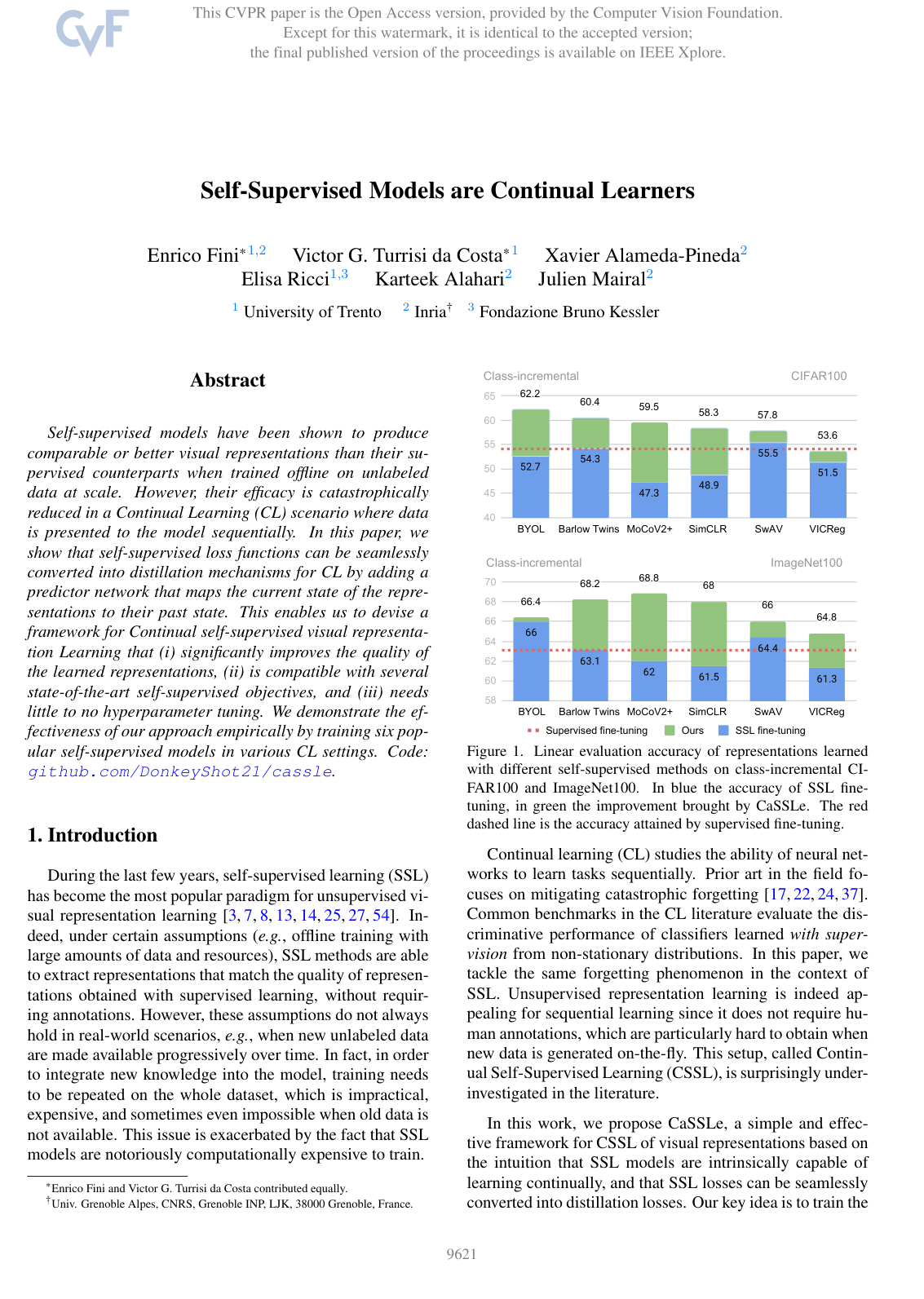
Self-supervised models have been shown to produce comparable or better visual representations than their supervised counterparts when trained offline on unlabeled data at scale. However, their efficacy is catastrophically reduced in a Continual Learning (CL) scenario where data is presented to the model sequentially. In this paper, we show that self-supervised loss functions can be seamlessly converted into distillation mechanisms for CL by adding a predictor network that maps the current state of the representations to their past state. This enables us to devise a framework for Continual self-supervised visual representation Learning that (i) significantly improves the quality of the learned representations, (ii) is compatible with several state-of-the-art self-supervised objectives, and (iii) needs little to no hyperparameter tuning. We demonstrate the effectiveness of our approach empirically by training six popular self-supervised models in various CL settings. Code: github.com/DonkeyShot21/cassle.
Added
2026-09-26
On the Effectiveness of Lipschitz-Driven Rehearsal in Continual Learning
Lorenzo Bonicelli, Matteo Boschini, Angelo Porrello, Concetto Spampinato, Simone Calderara
Why you should read this
Proposes a surrogate objective that constrains layer-wise Lipschitz constants on replay data to prevent unstable decision boundaries and buffer overfitting across standard continual learning methods.
Rehearsal approaches enjoy immense popularity with Continual Learning (CL) practitioners. These methods collect samples from previously encountered data distributions in a small memory buffer; subsequently, they repeatedly optimize on the latter to prevent catastrophic forgetting. This work draws attention to a hidden pitfall of this widespread practice: repeated optimization on a small pool of data inevitably leads to tight and unstable decision boundaries, which are a major hindrance to generalization. To address this issue, we propose Lipschitz-DrivEn Rehearsal (LiDER), a surrogate objective that induces smoothness in the backbone network by constraining its layer-wise Lipschitz constants w.r.t. replay examples. By means of extensive experiments, we show that applying LiDER delivers a stable performance gain to several state-of-the-art rehearsal CL methods across multiple datasets, both in the presence and absence of pre-training. Through additional ablative experiments, we highlight peculiar aspects of buffer overfitting in CL and better characterize the effect produced by LiDER. Code is available at https://github.com/aimagelab/LiDER.
Added
2026-09-26
End-to-End Incremental Learning
Francisco M. Castro, Manuel J. Marín-Jiménez, Nicolás Guil, Cordelia Schmid, Karteek Alahari
Why you should read this
Proposes a fully end-to-end incremental learning framework that mitigates catastrophic forgetting by combining knowledge distillation with a small exemplar set to jointly optimize feature representations and classifiers on sequentially added image classes.
Although deep learning approaches have stood out in recent years due to their state-of-the-art results, they continue to suffer from catastrophic forgetting, a dramatic decrease in overall performance when training with new classes added incrementally. This is due to current neural network architectures requiring the entire dataset, consisting of all the samples from the old as well as the new classes, to update the model -a requirement that becomes easily unsustainable as the number of classes grows. We address this issue with our approach to learn deep neural networks incrementally, using new data and only a small exemplar set corresponding to samples from the old classes. This is based on a loss composed of a distillation measure to retain the knowledge acquired from the old classes, and a cross-entropy loss to learn the new classes. Our incremental training is achieved while keeping the entire framework end-to-end, i.e., learning the data representation and the classifier jointly, unlike recent methods with no such guarantees. We evaluate our method extensively on the CIFAR-100 and ImageNet (ILSVRC 2012) image classification datasets, and show state-of-the-art performance.
Added
2026-09-25
Incremental and Decremental Support Vector Machine Learning
G. Cauwenberghs, T. Poggio
Why you should read this
Presents an exact, reversible online learning algorithm for support vector machines that updates solutions analytically vector-by-vector and enables efficient leave-one-out cross-validation through exact decremental unlearning.
An on-line recursive algorithm for training support vector machines, one vector at a time, is presented. Adiabatic increments retain the Kuhn-Tucker conditions on all previously seen training data, in a number of steps each computed analytically. The incremental procedure is reversible, and decremental “unlearning” offers an efficient method to exactly evaluate leave-one-out generalization performance. Interpretation of decremental unlearning in feature space sheds light on the relationship between generalization and geometry of the data.
Added
2026-09-25
Riemannian Walk for Incremental Learning: Understanding Forgetting and Intransigence
Arslan Chaudhry, Puneet K. Dokania, Thalaiyasingam Ajanthan, Philip H. S. Torr
Why you should read this
Proposes Riemannian Walk (RWalk), a continual learning method based on KL-divergence that optimizes the trade-off between catastrophic forgetting and model intransigence, while establishing formal metrics to quantify both behaviors.
Incremental learning (IL) has received a lot of attention recently, however, the literature lacks a precise problem definition, proper evaluation settings, and metrics tailored specifically for the IL problem. One of the main objectives of this work is to fill these gaps so as to provide a common ground for better understanding of IL. The main challenge for an IL algorithm is to update the classifier whilst preserving existing knowledge. We observe that, in addition to forgetting, a known issue while preserving knowledge, IL also suffers from a problem we call intransigence, inability of a model to update its knowledge. We introduce two metrics to quantify forgetting and intransigence that allow us to understand, analyse, and gain better insights into the behaviour of IL algorithms. We present RWalk, a generalization of EWC++ (our efficient version of EWC [Kirkpatrick2016EWC]) and Path Integral [Zenke2017Continual] with a theoretically grounded KL-divergence based perspective. We provide a thorough analysis of various IL algorithms on MNIST and CIFAR-100 datasets. In these experiments, RWalk obtains superior results in terms of accuracy, and also provides a better trade-off between forgetting and intransigence.
Added
2026-09-25
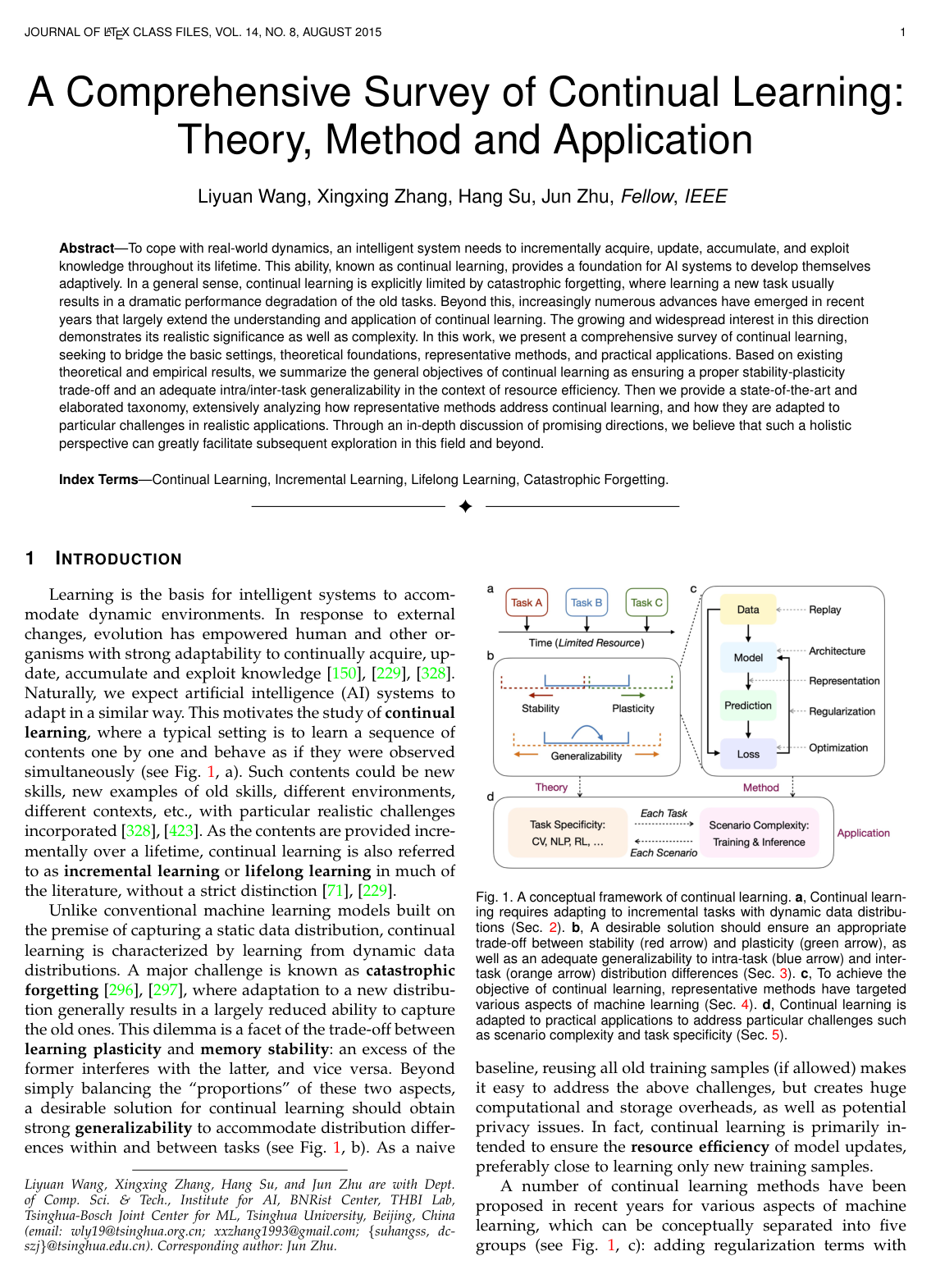
A Comprehensive Survey of Continual Learning: Theory, Method and Application
Liyuan Wang, Xingxing Zhang, Hang Su, Jun Zhu
Why you should read this
Presents a systematic taxonomy of continual learning that bridges theoretical foundations, methods for overcoming catastrophic forgetting, and practical applications across real-world dynamic environments.
To cope with real-world dynamics, an intelligent system needs to incrementally acquire, update, accumulate, and exploit knowledge throughout its lifetime. This ability, known as continual learning, provides a foundation for AI systems to develop themselves adaptively. In a general sense, continual learning is explicitly limited by catastrophic forgetting, where learning a new task usually results in a dramatic performance degradation of the old tasks. Beyond this, increasingly numerous advances have emerged in recent years that largely extend the understanding and application of continual learning. The growing and widespread interest in this direction demonstrates its realistic significance as well as complexity. In this work, we present a comprehensive survey of continual learning, seeking to bridge the basic settings, theoretical foundations, representative methods, and practical applications. Based on existing theoretical and empirical results, we summarize the general objectives of continual learning as ensuring a proper stability-plasticity trade-off and an adequate intra/inter-task generalizability in the context of resource efficiency. Then we provide a state-of-the-art and elaborated taxonomy, extensively analyzing how representative methods address continual learning, and how they are adapted to particular challenges in realistic applications. Through an in-depth discussion of promising directions, we believe that such a holistic perspective can greatly facilitate subsequent exploration in this field and beyond.
Added
2026-09-24
Learning in the Presence of Concept Drift and Hidden Contexts
G. Widmer, M. Kubát
Why you should read this
Presents the FLORA framework of incremental learning algorithms that dynamically adjust sample windows and reuse past concept descriptions to handle recurring hidden contexts and concept drift in continuous data streams.
On-line learning in domains where the target concept depends on some hidden context poses serious problems. A changing context can induce changes in the target concepts, producing what is known as concept drift. We describe a family of learning algorithms that flexibly react to concept drift and can take advantage of situations where contexts reappear. The general approach underlying all these algorithms consists of (1) keeping only a window of currently trusted examples and hypotheses; (2) storing concept descriptions and re-using them when a previous context re-appears; and (3) controlling both of these functions by a heuristic that constantly monitors the system's behavior. The paper reports on experiments that test the systems' performance under various conditions such as different levels of noise and different extent and rate of concept drift.
Added
2026-09-24
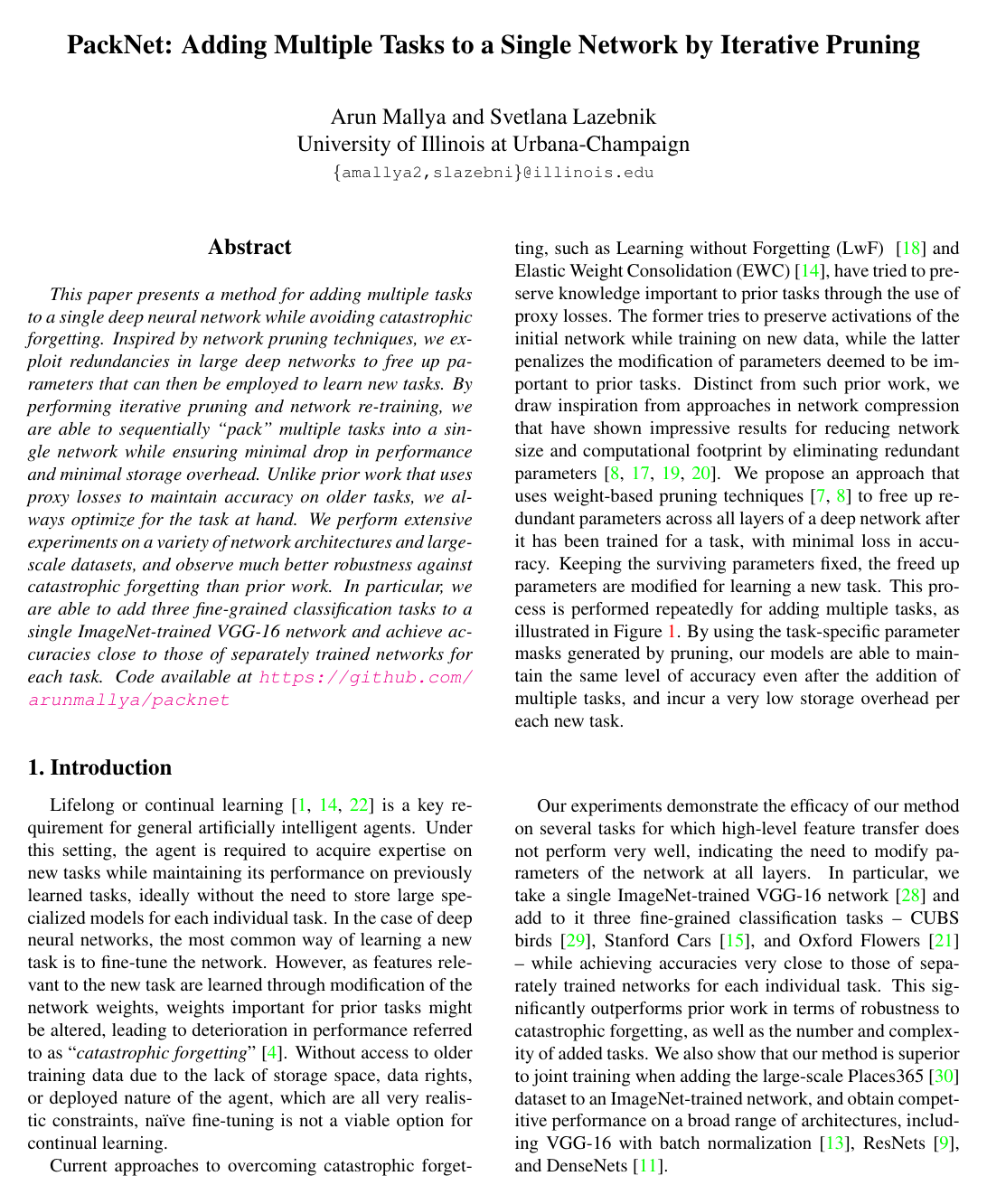
PackNet: Adding Multiple Tasks to a Single Network by Iterative Pruning
Arun Mallya, Svetlana Lazebnik
Why you should read this
Proposes an iterative network pruning and weight-freezing technique that packs multiple sequential tasks into a single deep model to eliminate catastrophic forgetting without relying on proxy loss functions.
This paper presents a method for adding multiple tasks to a single deep neural network while avoiding catastrophic forgetting. Inspired by network pruning techniques, we exploit redundancies in large deep networks to free up parameters that can then be employed to learn new tasks. By performing iterative pruning and network re-training, we are able to sequentially "pack" multiple tasks into a single network while ensuring minimal drop in performance and minimal storage overhead. Unlike prior work that uses proxy losses to maintain accuracy on older tasks, we always optimize for the task at hand. We perform extensive experiments on a variety of network architectures and large-scale datasets, and observe much better robustness against catastrophic forgetting than prior work. In particular, we are able to add three fine-grained classification tasks to a single ImageNet-trained VGG-16 network and achieve accuracies close to those of separately trained networks for each task. Code available at this https URL
Added
2026-09-24
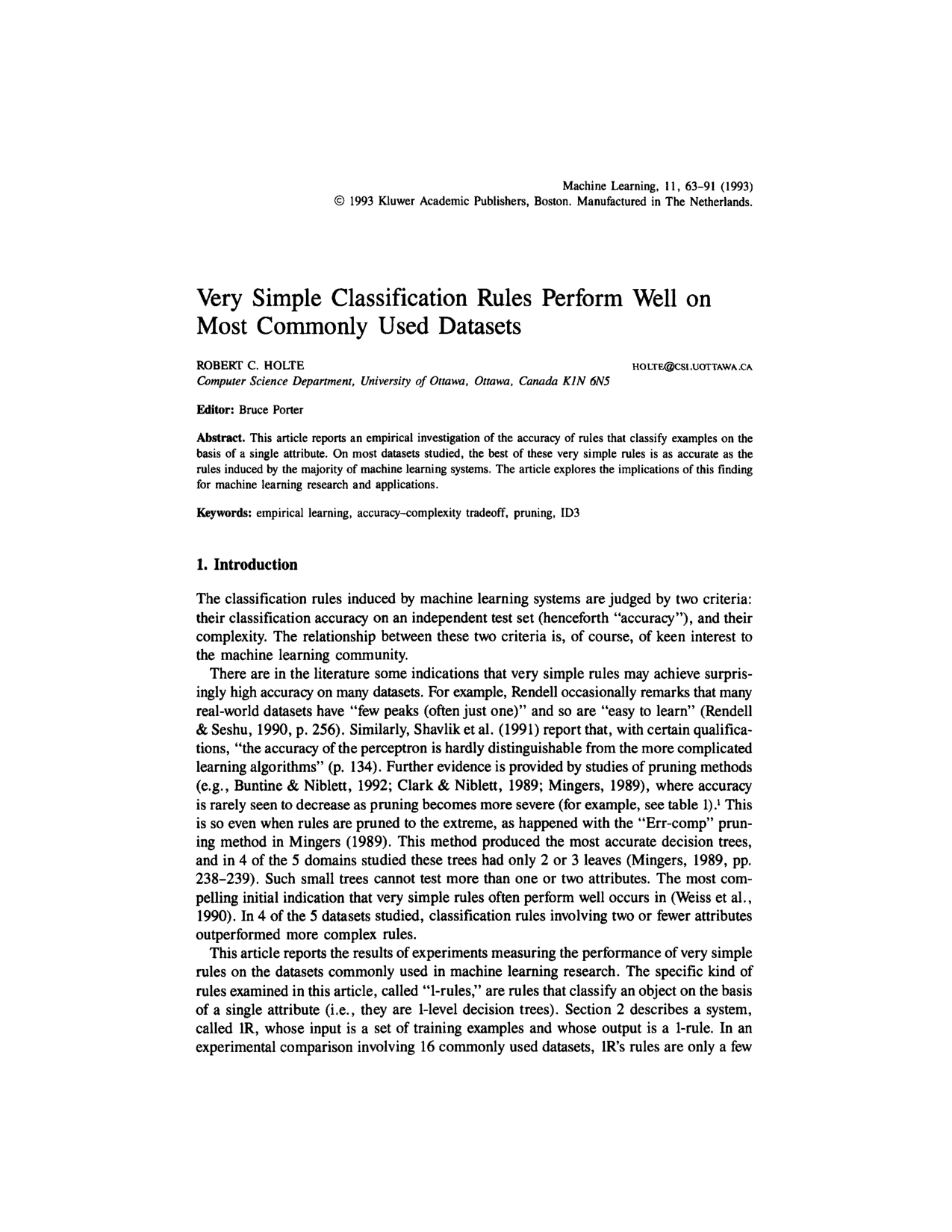
Very Simple Classification Rules Perform Well on Most Commonly Used Datasets
ROBERT C. HOLTE
Why you should read this
Demonstrates that extremely simple one-attribute classification rules achieve accuracy nearly competitive with complex decision tree algorithms across standard benchmarks, providing an essential baseline and questioning the assumed necessity of complex machine learning models.
This article reports an empirical investigation of the accuracy of rules that classify examples on the basis of a single attribute. On most datasets studied, the best of these very simple rules is as accurate as the rules induced by the majority of machine learning systems. The article explores the implications of this finding for machine learning research and applications.
Added
2026-09-18
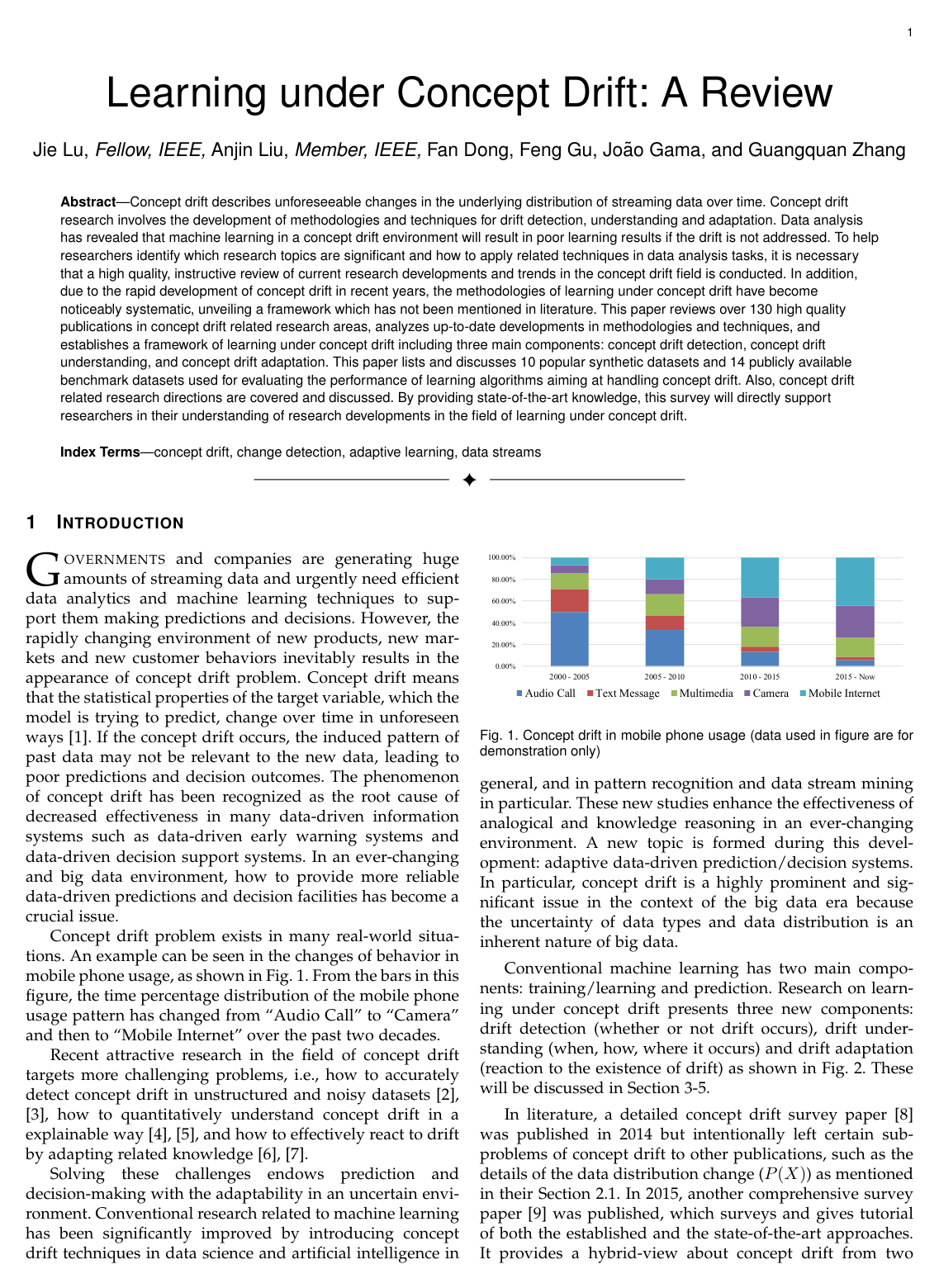
Learning under Concept Drift: A Review
Jie Lu, Anjin Liu, Fan Dong, Feng Gu, João Gama, Guangquan Zhang
Why you should read this
Establishes a unified structural framework covering concept drift detection, understanding, and adaptation while evaluating 24 benchmark datasets across more than 130 studies to guide machine learning on non-stationary data streams.
Concept drift describes unforeseeable changes in the underlying distribution of streaming data over time. Concept drift research involves the development of methodologies and techniques for drift detection, understanding and adaptation. Data analysis has revealed that machine learning in a concept drift environment will result in poor learning results if the drift is not addressed. To help researchers identify which research topics are significant and how to apply related techniques in data analysis tasks, it is necessary that a high quality, instructive review of current research developments and trends in the concept drift field is conducted. In addition, due to the rapid development of concept drift in recent years, the methodologies of learning under concept drift have become noticeably systematic, unveiling a framework which has not been mentioned in literature. This paper reviews over 130 high quality publications in concept drift related research areas, analyzes up-to-date developments in methodologies and techniques, and establishes a framework of learning under concept drift including three main components: concept drift detection, concept drift understanding, and concept drift adaptation. This paper lists and discusses 10 popular synthetic datasets and 14 publicly available benchmark datasets used for evaluating the performance of learning algorithms aiming at handling concept drift. Also, concept drift related research directions are covered and discussed. By providing state-of-the-art knowledge, this survey will directly support researchers in their understanding of research developments in the field of learning under concept drift.
Added
2026-09-18
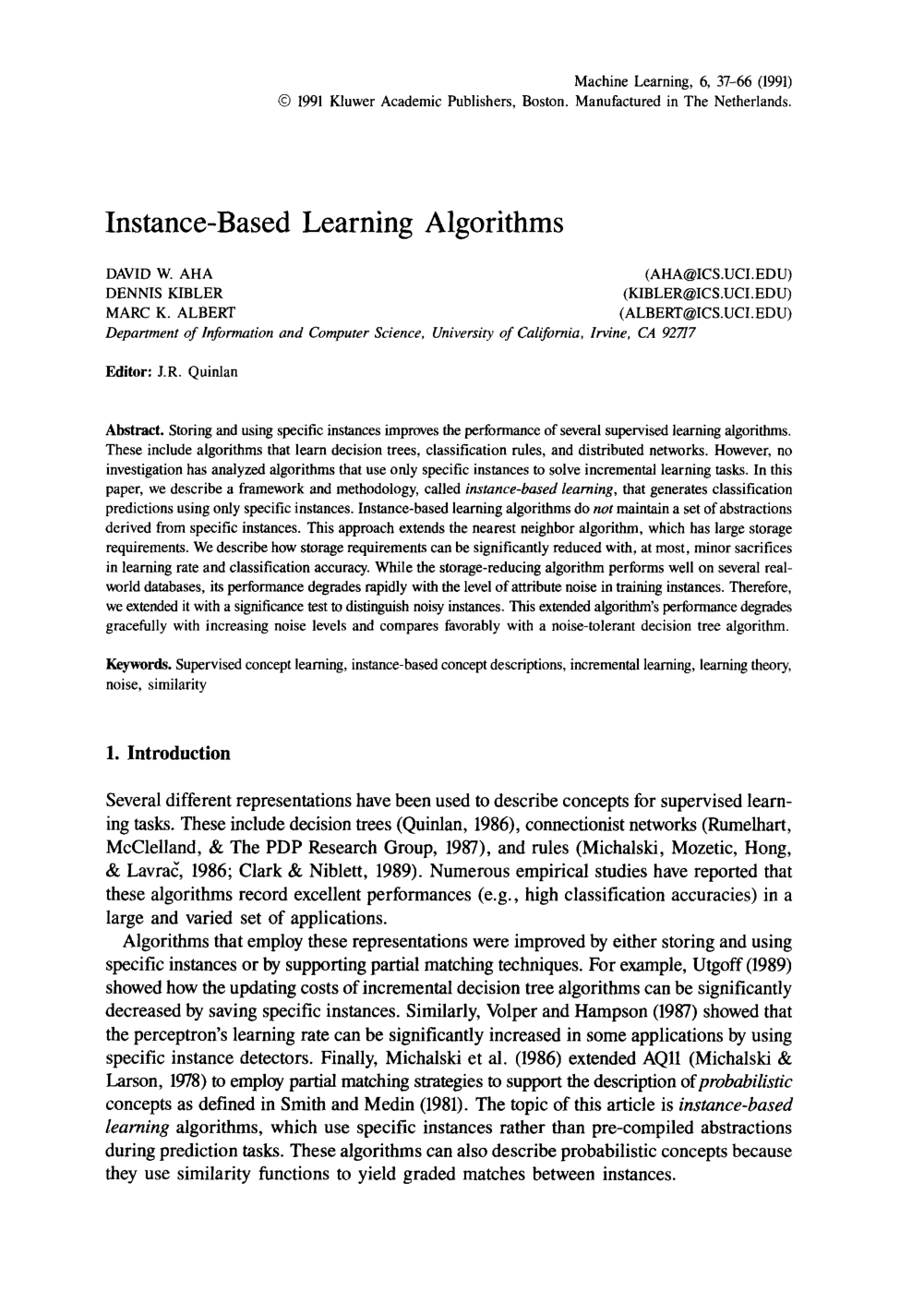
Instance-Based Learning Algorithms
David W. Aha, Dennis Kibler, Marc K. Albert
Why you should read this
Introduces incremental instance-based learning algorithms that extend nearest neighbor classification by significantly reducing storage requirements and filtering noisy instances with formal learnability guarantees.
Storing and using specific instances improves the performance of several supervised learning algorithms. These include algorithms that learn decision trees, classification rules, and distributed networks. However, no investigation has analyzed algorithms that use only specific instances to solve incremental learning tasks. In this paper, we describe a framework and methodology, called instance-based learning, that generates classification predictions using only specific instances. Instance-based learning algorithms do not maintain a set of abstractions derived from specific instances. This approach extends the nearest neighbor algorithm, which has large storage requirements. We describe how storage requirements can be significantly reduced with, at most, minor sacrifices in learning rate and classification accuracy. While the storage-reducing algorithm performs well on several real-world databases, its performance degrades rapidly with the level of attribute noise in training instances. Therefore, we extended it with a significance test to distinguish noisy instances. This extended algorithm's performance degrades gracefully with increasing noise levels and compares favorably with a noise-tolerant decision tree algorithm.
Added
2026-09-12
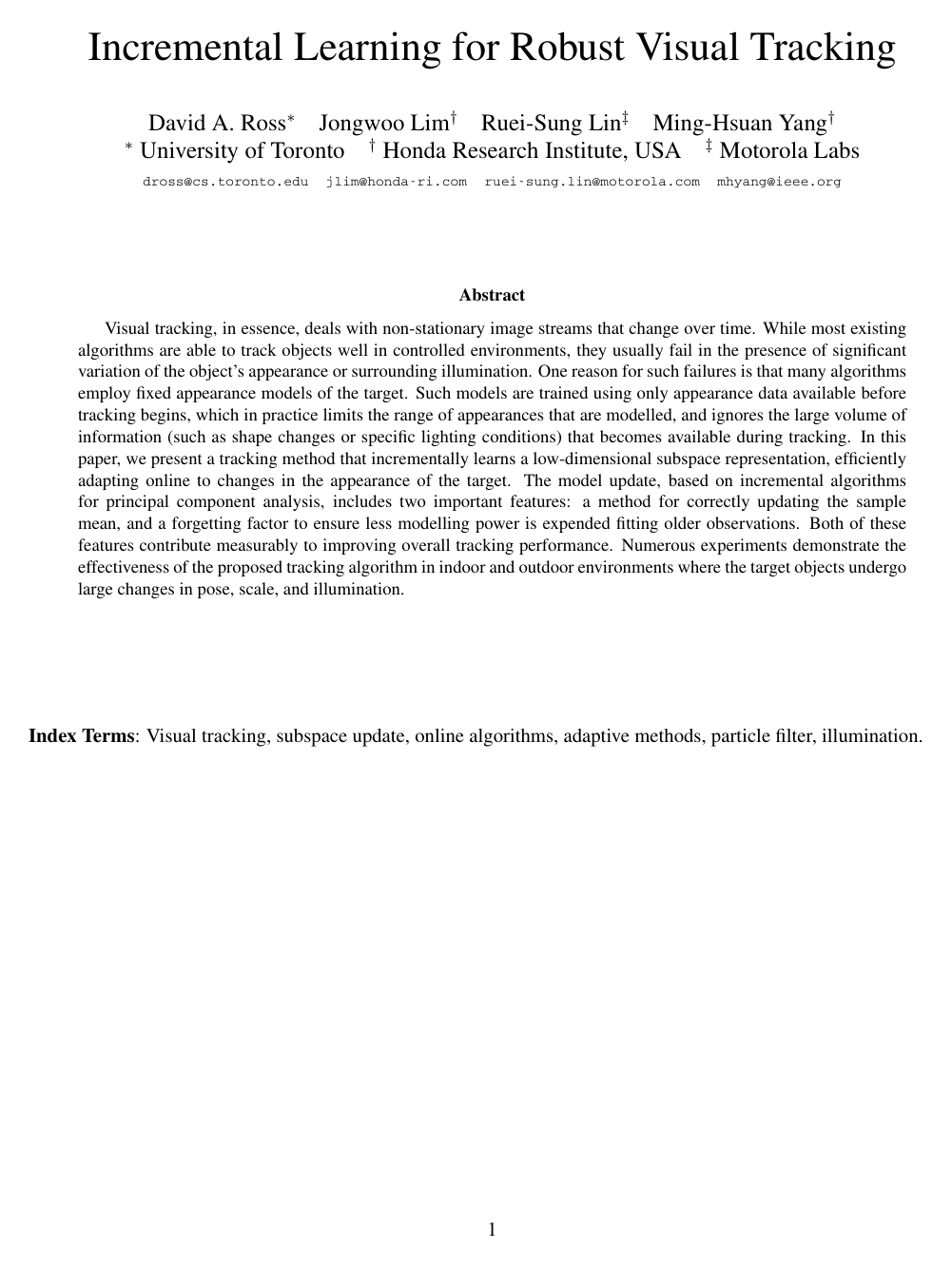
Incremental Learning for Robust Visual Tracking
David A. Ross, Jongwoo Lim, Ruei-Sung Lin, Ming-Hsuan Yang
Why you should read this
Proposes an adaptive visual tracking framework that learns target appearance online by integrating an incremental principal component analysis algorithm—featuring exact mean updates and a forgetting factor—directly into a particle filter.
Visual tracking, in essence, deals with non-stationary image streams that change over time. While most existing algorithms are able to track objects well in controlled environments, they usually fail in the presence of significant variation of the object’s appearance or surrounding illumination. One reason for such failures is that many algorithms employ fixed appearance models of the target. Such models are trained using only appearance data available before tracking begins, which in practice limits the range of appearances that are modelled, and ignores the large volume of information (such as shape changes or specific lighting conditions) that becomes available during tracking. In this paper, we present a tracking method that incrementally learns a low-dimensional subspace representation, efficiently adapting online to changes in the appearance of the target. The model update, based on incremental algorithms for principal component analysis, includes two important features: a method for correctly updating the sample mean, and a forgetting factor to ensure less modelling power is expended fitting older observations. Both of these features contribute measurably to improving overall tracking performance. Numerous experiments demonstrate the effectiveness of the proposed tracking algorithm in indoor and outdoor environments where the target objects undergo large changes in pose, scale, and illumination.
Added
2026-09-11
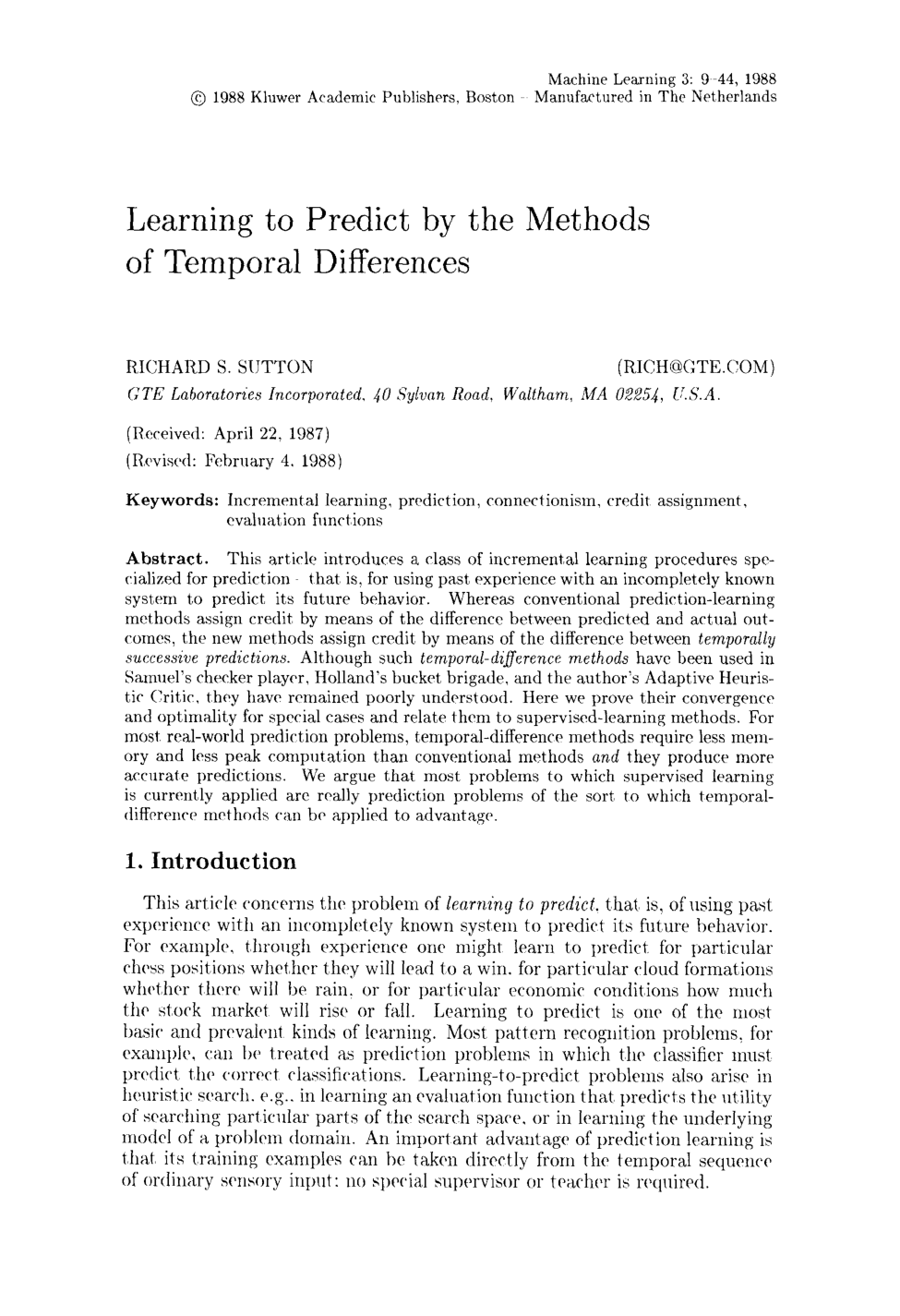
Learning to Predict by the Methods of Temporal Differences
Richard S. Sutton
Why you should read this
Formalizes temporal difference learning as a model-free method for predicting future values from sequential data.
This article introduces a class of incremental learning procedures specialized for prediction - that is, for using past experience with an incompletely known system to predict its future behavior. Whereas conventional prediction-learning methods assign credit by means of the difference between predicted and actual outcomes, the new methods assign credit by means of the difference between temporally successive predictions. Although such temporal-difference methods have been used in Samuel's checker player, Holland's bucket brigade, and the author's Adaptive Heuristic Critic, they have remained poorly understood. Here we prove their convergence and optimality for special cases and relate them to supervised-learning methods. For most real-world prediction problems, temporal-difference methods require less memory and less peak computation than conventional methods and they produce more accurate predictions. We argue that most problems to which supervised learning is currently applied are really prediction problems of the sort to which temporal-difference methods can be applied to advantage.
Added
2026-05-14
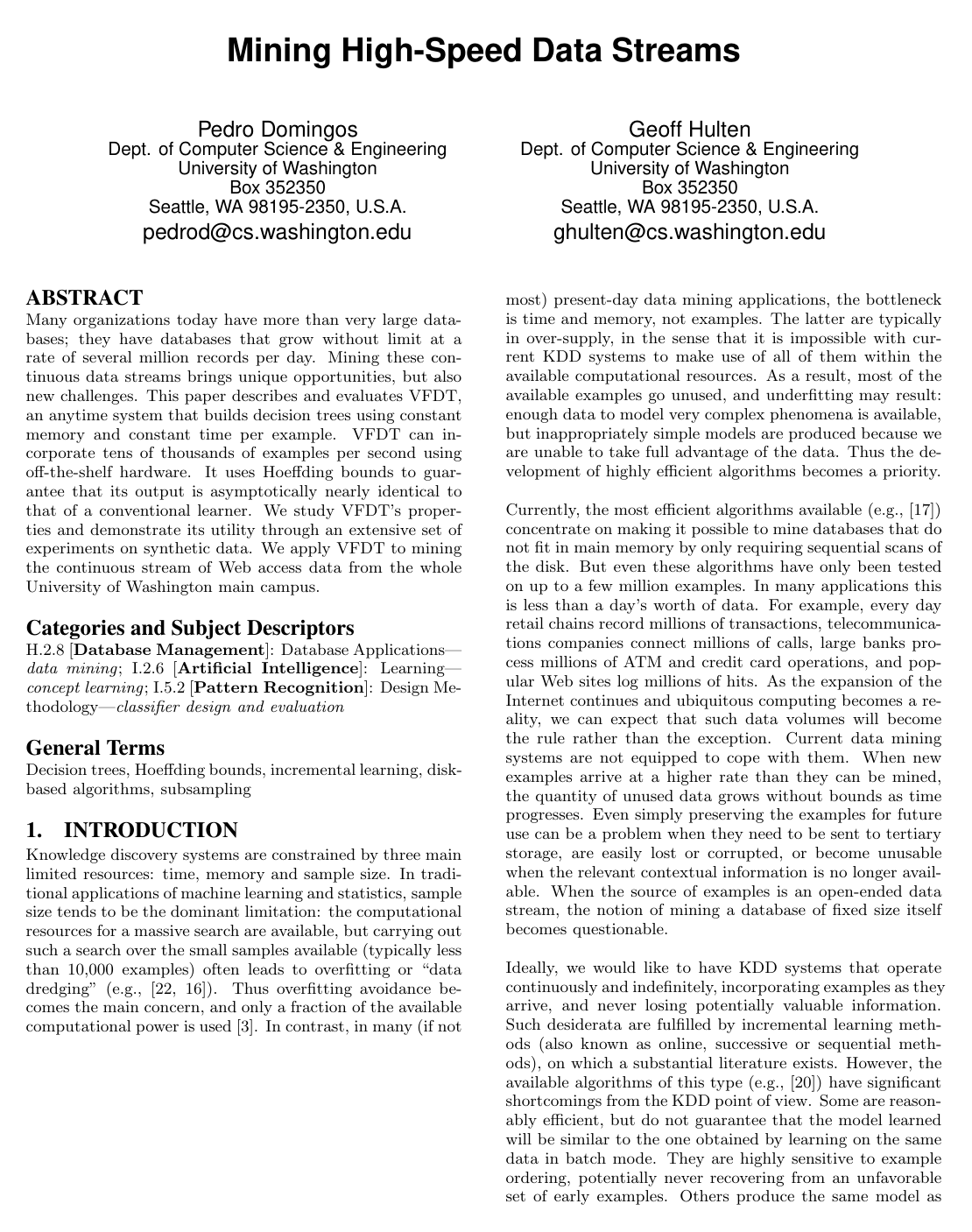
Mining high-speed data streams
Pedro Domingos, Geoff Hulten
Why you should read this
Introduces a seminal algorithm for inducing decision trees incrementally from infinite data streams using statistical confidence bounds.
wb ( b d0 6 X 80 6) S 7 !R % 0 6" ix iy w u 3r U f !1 20 w" " 0 61 ' ( B R S !7 ! S0 6a 6 !" ! 8 0 60 6" R " ! S 3a 6 " @ 1 T0 61 2
Added
2026-04-19