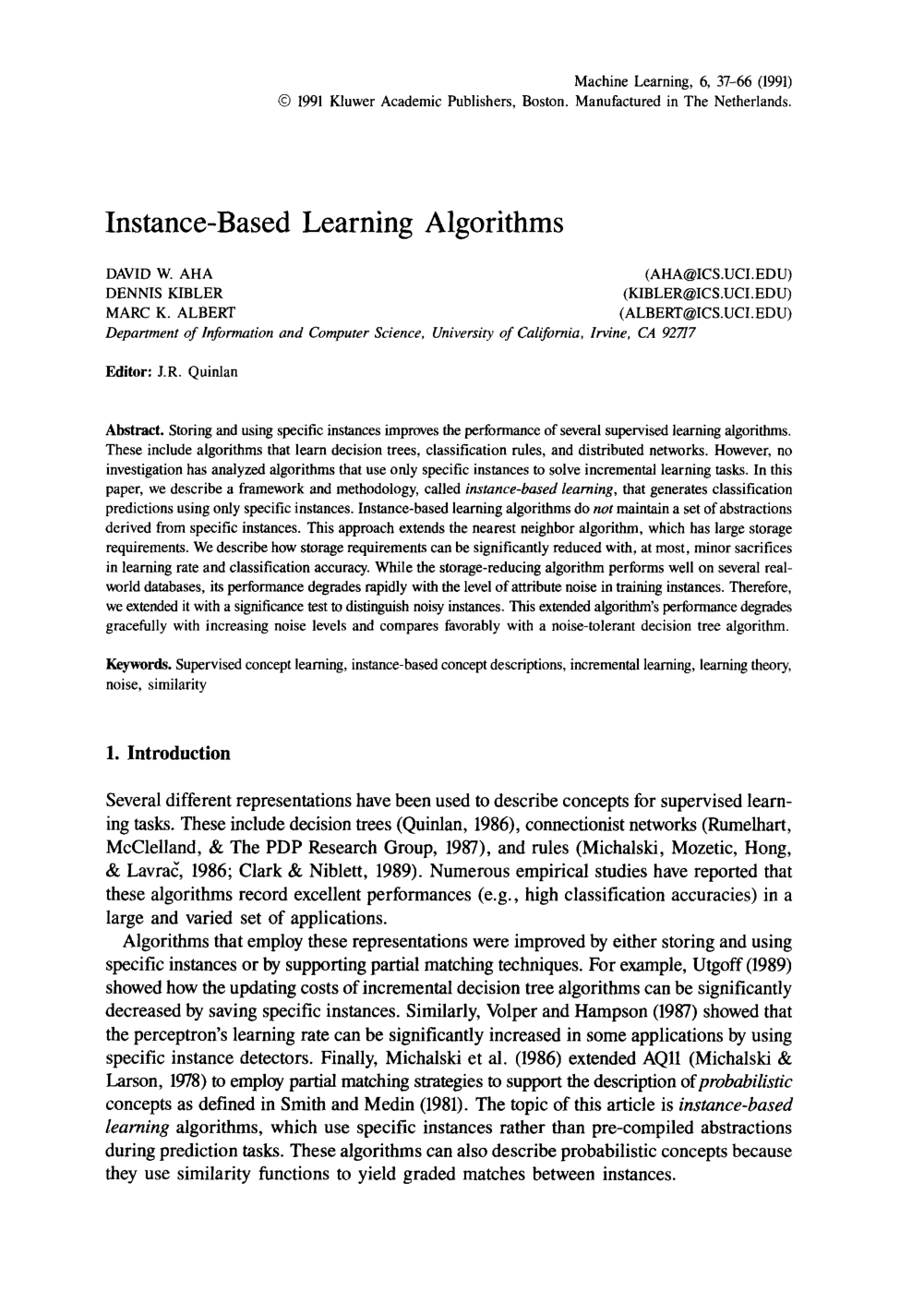
Instance-Based Learning Algorithms
David W. AhaDennis KiblerMarc K. Albert
Introduces incremental instance-based learning algorithms that extend nearest neighbor classification by significantly reducing storage requirements and filtering noisy instances with formal learnability guarantees.
Instance-based learning algorithms classify new examples solely by comparing them directly to stored training instances rather than deriving rules or decision trees. The paper examines this approach because many supervised learning tasks benefit from retaining specific examples, yet prior work had not systematically analyzed incremental algorithms that rely only on instances while addressing practical issues such as storage growth and noise.
The authors first define a general framework consisting of a similarity function, a classification rule, and an updater that decides which instances to retain. They analyze the simplest version, IB1, which stores every instance and classifies by nearest neighbor, proving that it can learn any concept whose boundary consists of a finite number of closed curves and that the number of instances required grows polynomially with boundary length. They then introduce IB2, which stores only misclassified instances, and IB3, which further applies a statistical significance test to discard likely noisy instances before they influence future predictions. These algorithms were evaluated on six real-world and artificial data sets, including congressional voting records, medical diagnosis collections, and two noisy synthetic domains, with results averaged over repeated random splits and compared against the pruned decision-tree learner C4.
IB2 reduced storage to between 11 % and 71 % of the original training set while maintaining classification accuracy within a few percentage points of IB1 on clean data. IB3 achieved still lower storage (often under 20 %) and, on noisy or imperfectly described domains, produced higher accuracy than both IB1 and IB2, matching or exceeding C4. The performance gap widened as noise increased, because IB3’s filter prevented noisy instances from participating in later decisions. These gains matter for applications that must update models frequently or operate under memory constraints, since instance-based methods incur almost no cost when incorporating a new training example and naturally represent probabilistic concepts through graded similarity.
The results indicate that selective retention of instances can deliver accuracy comparable to more elaborate abstractions while keeping computational overhead low during learning. For deployment, organizations should therefore consider IB3-style filters when data contain noise or when storage and update costs are primary concerns; when concepts are sparse or contain many irrelevant attributes, additional mechanisms for attribute weighting will be needed before reliable decisions can be made. Further controlled trials on larger, higher-dimensional data and integration with indexing structures are the logical next steps to confirm scalability. The main limitations are sensitivity to irrelevant attributes and the assumption that concepts are disjoint; both are acknowledged by the authors and remain open for refinement.
- Paper: Induction of Decision Trees, J. R. Quinlan (1986). Reading Quinlan's foundational work on decision tree induction provides essential context on non-incremental classification paradigms before exploring instance-based alternatives.
- Paper: Distance Metric Learning for Large Margin Nearest Neighbor Classification, Kilian Q. Weinberger et al. (2005). This paper extends instance-based and nearest-neighbor principles by introducing sophisticated metric learning techniques to optimize classification performance.