PMAL: Open Set Recognition via Robust Prototype Mining

Jing LuYunlu XuHao LiZhanzhan ChengYi Niu

article2022AAAI84 citations

Proposes a prototype mining and learning framework that improves open set recognition by selecting high-quality, diverse training samples as explicit class prototypes based on data uncertainty and feature topology.

Listen

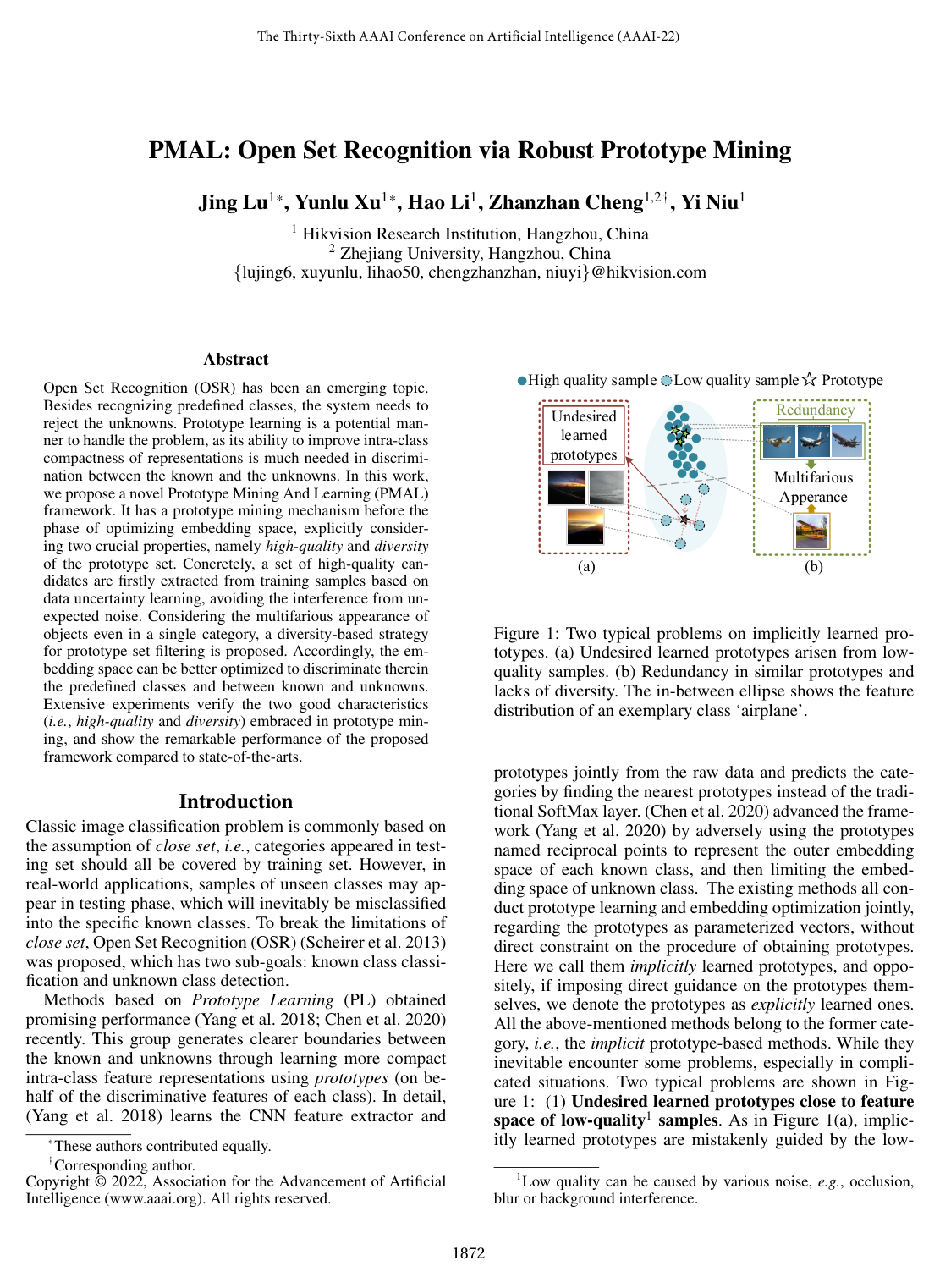
Real-world machine learning systems must operate in open environments where they encounter novel or unseen categories during deployment. Standard visual recognition models assume a closed-world setting and will incorrectly classify unknown objects into predefined known classes. Open Set Recognition addresses this challenge by requiring systems to accurately classify known categories while simultaneously detecting and rejecting unknown samples. While prototype-based learning methods have shown promise by grouping similar samples together in feature space, existing techniques learn prototypes implicitly alongside model parameters. This often leaves systems vulnerable to low-quality, noisy data such as blur or occlusion, and leads to redundant prototype representations that fail to capture the diverse visual appearances within a category.

The article introduces and evaluates a two-stage framework called Prototype Mining And Learning (PMAL). The objective is to demonstrate that explicitly selecting high-quality, diverse visual prototypes from training data before optimizing the feature space significantly improves both known-class classification accuracy and unknown-class detection.

The evaluated approach divides the recognition pipeline into two distinct phases. First, in the prototype mining phase, high-quality image candidates are selected by measuring how robustly sample relationships are preserved across different initial model training runs, which filters out inherent data noise. A diversity-based selection algorithm then chooses a diverse set of final prototype images per category to capture multifarious visual appearances without redundancy. Second, in the embedding learning phase, these mined images serve as fixed anchors to optimize a discriminative feature space using an attention-based distance metric. The authors evaluated this framework across six standard small-scale benchmarks (such as MNIST, SVHN, CIFAR variants, and TinyImageNet) and three challenging large-scale datasets (ImageNet-100, ImageNet-200, and the long-tailed ImageNet-LT dataset) using both compact and standard neural network architectures.

The evaluation yielded several key findings. First, on large-scale and complex benchmarks, the proposed framework achieved dramatic improvements in detecting unknown classes, increasing area-under-the-curve performance by 12.6% to 16.5% over previous state-of-the-art methods. Second, the framework maintained superior known-class accuracy across all small and large benchmarks, achieving gains of 2% to 3.2% in closed-set accuracy on datasets like ImageNet-LT and CIFAR. Third, unlike prior prototype-based models that add millions of learnable parameters as the number of classes grows, the proposed method introduces zero additional parameters during inference, ensuring consistent scalability and efficiency. Finally, using multiple diverse prototypes per category (such as ten prototypes) substantially outperformed single-prototype baselines, effectively easing model optimization and creating wider safety margins between known and unknown categories.

These findings indicate that decoupling prototype selection from feature optimization provides a more robust and scalable path for deploying computer vision systems in unconstrained environments. By eliminating extra prototype parameters and avoiding noise interference, the approach reduces computational overhead during inference and lowers operational risk in safety-critical applications where unseen inputs must be rejected reliably. Furthermore, its strong performance on long-tailed data indicates high resilience when dealing with real-world category imbalances where sample counts vary widely.

Organizations developing computer vision systems for open-world deployments should adopt explicit sample-filtering pipelines to anchor category representations before training feature embeddings. Implementing a multi-prototype strategy per class is strongly advised over single-prototype approaches to capture real-world visual diversity. Teams can safely adopt compact neural architectures paired with this mining strategy to achieve competitive accuracy with minimal hardware resources.

The primary limitation noted in the article is that the framework was evaluated exclusively on image recognition tasks, and prototype candidate mining depends on an initial filtering threshold that balances sample quality against visual diversity. Nonetheless, the experimental evidence across multiple diverse benchmarks and model backbones provides high confidence in the framework's reliability and practical advantages.

  • Paper: Toward Open Set Recognition, W. Scheirer et al. (2013). This seminal paper mathematically formalizes open set recognition and the minimization of open space risk, providing the foundational problem formulation that PMAL builds upon.
  • Paper: Towards Open Set Deep Networks, Abhijit Bendale et al. (2015). This work establishes the foundational OpenMax architecture for deep open set recognition, introducing the standard benchmark protocol and activation-space rejection mechanisms that PMAL seeks to improve.
  • Paper: Prototypical Networks for Few-shot Learning, Jake Snell et al. (2017). This paper introduces metric-based prototypical learning using class centroid anchors, which forms the underlying representation paradigm PMAL adapts through robust prototype mining.
  • Paper: Large-Scale Long-Tailed Recognition in an Open World, Ziwei Liu et al. (2019). This paper establishes the open long-tailed recognition framework and the ImageNet-LT benchmark, which PMAL directly uses to demonstrate robustness against class imbalance and open-world shift.
  • Paper: Generalized Out-of-Distribution Detection: A Survey, Jingkang Yang et al. (2021). This comprehensive survey categorizes open set and out-of-distribution detection benchmarks and evaluation methodologies, contextualizing the experimental landscape evaluated in PMAL.
  • Paper: A Simple Unified Framework for Detecting Out-of-Distribution Samples and Adversarial Attacks, Kimin Lee et al. (2018). This foundational chapter establishes distance-based anomaly detection using feature-space class distributions, motivating PMAL's metric-distance approach to unknown rejection.
  • Paper: Deep Anomaly Detection with Outlier Exposure, Dan Hendrycks et al. (2019). This work establishes standard outlier evaluation protocols and loss formulations for detecting unknown inputs, offering essential background for evaluating open set discriminative spaces.
Cover for PMAL: Open Set Recognition via Robust Prototype Mining

Abstract

Open Set Recognition (OSR) has been an emerging topic. Besides recognizing predefined classes, the system needs to reject the unknowns. Prototype learning is a potential manner to handle the problem, as its ability to improve intra-class compactness of representations is much needed in discrimination between the known and the unknowns. In this work, we propose a novel Prototype Mining And Learning (PMAL) framework. It has a prototype mining mechanism before the phase of optimizing embedding space, explicitly considering two crucial properties, namely high-quality and diversity of the prototype set. Concretely, a set of high-quality candidates are firstly extracted from training samples based on data uncertainty learning, avoiding the interference from unexpected noise. Considering the multifarious appearance of objects even in a single category, a diversity-based strategy for prototype set filtering is proposed. Accordingly, the embedding space can be better optimized to discriminate therein the predefined classes and between known and unknowns. Extensive experiments verify the two good characteristics (i.e., high-quality and diversity) embraced in prototype mining, and show the remarkable performance of the proposed framework compared to state-of-the-arts.

Table of Contents

  • Introduction
  • Related Work
  • Notation and Preliminaries
  • Notations
  • Preliminaries of Uncertainty
  • Prototype Mining
  • High-Quality Candidate Selection
  • Diverse Prototype-Set Filtering
  • Embedding Optimization
  • Prototype-based Space Optimization
  • Rejecting Unknowns
  • Experiments
  • Experiments on Small-Scale Benchmarks
  • Experiments on Larger-Scale Benchmarks
  • Detailed Analysis
  • Conclusion
  • References

Knowls

  1. Knowl 1 — Prototype Mining And Learning framework

    model/method

    Prototype Mining And Learning (PMAL) is an open-set recognition framework that treats prototypes as selected training samples rather than independently learned feature vectors. It separates training into two ordered phases: (1) prototype mining, which selects class-specific samples that are both high-quality and diverse, and (2) embedding optimization, which uses the mined samples as fixed prototype anchors while learning a feature space that compactly represents known classes and separates them from unknowns. Because prototypes are mined before embedding optimization and introduce no trainable prototype parameters, the embedding model can focus on learning sample representations without jointly optimizing unstable prototype vectors.

  2. Knowl 2 — Embedding topology robustness for measuring sample quality

    definition

    For an input sample xix_i, the paper models its embedding as

    zi=ϕi+ni,ni∼N(0,σi),z_i=\phi_i+n_i,\qquad n_i\sim\mathcal{N}(0,\sigma_i),

    where zi∈RDz_i\in\mathbb{R}^{D} is the observed embedding, ϕi∈RD\phi_i\in\mathbb{R}^{D} is the ideal class-relevant feature, and σi\sigma_i represents data uncertainty caused by image-quality factors such as occlusion, blur, or background interference. Lower uncertainty implies a more reliable sample.

    Two independently trained classifiers produce embeddings Z1Z^1 and Z2Z^2. For an embedding ziz_i, define its embedding topology as the vector of Mahalanobis distances to all NN training samples:

    t(zi)=(dM(zi,z1),…,dM(zi,zN)),dM(a,b)=(a−b)Σ−1(a−b)⊤,t(z_i)=\bigl(d_M(z_i,z_1),\ldots,d_M(z_i,z_N)\bigr),\qquad d_M(a,b)=\sqrt{(a-b)\Sigma^{-1}(a-b)^\top},

    where Σ\Sigma is the embedding-space covariance matrix and a,b∈RDa,b\in\mathbb{R}^{D} are row-vector embeddings. Embedding topology robustness is

    r(xi)=exp⁡(−∥t(zi1)−t(zi2)∥2),r(x_i)=\exp\left(-\left\|t(z_i^1)-t(z_i^2)\right\|_2\right),

    where zi1z_i^1 and zi2z_i^2 are the embeddings of the same sample under the two classifiers. High-quality samples preserve their relative distances across the two embedding spaces, giving r(xi)r(x_i) close to 11; noisy, low-quality samples have less stable relative positions and therefore smaller r(xi)r(x_i).

  3. Knowl 3 — High-quality candidate prototype selection

    algorithm

    The candidate-selection procedure takes a labeled training set of KK known classes and returns a high-quality candidate set for each class.

    1. Train U=2U=2 SoftMax classifiers on the known-class training data, repeating initialization and data shuffling so that the classifiers induce two different embedding spaces.
    2. Embed every training sample with both classifiers and compute each sample's embedding topology robustness r(xi)r(x_i).
    3. For class kk, let SkS_k be all training samples with label kk, and let rkmax⁡=max⁡xi∈Skr(xi)r_k^{\max}=\max_{x_i\in S_k}r(x_i).
    4. Retain the class samples satisfying r(xi)≥ϵrkmax⁡r(x_i)\geq\epsilon r_k^{\max} as the candidate set CkC_k, using ϵ=0.7\epsilon=0.7 in the main experiments.
    5. Return C=⋃k=1KCkC=\bigcup_{k=1}^{K}C_k.

    The procedure explicitly removes low-quality samples before diversity selection. The two classifiers are needed only during prototype mining; the final embedding model uses one classifier and adds no prototype-specific inference parameters.

  4. Knowl 4 — Diversity-based prototype-set filtering

    algorithm

    For each class kk, the diversity filter receives a candidate set CkC_k of NkN_k samples, their embeddings in either of the two independently trained spaces, a robustness score r(x)r(x) for every candidate, and a target prototype count T=10T=10. It returns a prototype set PkP_k of TT training samples.

    Input: Candidate sets CkC_k for k=1,…,Kk=1,\ldots,K; robustness scores r(x)r(x); target count $T=10
    Output: Prototype sets PkP_k
    for each class k do
        Compute the pairwise Mahalanobis distance matrix DkD_k among samples in CkC_k
        For every candidate xix_i in CkC_k do
            Find the closest candidate xjx_j satisfying r(xj)>r(xi)r(x_j)>r(x_i), if such a candidate exists
            Set E[i]E[i] to the distance Dk[i,j]D_k[i,j]; if no such candidate exists, initialize E[i]E[i] to the maximum distance in DkD_k
        end for
        Sort candidate indices by decreasing E[i]E[i]
        Initialize PkP_k with the candidate having the largest robustness score
        while ∣Pk∣<T|P_k|<T do
            Append the remaining candidate with the largest E[i]E[i] to PkP_k
            Remove that candidate from the sorted list
        end while
    end for
    return all PkP_k

    The score E[i]E[i] favors candidates that are far from a nearby candidate of higher quality, so the procedure retains local high-robustness representatives while covering separated regions of the class embedding distribution. It therefore removes redundant candidates without discarding distinct visual modes within a class. Because high-quality samples have stable Mahalanobis distances across the two spaces, either space can be used for the filtering distances.

  5. Knowl 5 — Prototype-based embedding optimization with self-attentive point-to-set distance

    model/method

    Let xix_i be a known-class training sample with embedding zi∈Rdz_i\in\mathbb{R}^{d} and true class mm. Let Pk={pk,1,…,pk,T}P_k=\{p_{k,1},\ldots,p_{k,T}\} be the mined samples for class kk, and let

    z(Pk)=[z(pk,1),…,z(pk,T)]∈Rd×Tz(P_k)=\bigl[z(p_{k,1}),\ldots,z(p_{k,T})\bigr]\in\mathbb{R}^{d\times T}

    be their embeddings under the current feature extractor. The point-to-set distance uses the sample embedding as a query over all prototypes:

    ziatt(Pk)=SoftMax⁡(zi⊤z(Pk)d)z(Pk),z_i^{\mathrm{att}}(P_k)=\operatorname{SoftMax}\left(\frac{z_i^\top z(P_k)}{\sqrt d}\right)z(P_k),

    d(zi,z(Pk))=1−zi⊤ziatt(Pk)∥zi∥2 ∥ziatt(Pk)∥2.d\bigl(z_i,z(P_k)\bigr)=1-\frac{z_i^\top z_i^{\mathrm{att}}(P_k)}{\lVert z_i\rVert_2\,\lVert z_i^{\mathrm{att}}(P_k)\rVert_2}.

    The loss compares the distance to the true class's prototype set with the closest competing prototype set:

    Lp=1N∑i=1N[d(zi,z(Pm))−d(zi,z(Pu))+δ]+,L_p=\frac{1}{N}\sum_{i=1}^{N}\left[d\bigl(z_i,z(P_m)\bigr)-d\bigl(z_i,z(P_u)\bigr)+\delta\right]_+,

    Pu=arg⁡min⁡Pk∈P, Pk≠Pm d(zi,z(Pk)),P_u=\underset{P_k\in P,\,P_k\neq P_m}{\arg\min}\ d\bigl(z_i,z(P_k)\bigr),

    where NN is the training-set size, [a]+=max⁡(a,0)[a]_+=\max(a,0), and δ=0.5\delta=0.5 is the margin used in the experiments. The total training objective is

    L=Lcls+λpLp,L=L_{\mathrm{cls}}+\lambda_pL_p,

    where LclsL_{\mathrm{cls}} is the ordinary SoftMax classification loss and λp=1\lambda_p=1. The mined samples remain fixed as sample identities, but their embeddings are recomputed by the current feature extractor; unlike implicit prototype methods, no separate prototype vectors are optimized.

  6. Knowl 6 — Unknown rejection using probabilities or prototype-set distance

    model/method

    PMAL supports two unknown-rejection rules after embedding optimization. Probability-based rejection rejects a sample when its maximum SoftMax class probability is below a selected threshold. Distance-based rejection rejects a sample when its nearest prototype-set distance,

    min⁡Pkd(zi,z(Pk)),\min_{P_k}d\bigl(z_i,z(P_k)\bigr),

    is above a selected threshold. The distance rule is motivated by the expected separation of unknown samples from every known-class prototype set. The paper reports distance-based results because the two rejection rules produced similar performance.

  7. Knowl 7 — Experimental protocol and implementation settings

    experimental setup

    The evaluation measures both known-class recognition and unknown detection. Known-class performance is reported as classification accuracy (ACC), while open-set performance is reported as AUROC over known and unknown test samples; results on the small benchmarks are averaged over five random known/unknown splits.

    Small-scale experiments use MNIST, SVHN, CIFAR-10, CIFAR+10, CIFAR+50, and TinyImageNet. Four classes are known for MNIST, SVHN, and CIFAR-10; four non-animal CIFAR-10 classes are known for CIFAR+10 and CIFAR+50; and 20 randomly selected TinyImageNet classes are known. The lightweight OSCRI backbone has fewer than 1M parameters, and Wide-ResNet has about 9M parameters. Training uses Adam for 600 epochs with batch size 128, initial learning rate 0.010.01, a 0.10.1 learning-rate multiplier every 120 epochs, momentum 0.90.9, and weight decay 5×10−45\times10^{-4}. The default PMAL settings are T=10T=10, ϵ=0.7\epsilon=0.7, U=2U=2, δ=0.5\delta=0.5, and λp=1\lambda_p=1.

    Large-scale experiments use ImageNet-100, ImageNet-200, and long-tailed ImageNet-LT. ResNet-50 is trained with SGD at learning rate 0.20.2, reduced by a factor of 0.10.1 every 30 epochs; other settings follow the small-scale protocol. ImageNet-LT contains 1,000 known ImageNet-2012 classes with additional ImageNet-2010 classes treated as unknown, and has between 5 and 1,280 images per class.

  8. Knowl 8 — Small-scale open-set recognition results

    data/table

    The numerical benchmark results reported on page 6 compare close-set ACC and open-set AUROC across six small datasets. PMAL obtains the strongest or tied-strongest results throughout, with PMAL-WRN reaching AUROC values from 83.183.1 to 99.799.7 and PMAL-OSCRI remaining competitive despite its much smaller backbone. The results demonstrate that mined prototypes improve both known-class classification and unknown detection.

    Could not parse LaTeX table

    Here C10 denotes CIFAR-10, C+10 and C+50 denote CIFAR+10 and CIFAR+50, TINY denotes TinyImageNet, and ∗^* marks results implemented by the paper's authors. Compared with RPL-WRN, PMAL-WRN improves TinyImageNet AUROC from 80.980.9 to 83.183.1; compared with same-backbone alternatives, PMAL-OSCRI improves TinyImageNet AUROC from 70.270.2 for RPL-OSCRI to 81.881.8.

  9. Knowl 9 — Large-scale and long-tailed benchmark results

    data/table

    The large-scale results reported on page 7 show substantially larger gains for PMAL than those observed on the small datasets. PMAL improves close-set ACC by 3.23.2 percentage points on ImageNet-LT relative to RPL++ and by 2.02.0 points on ImageNet-200 relative to the strongest listed prior result. Its AUROC gains over the strongest prior listed method are 16.516.5, 12.612.6, and 13.713.7 points on ImageNet-LT, ImageNet-100, and ImageNet-200, respectively. PMAL also uses no additional prototype parameters, whereas prior prototype methods add up to 44M parameters on ImageNet-LT.

    Could not parse LaTeX table

    IN-LT denotes ImageNet-LT, and IN-100 and IN-200 denote ImageNet-100 and ImageNet-200. The results support the paper's claim that directly mining reliable samples is particularly beneficial when the number of known classes is large or the class distribution is long-tailed, where jointly learned prototype parameters become difficult to optimize and unstable for few-sample classes.

  10. Knowl 10 — Ablation and sensitivity evidence for quality, diversity, and point-to-set learning

    empirical result

    The component studies on TinyImageNet show that both prototype quality and prototype diversity contribute to PMAL, with high-quality selection being the more important factor. Combining both properties and the proposed point-to-set embedding objective gives the best ablation AUROC of 83.183.1; replacing the point-to-set distance with the usual nearest-prototype distance reduces AUROC by about 1.21.2 percentage points.

    For selecting high-quality samples, the reported ACC/AUROC pairs are: probability selection (81.9,79.3)(81.9,79.3), deep ensembles (82.3,80.5)(82.3,80.5), MC-dropout (81.6,78.8)(81.6,78.8), and embedding topology robustness (84.7,83.1)(84.7,83.1). For selecting multiple prototypes, randomization gives (81.5,79.1)(81.5,79.1), clustering gives (81.8,79.6)(81.8,79.6), and the proposed diversity filter gives (84.7,83.1)(84.7,83.1), where each pair is (ACC,AUROC)(\mathrm{ACC},\mathrm{AUROC}).

    The reported AUROC sensitivity values are 79.9,81.1,83.1,82.6,83.179.9,81.1,83.1,82.6,83.1 for prototype counts T=1,5,10,20,30T=1,5,10,20,30; 73.6,78.1,82.6,83.1,81.273.6,78.1,82.6,83.1,81.2 for quality thresholds ϵ=0.1,0.3,0.5,0.7,0.9\epsilon=0.1,0.3,0.5,0.7,0.9; 83.1,83.3,83.2,83.0,83.383.1,83.3,83.2,83.0,83.3 for U=2,3,4,5,6U=2,3,4,5,6 embedding models; and 80.9,82.8,83.1,82.1,80.580.9,82.8,83.1,82.1,80.5 for margins δ=0.1,0.3,0.5,0.8,1.0\delta=0.1,0.3,0.5,0.8,1.0. Varying λp\lambda_p over 0.5,0.8,10.5,0.8,1 produces AUROC values 82.6,82.8,82.982.6,82.8,82.9, respectively. These results motivate the default setting T=10T=10, ϵ=0.7\epsilon=0.7, U=2U=2, δ=0.5\delta=0.5, and λp=1\lambda_p=1.

Coverage note — Qualitative t-SNE visualizations of learned embeddings and the small fluctuation of mined prototypes across three repetitions were omitted because they corroborate the quantitative quality, diversity, and stability results rather than add a separate load-bearing method or numerical conclusion.

References

  1. 1.Bendale, A.; and Boult, T. E. 2016. Towards Open Set Deep Networks. In CVPR, 1563–1572.
  2. 2.Chang, J.; Lan, Z.; Cheng, C.; and Wei, Y. 2020. Data Uncertainty Learning in Face Recognition. In CVPR, 5709–5718.
  3. 3.Chen, G.; Peng, P.; Wang, X.; and Tian, Y. 2021. Adversarial Reciprocal Points Learning for Open Set Recognition. IEEE TPAMI, 1–1.
  4. 4.Chen, G.; Qiao, L.; Shi, Y.; Peng, P.; Li, J.; Huang, T.; Pu, S.; and Tian, Y. 2020. Learning Open Set Network with Discriminative Reciprocal Points. In ECCV, volume 12348, 507–522.
  5. 5.Deng, J.; Dong, W.; Socher, R.; Li, L.; Li, K.; and Li, F. 2009. ImageNet: A large-scale hierarchical image database. In CVPR, 248–255.
  6. 6.Gal, Y.; and Ghahramani, Z. 2016. Dropout as a Bayesian Approximation: Representing Model Uncertainty in Deep Learning. In ICML, volume 48, 1050–1059.
  7. 7.Ge, Z.; Demyanov, S.; and Garnavi, R. 2017. Generative OpenMax for Multi-Class Open Set Classification. arXiv:1707.07418.
  8. 8.He, K.; Zhang, X.; Ren, S.; and Sun, J. 2016. Deep Residual Learning for Image Recognition. In CVPR, 770–778.
  9. 9.Kendall, A.; Badrinarayanan, V.; and Cipolla, R. 2016. Bayesian segnet: Model uncertainty in deep convolutional encoder-decoder architectures for scene understanding. arXiv:1511.02680.
  10. 10.Krizhevsky, A.; and et al, G. H. 2009. Learning multiple layers of features from tiny images. Technical report.
  11. 11.Lakshminarayanan, B.; Pritzel, A.; and Blundell, C. 2017. Simple and Scalable Predictive Uncertainty Estimation using Deep Ensembles. In NeurIPS, 6402–6413.
  12. 12.LeCun, Y.; Bottou, L.; Bengio, Y.; and Haffner, P. e. a. 1998. Gradient-based learning applied to document recognition. Proceedings of the IEEE, 86(11): 2278–2324.
  13. 13.Liu, Z.; Miao, Z.; Zhan, X.; Wang, J.; Gong, B.; and Yu, S. X. 2019. Large-Scale Long-Tailed Recognition in an Open World. In CVPR, 2537–2546.
  14. 14.Ma, M.; Shao, M.; Zhao, X.; and Fu, Y. 2013. Prototype based feature learning for face image set classification. In FG, 1–6.
  15. 15.Neal, L.; Olson, M. L.; Fern, X. Z.; Wong, W.; and Li, F. 2018. Open Set Learning with Counterfactual Images. In ECCV, volume 11210, 620–635.
  16. 16.Netzer, Y.; Wang, T.; Coates, A.; Bissacco, A.; Wu, B.; and Ng, A. 2011. Reading digits in natural images with unsupervised feature learning. In NeurIPS workshop.
  17. 17.Oza, P.; and Patel, V. M. 2019. C2AE: Class Conditioned Auto-Encoder for Open-Set Recognition. In CVPR, 2307–2316.
  18. 18.Rosch, E. 1973. Natural categories. Cognitive psychology, 4(3): 328–350.
  19. 19.Scheirer, W. J.; de Rezende Rocha, A.; Sapkota, A.; and Boult, T. E. 2013. Toward Open Set Recognition. IEEE TPAMI, 35(7): 1757–1772.
  20. 20.Sener, O.; and Savarese, S. 2018. Active Learning for Convolutional Neural Networks: A Core-Set Approach. arXiv:1708.00489.
  21. 21.Shi, Y.; and Jain, A. K. 2019. Probabilistic Face Embeddings. In ICCV, 6901–6910.
  22. 22.Snell, J.; Swersky, K.; and Zemel, R. S. 2017. Prototypical Networks for Few-shot Learning. In NeurIPS, 4077–4087.
  23. 23.Sun, X.; Yang, Z.; Zhang, C.; Ling, K. V.; and Peng, G. 2020. Conditional Gaussian Distribution Learning for Open Set Recognition. In CVPR, 13477–13486.
  24. 24.Vaswani, A.; Shazeer, N.; Parmar, N.; Uszkoreit, J.; Jones, L.; Gomez, A. N.; Kaiser, L.; and Polosukhin, I. 2017. Attention Is All You Need. In NeurIPS, 6000–6010.
  25. 25.Wang, W.; Wang, R.; Shan, S.; and Chen, X. 2016. Prototype Discriminative Learning for Face Image Set Classification. In ACCV, volume 10113, 344–360.
  26. 26.Ya, L.; and Xuan, Y. 2015. Tiny imagenet visual recognition challenge. CS 231N, 7(7): 3.
  27. 27.Yang, H.; Zhang, X.; Yin, F.; and Liu, C. 2018. Robust Classification With Convolutional Prototype Learning. In CVPR, 3474–3482.
  28. 28.Yang, H.-M.; Zhang, X.-Y.; Yin, F.; Yang, Q.; and Liu, C.-L. 2020. Convolutional Prototype Network for Open Set Recognition. IEEE TPAMI, 1–1.
  29. 29.Yoshihashi, R.; Shao, W.; Kawakami, R.; You, S.; Iida, M.; and Naemura, T. 2019. Classification-Reconstruction Learning for Open-Set Recognition. In CVPR, 4016–4025.
  30. 30.Zhang, H.; Li, A.; Guo, J.; and Guo, Y. 2020. Hybrid Models for Open Set Recognition. In ECCV, volume 12348, 102–117.
  31. 31.Zhou, D.; Ye, H.; and Zhan, D. 2021. Learning Placeholders for Open-Set Recognition. In CVPR, 4401–4410.

Citation

MLA
Lu, J., et al. “PMAL: Open Set Recognition via Robust Prototype Mining”. arXiv, 2022, http://arxiv.org/abs/2203.08569v1.
APA
Lu, J., Xu, Y., Li, H., Cheng, Z., & Niu, Y. (2022). PMAL: Open Set Recognition via Robust Prototype Mining. arXiv. http://arxiv.org/abs/2203.08569v1
Chicago
Lu, J., Y. Xu, H. Li, Z. Cheng, and Y. Niu. 2022. “PMAL: Open Set Recognition via Robust Prototype Mining”. arXiv. http://arxiv.org/abs/2203.08569v1.
Harvard
Lu, J. et al. (2022) “PMAL: Open Set Recognition via Robust Prototype Mining”, arXiv [Preprint]. Available at: http://arxiv.org/abs/2203.08569v1.
Vancouver
1. Lu J, Xu Y, Li H, Cheng Z, Niu Y (2022) PMAL: Open Set Recognition via Robust Prototype Mining. arXiv

BibTeX

@article{lu2022pmal,
  title = {PMAL: Open Set Recognition via Robust Prototype Mining},
  author = {Lu, Jing and Xu, Yunxu and Li, Hao and Cheng, Zhanzhan and Niu, Yi},
  year = {2022},
  journal = {arXiv},
  url = {http://arxiv.org/abs/2203.08569v1},
  eprint = {2203.08569}
}
Metadata:arXiv

Access the Paper

This paper is available from its original source. Click below to access the PDF.

Open PDF