
keyword
prototype learning
Prototype learning is a machine learning paradigm in which categories or data distributions are represented by a set of representative reference points called prototypes, typically optimized within a latent feature space. In this framework, decision-making and classification are conducted through case-based reasoning by calculating the similarity or metric distance between an input sample and the learned prototypes. By summarizing complex data distributions into compact, distinct representatives, prototype learning offers inherent model interpretability, reinforces intra-class compactness and inter-class separability, and facilitates tasks that require modular knowledge representation, such as continual learning, open-set recognition, and federated learning.
5 items
ProtGNN: Towards Self-Explaining Graph Neural Networks
Zaixi Zhang, Qi Liu, Hao Wang, Chengqiang Lu, Cheekong Lee
Why you should read this
Proposes an inherently interpretable graph neural network framework that integrates prototype learning and subgraph sampling to make classifications based on transparent comparisons with learned exemplar subgraphs without sacrificing predictive accuracy.
Despite the recent progress in Graph Neural Networks (GNNs), it remains challenging to explain the predictions made by GNNs. Existing explanation methods mainly focus on post-hoc explanations where another explanatory model is employed to provide explanations for a trained GNN. The fact that post-hoc methods fail to reveal the original reasoning process of GNNs raises the need of building GNNs with built-in interpretability. In this work, we propose Prototype Graph Neural Network (ProtGNN), which combines prototype learning with GNNs and provides a new perspective on the explanations of GNNs. In ProtGNN, the explanations are naturally derived from the case-based reasoning process and are actually used during classification. The prediction of ProtGNN is obtained by comparing the inputs to a few learned prototypes in the latent space. Furthermore, for better interpretability and higher efficiency, a novel conditional subgraph sampling module is incorporated to indicate which part of the input graph is most similar to each prototype in ProtGNN+. Finally, we evaluate our method on a wide range of datasets and perform concrete case studies. Extensive results show that ProtGNN and ProtGNN+ can provide inherent interpretability while achieving accuracy on par with the non-interpretable counterparts.
Added
2026-10-05
FedProto: Federated Prototype Learning across Heterogeneous Clients
Yue Tan, Guodong Long, Lu Liu, Tianyi Zhou, Qinghua Lu, Jing Jiang, Chengqi Zhang
Why you should read this
Proposes a federated prototype learning framework that transmits and aggregates abstract class representations rather than model gradients, enabling efficient collaborative training across clients with heterogeneous model architectures and data distributions.
Heterogeneity across clients in federated learning (FL) usually hinders the optimization convergence and generalization performance when the aggregation of clients' knowledge occurs in the gradient space. For example, clients may differ in terms of data distribution, network latency, input/output space, and/or model architecture, which can easily lead to the misalignment of their local gradients. To improve the tolerance to heterogeneity, we propose a novel federated prototype learning (FedProto) framework in which the clients and server communicate the abstract class prototypes instead of the gradients. FedProto aggregates the local prototypes collected from different clients, and then sends the global prototypes back to all clients to regularize the training of local models. The training on each client aims to minimize the classification error on the local data while keeping the resulting local prototypes sufficiently close to the corresponding global ones. Moreover, we provide a theoretical analysis to the convergence rate of FedProto under non-convex objectives. In experiments, we propose a benchmark setting tailored for heterogeneous FL, with FedProto outperforming several recent FL approaches on multiple datasets.
Added
2026-10-05
Prototype-Sample Relation Distillation: Towards Replay-Free Continual Learning
Nader Asadi, MohammadReza Davari, Sudhir P. Mudur, Rahaf Aljundi, Eugene Belilovsky
Why you should read this
Proposes a replay-free continual learning framework that prevents catastrophic forgetting by distilling the relative similarities between incoming samples and past class prototypes, outperforming memory-buffer methods without storing historical data.
In Continual learning (CL) balancing effective adaptation while combating catastrophic forgetting is a central challenge. Many of the recent best-performing methods utilize various forms of prior task data, e.g. a replay buffer, to tackle the catastrophic forgetting problem. Having access to previous task data can be restrictive in many real-world scenarios, for example when task data is sensitive or proprietary. To overcome the necessity of using previous tasks' data, in this work, we start with strong representation learning methods that have been shown to be less prone to forgetting. We propose a holistic approach to jointly learn the representation and class prototypes while maintaining the relevance of old class prototypes and their embedded similarities. Specifically, samples are mapped to an embedding space where the representations are learned using a supervised contrastive loss. Class prototypes are evolved continually in the same latent space, enabling learning and prediction at any point. To continually adapt the prototypes without keeping any prior task data, we propose a novel distillation loss that constrains class prototypes to maintain relative similarities as compared to new task data. This method yields state-of-the-art performance in the task-incremental setting, outperforming methods relying on large amounts of data, and provides strong performance in the class-incremental setting without using any stored data points.
Added
2026-10-03
PMAL: Open Set Recognition via Robust Prototype Mining
Jing Lu, Yunlu Xu, Hao Li, Zhanzhan Cheng, Yi Niu
Why you should read this
Proposes a prototype mining and learning framework that improves open set recognition by selecting high-quality, diverse training samples as explicit class prototypes based on data uncertainty and feature topology.
Open Set Recognition (OSR) has been an emerging topic. Besides recognizing predefined classes, the system needs to reject the unknowns. Prototype learning is a potential manner to handle the problem, as its ability to improve intra-class compactness of representations is much needed in discrimination between the known and the unknowns. In this work, we propose a novel Prototype Mining And Learning (PMAL) framework. It has a prototype mining mechanism before the phase of optimizing embedding space, explicitly considering two crucial properties, namely high-quality and diversity of the prototype set. Concretely, a set of high-quality candidates are firstly extracted from training samples based on data uncertainty learning, avoiding the interference from unexpected noise. Considering the multifarious appearance of objects even in a single category, a diversity-based strategy for prototype set filtering is proposed. Accordingly, the embedding space can be better optimized to discriminate therein the predefined classes and between known and unknowns. Extensive experiments verify the two good characteristics (i.e., high-quality and diversity) embraced in prototype mining, and show the remarkable performance of the proposed framework compared to state-of-the-arts.
Added
2026-09-26
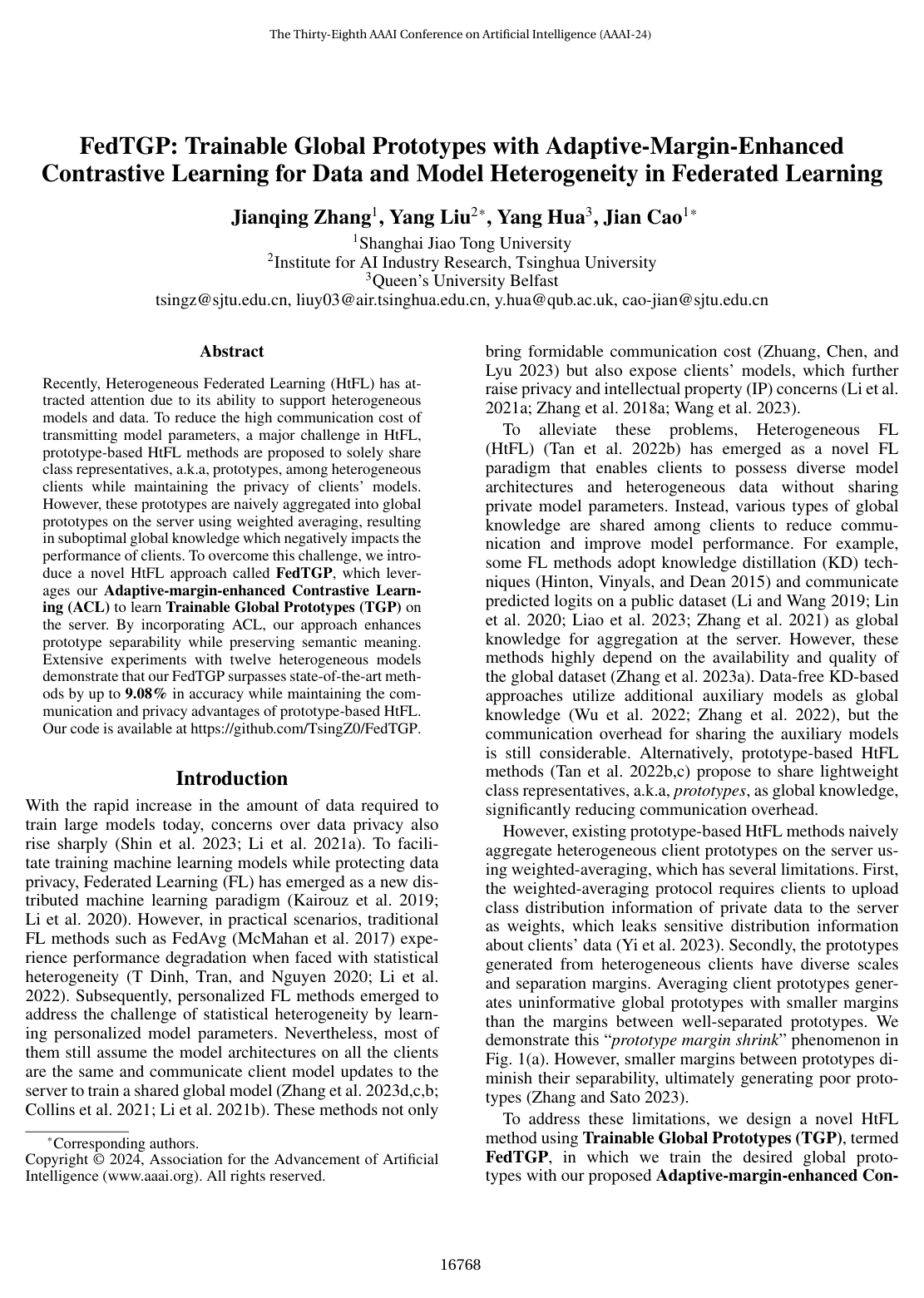
FedTGP: Trainable Global Prototypes with Adaptive-Margin-Enhanced Contrastive Learning for Data and Model Heterogeneity in Federated Learning
Jianqing Zhang, Yang Liu, Yang Hua, Jian Cao
Why you should read this
Proposes a heterogeneous federated learning framework that replaces naive prototype averaging with server-side trainable global prototypes optimized through adaptive-margin contrastive learning, boosting classification accuracy across diverse client models while preserving communication efficiency and privacy.
Recently, Heterogeneous Federated Learning (HtFL) has attracted attention due to its ability to support heterogeneous models and data. To reduce the high communication cost of transmitting model parameters, a major challenge in HtFL, prototype-based HtFL methods are proposed to solely share class representatives, a.k.a, prototypes, among heterogeneous clients while maintaining the privacy of clients' models. However, these prototypes are naively aggregated into global prototypes on the server using weighted averaging, resulting in suboptimal global knowledge which negatively impacts the performance of clients. To overcome this challenge, we introduce a novel HtFL approach called FedTGP, which leverages our Adaptive-margin-enhanced Contrastive Learning (ACL) to learn Trainable Global Prototypes (TGP) on the server. By incorporating ACL, our approach enhances prototype separability while preserving semantic meaning. Extensive experiments with twelve heterogeneous models demonstrate that our FedTGP surpasses state-of-the-art methods by up to 9.08% in accuracy while maintaining the communication and privacy advantages of prototype-based HtFL. Our code is available at https://github.com/TsingZ0/FedTGP.
Added
2026-09-26