
keyword
unseen classes
Unseen classes refer to categories or labels for which a machine learning model receives no labeled training examples during its training phase, yet must handle during evaluation or inference. In paradigms such as zero-shot learning and open-set recognition, these categories contrast with seen or predefined classes that the model was explicitly trained to recognize. Depending on the objective, a system evaluates instances from unseen classes either by rejecting them as unknown or out-of-distribution data, or by classifying them into their specific categories through the use of transferred semantic information, such as shared attributes, textual descriptions, or knowledge graph embeddings.
2 items
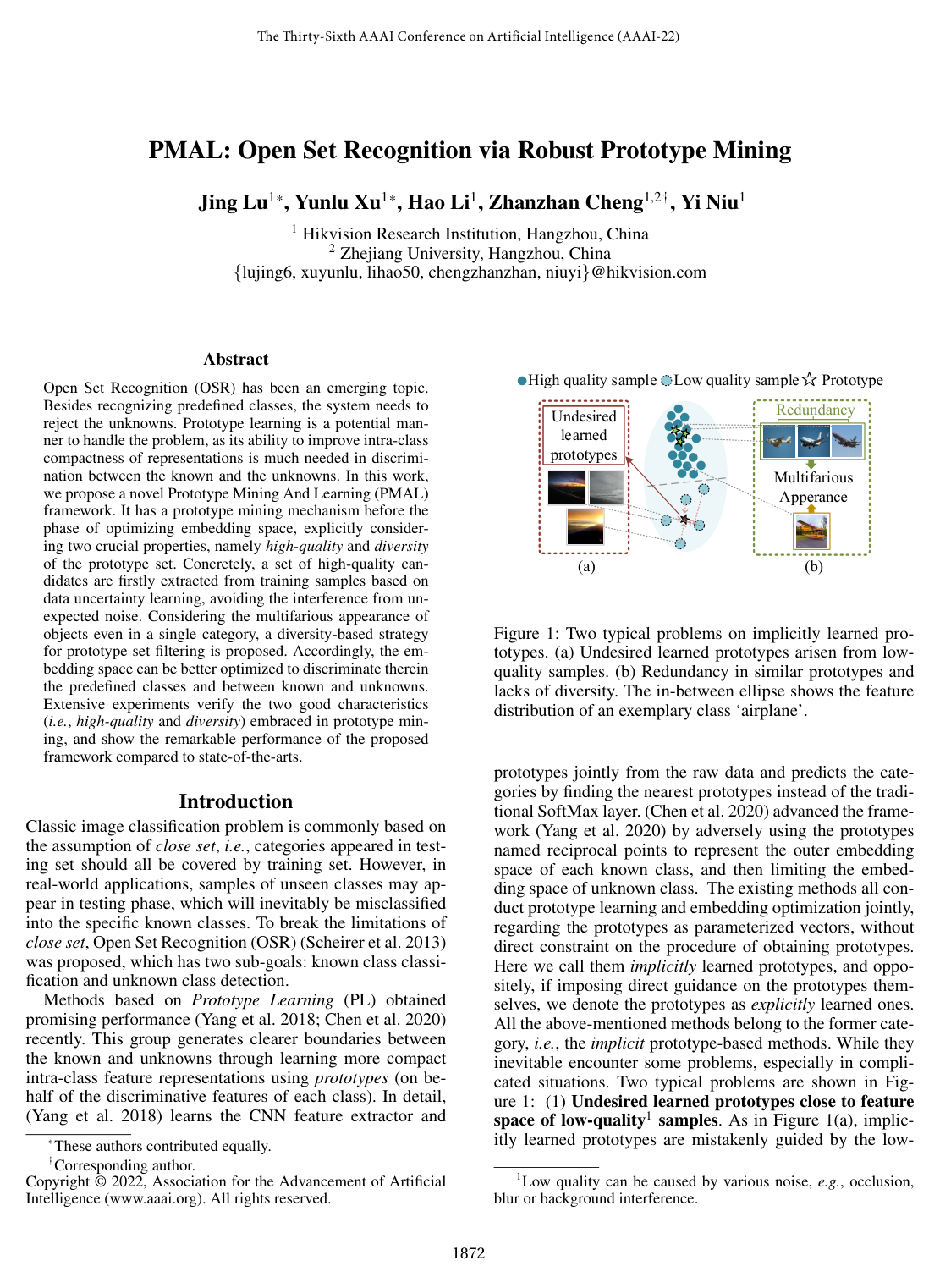
PMAL: Open Set Recognition via Robust Prototype Mining
Jing Lu, Yunlu Xu, Hao Li, Zhanzhan Cheng, Yi Niu
Why you should read this
Proposes a prototype mining and learning framework that improves open set recognition by selecting high-quality, diverse training samples as explicit class prototypes based on data uncertainty and feature topology.
Open Set Recognition (OSR) has been an emerging topic. Besides recognizing predefined classes, the system needs to reject the unknowns. Prototype learning is a potential manner to handle the problem, as its ability to improve intra-class compactness of representations is much needed in discrimination between the known and the unknowns. In this work, we propose a novel Prototype Mining And Learning (PMAL) framework. It has a prototype mining mechanism before the phase of optimizing embedding space, explicitly considering two crucial properties, namely high-quality and diversity of the prototype set. Concretely, a set of high-quality candidates are firstly extracted from training samples based on data uncertainty learning, avoiding the interference from unexpected noise. Considering the multifarious appearance of objects even in a single category, a diversity-based strategy for prototype set filtering is proposed. Accordingly, the embedding space can be better optimized to discriminate therein the predefined classes and between known and unknowns. Extensive experiments verify the two good characteristics (i.e., high-quality and diversity) embraced in prototype mining, and show the remarkable performance of the proposed framework compared to state-of-the-arts.
Added
2026-09-26
Zero-Shot Learning—A Comprehensive Evaluation of the Good, the Bad and the Ugly
Yongqin Xian, Christoph H. Lampert, Bernt Schiele, Zeynep Akata
Why you should read this
Establishes a unified evaluation benchmark and standardized data splits to resolve widespread test-set overlap in zero-shot learning, while introducing the Animals with Attributes 2 (AWA2) dataset and systematically comparing leading methods under both standard and generalized settings.
Due to the importance of zero-shot learning, i.e. classifying images where there is a lack of labeled training data, the number of proposed approaches has recently increased steadily. We argue that it is time to take a step back and to analyze the status quo of the area. The purpose of this paper is three-fold. First, given the fact that there is no agreed upon zero-shot learning benchmark, we first define a new benchmark by unifying both the evaluation protocols and data splits of publicly available datasets used for this task. This is an important contribution as published results are often not comparable and sometimes even flawed due to, e.g. pre-training on zero-shot test classes. Moreover, we propose a new zero-shot learning dataset, the Animals with Attributes 2 (AWA2) dataset which we make publicly available both in terms of image features and the images themselves. Second, we compare and analyze a significant number of the state-of-the-art methods in depth, both in the classic zero-shot setting but also in the more realistic generalized zero-shot setting. Finally, we discuss in detail the limitations of the current status of the area which can be taken as a basis for advancing it.
Added
2026-09-18