PROB: Probabilistic Objectness for Open World Object Detection
Orr ZoharKuan-Chieh WangSerena Yeung
Presents a probabilistic framework that models feature-space objectness distributions to distinguish unknown objects from background without pseudo-labels, doubling unknown object recall over prior open-world detection methods.
Standard computer vision models struggle when deployed in real-world environments because they assume all possible objects belong to fixed, predefined categories. When traditional detectors encounter novel or unlabeled items, they incorrectly classify them as background. Open-world object detection aims to bridge this gap by enabling models to recognize known items, flag novel objects for human annotation, and incrementally learn these new classes without forgetting earlier knowledge. However, existing methods suffer from extremely low unknown object recall (typically around 10%) because distinguishing unlabeled objects from true background without direct supervision remains fundamentally difficult.
The main objective of the article is to introduce and evaluate PROB (Probabilistic Objectness Open World Detection Transformer), a framework that estimates general objectness via a probabilistic model to improve both unknown object discovery and continuous learning.
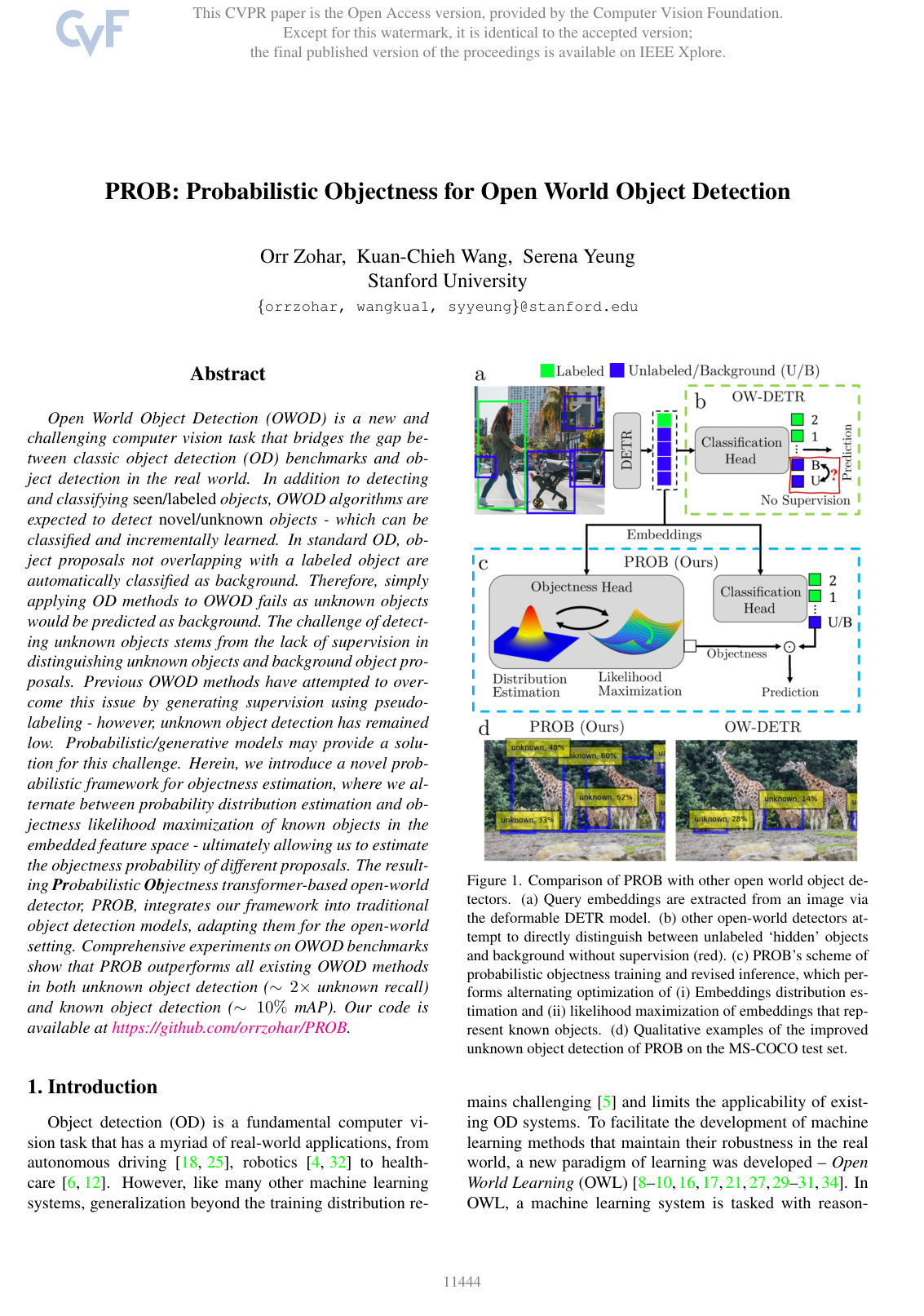
The authors implemented PROB by integrating a probabilistic objectness head into a transformer-based object detection architecture. Rather than relying on heuristic pseudo-labels to guess unknown objects during training, the approach models the distribution of query features as a class-agnostic Gaussian distribution. Training alternates between estimating this probability distribution and maximizing the likelihood of known objects. For incremental updates, the system selects stored representative images (exemplars) based on high and low objectness scores. The method was evaluated on standard open-world benchmarks built on MS-COCO and PASCAL VOC datasets across multiple incremental tasks, tracking unknown recall, classification error, and known mean average precision.
The evaluation yielded several key findings. First, PROB doubled to tripled unknown object recall across all tasks, achieving relative gains of 100% to 300% over prior state-of-the-art methods (for example, reaching 17.6% to 24.8% unknown recall on the separated-superclass benchmark compared to 5.7% to 6.9% for the leading baseline). Second, the method significantly reduced the rate of unknown objects being mistakenly classified as known classes, lowering open-set errors by roughly 25% to 60%. Third, PROB improved known object detection accuracy by approximately 10% across tasks and maintained higher accuracy during incremental updates, demonstrating superior resistance to catastrophic forgetting.
These findings indicate that decoupling general objectness estimation from specific category classification resolves the core tension between identifying novel objects and ignoring background. For operational computer vision systems in robotics, autonomous driving, and healthcare, this reduces the safety risks associated with unflagged novel hazards while optimizing human-in-the-loop annotation workflows by delivering more reliable candidate detections.
Organizations developing open-world computer vision systems should consider adopting probabilistic density estimation over heuristic pseudo-labeling. Practitioners should also leverage objectness-driven exemplar selection to maintain performance during continuous retraining. Before broad deployment, engineering teams should conduct domain-specific pilot studies on custom video feeds or specialized sensors to establish baseline operational confidence.
The primary limitation of this work is that overall unknown object recall remains below 25%, meaning most novel objects still go undetected despite the substantial relative gains. Additionally, the evaluations rely on standardized benchmark datasets, which may not capture all operational complexities of open-ended physical environments. Consequently, while the probabilistic mechanism is sound and outperforms current alternatives, users should maintain human oversight until detection rates on novel classes improve further.
- Paper: Generalized Out-of-Distribution Detection: A Survey, Jingkang Yang et al. (2021). It provides a comprehensive taxonomy and benchmark foundations for out-of-distribution and open-world recognition tasks central to PROB's problem setting.
- Paper: Towards Open Set Deep Networks, Abhijit Bendale et al. (2015). It introduces open-set probability modeling to reject unknown categories in deep neural networks, laying foundational concepts for open-world detection.
- Paper: Toward Open Set Recognition, W. Scheirer et al. (2013). It formalizes the core theoretical framework of managing open space risk when identifying novel classes.
- Paper: Open-vocabulary Object Detection via Vision and Language Knowledge Distillation, Xiuye Gu et al. (2021). It establishes techniques for detecting novel, unannotated object categories using class-agnostic proposals and feature representations.
- Paper: Large-Scale Long-Tailed Recognition in an Open World, Ziwei Liu et al. (2019). It models open-world recognition across known and unseen categories using feature space reachability metrics.
- Paper: End-to-End Object Detection with Transformers, Nicolas Carion et al. (2020). It introduces the end-to-end transformer-based object detection framework upon which transformer open-world detectors are built.
- Paper: Deformable DETR: Deformable Transformers for End-to-End Object Detection, Xizhou Zhu et al. (2021). It develops efficient deformable transformer attention mechanisms commonly utilized in modern transformer-based object detectors.
- Paper: Out-of-Distribution Detection with Deep Nearest Neighbors, Yiyou Sun et al. (2022). It demonstrates how to leverage feature-space distance distributions to identify unknown and out-of-distribution samples.
- Paper: Faster R-CNN: Towards Real-Time Object Detection with Region Proposal Networks, Shaoqing Ren et al. (2015). It introduces the Region Proposal Network and foundational objectness estimation pipeline used in standard object detection.
- Paper: Grounding DINO: Marrying DINO with Grounded Pre-Training for Open-Set Object Detection, Shilong Liu et al. (2023). It advances open-set object detection by integrating grounded vision-language pre-training into transformer architectures.
- Paper: WildDet3D: Scaling Promptable 3D Detection in the Wild, Weikai Huang et al. (2026). It extends open-world and promptable object detection into 3D spatial settings in unconstrained environments.