Built independently by an author, for readers. Read the story and support ChapterPal

keyword

objectness likelihood maximization

Objectness likelihood maximization is an optimization process in probabilistic computer vision and object detection that adjusts a model's feature representations to maximize the statistical probability that observed, labeled objects fit estimated object distributions. In this learning framework, the model alternates between modeling probability distributions in an embedded feature space and updating parameters to maximize the likelihood that ground-truth object proposals belong to those distributions. By structuring feature space around the likelihood of true object characteristics rather than merely classifying non-matching proposals as background, this process establishes a probabilistic measure of generic object presence. Consequently, it allows detection systems to reliably estimate the objectness of candidate regions and identify novel or unseen objects without relying solely on rigid category supervision.

1 item

PROB: Probabilistic Objectness for Open World Object Detection

PROB: Probabilistic Objectness for Open World Object Detection

Orr Zohar, Kuan-Chieh Wang, Serena Yeung

OrganizationsStanford University

Why you should read this

Presents a probabilistic framework that models feature-space objectness distributions to distinguish unknown objects from background without pseudo-labels, doubling unknown object recall over prior open-world detection methods.

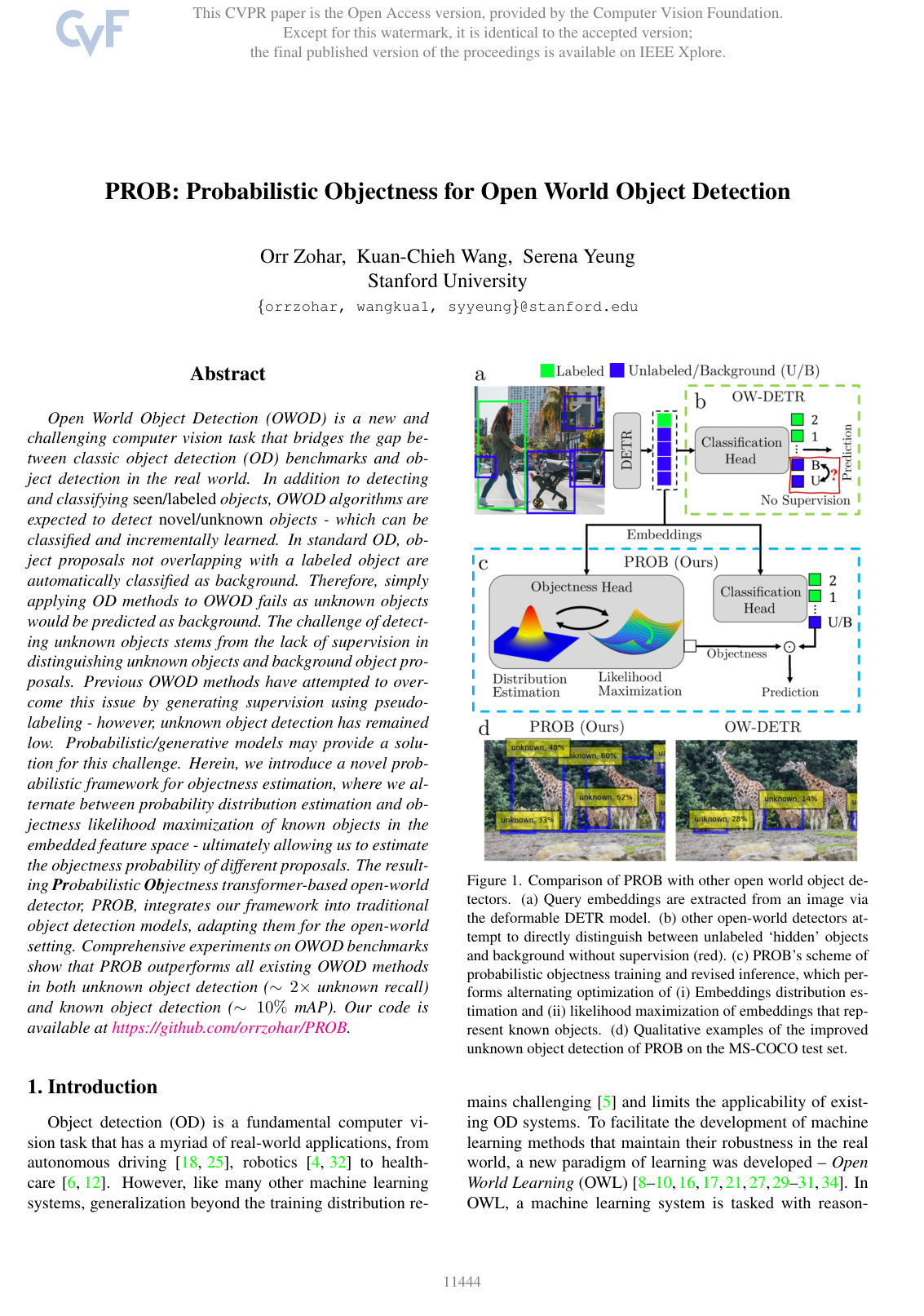
Open World Object Detection (OWOD) is a new and challenging computer vision task that bridges the gap between classic object detection (OD) benchmarks and object detection in the real world. In addition to detecting and classifying seen/labeled objects, OWOD algorithms are expected to detect novel/unknown objects - which can be classified and incrementally learned. In standard OD, object proposals not overlapping with a labeled object are automatically classified as background. Therefore, simply applying OD methods to OWOD fails as unknown objects would be predicted as background. The challenge of detecting unknown objects stems from the lack of supervision in distinguishing unknown objects and background object proposals. Previous OWOD methods have attempted to overcome this issue by generating supervision using pseudo-labeling - however, unknown object detection has remained low. Probabilistic/generative models may provide a solution for this challenge. Herein, we introduce a novel probabilistic framework for objectness estimation, where we alternate between probability distribution estimation and objectness likelihood maximization of known objects in the embedded feature space - ultimately allowing us to estimate the objectness probability of different proposals. The resulting Probabilistic Objectness transformer-based open-world detector, PROB, integrates our framework into traditional object detection models, adapting them for the open-world setting. Comprehensive experiments on OWOD benchmarks show that PROB outperforms all existing OWOD methods in both unknown object detection (~ 2× unknown recall) and known object detection (~ 10% mAP). Our code is available at https://github.com/orrzohar/PROB.

Added

2026-09-26