
keyword
open-world object detection
Open-world object detection is a computer vision task in which an artificial intelligence model localizes and classifies known categories of objects while simultaneously identifying unfamiliar objects as unknown instances. Unlike standard closed-set object detection systems that automatically treat any unannotated visual region as background, an open-world detector actively distinguishes novel foreground objects from the background without having explicit supervision for those unseen categories. Furthermore, when annotations for these previously unknown objects become available in subsequent learning phases, the system incrementally integrates the new classes into its knowledge base while continuing to accurately detect previously learned categories without catastrophic forgetting.
2 items
OW-DETR: Open-world Detection Transformer
Akshita Gupta, Sanath Narayan, K. J. Joseph, Salman Khan, Fahad Shahbaz Khan, Mubarak Shah
Why you should read this
Proposes an end-to-end transformer-based framework that accurately discovers unknown objects and incrementally learns new classes by combining attention-driven pseudo-labeling, novelty classification, and objectness scoring without requiring supervision on novel categories.
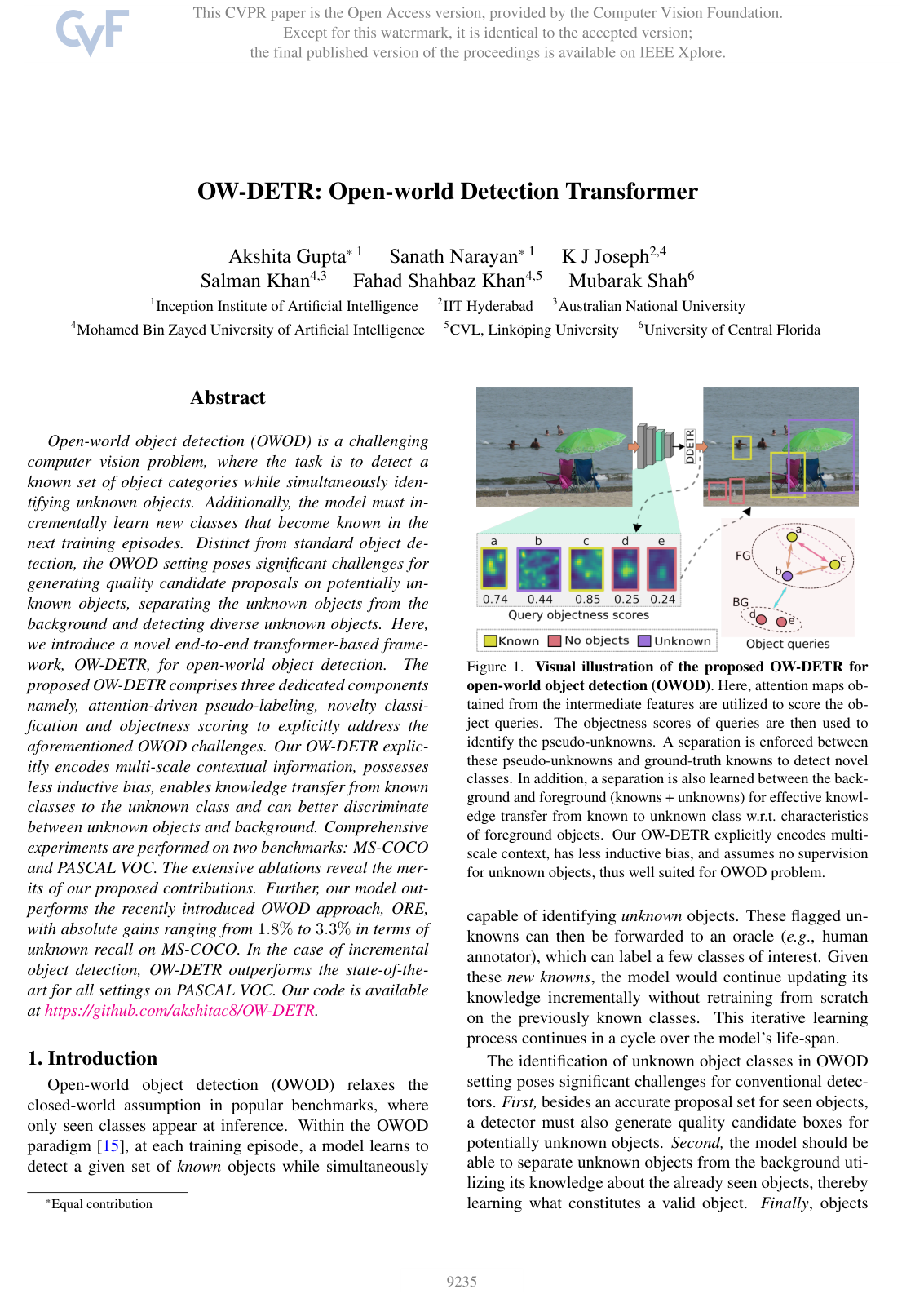
Open-world object detection (OWOD) is a challenging computer vision problem, where the task is to detect a known set of object categories while simultaneously identifying unknown objects. Additionally, the model must incrementally learn new classes that become known in the next training episodes. Distinct from standard object detection, the OWOD setting poses significant challenges for generating quality candidate proposals on potentially unknown objects, separating the unknown objects from the background and detecting diverse unknown objects. Here, we introduce a novel end-to-end transformer-based framework, OW-DETR, for open-world object detection. The proposed OW-DETR comprises three dedicated components namely, attention-driven pseudo-labeling, novelty classification and objectness scoring to explicitly address the aforementioned OWOD challenges. Our OW-DETR explicitly encodes multi-scale contextual information, possesses less inductive bias, enables knowledge transfer from known classes to the unknown class and can better discriminate between unknown objects and background. Comprehensive experiments are performed on two benchmarks: MS-COCO and PASCAL VOC. The extensive ablations reveal the merits of our proposed contributions. Further, our model outperforms the recently introduced OWOD approach, ORE, with absolute gains ranging from 1.8% to 3.3% in terms of unknown recall on MS-COCO. In the case of incremental object detection, OW-DETR outperforms the state-of-the-art for all settings on PASCAL VOC. Our code is available at https://github.com/akshitac8/OW-DETR.
Added
2026-09-26
PROB: Probabilistic Objectness for Open World Object Detection
Orr Zohar, Kuan-Chieh Wang, Serena Yeung
Why you should read this
Presents a probabilistic framework that models feature-space objectness distributions to distinguish unknown objects from background without pseudo-labels, doubling unknown object recall over prior open-world detection methods.
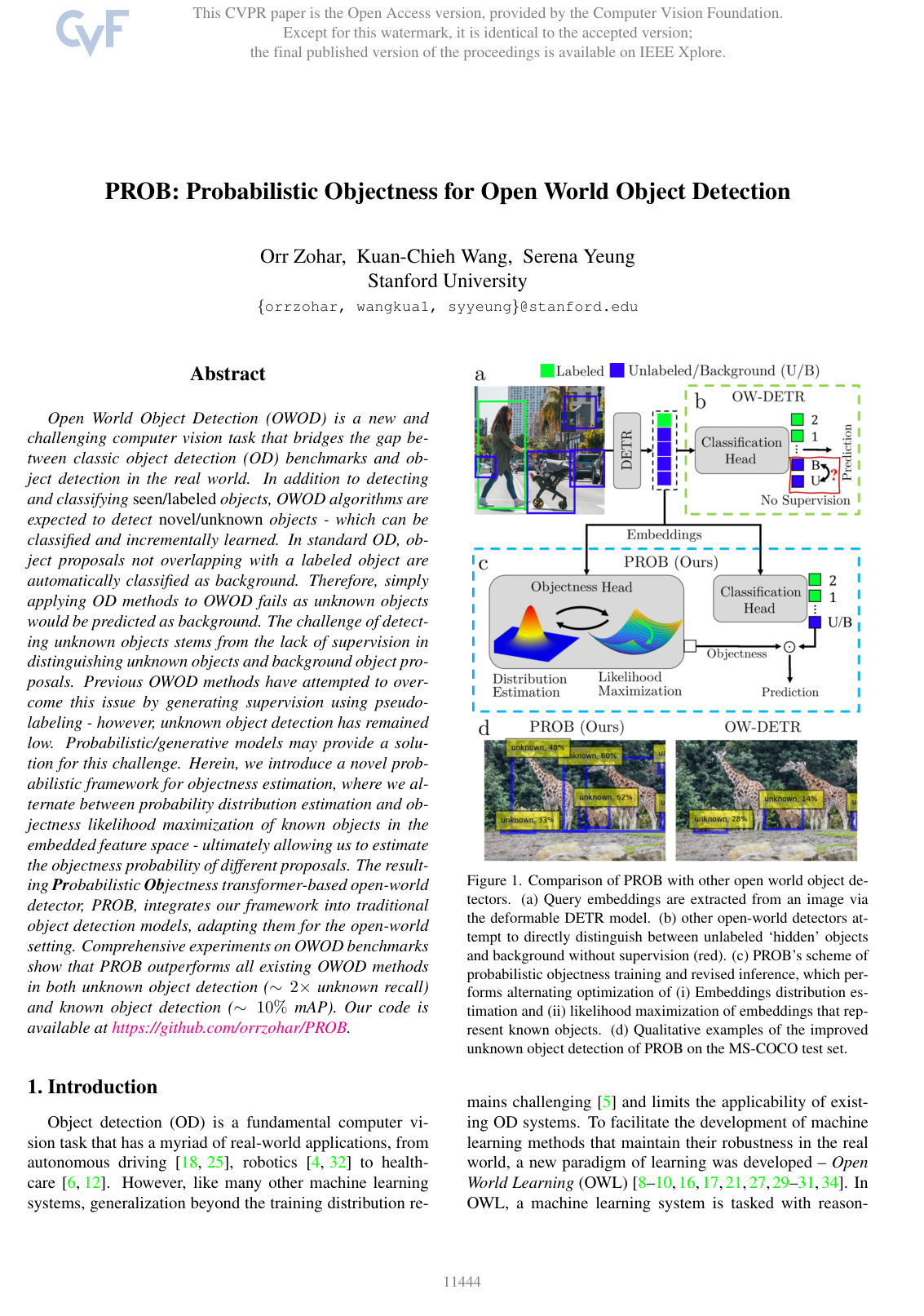
Open World Object Detection (OWOD) is a new and challenging computer vision task that bridges the gap between classic object detection (OD) benchmarks and object detection in the real world. In addition to detecting and classifying seen/labeled objects, OWOD algorithms are expected to detect novel/unknown objects - which can be classified and incrementally learned. In standard OD, object proposals not overlapping with a labeled object are automatically classified as background. Therefore, simply applying OD methods to OWOD fails as unknown objects would be predicted as background. The challenge of detecting unknown objects stems from the lack of supervision in distinguishing unknown objects and background object proposals. Previous OWOD methods have attempted to overcome this issue by generating supervision using pseudo-labeling - however, unknown object detection has remained low. Probabilistic/generative models may provide a solution for this challenge. Herein, we introduce a novel probabilistic framework for objectness estimation, where we alternate between probability distribution estimation and objectness likelihood maximization of known objects in the embedded feature space - ultimately allowing us to estimate the objectness probability of different proposals. The resulting Probabilistic Objectness transformer-based open-world detector, PROB, integrates our framework into traditional object detection models, adapting them for the open-world setting. Comprehensive experiments on OWOD benchmarks show that PROB outperforms all existing OWOD methods in both unknown object detection (~ 2× unknown recall) and known object detection (~ 10% mAP). Our code is available at https://github.com/orrzohar/PROB.
Added
2026-09-26