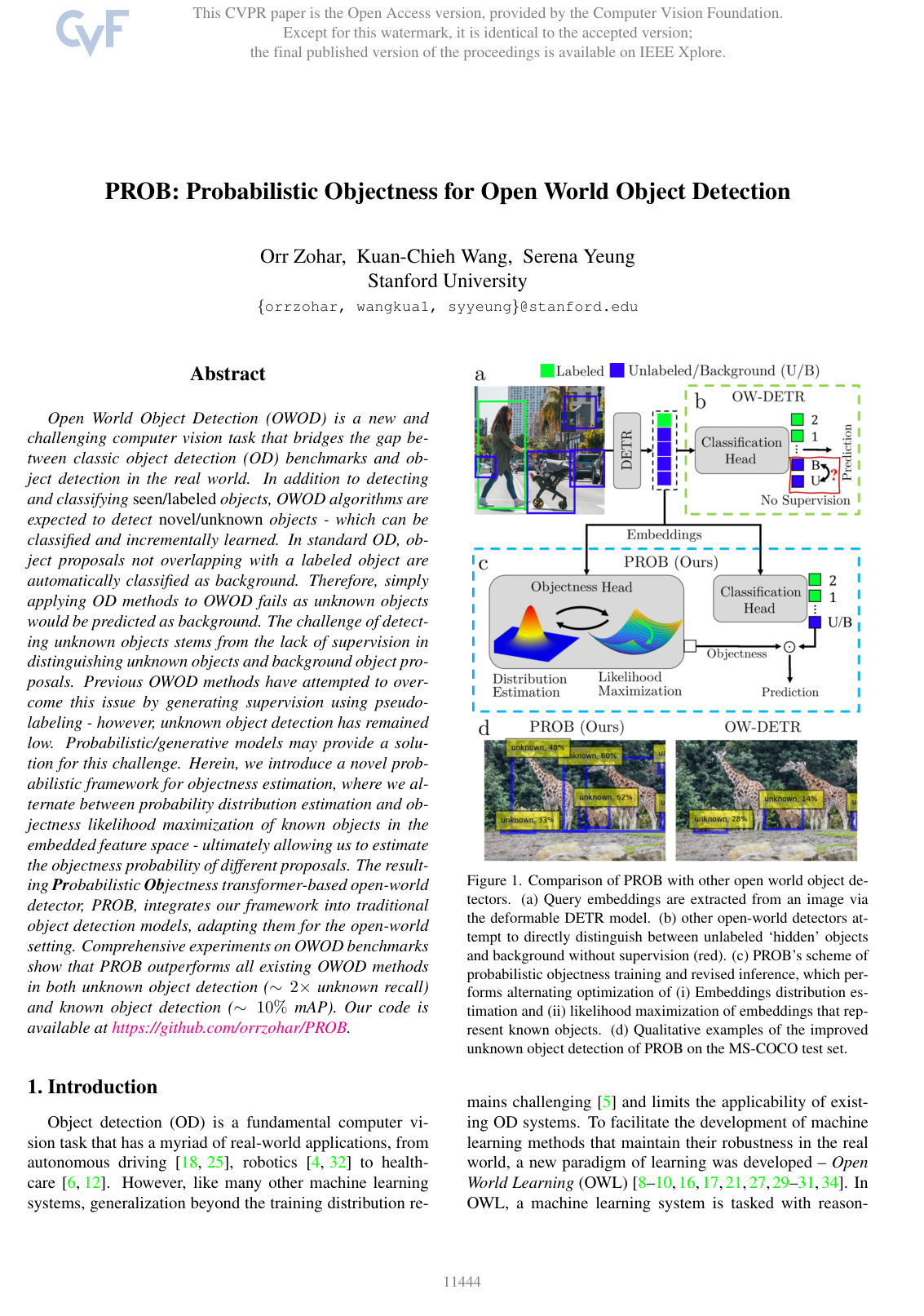
In computer vision and machine learning, unknown objects are visual entities present in an image or scene that belong to classes not labeled, seen, or explicitly supervised during a model's prior training. While conventional closed-world object detection systems automatically categorize any region lacking a known label as background, open-world frameworks treat unknown objects as valid foreground instances distinct from both familiar categories and non-object background noise. Accurately identifying and localizing these unmodeled objects allows perceptual systems to detect novel categories in dynamic real-world environments, facilitating subsequent annotation, classification, and incremental learning over time.