Modeling and rendering architecture from photographs: a hybrid geometry- and image-based approach
Paul E. DebevecCamillo J. TaylorJitendra Malik
Presents a hybrid modeling framework that reconstructs photorealistic 3D architectural scenes from a sparse set of photographs by combining interactive block-based photogrammetry, model-based stereo, and view-dependent texture mapping.
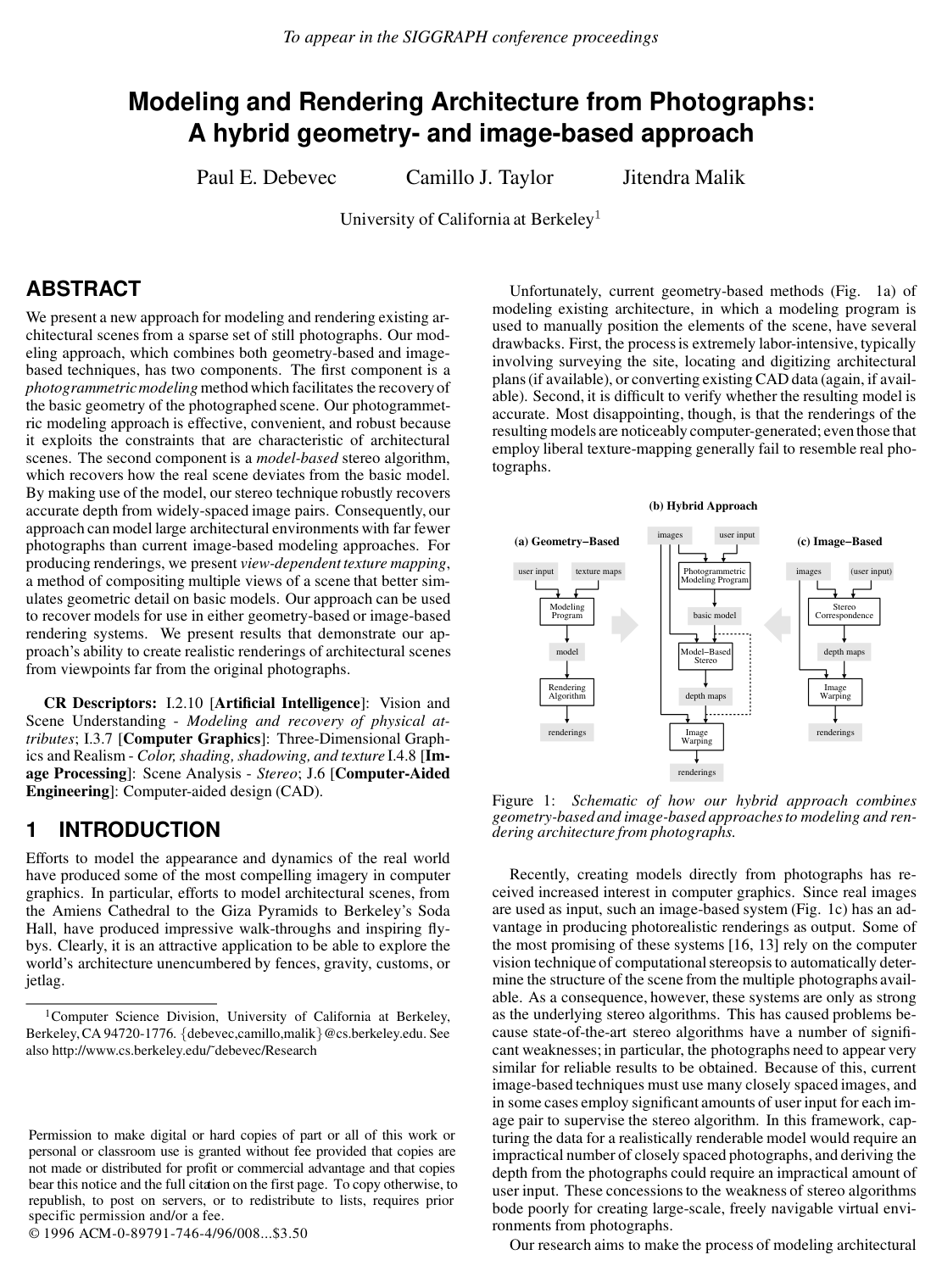
Digital 3D modeling of real-world architecture is vital for virtual exploration and visual simulation, but conventional methods face significant practical barriers. Traditional geometry-based computer-aided design requires tedious manual labor, expensive surveying equipment, or difficult-to-verify floor plans, yet still yields synthetic-looking results. Conversely, automated image-based systems rely heavily on computational stereo algorithms that fail when camera viewpoints are far apart, demanding thousands of closely spaced photographs and intensive manual corrections to cover even a single city block.
The article demonstrates a hybrid geometry- and image-based modeling and rendering framework that reconstructs photorealistic 3D architectural scenes from a sparse set of still photographs. By dividing the workload between an interactive human interface and robust computer algorithms, the system evaluates how geometric constraints and approximate structural models can overcome standard limitations in stereo correspondence and image rendering.
The approach consists of three integrated components. First, users assemble an approximate, hierarchical block model of a building in an interactive program called Façade, marking visible edges that are automatically matched to photograph lines to solve for camera and model parameters. Second, a view-dependent texture-mapping algorithm composites projected images onto this base model, dynamically weighting source images based on the virtual viewing angle. Third, an automated model-based stereo algorithm projects widely spaced image pairs onto the basic model to remove distortion and compute fine geometric deviations, such as ornate carvings and facades.
Key findings show that architectural geometric constraints reduce the mathematical parameters needed for reconstruction by orders of magnitude—lowering a representative tower model from nearly 3,000 independent line parameters to just 33 variables. As a result, non-linear optimization converges in fewer than ten iterations with projected model edges matching photograph features within sub-pixel accuracy. Additionally, projecting widely spaced photographs onto the base geometry eliminates severe foreshortening differences, allowing stereo algorithms to accurately compute depth from images taken far apart without dense sampling. Entire building exteriors were fully modeled and rendered into 360-degree virtual fly-arounds using as few as 12 standard photographs in roughly four hours of modeling time.
These results demonstrate that organizations can generate high-fidelity virtual environments rapidly without specialized scanning instruments, CAD blueprints, or intrusive physical access. This significantly reduces data capture costs, operational timelines, and computational overhead for large-scale architectural simulation. Next steps supported by the article include automating the recovery of curved architectural surfaces (such as domes), developing algorithms to estimate surface material reflectances across varying lighting conditions, and integrating these models into real-time rendering pipelines.
While highly effective for polyhedral structures in consistent daylight, the framework's primary limitations include manual intervention for curved geometry, sensitivity to harsh lighting variations across photographs, and occasional visual seam artifacts during image blending. Confidence in the underlying method is high, as the recovered camera and structural parameters routinely align to within one pixel of source imagery.
- Paper: View Interpolation for Image Synthesis, Shenchang Eric Chen et al. (1993). Introduces foundational image-based view interpolation techniques using depth-guided pixel morphing that directly motivated the source's view-dependent rendering approach.
- Paper: QuickTime VR: an image-based approach to virtual environment navigation, Shenchang Eric Chen (1995). Establishes image-based virtual navigation using photographic warps and stitching, illustrating the early IBR paradigms the source sought to enhance with geometric constraints.
- Paper: Shape and motion from image streams under orthography: a factorization method, Carlo Tomasi et al. (1992). Formulates foundational principles of recovering shape and camera motion from image sequences via geometric optimization and matrix decomposition.
- Paper: Zippered polygon meshes from range images, Greg Turk et al. (1994). Provides fundamental techniques for registering multiple range scans and assembling continuous polygonal models that ground multi-view geometric reconstruction.
- Paper: The Visual Hull Concept for Silhouette-Based Image Understanding, Aldo Laurentini (1994). Defines the mathematical limits of silhouette-based reconstruction, providing theoretical context for the geometric ambiguities addressed by the source's hybrid model.
- Paper: Mesh optimization, Hugues Hoppe et al. (1993). Details mesh optimization algorithms that balance geometric accuracy against model conciseness, foundational to the parametric block models used in the Façade system.
- Paper: Rendering synthetic objects into real scenes: bridging traditional and image-based graphics with global illumination and high dynamic range photography, P. Debevec (1998). Extends the source's photogrammetric architectural modeling by combining image-based lighting and global illumination to seamlessly insert synthetic objects into real scenes.
- Paper: Layered depth images, Jonathan Shade et al. (1998). Develops layered depth representations that advance view synthesis and solve the occlusion and parallax blending issues noted in early hybrid IBR methods.
- Paper: Modeling the World from Internet Photo Collections, Noah Snavely et al. (2008). Scales the vision of multi-view 3D architectural reconstruction from small curated photograph sets to unstructured, crowd-sourced Internet photo collections.
- Paper: Accurate, Dense, and Robust Multiview Stereopsis, Yasutaka Furukawa et al. (2010). Presents a fully automated patch-based multi-view stereo algorithm that overcomes the manual block-modeling requirements of early architectural reconstruction systems.
- Paper: Building Rome in a day, Sameer Agarwal et al. (2009). Applies scalable distributed optimization to enable automated 3D city-scale reconstruction from massive collections of uncalibrated public imagery.
- Paper: Structure-from-Motion Revisited, Johannes L. Schönberger et al. (2016). Refines incremental structure-from-motion pipelines into an automated, highly robust framework for reconstructing detailed 3D scenes from unorganized photos.
- Paper: NeRF in the Wild: Neural Radiance Fields for Unconstrained Photo Collections, Ricardo Martin-Brualla et al. (2021). Advances novel-view synthesis of complex architectural landmarks to unconstrained photo collections using coordinate-based neural radiance fields with transient handling.
- Paper: MVSNet: Depth Inference for Unstructured Multi-view Stereo, Yao Yao et al. (2018). Introduces a deep learning cost-volume framework that automates dense multi-view depth estimation without needing human-guided geometric primitives.
- Paper: Automatic Panoramic Image Stitching using Invariant Features, Matthew Brown et al. (2007). Fully automates multi-image alignment and panoramic blending using scale-invariant feature matching and bundle adjustment without interactive manual guidance.
- Paper: DAISY: An Efficient Dense Descriptor Applied to Wide-Baseline Stereo, Engin Tola et al. (2010). Addresses wide-baseline stereo matching across severe perspective distortions by designing a fast, robust local dense descriptor.