
keyword
camera calibration
Camera calibration is the process of determining the optical and geometric parameters of an imaging device to establish the mathematical relationship between three-dimensional coordinates in the physical world and two-dimensional pixel coordinates in an image. The procedure involves estimating intrinsic parameters, such as focal length, optical center, pixel aspect ratio, and lens distortion, as well as extrinsic parameters, which define the position and orientation of the camera relative to a reference coordinate system. By accurately modeling how light projects onto the camera sensor and correcting for optical aberrations such as radial and tangential distortion, camera calibration enables precise metric measurements, stereo triangulation, three-dimensional scene reconstruction, and robotic visual tracking.
5 items
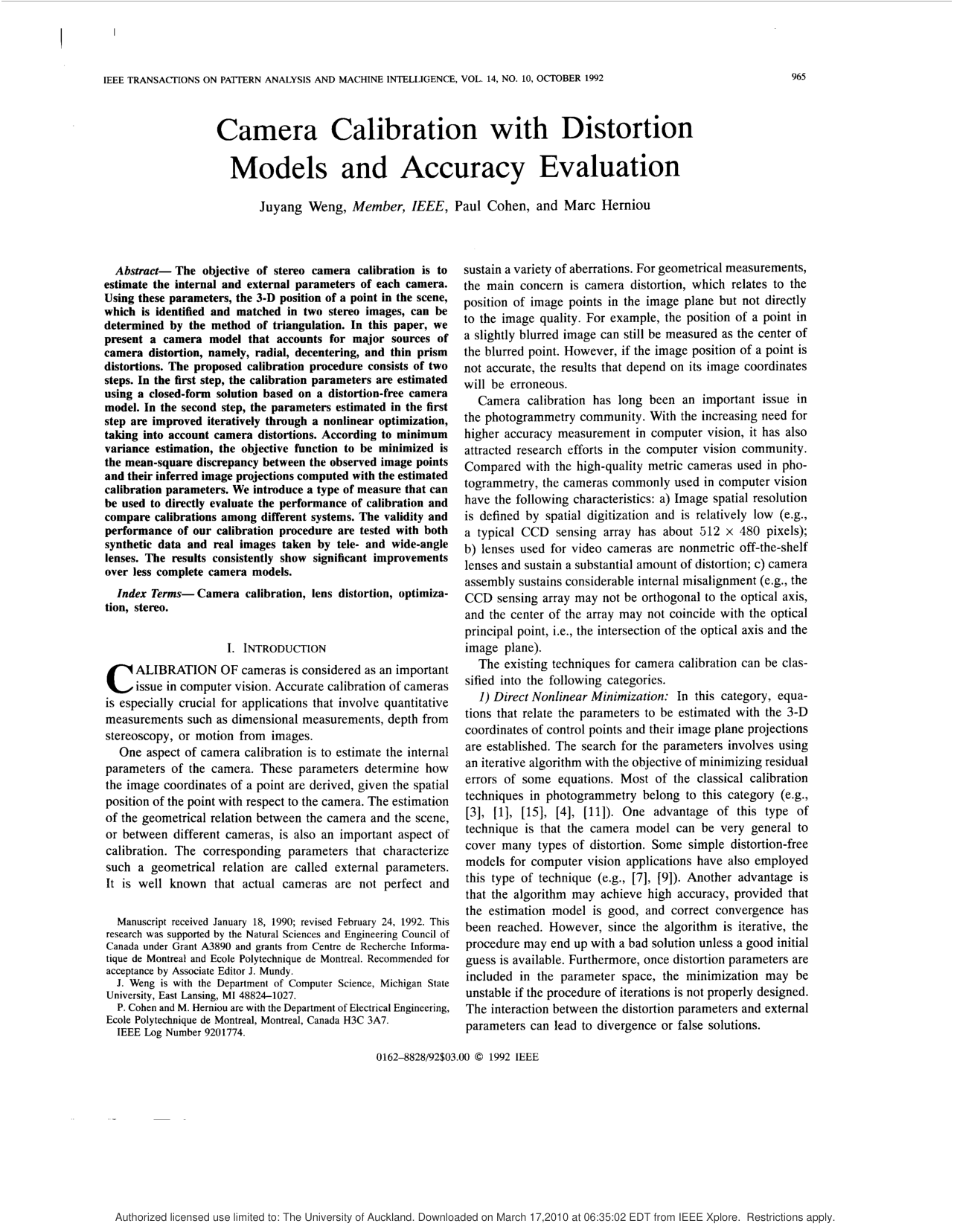
Camera Calibration with Distortion Models and Accuracy Evaluation
J. Weng, P. Cohen, Marc Herniou
Why you should read this
Develops a two-step camera calibration framework incorporating radial, decentering, and thin prism distortions through closed-form initialization followed by full nonlinear optimization, complemented by a normalized error metric to quantitatively benchmark calibration accuracy across different optical setups.
The objective of stereo camera calibration is to estimate the internal and external parameters of each camera. Using these parameters, the 3-D position of a point in the scene, which is identified and matched in two stereo images, can be determined by the method of triangulation. In this paper, we present a camera model that accounts for major sources of camera distortion, namely, radial, decentering, and thin prism distortions. The proposed calibration procedure consists of two steps. In the first step, the calibration parameters are estimated using a closed-form solution based on a distortion-free camera model. In the second step, the parameters estimated in the first step are improved iteratively through a nonlinear optimization, taking into account camera distortions. According to minimum variance estimation, the objective function to be minimized is the mean-square discrepancy between the observed image points and their inferred image projections computed with the estimated calibration parameters. We introduce a type of measure that can be used to directly evaluate the performance of calibration and compare calibrations among different systems. The validity and performance of our calibration procedure are tested with both synthetic data and real images taken by tele- and wide-angle lenses. The results consistently show significant improvements over less complete camera models.
Added
2026-09-17
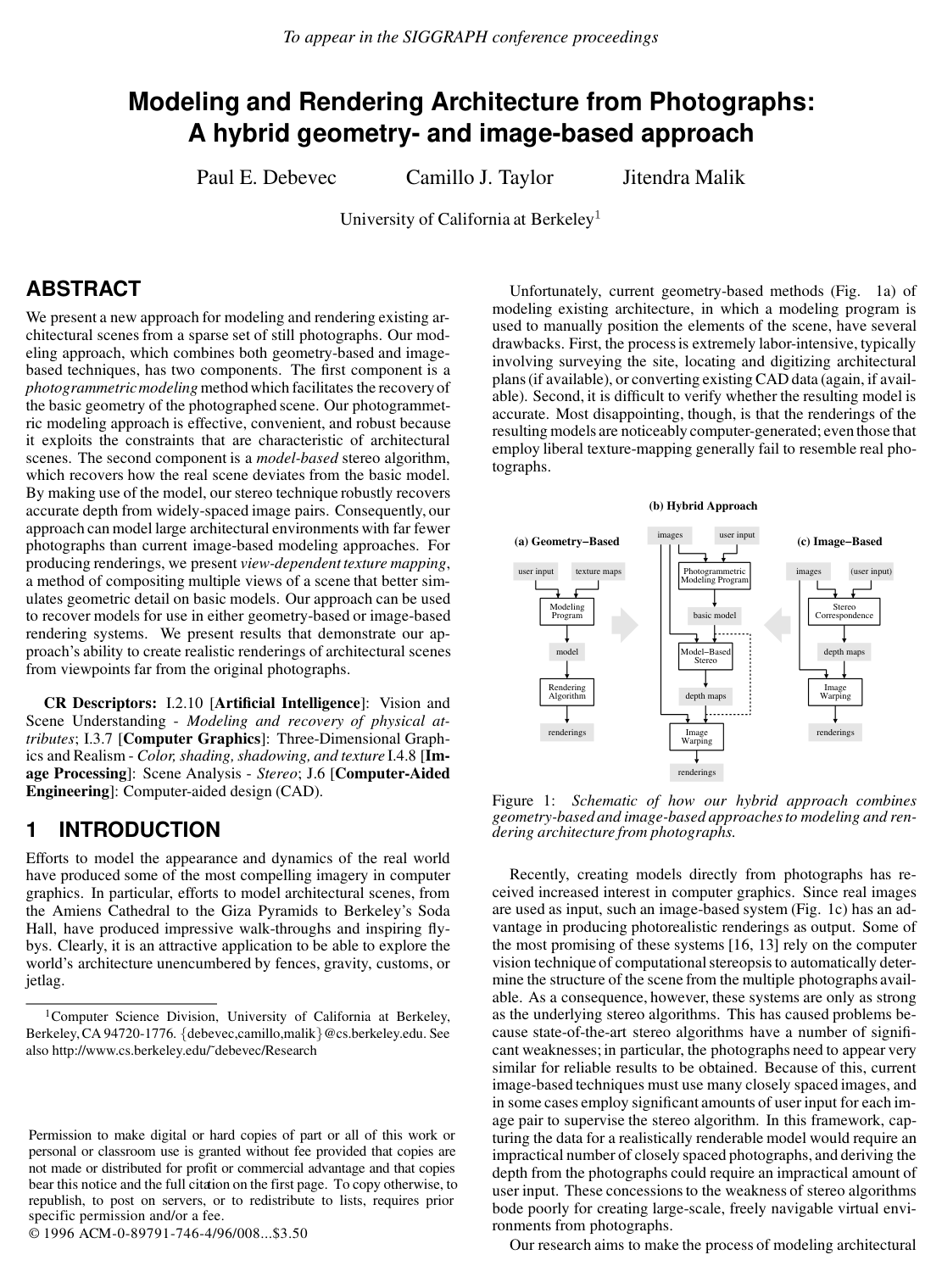
Modeling and rendering architecture from photographs: a hybrid geometry- and image-based approach
Paul E. Debevec, Camillo J. Taylor, Jitendra Malik
Why you should read this
Presents a hybrid modeling framework that reconstructs photorealistic 3D architectural scenes from a sparse set of photographs by combining interactive block-based photogrammetry, model-based stereo, and view-dependent texture mapping.
We present a new approach for modeling and rendering existing architectural scenes from a sparse set of still photographs. Our modeling approach, which combines both geometry-based and image-based techniques, has two components. The first component is a photogrammetric modeling method which facilitates the recovery of the basic geometry of the photographed scene. Our photogrammetric modeling approach is effective, convenient, and robust because it exploits the constraints that are characteristic of architectural scenes. The second component is a model-based stereo algorithm, which recovers how the real scene deviates from the basic model. By making use of the model, our stereo technique robustly recovers accurate depth from widely-spaced image pairs. Consequently, our approach can model large architectural environments with far fewer photographs than current image-based modeling approaches. For producing renderings, we present view-dependent texture mapping, a method of compositing multiple views of a scene that better simulates geometric detail on basic models. Our approach can be used to recover models for use in either geometry-based or image-based rendering systems. We present results that demonstrate our approach’s ability to create realistic renderings of architectural scenes from viewpoints far from the original photographs.
Added
2026-09-16
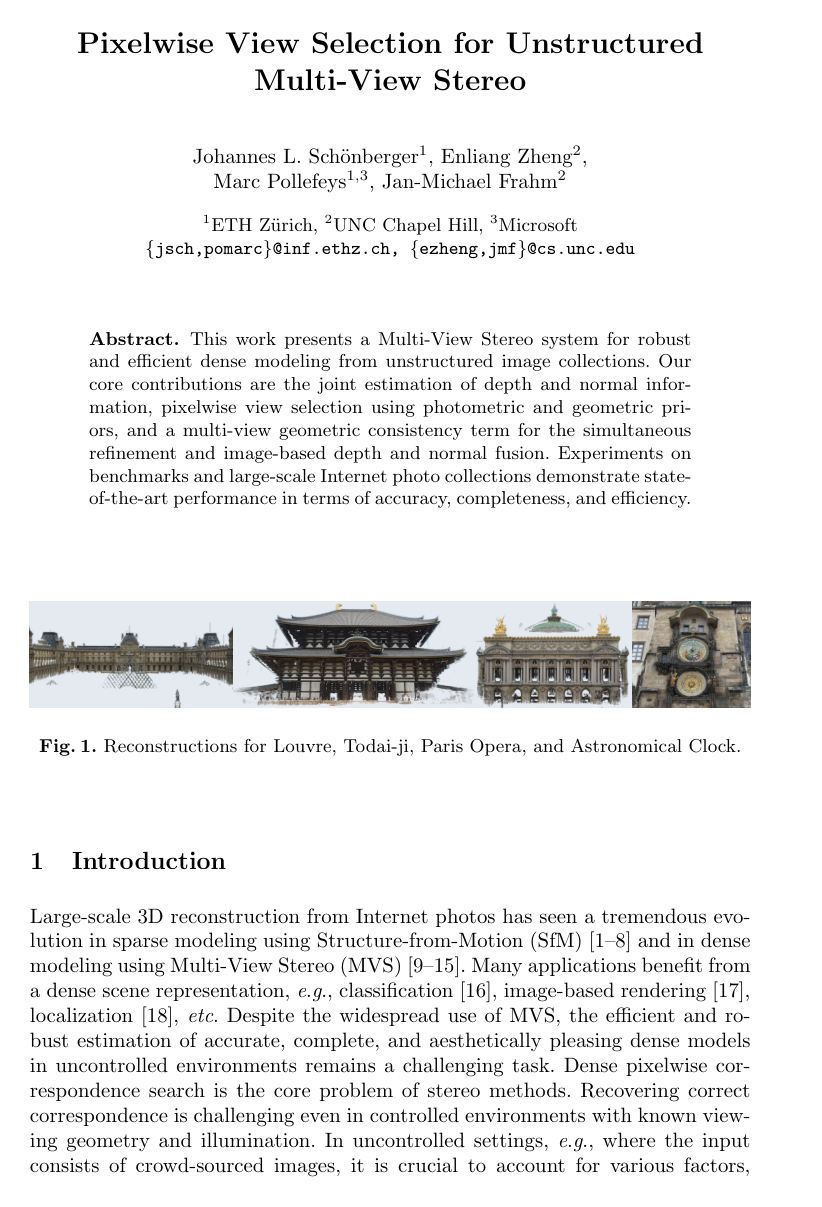
Pixelwise View Selection for Unstructured Multi-View Stereo
Johannes L. Schönberger, Enliang Zheng, Jan-Michael Frahm, Marc Pollefeys
Why you should read this
Presents the dense reconstruction pipeline behind COLMAP, which jointly estimates depth and surface normals using PatchMatch and selects optimal source views at the pixel level through photometric and geometric priors.
This work presents a Multi-View Stereo system for robust and efficient dense modeling from unstructured image collections. Our core contributions are the joint estimation of depth and normal information, pixelwise view selection using photometric and geometric priors, and a multi-view geometric consistency term for the simultaneous refinement and image-based depth and normal fusion. Experiments on benchmarks and large-scale Internet photo collections demonstrate state-of-the-art performance in terms of accuracy, completeness, and efficiency.
Added
2026-09-14
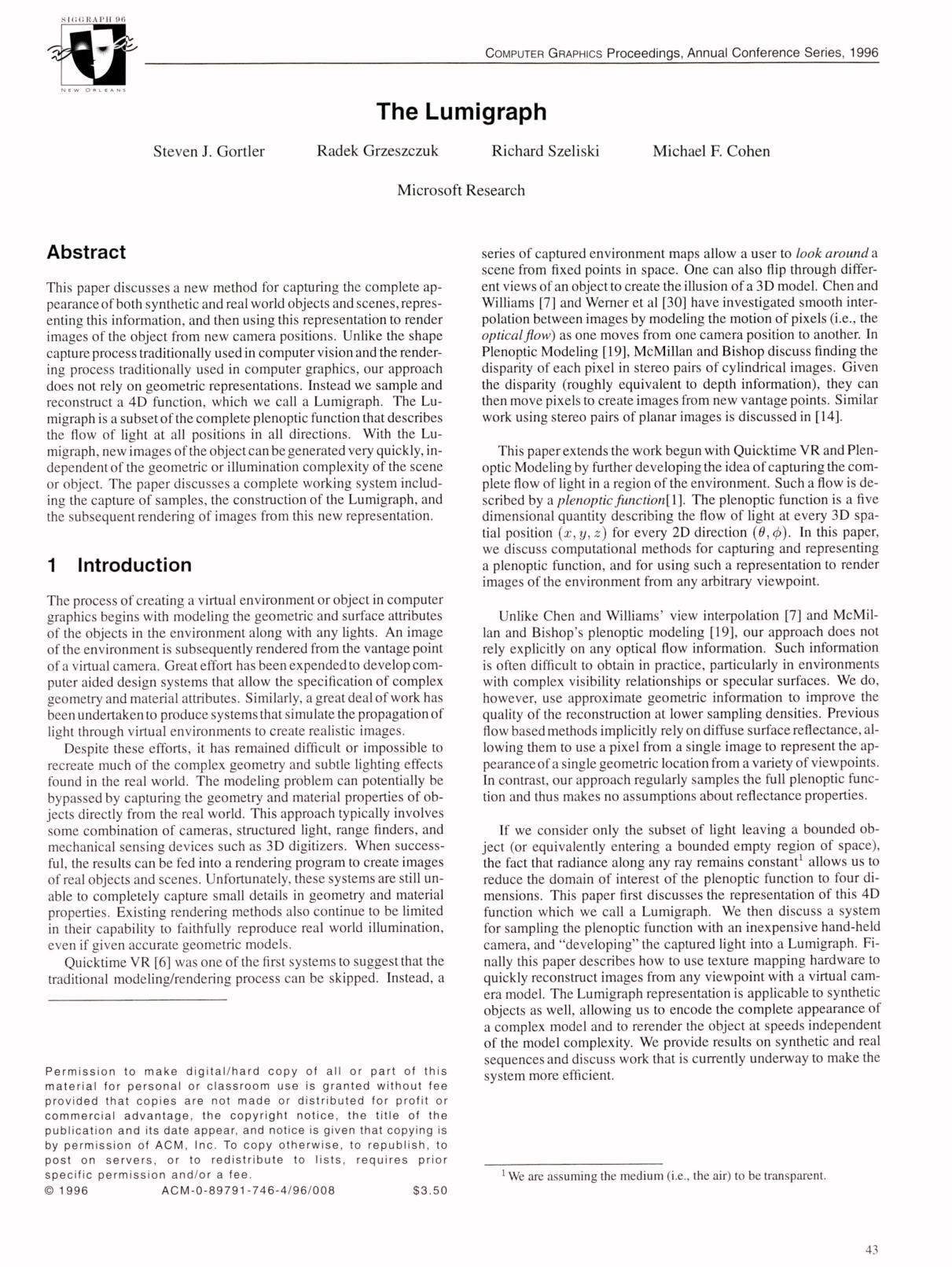
The lumigraph
Steven J. Gortler, Radek Grzeszczuk, Richard Szeliski, Michael F. Cohen
Why you should read this
Introduces a four-dimensional light-field representation and rendering pipeline that captures the complete visual appearance of objects from unstructured camera images and reconstructs novel views in real time without requiring detailed 3D geometry.
This paper discusses a new method for capturing the complete appearance of both synthetic and real world objects and scenes, representing this information, and then using this representation to render images of the object from new camera positions. Unlike the shape capture process traditionally used in computer vision and the rendering process traditionally used in computer graphics, our approach does not rely on geometric representations. Instead we sample and reconstruct a 4D function, which we call a Lumigraph. The Lumigraph is a subset of the complete plenoptic function that describes the flow of light at all positions in all directions. With the Lumigraph, new images of the object can be generated very quickly, independent of the geometric or illumination complexity of the scene or object. The paper discusses a complete working system including the capture of samples, the construction of the Lumigraph, and the subsequent rendering of images from this new representation.
Added
2026-09-12
A Flexible New Technique for Camera Calibration
Zhengyou Zhang
Why you should read this
Introduces a practical camera calibration technique that accurately estimates intrinsic parameters and lens distortion using only a planar pattern viewed from multiple unknown orientations, eliminating the need for specialized 3D calibration apparatus.
We propose a flexible new technique to easily calibrate a camera. It is well suited for use without specialized knowledge of 3D geometry or computer vision. The technique only requires the camera to observe a planar pattern shown at a few (at least two) different orientations. Either the camera or the planar pattern can be freely moved. The motion need not be known. Radial lens distortion is modeled. The proposed procedure consists of a closed-form solution, followed by a nonlinear refinement based on the maximum likelihood criterion. Both computer simulation and real data have been used to test the proposed technique, and very good results have been obtained. Compared with classical techniques which use expensive equipment such as two or three orthogonal planes, the proposed technique is easy to use and flexible. It advances 3D computer vision one step from laboratory environments to real world use.
Added
2026-09-06