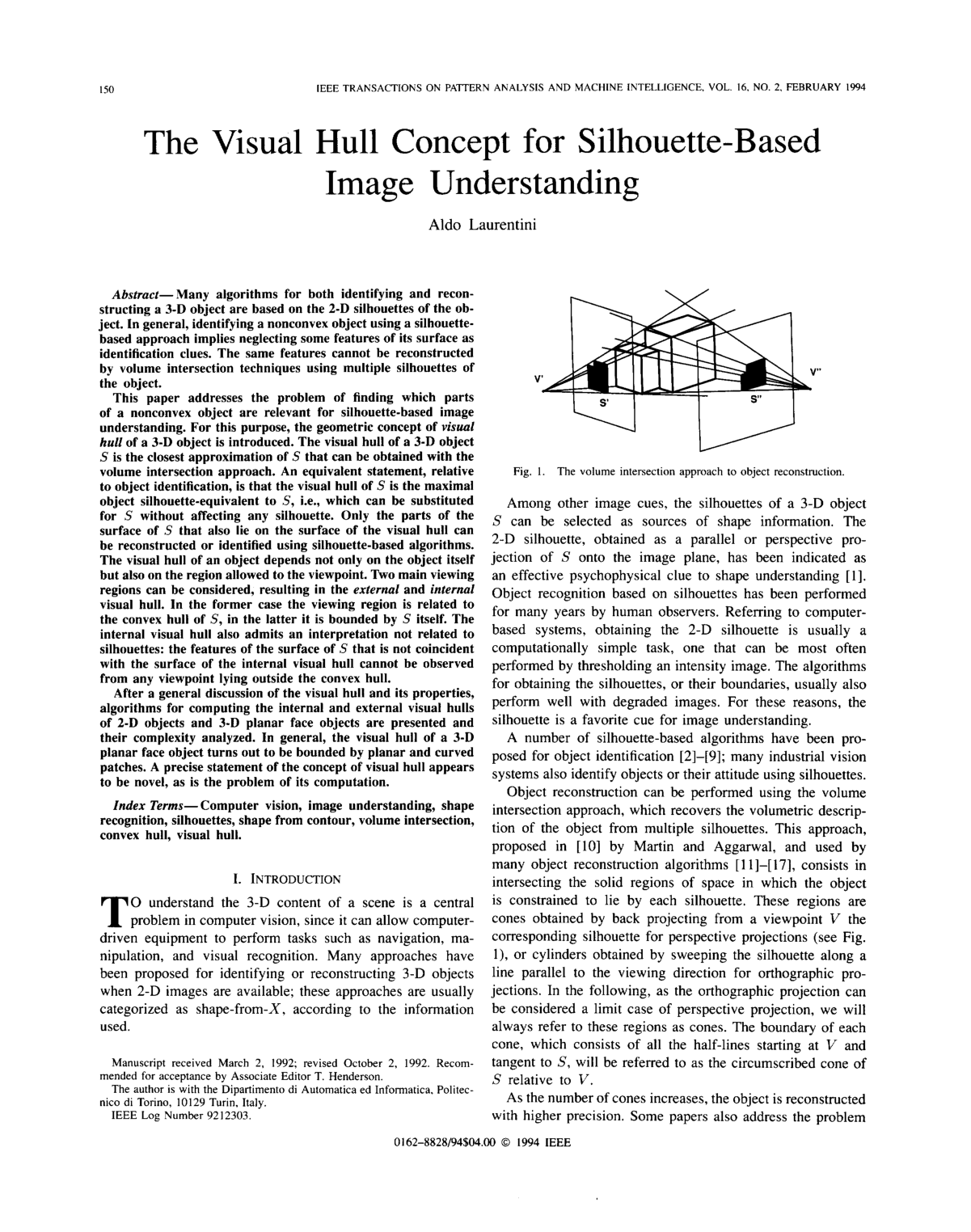
The Visual Hull Concept for Silhouette-Based Image Understanding

Aldo Laurentini

article1994TPAMI1,772 citations

Introduces the foundational concept of the visual hull to establish the exact theoretical limits and computational algorithms for reconstructing and recognizing 3D objects from 2D silhouette intersections.

Listen

Silhouette-based image processing is widely used in automated inspection, navigation, and robotic manipulation because extracting two-dimensional silhouettes from camera images is computationally simple and robust to degraded conditions. However, standard systems using multi-view volume intersection cannot fully identify or reconstruct complex, non-convex objects because concavities and hidden recesses do not appear in silhouette projections. This fundamental limitation creates uncertainty regarding which surface features can actually be reconstructed or distinguished from silhouette data alone.

The article introduces the formal geometric concept of the "visual hull" to mathematically define and compute the theoretical limits of silhouette-based object recognition and three-dimensional shape reconstruction. It establishes exact geometric conditions under which non-convex surfaces can be recovered or differentiated using multiple camera viewpoints.

To solve this, the author develops computational geometric frameworks that categorize viewing zones and surface visibility across two-dimensional and three-dimensional spaces. The visual hull is defined as the closest possible volumetric approximation of an object that can be obtained using volume intersection, or equivalently, the maximal object that produces identical silhouettes from all allowable viewpoints within a specified region. The article evaluates two primary viewing domains: the external visual hull, where viewpoints remain outside the object's convex hull, and the internal visual hull, where viewpoints are constrained only by the object's surface.

The findings establish that an object can only be distinguished or reconstructed on its "silhouette-active" surfaces, which lie directly on the visual hull's boundary. For standard external viewing, there is a single, unique external visual hull that never exceeds the object's convex hull. The analysis demonstrates that the visual hull of a three-dimensional planar-faced polyhedron is not strictly planar; its boundaries consist of planar patches and curved ruled quadric surfaces formed by alignments between vertices and edges. Computationally, two-dimensional visual hulls can be computed efficiently in polynomial time, allowing the active surfaces of three-dimensional polyhedra to be determined by slicing planes along each polyhedral face.

These results demonstrate that investing in additional silhouette cameras or finer image intersections cannot overcome geometric concavity limits; any surface feature residing in an inactive concavity is physically unrecoverable from external silhouette data alone. In terms of engineering and algorithm design, teams must recognize that silhouette-based reconstruction may return an object larger than the actual part or introduce spurious unconnected components, which directly affects quality inspection, collision-free path planning, and automated tolerance verification.

Organizations developing automated optical inspection or robotic systems should use the visual hull algorithm as a design-time evaluation tool to determine whether silhouette methods are sufficient for a specific component's geometry before deploying physical sensor hardware. If critical features fall within silhouette-inactive areas, vision systems must be augmented with alternative cues such as stereo depth, structured light, or photometric sensors. Current algorithms for full three-dimensional polyhedra rely on high-complexity brute-force methods, meaning computational pipelines should focus on the more efficient face-by-face active surface algorithms. Future work is required to develop optimized three-dimensional implementations and expand theoretical formulations to objects with smooth, curved surfaces.

Laurentini (1994).pdf
Cover for The Visual Hull Concept for Silhouette-Based Image Understanding

Abstract

Abstract—Many algorithms for both identifying and reconstructing a 3-D object are based on the 2-D silhouettes of the object. In general, identifying a nonconvex object using a silhouette-based approach implies neglecting some features of its surface as identification clues. The same features cannot be reconstructed by volume intersection techniques using multiple silhouettes of the object. This paper addresses the problem of finding which parts of a nonconvex object are relevant for silhouette-based image understanding. For this purpose, the geometric concept of visual hull of a 3-D object S is introduced. The visual hull of a 3-D object S is the closest approximation of S that can be obtained with the volume intersection approach. An equivalent statement, relative to object identification, is that the visual hull of S is the maximal object silhouette-equivalent to S, i.e., which can be substituted for S without affecting any silhouette. Only the parts of the surface of S that also lie on the surface of the visual hull can be reconstructed or identified using silhouette-based algorithms. The visual hull of an object depends not only on the object itself but also on the region allowed to the viewpoint. Two main viewing regions can be considered, resulting in the external and internal visual hull. In the former case the viewing region is related to the convex hull of S, in the latter it is bounded by S itself. The internal visual hull also admits an interpretation not related to silhouettes: the features of the surface of S that is not coincident with the surface of the internal visual hull cannot be observed from any viewpoint lying outside the convex hull. After a general discussion of the visual hull and its properties, algorithms for computing the internal and external visual hulls of 2-D objects and 3-D planar face objects are presented and their complexity analyzed. In general, the visual hull of a 3-D planar face object turns out to be bounded by planar and curved patches. A precise statement of the concept of visual hull appears to be novel, as is the problem of its computation.

Table of Contents

  • I. INTRODUCTION
  • II. THE VISUAL HULL: DEFINITIONS AND GENERAL PROPERTIES
  • A. The Visual Hull of an Object Relative to a Viewing Region
  • B. The Main Case: The External Visual Hull
  • C. The Internal Visual Hull
  • III. THE COMPUTATION OF VH(S) AND OF IVH(S) IN 2-D
  • A. An Efficient Algorithm for Computing the 2-D Visual Hull
  • B. An Algorithm for Computing the 2-D Internal Visual Hull
  • IV. COMPUTING THE SILHOUETTE-ACTIVE SURFACES OF POLYHEDRAL OBJECTS
  • V. COMPUTING VH AND IVH FOR POLYHEDRAL OBJECTS
  • A. The 3-D Visual Number
  • B. The Active Surfaces
  • C. Examples of Visual Hulls of Simple Polyhedra
  • D. The Visual Hull and the Aspect Graphs
  • E. A Brute-Force Algorithm for Computing the Visual Hull
  • F. The Computation of the Internal Visual Hull
  • VI. CONCLUSION
  • REFERENCES

Knowls

  1. Knowl 1 — Visual Hull Relative to a Viewing Region

    definition

    Let S⊂E3S \subset \mathbb{E}^3 be a 3-D object, and let R⊆E3R \subseteq \mathbb{E}^3 be a viewing region containing all allowable viewpoints from which SS may be observed.

    The visual hull of SS relative to viewing region RR, denoted VH(S,R)VH(S, R), is defined as: VH(S,R)={P∈E3∣∀V∈R, the half-line starting at V and passing through P intersects S at least once}VH(S, R) = \{ P \in \mathbb{E}^3 \mid \forall V \in R, \text{ the half-line starting at } V \text{ and passing through } P \text{ intersects } S \text{ at least once} \}

    Key properties of VH(S,R)VH(S, R) include:

    1. S⊆VH(S,R)S \subseteq VH(S, R).
    2. VH(S,R)VH(S, R) is the maximal object that is silhouette-equivalent to SS with respect to RR (it yields the identical silhouette as SS from every viewpoint V∈RV \in R).
    3. VH(S,R)VH(S, R) is the closest volume approximation of SS obtainable by intersecting visual cones (the circumscribed cones with apex at VV and tangent to SS) from all viewpoints V∈RV \in R.
    4. If R⊃R′R \supset R', then VH(S,R)⊆VH(S,R′)VH(S, R) \subseteq VH(S, R').
    5. An object SS can be reconstructed exactly from silhouettes observed from RR if and only if S=VH(S,R)S = VH(S, R).
    6. Two objects SS and S′S' can be distinguished from their silhouettes observed from RR if and only if VH(S,R)≠VH(S′,R)VH(S, R) \neq VH(S', R).

    The surface s(S)s(S) of SS is partitioned relative to RR into:

    • Silhouette-active surface sa(S,R)sa(S, R): the subset of s(S)s(S) that lies on the boundary vh(S,R)vh(S, R) of VH(S,R)VH(S, R), i.e., sa(S,R)=s(S)∩vh(S,R)sa(S, R) = s(S) \cap vh(S, R). This surface uniquely determines VH(S,R)VH(S, R).
    • Silhouette-inactive surface si(S,R)=s(S)∖sa(S,R)si(S, R) = s(S) \setminus sa(S, R): points on s(S)s(S) not on vh(S,R)vh(S, R), which can be reshaped arbitrarily within VH(S,R)∖SVH(S, R) \setminus S without altering any silhouette observed from RR.
  2. Knowl 2 — External Visual Hull and Line Intersection Characterization

    theoretical result

    Let S⊂E3S \subset \mathbb{E}^3 be a bounded 3-D object, and let CH(S)CH(S) denote its convex hull. The standard viewing region outside the convex hull of SS is Re=E3∖CH(S)R_e = \mathbb{E}^3 \setminus CH(S).

    The external visual hull (or simply the visual hull) of SS, denoted VH(S)VH(S), is defined as VH(S)=VH(S,Re)VH(S) = VH(S, R_e).

    Key theoretical properties established for VH(S)VH(S) include:

    1. Convex Hull Containment: For any viewing region R′⊆ReR' \subseteq R_e that completely encloses SS, VH(S,R′)⊆CH(S)VH(S, R') \subseteq CH(S).
    2. Viewing Region Invariance: For any two viewing regions R′R' and R′′R'' that enclose SS and lie entirely outside CH(S)CH(S), VH(S,R′)=VH(S,R′′)=VH(S)VH(S, R') = VH(S, R'') = VH(S)
    3. Line Intersection Characterization: A point Q∈E3Q \in \mathbb{E}^3 belongs to VH(S)VH(S) if and only if every straight line passing through QQ contains at least one point of SS: Q∈VH(S)  ⟺  ∀ lines L passing through Q,  L∩S≠∅Q \in VH(S) \iff \forall \text{ lines } L \text{ passing through } Q, \; L \cap S \neq \emptyset

    The silhouette-active surface of SS relative to ReR_e is denoted sa(S)=s(S)∩vh(S)sa(S) = s(S) \cap vh(S), where vh(S)vh(S) is the boundary of VH(S)VH(S).

  3. Knowl 3 — Internal Visual Hull and Half-Line Characterization

    theoretical result

    Let S⊂E3S \subset \mathbb{E}^3 be a 3-D object. When viewpoints are permitted everywhere outside SS itself (including within concavities inside the convex hull CH(S)CH(S)), the viewing region is Ri=E3∖SR_i = \mathbb{E}^3 \setminus S.

    The internal visual hull of SS, denoted IVH(S)IVH(S), is defined as IVH(S)=VH(S,Ri)IVH(S) = VH(S, R_i).

    Theoretical properties of IVH(S)IVH(S) include:

    1. Half-Line Intersection Characterization: A point Q∈E3Q \in \mathbb{E}^3 belongs to IVH(S)IVH(S) if and only if every half-line starting at QQ intersects SS at least once: Q∈IVH(S)  ⟺  ∀ half-lines H starting at Q,  H∩S≠∅Q \in IVH(S) \iff \forall \text{ half-lines } H \text{ starting at } Q, \; H \cap S \neq \emptyset
    2. Containment: Because Re⊂RiR_e \subset R_i, the internal visual hull is always contained within the external visual hull: IVH(S)⊆VH(S)IVH(S) \subseteq VH(S)
    3. Unobservability of Internal Silhouette-Inactive Surface: The boundary surface of SS is partitioned into the internal silhouette-active surface isa(S)=s(S)∩ivh(S)isa(S) = s(S) \cap ivh(S) and the internal silhouette-inactive surface isi(S)=s(S)∖isa(S)isi(S) = s(S) \setminus isa(S), where ivh(S)ivh(S) is the boundary of IVH(S)IVH(S). Any feature lying on isi(S)isi(S) cannot be observed from any viewpoint V∉CH(S)V \notin CH(S).
  4. Knowl 4 — Geometric Boundary Structure of 3-D Polyhedral Visual Hulls

    theoretical result

    For a general 3-D polyhedron SS with planar faces and straight edges, the boundary of its visual hull VH(S)VH(S) is not planar in general; it consists of planar patches and ruled quadric surface patches.

    The bounding surface patches arise from two classes of active surfaces generated by straight lines tangent to SS:

    1. VEVE Surfaces (Planar Patches): Formed by lines that pass through a vertex VV of SS and are tangent to an edge EkE_k of SS (or part of it) without intersecting the interior of SS. These surfaces are planar sheets.
    2. EEEEEE Surfaces (Ruled Quadric Patches): Formed by lines tangent to three mutually skew straight edges Ei,Ej,EkE_i, E_j, E_k of SS without intersecting the interior of SS. These lines sweep out a ruled quadric surface:
      • A hyperboloid of one sheet when the three edges are mutually skew and not all parallel to a single plane.
      • A hyperbolic paraboloid when the three edges are parallel to a common plane.

    Consequently, the boundary vh(S)vh(S) of the visual hull of a polyhedron is a piecewise smooth surface composed of planar and quadric patches.

  5. Knowl 5 — Polyhedral Silhouette-Active Surface Characterization via 2-D Cross Sections

    theoretical result

    Let S⊂E3S \subset \mathbb{E}^3 be a polyhedron with planar faces {Fi}\{F_i\}. For each face FiF_i, let pip_i be the plane supporting FiF_i, and let PSi=(pi∩S)∖FiPS_i = (p_i \cap S) \setminus F_i be the 2-D polygonal cross-section of SS in plane pip_i, excluding face FiF_i itself.

    A point QQ on face FiF_i belongs to the silhouette-active surface sa(S)sa(S) if and only if QQ does not belong to the 2-D visual hull of PSiPS_i within plane pip_i: Q∈Fi∩sa(S)  ⟺  Q∉VH(PSi)Q \in F_i \cap sa(S) \iff Q \notin VH(PS_i)

    This equivalence holds because Q∈sa(S)Q \in sa(S) if and only if there exists a visual line passing outside SS at an infinitesimal distance from QQ. In the limit, this visual line must lie in the supporting plane pip_i and not intersect PSiPS_i, which is precisely the condition that Q∉VH(PSi)Q \notin VH(PS_i).

  6. Knowl 6 — Algorithm for 2-D Visual Hull Computation

    algorithm

    The 2-D visual hull algorithm computes VH(SP)VH(SP) for a set of planar polygons SPSP with nn total vertices. A point Q∈E2Q \in \mathbb{E}^2 belongs to VH(SP)VH(SP) if and only if its 2-D visual number VN(Q,SP)=0VN(Q, SP) = 0, defined as the number of disconnected families of visual lines passing through QQ that do not intersect SPSP.

    Input: Set of planar polygons SPSP with nn vertices
    Output: 2-D visual hull VH(SP)VH(SP)
    1. Find all active lines:
       a. Identify candidate bitangent lines passing through pairs of vertices (Vi,Vj)(V_i, V_j) that are tangent to SPSP at two points and do not cross SPSP locally.
       b. Prune lines that cross SPSP at either vertex or lie entirely outside the convex hull CH(SP)CH(SP).
       c. For remaining lines, test intersection against the O(n)O(n) edges of SPSP to extract active segments (segments where crossing changes VNVN by +1+1 or −1-1).
    2. Construct the planar arrangement / partition of E2\mathbb{E}^2 induced by the active segments and the edges of SPSP using a plane sweep algorithm.
    3. Traverse the planar partition via a dual-graph depth-first search:
       a. Start at a known region inside SPSP where VN=0VN = 0.
       b. Cross between adjacent regions across active segments, incrementing or decrementing VNVN according to the segment crossing orientation.
    4. Merge all adjacent regions having visual number VN=0VN = 0 to obtain VH(SP)VH(SP).

    Complexity:

    • Finding active segments takes O(n3)O(n^3) time (O(n2)O(n^2) vertex pairs tested against O(n)O(n) polygon edges) and yields O(n2)O(n^2) active segments.
    • Constructing the planar partition takes O(mlog⁡m)O(m \log m) time, where mm is the number of vertices in the partition (m=O(n4)m = O(n^4) in the worst case).
    • Partition traversal and merging take O(m)O(m) time.
    • Total time complexity: O(n3+mlog⁡m)O(n^3 + m \log m).
  7. Knowl 7 — Algorithm for 2-D Internal Visual Hull Computation

    algorithm

    The 2-D internal visual hull algorithm computes IVH(SP)IVH(SP) for a set of planar polygons SPSP with nn total vertices. A point Q∈E2Q \in \mathbb{E}^2 belongs to IVH(SP)IVH(SP) if and only if its internal visual number IVN(Q,SP)=0IVN(Q, SP) = 0, defined as the number of disconnected families of visual half-lines starting at QQ that do not intersect SPSP.

    Input: Set of planar polygons SPSP with nn vertices
    Output: 2-D internal visual hull IVH(SP)IVH(SP)
    1. Compute active segments with respect to IVHIVH:
       a. Identify candidate lines tangent to SPSP at two points or tangent to a vertex and an edge.
       b. If all active lines belong to configurations that cannot bound IVHIVH, terminate and output IVH(SP)=SPIVH(SP) = SP.
       c. Otherwise, extract the active segments that separate regions whose IVNIVN differs by 1.
    2. Construct the planar partition generated by the active segments and all edges of SPSP using a plane sweep algorithm.
    3. Compute the starting IVNIVN for an initial region containing a point PP:
       a. Connect PP to all nn vertices ViV_i of SPSP with straight lines.
       b. Count the number of visual lines passing through PP tangent to SPSP at ViV_i that bound families of internal visual lines, computing the starting IVNIVN in O(n2)O(n^2) time.
    4. Traverse the dual graph of the planar partition:
       a. Propagate IVNIVN values to adjacent regions by adding or subtracting 1 according to the crossing orientation of each active segment.
       b. Do not cross boundary edges of SPSP during traversal (evaluating separate connected components of E2∖SP\mathbb{E}^2 \setminus SP independently).
    5. Merge all regions with IVN=0IVN = 0 to form IVH(SP)IVH(SP).

    Complexity:

    • Active segment computation takes O(n3)O(n^3) time.
    • Planar sweep and partition construction takes O(mlog⁡m)O(m \log m) time, where mm is the number of vertices in the partition.
    • Traversal and merging take O(m)O(m) time.
    • Total time complexity: O(n3+mlog⁡m)O(n^3 + m \log m).
  8. Knowl 8 — Algorithm for Computing Silhouette-Active Surfaces of a Polyhedron

    algorithm

    The silhouette-active surface sa(S)sa(S) of a 3-D polyhedron SS with KK planar faces {F1,…,FK}\{F_1, \dots, F_K\} and nn total vertices is computed face-by-face using 2-D visual hull operations.

    Input: Polyhedron SS with planar faces F1,…,FKF_1, \dots, F_K and nn total vertices
    Output: Silhouette-active surface sa(S)⊆∂Ssa(S) \subseteq \partial S
    1. Compute the convex hull CH(S)CH(S) in O(nlog⁡n)O(n \log n) time. Any face FiF_i belonging to ∂CH(S)\partial CH(S) is immediately added to sa(S)sa(S).
    2. For each remaining face FiF_i:
       a. Compute the plane pip_i supporting FiF_i.
       b. Compute the 2-D polygonal cross-section PSi=(pi∩S)∖FiPS_i = (p_i \cap S) \setminus F_i in O(n)O(n) time.
       c. Apply the 2-D visual hull algorithm to compute VH(PSi)VH(PS_i) within plane pip_i, restricting active segments and sweep partition to the region enclosed by FiF_i.
       d. Set sa(S)∩Fi=Fi∖VH(PSi)sa(S) \cap F_i = F_i \setminus VH(PS_i).
    3. Output the union of all computed face active regions: ⋃i=1K(sa(S)∩Fi)\bigcup_{i=1}^K (sa(S) \cap F_i).

    Complexity:

    • For each face FiF_i, the 2-D visual hull computation takes O(n3+kilog⁡ki)O(n^3 + k_i \log k_i) time, where kik_i is the size of the planar partition on face FiF_i.
    • Summing over all O(n)O(n) faces, the overall time complexity is O(n4+np)O(n^4 + n p), where pp is the average value of kilog⁡kik_i \log k_i across all faces.
  9. Knowl 9 — Algorithm for 3-D Polyhedral Visual Hull and Internal Visual Hull Computation

    algorithm

    The 3-D visual hull VH(S)VH(S) and internal visual hull IVH(S)IVH(S) of a general polyhedron SS with nn edges and vertices are computed by constructing the 3-D spatial arrangement induced by active surfaces and evaluating visual numbers in each cell.

    For a point Q∉SQ \notin S:

    • The 3-D visual number VN3D(Q,S)VN3D(Q, S) is the number of faces of the 3-D visual cone of QQ relative to SS. A point Q∈VH(S)Q \in VH(S) if and only if VN3D(Q,S)=0VN3D(Q, S) = 0.
    • The internal 3-D visual number IVN3D(Q,S)IVN3D(Q, S) is the number of faces of the circumscribed visual half-cone from QQ relative to SS. A point Q∈IVH(S)Q \in IVH(S) if and only if IVN3D(Q,S)=0IVN3D(Q, S) = 0.
    Input: Polyhedron SS with nn vertices and edges
    Output: 3-D visual hull VH(S)VH(S) (or IVH(S)IVH(S))
    1. Compute all potentially active surfaces:
       a. Generate O(n2)O(n^2) vertex-edge (VEVE) planar surfaces.
       b. Generate O(n3)O(n^3) edge-edge-edge (EEEEEE) ruled quadric surfaces.
       Total number of active surfaces is Ns=O(n3)N_s = O(n^3).
    2. Construct the 3-D spatial arrangement of E3\mathbb{E}^3 generated by the O(n3)O(n^3) algebraic surfaces using an incremental algorithm.
       - The partition contains O(Ns3)=O(n9)O(N_s^3) = O(n^9) cells, faces, edges, and vertices.
       - Partition construction runs in O(n9log⁡n)O(n^9 \log n) time.
    3. For each 3-D cell CC in the partition:
       a. Select an interior sample point Q∈CQ \in C.
       b. For each of the O(n)O(n) potential visual angles of SS, compute the 2-D polygonal intersection INTiINT_i with SS in O(n2)O(n^2) time.
       c. Compute the 2-D visual number of QQ relative to INTiINT_i in O(n2)O(n^2) time.
       d. Sum the 2-D visual numbers over all visual angles to compute VN3D(Q,S)VN3D(Q, S) (or IVN3D(Q,S)IVN3D(Q, S)) in O(n3)O(n^3) time per cell.
    4. Merge all cells in the 3-D arrangement where VN3D(Q,S)=0VN3D(Q, S) = 0 (or IVN3D(Q,S)=0IVN3D(Q, S) = 0) to form VH(S)VH(S) (or IVH(S)IVH(S)).

    Complexity: Evaluating O(n9)O(n^9) cells at O(n3)O(n^3) time per cell yields an overall worst-case computational complexity of O(n12)O(n^{12}) for both VH(S)VH(S) and IVH(S)IVH(S).

Coverage note — The brief discussion linking active surfaces to visual event surfaces in polyhedral aspect graphs was omitted as it serves as a conceptual connection to external literature rather than a standalone technical contribution.

References

  1. 1.J. Aloimonos, "Visual shape computation," IEEE Proc., vol. 76, no. 8, pp. 899-916, 1988.
  2. 2.P. J. Besl and R. C. Jain, "Three-dimensional object recognition," Comput. Surveys, vol. 17, pp. 75-145, 1985.
  3. 3.C. Chien and J. K. Aggarwal, "Model reconstruction and shape recogni-tion from occluding contours," IEEE Trans. Patt. Anal. Machine Intell., vol. 11, pp. 372-389, 1989.
  4. 4.T. P. Wallace and P. A. Wintz, "An efficient three-dimensional aircraft recognition algorithm using normalized Fourier descriptors," Comput. Graphics Image Processing, vol 13, pp. 99-126, 1980.
  5. 5.M. Hebert and T. Kanade, "The 3-D profile method for object recog-nition," in Proc. IEEE Computer Society Conf. Computer Vision and Pattern Recognition, pp. 458-463, June 1985.
  6. 6.A. P. Reeves et al., "Three-dimensional shape analysis using moments and Fourier descriptors," IEEE Trans. Patt. Anal. Machine Intell., vol. 10, pp. 937-943, 1988.
  7. 7.S. A. Dudani et al., "Aircraft identification by moment invariants," IEEE Trans. Comput., vol. C-26, pp. 39-46, 1981.
  8. 8.Y. F. Wang, M. J. Magee, and J. K. Aggarwal, "Matching three-dimensional objects using silhouettes," IEEE Trans. Patt. Anal. Machine Intell., vol. PAMI-6, pp. 513-518, 1984.
  9. 9.M. Brady and A. Yuille, "An extremum principle for shape from contour," IEEE Trans. Patt. Anal. Machine Intell., vol. PAMI-6, pp. 288-301, 1984.
  10. 10.W. N. Martin and J. K. Aggarwal, "Volumetric description of objects from multiple views," IEEE Trans. Patt. Anal. Machine Intell., vol. PAMI-5, pp. 150-158, 1983.
  11. 11.P. Srinivasan et al., "Computational geometric methods in volumetric intersection for 3D reconstruction," Patt. Recogn., vol. 23, pp. 843-857, 1990.
  12. 12.M. Potemesil, "Generating octree models of 3D objects from their silhouettes in a sequence of images," Comput. Vision Graphics Image Processing, vol. 40, pp. 1-29, 1987.
  13. 13.H. Noborio et al., "Construction of the octree approximating three-dimensional objects by using multiple views," IEEE Trans. Patt. Anal. Machine Intell., vol. 10, pp. 769-782, 1988.
  14. 14.C. H. Chien and J. K. Aggarwal, "Volume/surface octrees for the representation of three-dimensional objects," Comput. Vision, Graphics and Image Processing, vol. 36, pp. 100-113, 1986.
  15. 15.V. Cappellini et al., "From multiple views to object recognition," IEEE Trans. Circuits Syst., vol. CS-34, pp. 1344-1350, 1987.
  16. 16.N. Ahuja and J. Veenstra, "Generating octrees from object silhouettes in orthographic views," IEEE Trans. Patt. Anal. Machine Intell., vol. 11, pp. 137-149, 1989.
  17. 17.T. H. Hong and M. Schneier, "Describing a robot's workspace using a sequence of views from a moving camera," IEEE Trans. Patt. Anal. Machine Intell., vol. PAMI-7, pp. 721-726, 1985.
  18. 18.K. Slanunukh and A. K. Pujari, "Volume intersection with optimal set of directions," Patt. Recogn. Lett., vol. 12, pp. 165-170, 1991.
  19. 19.A. Laurentini, "The visual hull: A new tool for contour-based image understanding," in Proc. 7th Scandinavian Conf. Image Analysis, pp. 993-1002, 1991.
  20. 20.--------, "The visual hull of solids of revolution," in Proc. 11th IAPR, The Hague, Netherlands, Aug. 30-Sept. 3, 1992, pp. 720-724.
  21. 21.F. Preparata and M. Shamos, Computational Geometry. New York: Springer, 1985.
  22. 22.Z. Gigus, J. Canny, and R. Seidel, "Efficiently computing and repre-senting aspect graphs of polyhedral objects," IEEE Trans. Patt. Anal. Machine Intell., vol. 13, pp. 542-551, June 1991.
  23. 23.S. Baase, Computer Algorithms. New York: Addison-Wesley, 1988.
  24. 24.H. Plantinga and C. R. Dyer, "Visibility, occlusion and the aspect graph," Int. J. Comput. Vision, vol. 5, no. 2, pp. 137-160, 1990.
  25. 25.K. W. Bowyer and C. R. Dyer, "Aspect graphs: An introduction and survey of recent results," Int. J. Imaging Syst. Technol., vol. 2, pp. 315-328, 1990.

Citation

MLA
Laurentini, A. “The Visual Hull Concept for Silhouette-based Image Understanding”. IEEE Transactions on Pattern Analysis and Machine Intelligence, vol. 16, no. 2, 1994, pp. 150–62, https://doi.org/10.1109/34.273735.
APA
Laurentini, A. (1994). The visual hull concept for silhouette-based image understanding. IEEE Transactions on Pattern Analysis and Machine Intelligence, 16(2), 150–162. https://doi.org/10.1109/34.273735
Chicago
Laurentini, A. 1994. “The Visual Hull Concept for Silhouette-based Image Understanding”. IEEE Transactions on Pattern Analysis and Machine Intelligence 16 (2): 150–62. https://doi.org/10.1109/34.273735.
Harvard
Laurentini, A. (1994) “The visual hull concept for silhouette-based image understanding”, IEEE Transactions on Pattern Analysis and Machine Intelligence, 16(2), pp. 150–162. Available at: https://doi.org/10.1109/34.273735.
Vancouver
1. Laurentini A (1994) The visual hull concept for silhouette-based image understanding. IEEE Transactions on Pattern Analysis and Machine Intelligence 16:150–162

BibTeX

@article{Laurentini_1994, title={The visual hull concept for silhouette-based image understanding}, volume={16}, ISSN={0162-8828}, url={http://dx.doi.org/10.1109/34.273735}, DOI={10.1109/34.273735}, number={2}, journal={IEEE Transactions on Pattern Analysis and Machine Intelligence}, publisher={Institute of Electrical and Electronics Engineers (IEEE)}, author={Laurentini, A.}, year={1994}, pages={150–162} }
Metadata:Crossref

Access the Paper

This paper is available from its original source. Click below to access the PDF.

Open PDF