RADIANT: Radar-Image Association Network for 3D Object Detection
Yunfei LongAbhinav KumarDaniel D. MorrisXiaoming LiuMarcos CastroPunarjay Chakravarty
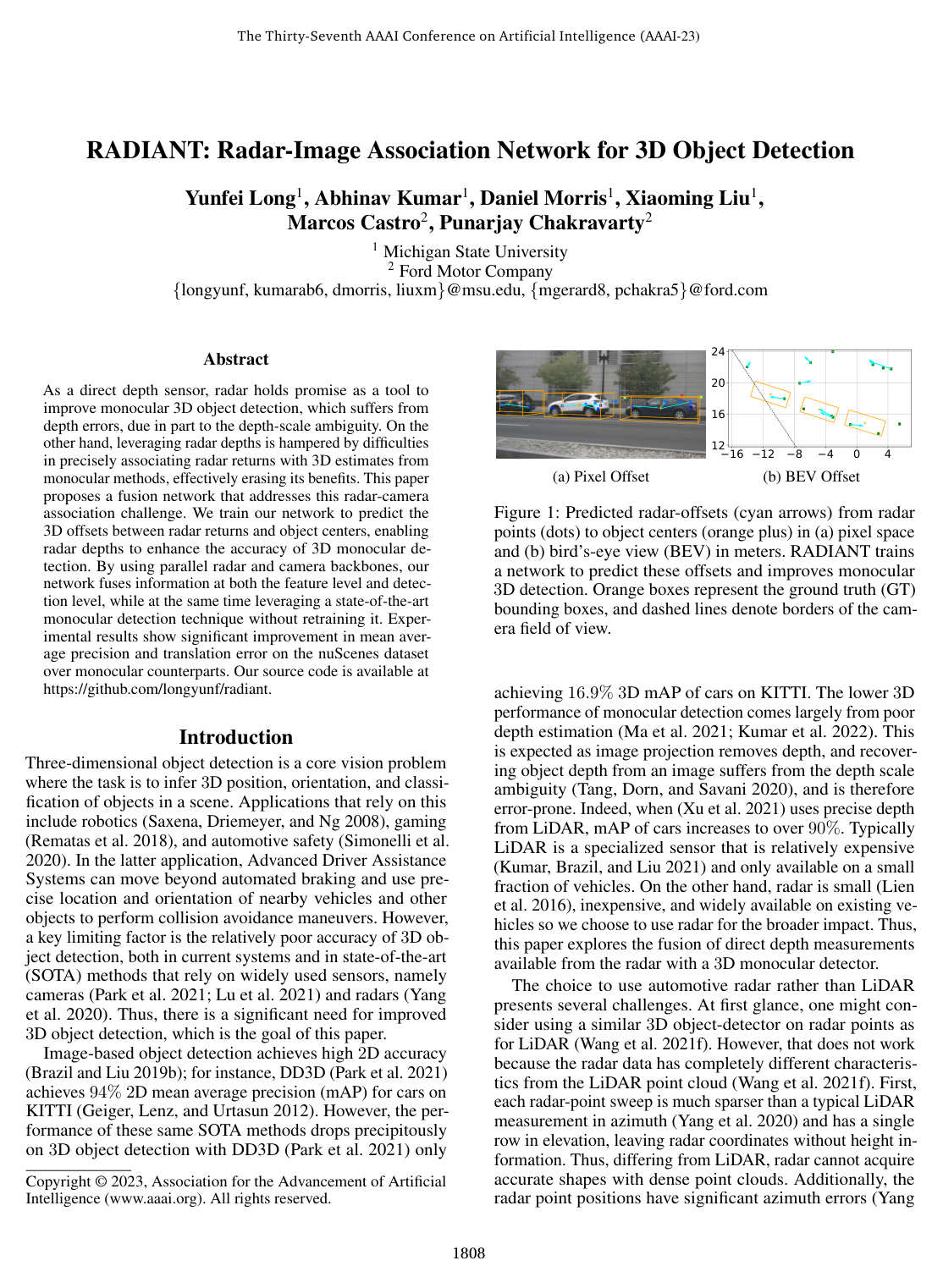
Proposes a radar-camera fusion framework that predicts 3D spatial offsets between radar returns and object centers, effectively resolving radar-to-object association errors and correcting depth inaccuracies in monocular 3D detection without retraining the base camera model.
Reliable three-dimensional object detection is essential for advanced automotive safety systems, robotics, and collision-avoidance maneuvers. While standard single-camera systems achieve high accuracy in two-dimensional image recognition, their ability to pinpoint three-dimensional locations degrades sharply due to severe depth estimation errors. Direct depth sensors like light detection and ranging (LiDAR) offer high precision but remain prohibitively expensive for mass deployment. Automotive radar provides an inexpensive, robust, and widely installed alternative; however, radar data is inherently sparse, lacks height information, and exhibits measurement noise. Furthermore, radar return points do not usually align with actual object centers, creating a challenging association problem that previously undermined the benefits of fusing radar with camera systems.
The article demonstrates a sensor-fusion framework called RADIANT (Radar-Image Association Network) that improves three-dimensional object detection by pairing existing single-camera detection pipelines with automotive radar. The primary objective is to resolve the spatial misalignment between radar points and physical object centers, enabling radar-derived depth to correct image-based distance estimates without requiring changes to underlying camera architectures.
To accomplish this, the authors engineered a dual-branch neural network evaluated on the large-scale, real-world nuScenes autonomous driving dataset, which spans over 40,000 traffic scenes. Rather than attempting to retrain the image network, the system freezes a pre-trained camera model and operates a parallel radar branch. This branch projects radar points into the image plane, borrows contextual features from the camera, and predicts the exact geometric offsets between radar reflections and three-dimensional object centers. A dedicated depth-weighting neural network then evaluates whether the camera or radar depth is more reliable for each detected object, dynamically calculating a fused depth estimate.
The evaluation produced several decisive findings. First, predicting geometric offsets between radar points and object centers drastically reduces depth error: the radar branch reduced overall depth prediction error to 0.79 meters compared to 3.42 meters for the camera-only baseline, with the greatest advantage occurring at distances exceeding 30 meters. Second, when integrated with leading monocular vision models, RADIANT substantially outperformed stand-alone camera detection, decreasing translation error and lifting overall precision across standard automotive benchmarks. Third, RADIANT surpassed CenterFusion—the previous leading radar-camera fusion method—yielding gains exceeding 18% in precision for cars and 20% for pedestrians. Finally, ablation studies showed that intelligent confidence-based weighting via the depth network significantly outperformed simple mathematical averaging of sensor depths.
These findings indicate that automakers and autonomy developers can achieve significant gains in vehicle perception accuracy and safety without adopting costly LiDAR hardware. By effectively leveraging low-cost radar already present on modern vehicles, RADIANT offers an economically viable pathway to enhance collision avoidance and driver assistance systems. Crucially, because RADIANT attaches as a modular add-on without altering or retraining existing camera models, engineering teams can upgrade current visual detection stacks with minimal architectural disruption and reduced development timelines.
Moving forward, development teams should adopt offset-prediction strategies when combining radar with visual data rather than attempting naive point-to-box associations. Technical leadership should consider pilot testing RADIANT-style fusion modules across existing vision stacks to validate real-time computational performance on automotive-grade microprocessors. Additional research is recommended to expand radar fusion beyond depth correction, specifically targeting object velocity, orientation, and physical dimensions.
Confidence in these findings is supported by thorough benchmark testing against top-tier baselines on the standard nuScenes dataset. However, stakeholders should note specific limitations: the evaluated method focuses exclusively on refining depth, leaving object boundaries, orientations, and velocities dependent on the underlying vision model. Additionally, performance remains bounded by the quality of the baseline camera network and the presence of detectable radar returns on target objects.
- Paper: Center-based 3D Object Detection and Tracking, Tianwei Yin et al. (2020). Introduces the center-point based representation for 3D object detection that underlies modern anchor-free pipelines and forms the basis for associating radar reflections with object centers in RADIANT.
- Paper: Deep Multi-Modal Object Detection and Semantic Segmentation for Autonomous Driving: Datasets, Methods, and Challenges, Di Feng et al. (2019). Provides a comprehensive overview of multi-modal fusion architectures and sensor misalignment challenges in autonomous driving, establishing the foundational problem RADIANT addresses.
- Paper: BEVFusion: Multi-Task Multi-Sensor Fusion with Unified Bird's-Eye View Representation, Zhijian Liu et al. (2022). Presents a shared bird's-eye-view representation for multi-sensor fusion, offering key context on coordinate transformation and feature-level fusion strategies.
- Paper: Lift, Splat, Shoot: Encoding Images From Arbitrary Camera Rigs by Implicitly Unprojecting to 3D, Jonah Philion et al. (2020). Introduces the lift-splat-shoot paradigm for lifting 2D image features into 3D space via depth probability distributions, foundational to camera-based 3D depth reasoning.
- Paper: Raw High-Definition Radar for Multi-Task Learning, Julien Rebut et al. (2022). Analyzes raw automotive radar characteristics and deep learning representations, providing essential domain knowledge on radar noise and sparsity.
- Paper: Deep Ordinal Regression Network for Monocular Depth Estimation, Huan Fu et al. (2018). Details methods for monocular depth estimation and uncertainty modeling, which RADIANT enhances using radar depth fusion.
- Paper: BEVNeXt: Reviving Dense BEV Frameworks for 3D Object Detection, Zhenxin Li et al. (2024). Advances camera-based dense 3D object detection using conditional random fields and depth embedding refinement, extending the depth modeling principles addressed in RADIANT.
- Paper: Symphonize 3D Semantic Scene Completion with Contextual Instance Queries, Haoyi Jiang et al. (2024). Applies instance queries to bridge 2D visual features and 3D geometric scene representations, continuing the investigation into rectifying 2D-to-3D projection ambiguities.
- Paper: BEVHeight: A Robust Framework for Vision-based Roadside 3D Object Detection, Lei Yang et al. (2023). Extends 3D localization paradigms by predicting height rather than depth to resolve sensor-plane depth degradation in vision-based infrastructure perception.
- Paper: DI-V2X: Learning Domain-Invariant Representation for Vehicle-Infrastructure Collaborative 3D Object Detection, Xiang Li et al. (2024). Explores domain-invariant representation learning and adaptive offset correction to overcome heterogeneous sensor mismatches in collaborative perception.