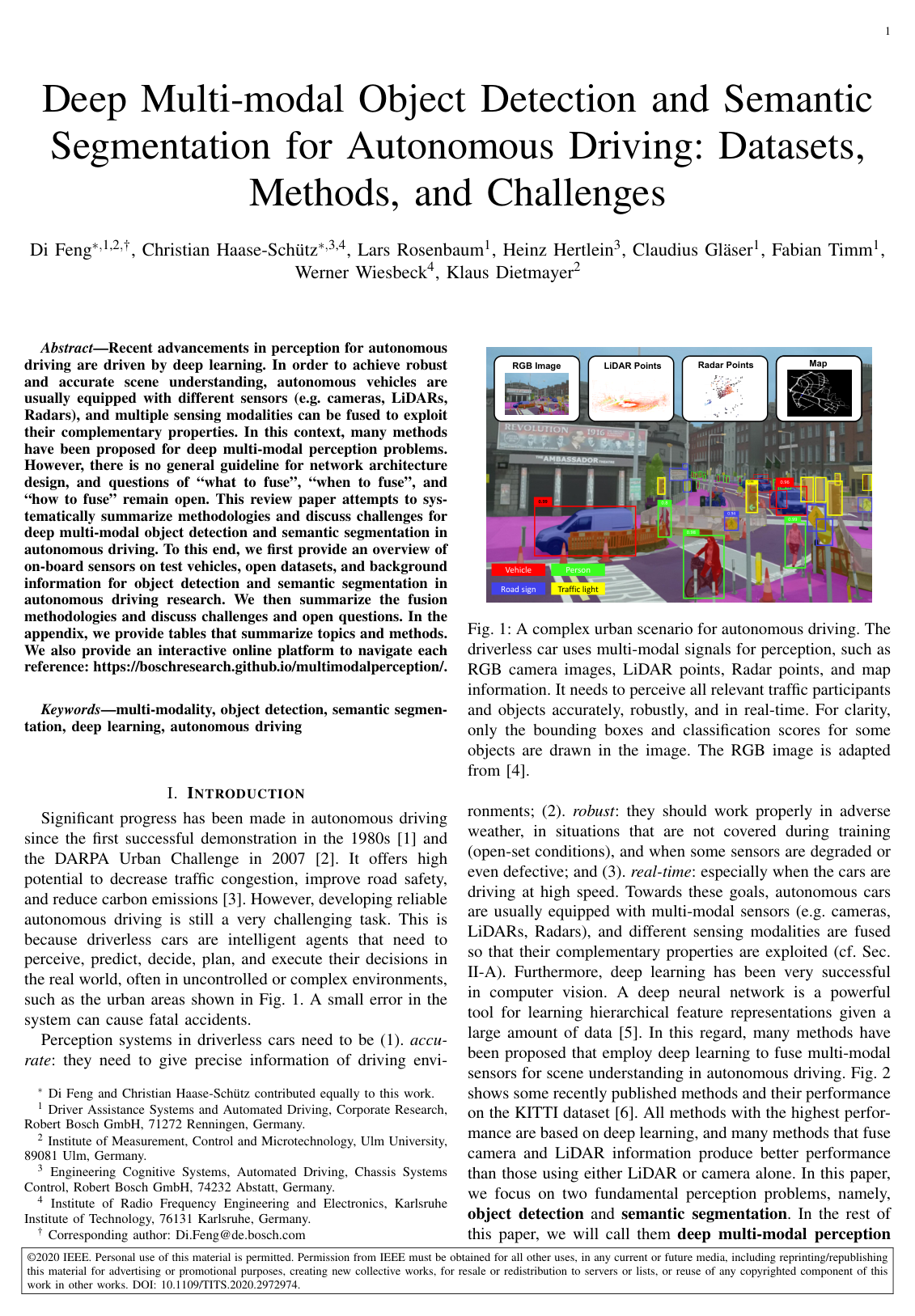
Deep Multi-Modal Object Detection and Semantic Segmentation for Autonomous Driving: Datasets, Methods, and Challenges
Di FengChristian Haase-SchützLars RosenbaumHeinz HertleinClaudius GlaeserFabian TimmWerner WiesbeckKlaus Dietmayer
Systematizes multi-sensor fusion methodologies across camera, LiDAR, and radar modalities to provide clear architectural guidelines on what, when, and how to integrate data for autonomous object detection and semantic segmentation.
Autonomous vehicles must operate reliably in complex environments, where minor perception errors can result in catastrophic accidents. To achieve safe navigation, perception systems require precise environmental data, robust handling of adverse conditions, and real-time execution speeds. Relying on single-sensor solutions such as cameras or Light Detection and Ranging (LiDAR) introduces failure modes under varying weather, lighting, and sparse depth conditions. Fusing complementary modalities through deep learning has become the primary avenue to overcome these individual sensor limitations.
The article systematically reviews and evaluates deep multi-modal object detection and semantic segmentation methods for autonomous driving. It examines sensor setups, public datasets, fusion architectures, and performance metrics while identifying critical challenges in multi-modal system design.
To conduct this evaluation, the authors analyzed public autonomous driving datasets published between 2013 and 2019 and reviewed dozens of deep learning fusion architectures. The analysis categorized methods by input representations, architectural fusion stages (early, middle, or late), and mathematical fusion mechanisms (such as concatenation, addition, ensembling, and Mixture of Experts).
The article highlights five key findings. First, combining camera images and LiDAR point clouds consistently outperforms single-modality baselines in detection accuracy, while the top-performing models across major benchmarks rely universally on deep learning. Second, there is no universally optimal fusion architecture: performance varies significantly depending on network topologies, sensor representations, and application domains. Third, multi-sensor datasets expanded by two orders of magnitude between 2014 and 2019, yet they remain small compared to traditional computer vision datasets and suffer from heavy class imbalances and limited environmental diversity. Fourth, research on integrating Radar and Ultrasonic sensors with deep learning remains sparse despite their low cost and robustness in adverse conditions. Finally, most current fusion networks rely on rigid, empirical operations that fail to quantify sensor uncertainty or dynamically weight reliable modalities when a sensor degrades.
These findings indicate that relying solely on static, empirical fusion designs increases system-level safety risks, particularly under open-set and adverse conditions. Standard evaluation metrics focus almost entirely on predictive accuracy, masking vulnerabilities such as sensor misalignment and failure modes. Improving overall system safety requires explicitly modeling uncertainty and dynamically adapting sensor weights, which directly affects downstream planning, safety certification, and commercial deployment.
Organizations developing autonomous systems should prioritize incorporating probabilistic uncertainty estimation, such as Bayesian neural networks and Mixture of Experts gating mechanisms, into perception stacks. Stakeholders should also invest in automated sensor calibration tools and efficient data labeling frameworks, while expanding research into Radar fusion and simulation-based data augmentation. Because standardized hardware benchmarks and temporal-aware fusion frameworks remain underdeveloped, technical teams should evaluate multi-modal models under simulated sensor faults and realistic automotive processing constraints before committing to fixed hardware architectures.
- Paper: Multimodal Machine Learning: A Survey and Taxonomy, Tadas Baltrušaitis et al. (2017). This taxonomy establishes the core representation, alignment, fusion, and co-learning concepts that the source applies specifically to autonomous-driving perception.
- Paper: Object Detection With Deep Learning: A Review, Zhong-Qiu Zhao et al. (2018). This review supplies the object-detection architectures and trade-offs needed to follow the source’s multimodal detection comparisons.
- Paper: A Review on Deep Learning Techniques Applied to Semantic Segmentation, Alberto Garcia-Garcia et al. (2017). This survey provides the semantic-segmentation architectures, metrics, and design history that underpin the source’s segmentation discussion.
- Paper: Deep Learning for 3D Point Clouds: A Survey, Yulan Guo et al. (2019). This survey introduces the point-cloud representations and 3D detection and segmentation paradigms required for understanding LiDAR branches in the source.
- Paper: Multi-view 3D Object Detection Network for Autonomous Driving, Xiaozhi Chen et al. (2017). MV3D is a foundational camera–LiDAR fusion detector whose proposal and view-based fusion design is directly relevant to the source’s method taxonomy.
- Paper: Fully convolutional networks for semantic segmentation, Jonathan Long et al. (2015). FCN establishes the end-to-end dense-prediction framework underlying later semantic-segmentation methods reviewed by the source.
- Paper: nuScenes: A Multimodal Dataset for Autonomous Driving, Holger Caesar et al. (2019). nuScenes defines a major synchronized camera, LiDAR, and radar benchmark that grounds the source’s dataset and evaluation discussion.
- Paper: Lift, Splat, Shoot: Encoding Images From Arbitrary Camera Rigs by Implicitly Unprojecting to 3D, Jonah Philion et al. (2020). Lift, Splat, Shoot extends the source’s fusion taxonomy with a camera-only, learned projection of arbitrary camera rigs into a unified BEV representation.
- Paper: BEVFormer: Learning Bird's-Eye-View Representation from Multi-Camera Images via Spatiotemporal Transformers, Zhiqi Li et al. (2022). BEVFormer continues the source’s open fusion questions by using spatiotemporal transformers to construct BEV representations from multi-camera video.
- Paper: BEVFusion: Multi-Task Multi-Sensor Fusion with Unified Bird's-Eye View Representation, Zhijian Liu et al. (2022). BEVFusion generalizes the source’s multimodal fusion overview into a unified BEV architecture supporting both 3D detection and dense semantic tasks.
- Paper: Planning-oriented Autonomous Driving, Yi Hu et al. (2022). UniAD extends perception beyond the source’s detection and segmentation scope by coordinating BEV perception, prediction, and planning in one driving-oriented framework.
- Paper: Attention mechanisms in computer vision: A survey, Meng-Hao Guo et al. (2021). This later survey develops the attention mechanisms that became central to transformer-based multimodal perception architectures beyond the source’s 2019 review.