CycleMix: A Holistic Strategy for Medical Image Segmentation from Scribble Supervision
Ke ZhangXiahai Zhuang
Proposes a weakly-supervised medical image segmentation framework that combines mixup-based scribble augmentation with global and local cycle-consistency regularization to achieve segmentation accuracy comparable to fully-supervised methods.
Manual segmentation of medical imaging is essential for clinical decision-making and deep learning model training, yet acquiring complete pixel-level annotations requires extensive expert labor and significant financial expense. Weakly-supervised learning using sparse scribble annotations—where clinical experts draw simple line markings across target anatomical regions—offers a much faster and cheaper alternative. However, training effective models from sparse scribbles remains difficult because standard models struggle to capture correct anatomical boundaries and shape priors.
The article aims to introduce and evaluate CycleMix, a weakly-supervised deep learning framework designed to accurately segment medical images using only sparse scribble annotations. The framework addresses supervision sparsity by pairing a two-step data mixup augmentation with two-level consistency regularization.
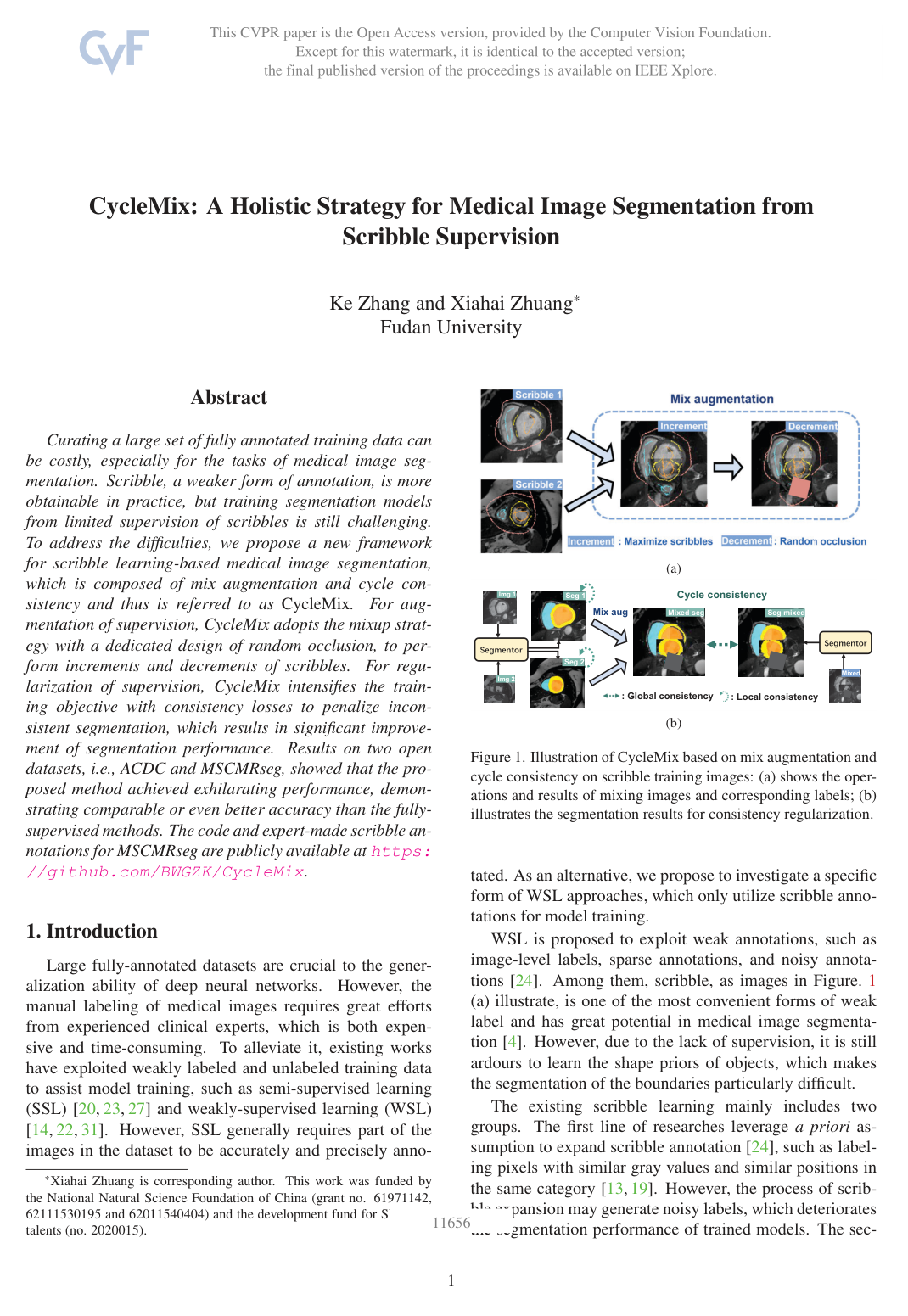
To evaluate this approach, the authors conducted experiments using two benchmark cardiac magnetic resonance imaging (MRI) datasets: the cine-MRI ACDC dataset (100 subjects) and the late gadolinium enhancement MSCMRseg dataset (45 subjects). The framework combines two training images and their annotations based on saliency (increments of scribbles) and applies random rectangular occlusions (decrements of scribbles) to improve target localization. To stabilize learning and preserve realistic organ shapes, CycleMix applies a global consistency loss—ensuring image patches segment consistently whether viewed individually or mixed—and a local consistency loss that enforces anatomical connectivity. Performance was evaluated using the Dice similarity coefficient against weakly-supervised baselines, shape-prior methods using additional masks, and fully-supervised models.
The findings show that CycleMix substantially improves scribble-based segmentation performance. First, on scribble annotations alone, CycleMix achieved average Dice scores of 84.8% on ACDC and 80.0% on MSCMRseg, outperforming standard mixup baselines by up to 22.4% and 55.9% in absolute score gains. Second, CycleMix surpassed competing weakly-supervised methods, including advanced generative models that required additional unpaired full-mask images. Third, models trained with CycleMix under scribble supervision matched or marginally exceeded the performance of standard networks trained on 100% fully-annotated masks (84.8% vs. 82.0% on ACDC; 80.0% vs. 75.5% on MSCMRseg). Finally, data sensitivity analyses revealed that incorporating just 20% fully-annotated data alongside scribbles pushed segmentation accuracy above 87%, with overall performance gains leveling off around a 40% full-annotation ratio.
These results demonstrate that clinical institutions can significantly lower data curation costs and project timelines by shifting from exhaustive pixel annotations to quick scribble labeling without compromising segmentation quality. In addition, the framework avoids the computational complexity and data overhead of auxiliary generative networks while preserving essential organ geometry.
Based on these findings, medical AI development teams should adopt scribble-based annotation protocols paired with CycleMix-style mixup and consistency objectives for cardiac MRI segmentation pipelines. When higher precision is required, teams can optimize annotation resources by creating a hybrid dataset containing roughly 20% to 40% fully-annotated cases combined with scribbles, rather than fully annotating the entire cohort.
While confidence in the reported cardiac benchmarks is high, the evaluation is limited to 2D cardiac MRI datasets with relatively small patient cohorts. Further validation across broader imaging modalities, distinct anatomical structures, and larger 3D clinical imaging volumes is recommended before general clinical deployment.
- Paper: U-Net: Convolutional Networks for Biomedical Image Segmentation, Olaf Ronneberger et al. (2015). Introduces the foundational U-Net architecture and data augmentation principles upon which medical image segmentation frameworks like CycleMix are built.
- Paper: DivideMix: Learning with Noisy Labels as Semi-supervised Learning, Junnan Li et al. (2020). Establishes key principles for combining mixup data augmentations with peer-network consistency regularization in weakly- and semi-supervised deep learning regimes.
- Paper: Unpaired Image-to-Image Translation Using Cycle-Consistent Adversarial Networks, Jun-Yan Zhu et al. (2017). Provides the foundational cycle-consistency formulation that inspires cyclic consistency constraints across transformed and augmented medical image views.
- Paper: Generalised Dice Overlap as a Deep Learning Loss Function for Highly Unbalanced Segmentations, Carole H. Sudre et al. (2017). Develops generalized Dice loss functions critical for stabilizing neural network training under extreme spatial class imbalances in medical image segmentation.
- Paper: The Effectiveness of Data Augmentation in Image Classification using Deep Learning, Luis Perez et al. (2017). Demonstrates how learned combinatorial data augmentation techniques effectively mitigate severe data scarcity in deep learning.
- Paper: Segment anything in medical images, Jun Ma et al. (2023). Extends the goal of minimizing exhaustive manual segmentation by adapting promptable vision foundation models across diverse clinical imaging modalities.
- Paper: Weakly Supervised Semantic Segmentation via Adversarial Learning of Classifier and Reconstructor, Hyeokjun Kweon et al. (2023). Explores an alternative weakly supervised segmentation framework using competitive adversarial classifiers and reconstructors to sharpen anatomical boundary localization.
- Paper: Self-supervised Image-specific Prototype Exploration for Weakly Supervised Semantic Segmentation, Qi Chen et al. (2022). Investigates self-supervised prototype exploration to enforce consistency and refine object boundaries in weakly supervised segmentation settings.
- Paper: Un-mix: Rethinking Image Mixtures for Unsupervised Visual Representation Learning, Zhiqiang Shen et al. (2022). Generalizes the mechanics of image mixing to broader unsupervised visual representation learning pipelines.
- Paper: ACPL: Anti-curriculum Pseudo-labelling for Semi-supervised Medical Image Classification, Fengbei Liu et al. (2022). Applies complementary semi-supervised pseudo-labelling strategies to manage sparse supervision and label imbalance in diagnostic medical image analysis.