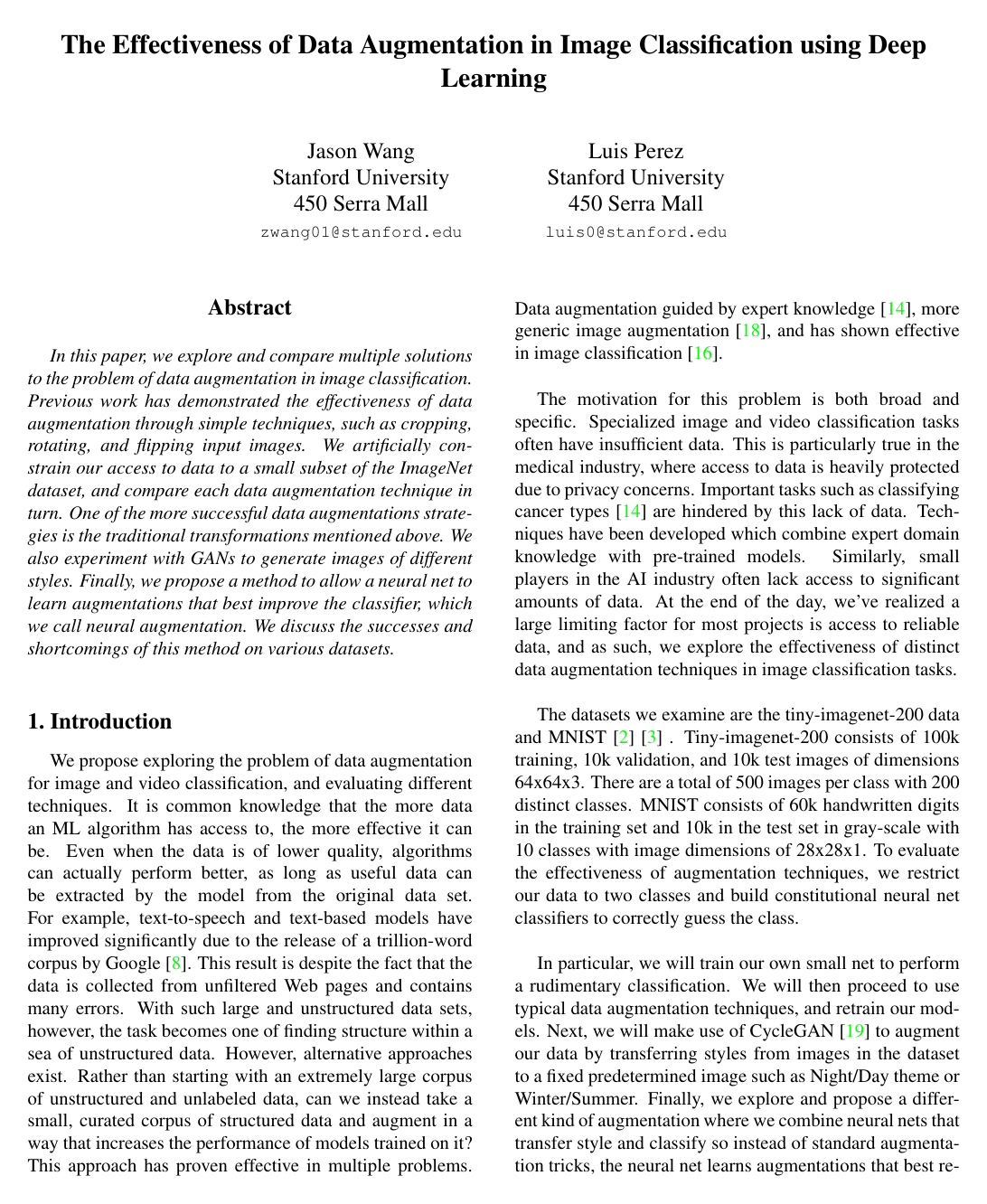
The Effectiveness of Data Augmentation in Image Classification using Deep Learning

Luis PerezJason Wang

article2017arXiv3,218 citations

Proposes a learned neural augmentation method while benchmarking traditional geometric transformations and GAN-based generation to improve deep image classifiers trained on limited data.

Listen

The research addresses the challenge of training effective image classifiers when only small, curated datasets are available, a common constraint in domains such as medical imaging and for smaller AI teams that lack access to massive corpora. Rather than relying solely on larger unstructured data, the work evaluates whether targeted augmentation of limited structured datasets can meaningfully improve model generalization and reduce overfitting.

The authors set out to compare three families of augmentation methodsstandard geometric and color transformations, style transfer via CycleGAN, and a novel neural augmentation approach that learns to combine pairs of same-class imageson binary classification tasks drawn from restricted subsets of Tiny ImageNet and MNIST.

They trained a compact three-layer CNN classifier on 400 images per class for dogs versus cats, dogs versus goldfish, and MNIST zeros versus eights. Each augmentation strategy was applied during training only, with performance measured by peak validation accuracy across 40 epochs using identical optimization settings. A control experiment tested whether gains simply reflected the use of a deeper network.

Traditional transformations raised validation accuracy by 67 percentage points on the ImageNet-derived tasks. Neural augmentation produced the largest gains, reaching 91.5 percent on dogs versus goldfish and 77 percent on dogs versus cats, while CycleGAN style transfer yielded smaller improvements of 12 points. The control condition performed no better than the unaugmented baseline, and none of the methods helped on the already high-performing MNIST task. Generated images from the neural method often blended salient class features while suppressing background noise, acting as a form of implicit regularization.

These results indicate that learned augmentation can extract additional value from scarce data without requiring domain-specific manual transforms or external style references, offering a practical route to stronger classifiers when privacy, cost, or access limits data collection. The approach is especially relevant for safety-critical applications such as medical diagnosis or autonomous driving, where collecting diverse real-world examples is difficult.

Traditional augmentation remains the most efficient first step and can be combined with neural augmentation for further gains. Future work should test the methods on larger architectures such as fine-tuned VGG16, evaluate them on multi-class and video data, and explore their use for balancing class distributions or generating synthetic night or weather conditions for driving datasets. The neural losses did not fully converge in the reported experiments, suggesting that regularization strength and network capacity merit additional tuning before broader deployment.

arXiv: 1712.04621
Cover for The Effectiveness of Data Augmentation in Image Classification using Deep Learning

Abstract

In this paper, we explore and compare multiple solutions to the problem of data augmentation in image classification. Previous work has demonstrated the effectiveness of data augmentation through simple techniques, such as cropping, rotating, and flipping input images. We artificially constrain our access to data to a small subset of the ImageNet dataset, and compare each data augmentation technique in turn. One of the more successful data augmentations strategies is the traditional transformations mentioned above. We also experiment with GANs to generate images of different styles. Finally, we propose a method to allow a neural net to learn augmentations that best improve the classifier, which we call neural augmentation. We discuss the successes and shortcomings of this method on various datasets.

Table of Contents

  • 1. Introduction
  • 2. Related Work
  • 3. Methods
  • 3.1. Traditional Transformations
  • 3.2. Generative Adversarial Networks
  • 3.3. Learning the Augmentation
  • 3. No loss is computed at this layer
  • 4. Datasets and Features
  • 5. Experiments
  • SmallNet
  • Augmentation Network
  • 6. Results
  • 1. EXPERIMENTS ON TRADITIONAL TRANSLATION
  • 2. EXPERIMENTS ON GANS
  • 3. EXPERIMENTS ON NEURAL NET AUGMENTATION
  • 4. SAME EXPERIMENTS ON DOG VS GOLDFISH
  • 5. CONTROL EXPERIMENT
  • 6. EXPERIMENTS WITH MNIST
  • 7. Conclusion/Future Work
  • References

Knowls

  1. Knowl 1 — Neural Augmentation Framework

    model/method

    Neural Augmentation is an end-to-end framework that learns to generate augmented training images using an auxiliary convolutional neural network (AugNet) prepended to a classification network (SmallNet).

    During training, two distinct images x1,x2RH×W×Cx_1, x_2 \in \mathbb{R}^{H \times W \times C} belonging to the same class are randomly sampled and concatenated along their channel dimension into a tensor of shape H×W×2CH \times W \times 2C. This input is passed into AugNet, which outputs a synthetic augmented image x^RH×W×C\hat{x} \in \mathbb{R}^{H \times W \times C}. The generated image x^\hat{x} and original training images are subsequently fed into the classification network. Gradients from the classification loss (and optional auxiliary augmentation loss) backpropagate through both SmallNet and AugNet, training the augmentation network to produce transformations that directly improve classification accuracy.

    During evaluation and inference, AugNet is bypassed entirely; test and validation images are passed directly into the trained classification network.

  2. Knowl 2 — Neural Augmentation Objective Functions

    equation

    The overall training loss L\mathcal{L} for the joint neural augmentation system combines a classification loss Lc\mathcal{L}_c and an auxiliary augmentation loss La\mathcal{L}_a:

    L=αLc+βLa\mathcal{L} = \alpha \mathcal{L}_c + \beta \mathcal{L}_a

    where α[0,1]\alpha \in [0, 1] and β[0,1]\beta \in [0, 1] are weighting hyperparameters (such as α=0.75,β=0.25\alpha = 0.75, \beta = 0.25). The classification loss Lc\mathcal{L}_c is a multi-class cross-entropy loss computed on the sigmoid scores produced by the classifier. The augmentation loss La\mathcal{L}_a measures the deviation of the augmented image ARH×W×CA \in \mathbb{R}^{H \times W \times C} from a third target image TRH×W×CT \in \mathbb{R}^{H \times W \times C} randomly selected from the same class, serving as a regularizer. Three formulations for La\mathcal{L}_a are defined:

    1. Content Loss, measuring pixel-level mean squared error where DD is the spatial dimension length: Lacontent=1D2i,j(AijTij)\mathcal{L}_a^{\text{content}} = \frac{1}{D^2} \sum_{i,j} (A_{ij} - T_{ij})

    2. Style Loss, computed from Gram matrices GAG^A and GTG^T on raw image channels with CC channels where Gij=kFikFjkG_{ij} = \sum_k F_{ik} F_{jk}: Lastyle=1C2i,j(GijAGijT)\mathcal{L}_a^{\text{style}} = \frac{1}{C^2} \sum_{i,j} (G^A_{ij} - G^T_{ij})

    3. No Loss, setting β=0\beta = 0 such that AugNet is guided exclusively by the downstream classification loss Lc\mathcal{L}_c.

  3. Knowl 3 — Architectures of AugNet and SmallNet

    model/method

    The neural augmentation architecture comprises two dedicated convolutional neural networks:

    1. Augmentation Network (AugNet): Accepts an input tensor formed by concatenating two images of the same class along the channel axis (shape H×W×2CH \times W \times 2C). It consists of 5 convolutional layers:
    • Conv2D (16 filters, 3×33 \times 3, ReLU)
    • Conv2D (16 filters, 3×33 \times 3, ReLU)
    • Conv2D (16 filters, 3×33 \times 3, ReLU)
    • Conv2D (16 filters, 3×33 \times 3, ReLU)
    • Conv2D (3 filters, 3×33 \times 3, linear output)
    1. Classifier (SmallNet): Accepts a single image (shape H×W×CH \times W \times C) and outputs class logits across 9 sequential stages:
    • Conv2D (16 filters, 3×33 \times 3, ReLU)
    • Batch Normalization
    • Max Pooling (2×22 \times 2 filter, stride 2)
    • Conv2D (32 filters, 3×33 \times 3, ReLU)
    • Conv2D (32 filters, 3×33 \times 3, ReLU)
    • Batch Normalization
    • Max Pooling (2×22 \times 2 filter, stride 2)
    • Fully Connected layer (output dimension 1024, Dropout)
    • Fully Connected layer (output dimension 2 for binary classification)
  4. Knowl 4 — Comparative Performance of Augmentation Techniques on Binary Tiny-ImageNet Classification

    data/table

    Experiments evaluated different data augmentation methods on binary classification tasks using 64x64x3 RGB image subsets from Tiny-ImageNet-200. Models were trained for 40 epochs using Adam optimization at a learning rate of 0.0001, reporting the highest validation accuracy achieved.

    Augmentation Technique Dogs vs. Goldfish Val. Acc. Dogs vs. Cats Val. Acc.
    None 0.855 0.705
    Traditional 0.890 0.775
    GANs (CycleGAN) 0.865 0.720
    Neural + No Loss 0.915 0.765
    Neural + Content Loss 0.900 0.770
    Neural + Style Loss 0.890 0.740
    Control 0.840 0.710

    Neural augmentation consistently outperforms the unaugmented baseline on both tasks (improving from 85.5% to 91.5% on Dogs vs. Goldfish, and from 70.5% to 77.0% on Dogs vs. Cats). Traditional affine augmentation provides strong competitive performance (89.0% and 77.5%), whereas CycleGAN style transfer provides modest improvements (86.5% and 72.0%).

  5. Knowl 5 — Verification of Neural Augmentation via Control Experiment

    empirical result

    To test whether the performance gains of Neural Augmentation stem from genuine data augmentation rather than added model capacity from the 5-layer AugNet prepended to the classifier, a control experiment was conducted. In the control, two identical copies of the same image (x1=x2x_1 = x_2) were concatenated and passed to AugNet, effectively simulating a single deeper 10-layer network without pairing diverse samples.

    The control achieved a validation accuracy of 0.840 on Dogs vs. Goldfish (worse than the unaugmented baseline of 0.855) and 0.710 on Dogs vs. Cats (essentially matching the baseline of 0.705). The inability of the control network to improve generalization confirms that the empirical gains of Neural Augmentation are driven by the combinatorial synthesis of features across pairs of distinct images (N2N^2 possible pairings from NN images), not from additional network depth or parameter count.

  6. Knowl 6 — CycleGAN Style Transfer Data Augmentation

    model/method

    CycleGAN is utilized as an offline data augmentation technique by transferring artistic and environmental styles onto training images prior to training the classifier. For each input image in the training set, a styled variant is generated by selecting from a palette of 6 visual styles: Cezanne, Enhance, Monet, Ukiyoe, Van Gogh, and Winter. Both the original images and their style-transformed counterparts are included in the training dataset for the classifier.

  7. Knowl 7 — Traditional Affine Data Augmentation Baseline

    model/method

    Traditional data augmentation applies a combination of affine transformations directly in image data space to manipulate training inputs offline. For each input image, a duplicate image is generated by applying spatial and color warping: translation/shifting, zoom in/out, rotation, horizontal reflection/flipping, elastic distortions, and hue shading. For a training dataset of size NN, this process creates an expanded dataset of size 2N2N, feeding both original and transformed images into the network during training.

  8. Knowl 8 — Neural Augmentation Evaluation on Structured MNIST Digit Classification

    data/table

    Neural augmentation was evaluated on a structured, low-complexity dataset using 2,000 grayscale images (28x28x1) from MNIST distinguishing digits 0 from 8 (1,000 images per class, split 80:20 between training and validation). Because the images are single-channel grayscale, style loss via Gram matrices was not applicable.

    Augmentation Strategy Validation Accuracy
    None 0.972
    Neural + No Loss 0.975
    Neural + Content Loss 0.968

    Unlike on Tiny-ImageNet, neural augmentation yielded negligible performance change on MNIST (+0.3% without loss, -0.4% with content loss). Because MNIST digits are already standardized, centered, and visually simple, standard convolutional networks already achieve ceiling performance, leaving little room for feature blending to supply novel discriminative information.

  9. Knowl 9 — Regularization Dynamics of Neural Augmentation Auxiliary Losses

    empirical result

    During joint training of AugNet and SmallNet with auxiliary losses, the auxiliary content loss and style loss do not minimize to zero: content loss only marginally decreases (from ~1.6 to 1.3–1.5 over 30 epochs without converging), and style loss hovers around 0.5. Perfect minimization of these losses would require AugNet to synthesize an exact target image from an arbitrary pair of input images, which is impossible for a shallow convolutional network. Instead of acting as exact reconstruction targets, the content and style loss terms function as soft regularizers that prevent AugNet from drifting into degenerate pixel distributions divergent from the training data.

Coverage note — No substantial contributed material was omitted from the paper.

References

  1. 1.2
  2. 2.Deep mnist for experts. https://www.tensorflow.org/get_started/mnist/pros. Accessed: 2017-05-19. 1
  3. 3.The mnist database of handwritten digits. http://yann.lecun.com/exdb/mnist. Accessed: 2017-05-19. 1
  4. 4.H. S. Baird. Document image analysis. chapter Document Image Defect Models, pages 315–325. IEEE Computer Society Press, Los Alamitos, CA, USA, 1995. 2
  5. 5.D. C. Ciresan, U. Meier, L. M. Gambardella, and J. Schmidhuber. Deep big simple neural nets excel on handwritten digit recognition. CoRR, abs/1003.0358, 2010. 2
  6. 6.Y. Gal and Z. Ghahramani. A Theoretically Grounded Application of Dropout in Recurrent Neural Networks. ArXiv e-prints, Dec. 2015. 2
  7. 7.S. Gurumurthy, R. Kiran Sarvadevabhatla, and V. Babu Radhakrishnan. DeLiGAN : Generative Adversarial Networks for Diverse and Limited Data. ArXiv e-prints, June 2017. 2
  8. 8.A. Halevy, P. Norvig, and F. Pereira. The unreasonable effectiveness of data. IEEE Intelligent Systems, 24(2):8–12, Mar. 2009. 1
  9. 9.E. Jannik Bjerrum. SMILES Enumeration as Data Augmentation for Neural Network Modeling of Molecules. ArXiv e-prints, Mar. 2017. 3
  10. 10.Y. Kubo, G. Tucker, and S. Wiesler. Compacting Neural Network Classifiers via Dropout Training. ArXiv e-prints, Nov. 2016. 2
  11. 11.X. Liang, Z. Hu, H. Zhang, C. Gan, and E. P. Xing. Recurrent topic-transition GAN for visual paragraph generation. CoRR, abs/1703.07022, 2017. 2
  12. 12.Y. Ma and D. Klabjan. Convergence analysis of batch normalization for deep neural nets. CoRR, abs/1705.08011, 2017. 2
  13. 13.M. Marchesi. Megapixel Size Image Creation using Generative Adversarial Networks. ArXiv e-prints, May 2017. 2
  14. 14.C. N. Vasconcelos and B. N. Vasconcelos. Increasing deep learning melanoma classification by classical and expert knowledge based image transforms. CoRR, abs/1702.07025, 2017. 1
  15. 15.B. Wang and D. Klabjan. Regularization for unsupervised deep neural nets. CoRR, abs/1608.04426, 2016. 2
  16. 16.S. C. Wong, A. Gatt, V. Stamatescu, and M. D. McDonnell. Understanding data augmentation for classification: when to warp? CoRR, abs/1609.08764, 2016. 1
  17. 17.S. Xiang and H. Li. On the Effects of Batch and Weight Normalization in Generative Adversarial Networks. ArXiv e-prints, Apr. 2017. 2
  18. 18.Y. Xu, R. Jia, L. Mou, G. Li, Y. Chen, Y. Lu, and Z. Jin. Improved relation classification by deep recurrent neural networks with data augmentation. CoRR, abs/1601.03651, 2016. 1
  19. 19.J. Zhu, T. Park, P. Isola, and A. A. Efros. Unpaired image-to-image translation using cycle-consistent adversarial networks. CoRR, abs/1703.10593, 2017. 1, 3

Citation

MLA
Perez, L., and J. Wang. “The Effectiveness of Data Augmentation in Image Classification Using Deep Learning”. arXiv, 2017, https://doi.org/10.48550/arxiv.1712.04621.
APA
Perez, L., & Wang, J. (2017). The Effectiveness of Data Augmentation in Image Classification using Deep Learning. arXiv. https://doi.org/10.48550/arxiv.1712.04621
Chicago
Perez, L., and J. Wang. 2017. “The Effectiveness of Data Augmentation in Image Classification Using Deep Learning”. Preprint, ArXiv. https://doi.org/10.48550/arxiv.1712.04621.
Harvard
Perez, L. and Wang, J. (2017) “The Effectiveness of Data Augmentation in Image Classification using Deep Learning”. arXiv. Available at: https://doi.org/10.48550/arxiv.1712.04621.
Vancouver
1. Perez L, Wang J (2017) The Effectiveness of Data Augmentation in Image Classification using Deep Learning. https://doi.org/10.48550/arxiv.1712.04621

BibTeX

@misc{https://doi.org/10.48550/arxiv.1712.04621,
  doi = {10.48550/ARXIV.1712.04621},
  url = {https://arxiv.org/abs/1712.04621},
  author = {Perez, Luis and Wang, Jason},
  keywords = {Computer Vision and Pattern Recognition (cs.CV), FOS: Computer and information sciences, FOS: Computer and information sciences},
  title = {The Effectiveness of Data Augmentation in Image Classification using Deep Learning},
  publisher = {arXiv},
  year = {2017},
  copyright = {arXiv.org perpetual, non-exclusive license}
}
Metadata:DOI registry

Access the Paper

This paper is available from its original source. Click below to access the PDF.

Open PDF

License: Authors