Weakly Supervised Semantic Segmentation via Adversarial Learning of Classifier and Reconstructor
Hyeokjun KweonSung-Hoon YoonKuk-Jin Yoon
Proposes an adversarial framework pitting a CAM-generating classifier against an image reconstructor to prevent over-erasing and under-activation by minimizing cross-segment inferability, achieving state-of-the-art weakly supervised semantic segmentation performance on PASCAL VOC and MS COCO.
Training computer vision systems to identify and outline objects at the pixel level typically requires expensive and time-consuming manual annotations. Weakly supervised semantic segmentation addresses this bottleneck by using simple, low-cost image-level tags that only indicate whether an object category exists in an image. However, standard methods relying on class activation maps consistently fail to capture entire objects and frequently bleed into irrelevant backgrounds, creating noisy training data that degrades segmentation quality.
The article demonstrates a novel framework called Adversarial learning of the Classifier and the Reconstructor to resolve these localization errors. The main objective is to significantly enhance the precision and completeness of object localization maps without relying on pixel-level annotations or auxiliary datasets.
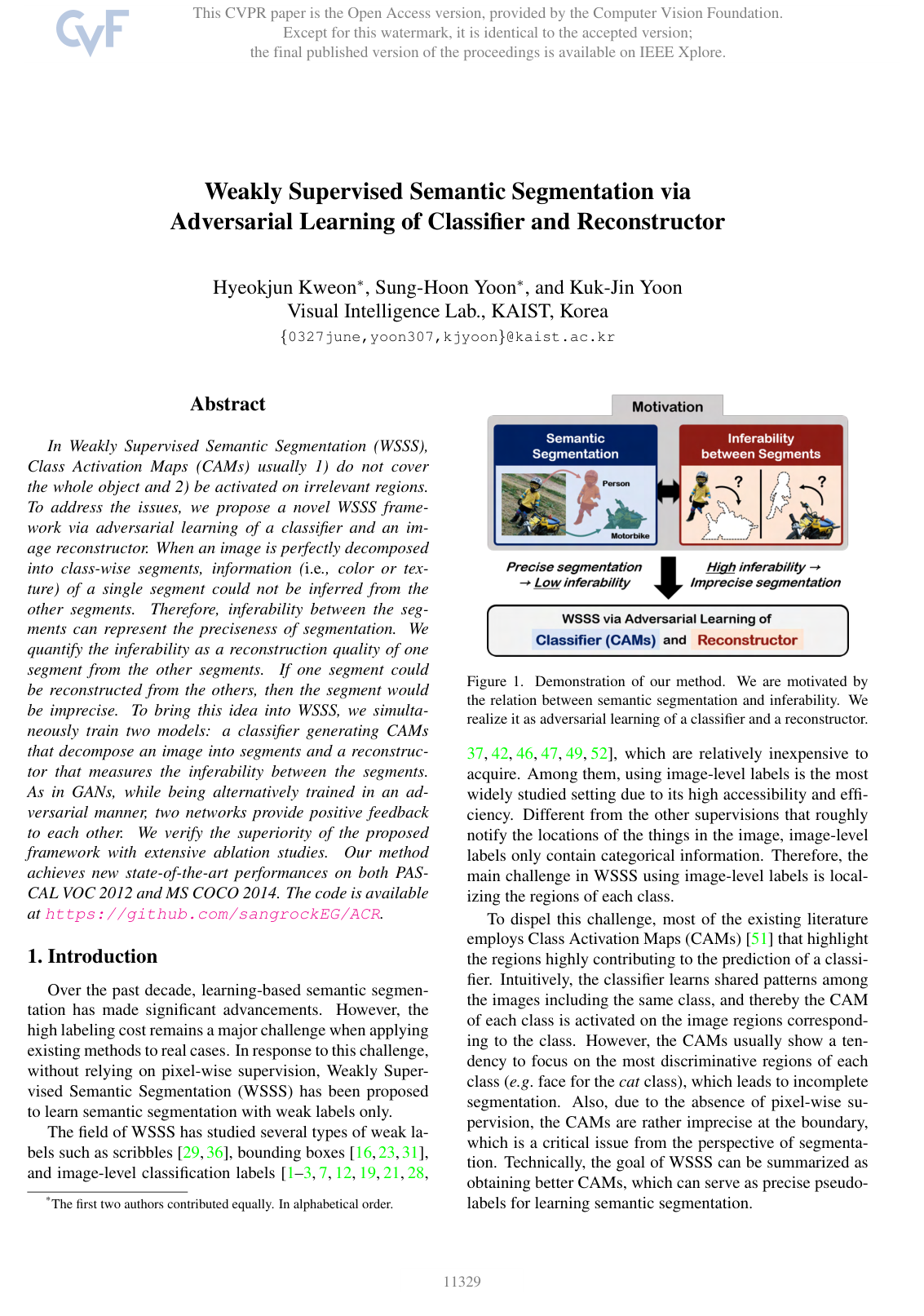
The authors approach the problem through the concept of mutual segment independence: if an image is cleanly divided into target and non-target segments, neither piece should contain enough residual information to infer the appearance of the other. The method pairs a classifier model, which generates segmentation maps, against an image reconstructor model in a two-player competitive learning setup. The reconstructor attempts to recreate the missing target segment using only the non-target background, while the classifier learns to produce clean boundaries that starve the reconstructor of helpful leftover visual clues. To prevent the reconstructor from simply memorizing training images, the authors introduce a synthetic noise strategy that injects controlled remnants during training. The framework was evaluated across standard benchmarks including PASCAL VOC 2012 (21 categories) and MS COCO 2014 (81 categories).
The evaluation yielded several critical findings. First, the proposed framework improved initial localization quality from a baseline of 48.4% mean Intersection over Union to 60.3% on the PASCAL VOC training set, representing a nearly 12-percentage-point jump. Second, incorporating both target and non-target adversarial loss terms proved essential; omitting either term caused severe under-segmentation or over-expansion. Third, the resulting segmentation models established new benchmark records, achieving 71.9% validation accuracy on PASCAL VOC and 45.3% on MS COCO when using convolutional backbones, and reaching 72.4% accuracy when paired with vision transformer architectures.
These findings demonstrate that image reconstruction can serve as an effective, self-supervised regularizer for weakly supervised visual learning. By outperforming existing adversarial erasing methods, the approach avoids the common pitfall of over-expanding object boundaries while completely removing the need for external saliency models or costly manual pixel annotations. This translates to substantial labor and cost savings when deploying high-accuracy segmentation tools in real-world computer vision pipelines.
Organizations developing segmentation systems should adopt this adversarial reconstruction framework when only category-level image labels are available. Because the methodology is compatible with both convolutional and transformer backbones, engineering teams can integrate it directly into existing training workflows. When deploying this training scheme, teams should include the synthetic remnant feeding mechanism to guard against model memorization.
The study notes certain operational boundaries. Reconstructor training is sensitive to specific data augmentations, requiring color jittering to be omitted to ensure stable model convergence. Furthermore, while the method operates efficiently on standard hardware—training in approximately 12 hours on a single commercial graphics processor—its performance has been primarily validated on natural object benchmarks, meaning performance on specialized domains such as medical imaging or industrial inspection warrants further verification.
- Paper: Learning Deep Features for Discriminative Localization, Bolei Zhou et al. (2016). Introduces Class Activation Mapping (CAM), providing the foundational seed-generation mechanism whose localization and coverage limitations this source directly aims to resolve.
- Paper: Grad-CAM: Visual Explanations from Deep Networks via Gradient-Based Localization, Ramprasaath R. Selvaraju et al. (2016). Extends class activation mapping to general CNN architectures, establishing key principles for using discriminative feature activations to localize object regions.
- Paper: Learning to Adapt Structured Output Space for Semantic Segmentation, Yi-Hsuan Tsai et al. (2018). Demonstrates how adversarial learning frameworks can be effectively formulated to evaluate and regularize structured segmentation outputs.
- Paper: Fully convolutional networks for semantic segmentation, Jonathan Long et al. (2015). Establishes the foundational fully convolutional network architecture used for end-to-end dense pixel classification in semantic segmentation.
- Paper: DeepLab: Semantic Image Segmentation with Deep Convolutional Nets, Atrous Convolution, and Fully Connected CRFs, Liang-Chieh Chen et al. (2016). Develops dense atrous convolution and boundary refinement strategies that standard weakly supervised semantic segmentation pipelines rely upon.
No sufficiently relevant recommendations were found.