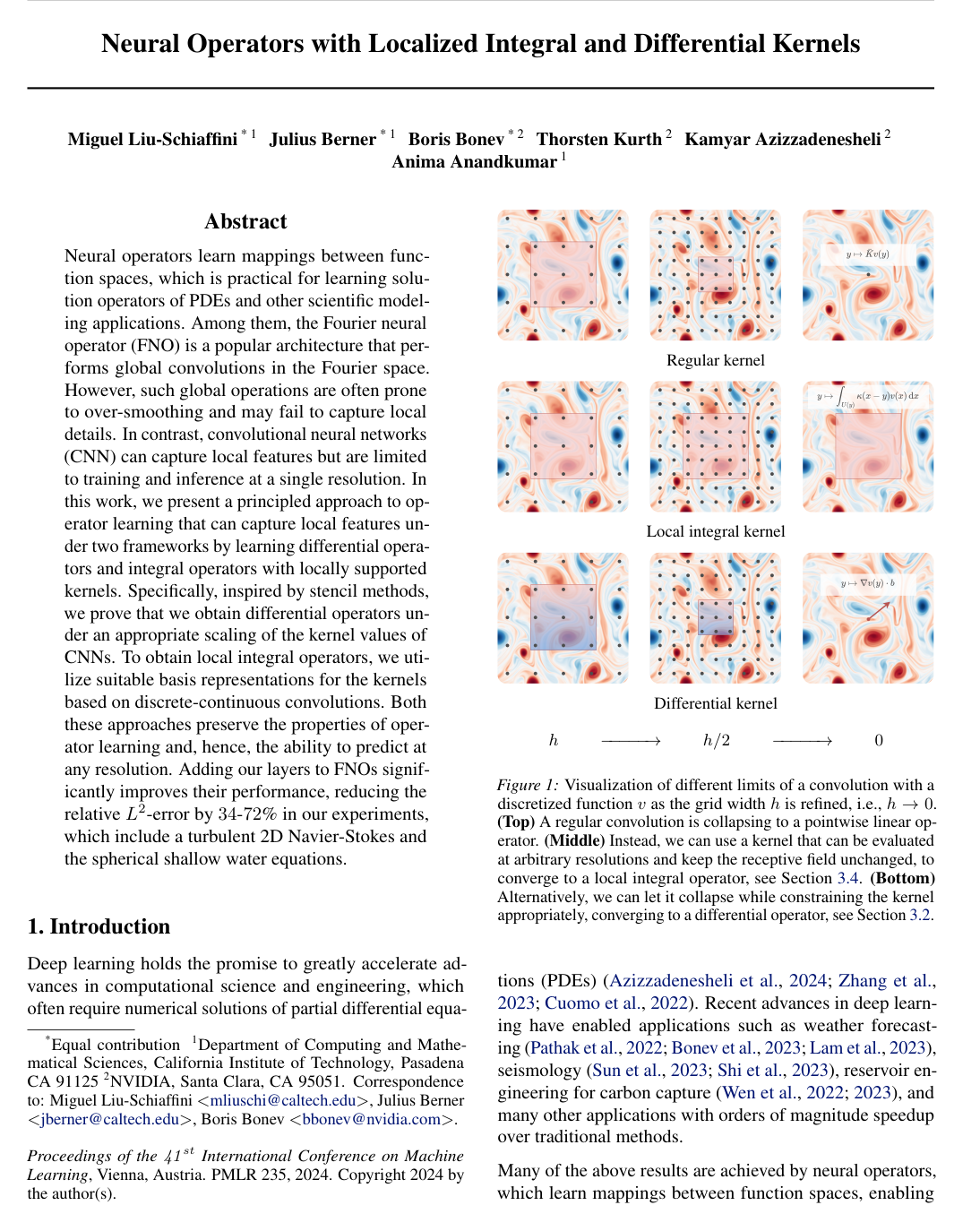
Neural Operators with Localized Integral and Differential Kernels

Miguel Liu-SchiaffiniJulius BernerBoris BonevThorsten KurthKamyar AzizzadenesheliAnima Anandkumar

article2024ICML87 citationsBest Paper Finalist

Develops discretization-independent localized differential and integral kernel layers for Fourier neural operators, enabling high-resolution local feature capture in PDE modeling and cutting relative prediction error by up to 72% across fluid dynamics benchmarks.

Listen

Simulating complex physical systems such as fluid turbulence, weather patterns, and biological processes often demands solving partial differential equations. While traditional numerical simulations require significant computing power, modern deep learning methods known as neural operators offer orders of magnitude speedups. However, existing neural operator models like Fourier neural operators tend to over-smooth solutions and miss fine-scale, local details because they rely primarily on global operations. Conversely, standard convolutional neural networks capture local details well but are constrained to a fixed grid resolution and cannot easily scale to higher-resolution or irregular meshes without losing critical high-frequency information.

The objective of the article is to formulate, prove, and demonstrate a principled neural operator framework that incorporates localized operations—specifically differential and local integral operators—while remaining independent of data grid resolution.

To achieve this, the authors develop two complementary local layers that integrate into existing neural operator frameworks: a differential layer derived from finite-difference stencils that rescales and centers convolutional kernels to converge to exact derivatives as grid spacing shrinks, and a local integral layer based on discrete-continuous convolutions parameterized by basis functions that function across planar, spherical, and unstructured geometries. The researchers evaluate these augmented architectures across five benchmark partial differential equation problems, including 2D Darcy flow, turbulent 2D Navier-Stokes flow, 2D diffusion-reaction systems, spherical shallow water equations, and fluid flow past an irregular cylindrical geometry, maintaining comparable parameter budgets across models to ensure fair comparisons.

The key findings show substantial performance gains across all benchmarks when incorporating local operations. Augmenting Fourier neural operators with both differential and local integral layers reduces relative prediction error by 34% in 2D turbulent Navier-Stokes flow and by 72% in spherical shallow water equations. For the 2D diffusion-reaction equation, the hybrid model cuts relative error by 63% and achieves markedly lower high-frequency errors. In the Darcy flow benchmark, which explicitly mimics a differential operator, the proposed differential kernels improve accuracy over standard Fourier neural operators by 87%. Furthermore, on unstructured meshes modeling flow past a cylinder, the local integral approach outperforms the strongest baseline by 42% while retaining zero-shot super-resolution capabilities across different grid scales.

These findings demonstrate that combining global Fourier convolutions with localized differential and integral kernels overcomes the trade-off between capturing fine-grained physical features and maintaining resolution independence. For engineering and scientific modeling teams, this enables faster, higher-fidelity simulations across varying resolutions without retraining, reducing the computational expense and latency associated with high-resolution forecasting and simulation workflows.

Organizations developing machine learning models for physics simulations should adopt hybrid neural operator architectures that merge global spectral layers with local differential and integral kernels. When configuring models, teams can allocate higher embedding capacity to local branches and use fewer global Fourier modes to improve accuracy without increasing overall parameter counts. Practitioners should also implement discrete-continuous convolutions as encoders and decoders when working with non-uniform or unstructured meshes.

Users should note that differential layers require sufficiently resolved training data; training on under-resolved data can induce discretization errors that compound across deep architectures. Furthermore, Fourier-based components still inherit minor boundary errors in non-periodic domains. Despite these constraints, the high level of experimental consistency across diverse physical domains provides strong confidence in the stability, scalability, and general applicability of the framework.

arXiv: 2402.16845
Cover for Neural Operators with Localized Integral and Differential Kernels

Abstract

Neural operators learn mappings between function spaces, which is practical for learning solution operators of PDEs and other scientific modeling applications. Among them, the Fourier neural operator (FNO) is a popular architecture that performs global convolutions in the Fourier space. However, such global operations are often prone to over-smoothing and may fail to capture local details. In contrast, convolutional neural networks (CNN) can capture local features but are limited to training and inference at a single resolution. In this work, we present a principled approach to operator learning that can capture local features under two frameworks by learning differential operators and integral operators with locally supported kernels. Specifically, inspired by stencil methods, we prove that we obtain differential operators under an appropriate scaling of the kernel values of CNNs. To obtain local integral operators, we utilize suitable basis representations for the kernels based on discrete-continuous convolutions. Both these approaches preserve the properties of operator learning and, hence, the ability to predict at any resolution. Adding our layers to FNOs significantly improves their performance, reducing the relative L2-error by 34-72% in our experiments, which include a turbulent 2D Navier-Stokes and the spherical shallow water equations.

Table of Contents

  • 1. Introduction
  • 2. Related work and connections to other frameworks
  • 3. Local Layers
  • 3.1. Motivation: Convolutional Layer
  • 3.2. Differential Layer
  • 3.3. Integral Kernel Layers
  • 3.4. General discrete-continuous convolutions
  • 3.5. Local neural operator architecture
  • 4. Experiments
  • 4.1. Darcy flow
  • 4.2. Navier-Stokes equations
  • 4.3. Diffusion-Reaction equation
  • 4.4. Shallow water equations
  • 4.5. Flow past a cylinder
  • 4.6. Results and discussion
  • 5. Conclusion
  • Acknowledgements
  • Impact Statement
  • References
  • A. General differential kernels
  • A.1. Theoretical construction
  • A.2. Empirical evaluation
  • B. Discrete-continuous convolutions
  • B.1. General Ideas
  • B.2. DISCO convolutions in one dimension
  • B.3. DISCO convolutions on the sphere
  • C. Implementation details
  • C.1. 2D Darcy flow equation
  • C.2. 2D Navier-Stokes Equations
  • C.3. Diffusion-Reaction equation
  • C.4. Shallow water Equations
  • C.5. Flow past a cylinder
  • C.6. Zero-shot super-resolution results
  • C.7. Computational efficiency of differential and local integral kernels

Knowls

  1. Knowl 1 — Localized neural-operator framework

    model/method

    The paper introduces local neural-operator layers that retain discretization independence while adding local inductive biases to Fourier neural operators (FNOs) and spherical FNOs (SFNOs). Two local operations are developed: (i) differential kernels obtained by resolution-dependent scaling and moment constraints on convolutional weights, and (ii) local integral kernels whose continuous support is fixed in the underlying domain. Unlike an ordinary CNN, both operations can be evaluated on multiple input resolutions without explicitly downsampling the function. The framework targets PDE solution operators whose behavior may combine pointwise, local, differential, and global effects.

  2. Knowl 2 — Differential convolution converges to a first-order operator

    theoretical result

    Consider a one-dimensional regular grid DhD_h with spacing hh, an odd stencil size SS, and a continuously differentiable vector-valued function v:D→Rnv:D\to\mathbb{R}^n. For a kernel K=(Ki)i=1SK=(K_i)_{i=1}^S with Ki∈RnK_i\in\mathbb{R}^n, define the cross-correlation convolution at grid point yy by

    Conv⁡K[v](y)=∑i=1SKi⋅v ⁣(y+h(i−1−S−12)),\operatorname{Conv}_{K}[v](y)=\sum_{i=1}^{S}K_i\cdot v\!\left(y+h\left(i-1-\frac{S-1}{2}\right)\right),

    where ⋅\cdot is the channel-wise inner product and values outside the domain are zero-padded. Let Kˉ=∑i=1SKi\bar K=\sum_{i=1}^{S}K_i denote the aggregate kernel value. For every such kernel, there are vectors bj∈Rb_j\in\mathbb{R} associated with the directional derivative of channel vjv_j such that, at every point where the refinement is valid,

    lim⁡h→01hConv⁡K−Kˉ[v](y)=∑j=1n∇vj(y)⋅bj.\lim_{h\to 0}\frac{1}{h}\operatorname{Conv}_{K-\bar K}[v](y)=\sum_{j=1}^{n}\nabla v_j(y)\cdot b_j.

    Thus, subtracting the aggregate kernel value removes the zeroth-order response, while multiplying by h−1h^{-1} converts the centered convolution into a first-order differential operator in the continuous-resolution limit. The construction extends to higher-order derivatives in principle by imposing additional moment constraints and scaling by h−kh^{-k}, although the paper implements higher-order behavior by composing first-order differential layers.

  3. Knowl 3 — Fixed-support local integral and DISCO convolutions

    model/method

    A local integral operator is formed by restricting a translation-equivariant kernel κ\kappa to a fixed spatial support:

    (Kκv)(y)=∫y+supp⁡(κ)κ(x−y)v(x) dx.(\mathcal{K}_{\kappa}v)(y)=\int_{y+\operatorname{supp}(\kappa)}\kappa(x-y)v(x)\,dx.

    For quadrature points xjx_j and weights qjq_j, its discretization is

    (Kκv)(y)≈∑xj−y∈supp⁡(κ)κ(xj−y)v(xj)qj.(\mathcal{K}_{\kappa}v)(y)\approx\sum_{x_j-y\in\operatorname{supp}(\kappa)}\kappa(x_j-y)v(x_j)q_j.

    The same continuous kernel κ\kappa is reused at every grid resolution, so the receptive field in physical coordinates does not collapse as the grid is refined. On a regular grid with constant quadrature weight qq, this is equivalent to a standard convolution with discrete weights Ki=qκ(zi)K_i=q\kappa(z_i), but the continuous formulation also applies to irregular meshes and non-Euclidean domains.

    The paper implements the generalization through discrete-continuous (DISCO) convolutions. For a group GG, group action g−1xg^{-1}x, invariant measure dμd\mu, input function vv, and kernel κ\kappa, the operation is

    (κ⋆v)(g)=∫Gκ(g−1x)v(x) dμ(x)≈∑j=1mκ(gi−1xj)v(xj)qj.(\kappa\star v)(g)=\int_G\kappa(g^{-1}x)v(x)\,d\mu(x)\approx\sum_{j=1}^{m}\kappa(g_i^{-1}x_j)v(x_j)q_j.

    For output locations gig_i, the kernel values form a sparse matrix Kij=κ(gi−1xj)K_{ij}=\kappa(g_i^{-1}x_j) when κ\kappa has compact support. The learnable filter is parameterized as κ=∑ℓ=1Lθ(ℓ)κ(ℓ)\kappa=\sum_{\ell=1}^{L}\theta^{(\ell)}\kappa^{(\ell)}, where θ(ℓ)\theta^{(\ell)} are trainable coefficients and κ(ℓ)\kappa^{(\ell)} are fixed basis functions. The resulting sparse matrix-vector product is efficient, and equivariance is exact when the quadrature rule exactly integrates the relevant function class; otherwise it is subject to quadrature error.

  4. Knowl 4 — Differential kernels on irregularly refined grids

    theoretical result

    The differential construction extends beyond equidistant grids. Let D⊂RdD\subset\mathbb{R}^d be a domain and let DℓD_\ell be grids with widths hℓ→0h_\ell\to0. Assume that every ball Bhℓ(y)={x:∥x−y∥≤hℓ}B_{h_\ell}(y)=\{x:\lVert x-y\rVert\le h_\ell\} contains at most NN grid points, for a resolution-independent constant NN, and that the lifted local points {(1,x):x∈Bhℓ(y)∩Dℓ}\{(1,x):x\in B_{h_\ell}(y)\cap D_\ell\} span Rd+1\mathbb{R}^{d+1}. If a bounded local kernel k(x,y)k(x,y) satisfies the moment constraints

    ∑x∈Bhℓ(y)∩Dℓk(x,y)=c,∑x∈Bhℓ(y)∩Dℓk(x,y)(x−y)=b,\sum_{x\in B_{h_\ell}(y)\cap D_\ell}k(x,y)=c, \qquad \sum_{x\in B_{h_\ell}(y)\cap D_\ell}k(x,y)(x-y)=b,

    for constants c∈Rc\in\mathbb{R} and b∈Rdb\in\mathbb{R}^d independent of the location and refinement level, then every v∈C1(D,R)v\in C^1(D,\mathbb{R}) satisfies

    lim⁡ℓ→∞∑x∈Bhℓ(y)∩Dℓk(x,y)v(x)=c v(y)+∇v(y)⋅b.\lim_{\ell\to\infty}\sum_{x\in B_{h_\ell}(y)\cap D_\ell}k(x,y)v(x)=c\,v(y)+\nabla v(y)\cdot b.

    Consequently, local kernel weights can be selected on irregularly refined meshes to converge to a prescribed combination of a pointwise term and a first-order differential term; the regular-grid differential convolution is a special case with c=0c=0.

  5. Knowl 5 — Hybrid local neural-operator layer for planar and spherical domains

    model/method

    The proposed layer augments an FNO on planar domains, or an SFNO on the sphere, with up to two additional local branches. Each layer contains a global Fourier convolution, a pointwise residual connection, a differential convolution, and a local integral convolution; their outputs are summed pointwise before the layer output is produced. The resulting architecture diagram on page 3 explicitly shows the coexistence of global, pointwise, differential-local, and integral-local paths.

    On the sphere, DISCO convolutions use the action of SO(3)SO(3) while restricting output locations to the quotient SO(3)/SO(2)≅S2SO(3)/SO(2)\cong S^2. Piecewise-linear basis functions are placed along radial rings and around each ring, allowing anisotropic locally supported filters. On an unstructured mesh, local integral convolutions are used as encoder and decoder maps to transfer data to and from an equidistant latent grid; an FNO with local integral layers then processes the latent representation. This permits the same local-operator framework to handle both regular spherical grids and irregular planar meshes.

  6. Knowl 6 — Benchmark comparison on Darcy flow, turbulent Navier–Stokes, and spherical shallow water

    data/table

    The main numerical comparison evaluates relative L2L^2 error after one prediction step and, for the two time-dependent systems, after five autoregressive steps. Models have approximately matched parameter counts. The results reported on page 9 are:

    Could not parse LaTeX table

    The differential branch is especially effective for Darcy flow, whose target map is itself differential: its one-step error is 7.357⋅10−37.357\cdot10^{-3} versus 5.867⋅10−25.867\cdot10^{-2} for FNO, an approximately 87%87\% reduction. For turbulent Navier–Stokes, combining both local branches with the global Fourier branch gives the best result, reducing one-step error from 1.381⋅10−11.381\cdot10^{-1} to 9.022⋅10−29.022\cdot10^{-2} and five-step error from 2.360⋅10−12.360\cdot10^{-1} to 1.956⋅10−11.956\cdot10^{-1}. For spherical shallow water, the SFNO with a local integral branch reduces one-step error from 9.220⋅10−49.220\cdot10^{-4} to 2.624⋅10−42.624\cdot10^{-4} and five-step error from 3.185⋅10−33.185\cdot10^{-3} to 5.392⋅10−45.392\cdot10^{-4}, corresponding to the paper's reported reduction of up to 72%72\% over the SFNO baseline. The page-3 architecture schematic and page-6 prediction visualizations illustrate that these gains are obtained by combining, rather than replacing, global and local receptive fields.

  7. Knowl 7 — Performance on diffusion–reaction dynamics and unstructured cylinder flow

    data/table

    The local layers also improve two settings not included in the preceding comparison. For the 2D diffusion–reaction benchmark, the models predict the coupled activator and inhibitor fields over an autoregressive rollout. The reported metrics are:

    Could not parse LaTeX table

    Here fRMSE denotes frequency-band RMSE, bRMSE denotes boundary RMSE, and cRMSE denotes RMSE for conserved quantities. The combined local model has the lowest relative error and substantially reduces high-frequency error relative to FNO, from 2.4⋅10−42.4\cdot10^{-4} to 6.2⋅10−56.2\cdot10^{-5}.

    For flow past a cylinder on an unstructured mesh, the proposed FNO with local integral kernels obtains MSE 2.88⋅10−32.88\cdot10^{-3} using 10⋅10610\cdot10^6 parameters and 250 training samples. The corresponding reported baselines are GINO: 2.09⋅10−22.09\cdot10^{-2} with 6⋅1076\cdot10^7 parameters; DeepONet: 1.39⋅10−11.39\cdot10^{-1} with 6⋅1066\cdot10^6; GNN: 5.00⋅10−35.00\cdot10^{-3} with 6⋅1056\cdot10^5; ViT: 1.19⋅10−21.19\cdot10^{-2} with 3⋅1073\cdot10^7; and U-Net: 9.34⋅10−29.34\cdot10^{-2} with 3⋅1073\cdot10^7. The proposed model is approximately 42%42\% better than the strongest listed baseline, the GNN. The unstructured-mesh prediction visualized on page 7 shows close agreement between the predicted and ground-truth horizontal velocity fields.

  8. Knowl 8 — Zero-shot super-resolution across resolutions

    data/table

    The proposed layers can be evaluated at resolutions different from the training resolution without fine-tuning. Darcy models were trained at 256×256256\times256 and spherical shallow-water models at 256×512256\times512; validation was then performed at one-half, equal, two-times, and four-times the training resolution. Relative L2L^2 errors reported on page 19 are:

    Could not parse LaTeX table

    The differential model improves over FNO at one-half, two-times, and four-times resolution, with four-times error 6.681⋅10−26.681\cdot10^{-2} versus 7.731⋅10−27.731\cdot10^{-2}. The spherical local-integral model improves over SFNO at every listed resolution, including four-times resolution where its error is 4.097⋅10−34.097\cdot10^{-3} versus 4.419⋅10−34.419\cdot10^{-3}. The page-18 visualizations show that the Darcy forcing and one-hour spherical solution remain qualitatively consistent under this resolution change.

  9. Knowl 9 — Computational scaling and implementation trade-offs

    empirical result

    On equidistant grids, differential kernels retain a constant stencil size as the resolution changes and therefore have computational complexity linear in the number of grid points. Local integral kernels can also use optimized standard convolution implementations on regular grids, making them more efficient in the paper's experiments than graph neural operators, which evaluate a learned kernel network over graph neighborhoods.

    On irregular meshes, the local integral operation is implemented as a sparse matrix-vector multiplication. Its complexity is linear in the number of points up to a constant determined by the sparsity of the local kernel matrix. If the physical support radius is fixed while resolution increases, the number of points inside each support grows and the cost can scale quadratically with resolution; if the support is chosen to track the resolution so that each point has a bounded number of neighbors, the practical scaling is linear. Thus, the method trades the fixed-resolution stencil cost of differential layers against the resolution-dependent neighborhood cost of local integral layers.

  10. Knowl 10 — Empirical convergence of the differential layer

    empirical result

    The paper directly tests the continuous-limit behavior of a randomly initialized first-order differential kernel. It uses n=10n=10 input channels and a vector-valued parabola on [0,1]2[0,1]^2, with channel coefficients sampled uniformly on [0,1][0,1] and multiplied by scale factors c∈{1,2,4,16}c\in\{1,2,4,16\}. The differential kernel is a mean-zero 3×33\times3 stencil scaled by h−1h^{-1}, and its output is compared with the analytically corresponding first-order differential operator at several grid resolutions.

    The error curves and resolution visualizations on page 13 show clear decay of the L2L^2 error as resolution increases for every coefficient scale. Convergence is slower at a fixed resolution when cc is larger, because the parabola has a larger second-derivative remainder relative to the first-order approximation. This experiment empirically supports the claimed convergence of centered, resolution-scaled convolutional kernels to a unique differential operator.

Coverage note — Detailed solver, optimizer, padding, and benchmark-generation hyperparameters were condensed because they support reproducibility but are not separate scientific contributions; the main zero-shot-resolution caveats and computational trade-offs are retained.

References

  1. 1.Azizzadenesheli, K., Kovachki, N., Li, Z., Liu-Schiaffini, M., Kossaifi, J., and Anandkumar, A. Neural operators for accelerating scientific simulations and design. Nature Reviews Physics, pp. 1–9, 2024.
  2. 2.Bekkers, E. J. B-spline CNNs on Lie groups. arXiv preprint arXiv:1909.12057, 2019.
  3. 3.Bonev, B., Kurth, T., Hundt, C., Pathak, J., Baust, M., Kashinath, K., and Anandkumar, A. Spherical Fourier neural operators: Learning stable dynamics on the sphere. arXiv preprint arXiv:2306.03838, 2023.
  4. 4.Cohen, T. and Welling, M. Group equivariant convolutional networks. In International conference on machine learning, pp. 2990–2999. PMLR, 2016.
  5. 5.Cohen-Tannoudji, C., Diu, B., and Laloe, F. Quantum mechanics; 1st ed. Wiley, New York, NY, 1977. Trans. of : Mecanique quantique. Paris : Hermann, 1973.
  6. 6.Cuomo, S., Di Cola, V. S., Giampaolo, F., Rozza, G., Raissi, M., and Piccialli, F. Scientific machine learning through physics–informed neural networks: Where we are and what’s next. Journal of Scientific Computing, 92(3):88, 2022.
  7. 7.Driscoll, J. and Healy, D. Computing fourier transforms and convolutions on the 2-sphere. Advances in Applied Mathematics, 15:202–250, 6 1994.
  8. 8.Ghosh, R. and Gupta, A. K. Scale steerable filters for locally scale-invariant convolutional neural networks. arXiv preprint arXiv:1906.03861, 2019.
  9. 9.Gupta, J. K. and Brandstetter, J. Towards multispatiotemporal-scale generalized pde modeling. arXiv preprint arXiv:2209.15616, 2022.
  10. 10.Hasani, E. and Ward, R. A. Generating synthetic data for neural operators. arXiv preprint arXiv:2401.02398, 2024.
  11. 11.Karras, T., Aittala, M., Laine, S., Hark¨onen, E., Hellsten, J., Lehtinen, J., and Aila, T. Alias-free generative adversarial networks. Advances in Neural Information Processing Systems, 34:852–863, 2021.
  12. 12.Kovachki, N., Li, Z., Liu, B., Azizzadenesheli, K., Bhattacharya, K., Stuart, A., and Anandkumar, A. Neural operator: Learning maps between function spaces. arXiv preprint arXiv:2108.08481, 2021.
  13. 13.Lam, R., Sanchez-Gonzalez, A., Willson, M., Wirnsberger, P., Fortunato, M., Alet, F., Ravuri, S., Ewalds, T., Eaton-Rosen, Z., Hu, W., et al. Learning skillful medium-range global weather forecasting. Science, 382(6677):1416–1421, 2023.
  14. 14.LeVeque, R. J. Numerical Methods for Conservation Laws. Birkhauser Basel, 1992.
  15. 15.Li, Z., Kovachki, N., Azizzadenesheli, K., Liu, B., Bhattacharya, K., Stuart, A., and Anandkumar, A. Fourier neural operator for parametric partial differential equations. arXiv preprint arXiv:2010.08895, 2020a.
  16. 16.Li, Z., Kovachki, N., Azizzadenesheli, K., Liu, B., Bhattacharya, K., Stuart, A., and Anandkumar, A. Neural operator: Graph kernel network for partial differential equations. arXiv preprint arXiv:2003.03485, 2020b.
  17. 17.Li, Z., Kovachki, N., Azizzadenesheli, K., Liu, B., Stuart, A., Bhattacharya, K., and Anandkumar, A. Multipole graph neural operator for parametric partial differential equations. Advances in Neural Information Processing Systems, 33:6755–6766, 2020c.
  18. 18.Li, Z., Zheng, H., Kovachki, N., Jin, D., Chen, H., Liu, B., Azizzadenesheli, K., and Anandkumar, A. Physics-informed neural operator for learning partial differential equations. arXiv preprint arXiv:2111.03794, 2021.
  19. 19.Li, Z., Liu-Schiaffini, M., Kovachki, N., Azizzadenesheli, K., Liu, B., Bhattacharya, K., Stuart, A., and Anandkumar, A. Learning chaotic dynamics in dissipative systems. Advances in Neural Information Processing Systems, 35:16768–16781, 2022a.
  20. 20.Li, Z., Meidani, K., and Farimani, A. B. Transformer for partial differential equations’ operator learning. arXiv preprint arXiv:2205.13671, 2022b.
  21. 21.Li, Z., Kovachki, N. B., Choy, C., Li, B., Kossaifi, J., Otta, S. P., Nabian, M. A., Stadler, M., Hundt, C., Azizzadenesheli, K., et al. Geometry-informed neural operator for large-scale 3d pdes. arXiv preprint arXiv:2309.00583, 2023.
  22. 22.Marcos, D., Kellenberger, B., Lobry, S., and Tuia, D. Scale equivariance in cnns with vector fields. arXiv preprint arXiv:1807.11783, 2018.
  23. 23.Ocampo, J., Price, M. A., and McEwen, J. D. Scalable and equivariant spherical CNNs by discrete-continuous (DISCO) convolutions. arXiv preprint arXiv:2209.13603, 9 2022.
  24. 24.Pathak, J., Subramanian, S., Harrington, P., Raja, S., Chattopadhyay, A., Mardani, M., Kurth, T., Hall, D., Li, Z., Azizzadenesheli, K., Hassanzadeh, P., Kashinath, K., and Anandkumar, A. FourCastNet: A global data-driven high-resolution weather model using adaptive Fourier neural operators. arXiv preprint arXiv:2202.11214, 2 2022.
  25. 25.Rahman, M. A. and Yeh, R. A. Truly scale-equivariant deep nets with Fourier layers. arXiv preprint arXiv:2311.02922, 2023.
  26. 26.Rahman, M. A., George, R. J., Elleithy, M., Leibovici, D., Li, Z., Bonev, B., White, C., Berner, J., Yeh, R. A., Kossaifi, J., et al. Pretraining codomain attention neural operators for solving multiphysics PDEs. arXiv preprint arXiv:2403.12553, 2024.
  27. 27.Raonic, B., Molinaro, R., Rohner, T., Mishra, S., and de Bezenac, E. Convolutional neural operators. arXiv preprint arXiv:2302.01178, 2023.
  28. 28.Ronneberger, O., Fischer, P., and Brox, T. U-Net: Convolutional networks for biomedical image segmentation. In Medical Image Computing and Computer-Assisted Intervention, pp. 234–241. Springer, 2015.
  29. 29.Shi, Y., Lavrentiadis, G., Asimaki, D., Ross, Z. E., and Azizzadenesheli, K. Broadband ground motion synthesis via generative adversarial neural operators: Development and validation. arXiv preprint arXiv:2309.03447, 2023.
  30. 30.Shocher, A., Feinstein, B., Haim, N., and Irani, M. From discrete to continuous convolution layers. arXiv preprint arXiv:2006.11120, 2020.
  31. 31.Sosnovik, I., Szmaja, M., and Smeulders, A. Scale-equivariant steerable networks. arXiv preprint arXiv:1910.11093, 2019.
  32. 32.Sosnovik, I., Moskalev, A., and Smeulders, A. Disco: accurate discrete scale convolutions. arXiv preprint arXiv:2106.02733, 2021.
  33. 33.Sun, H., Ross, Z. E., Zhu, W., and Azizzadenesheli, K. Phase neural operator for multi-station picking of seismic arrivals. Geophysical Research Letters, 50(24):e2023GL106434, 2023.
  34. 34.Takamoto, M., Praditia, T., Leiteritz, R., MacKinlay, D., Alesiani, F., Pfluger, D., and Niepert, M. PDEBench: An extensive benchmark for scientific machine learning. Advances in Neural Information Processing Systems, 35:1596–1611, 2022.
  35. 35.Thomas, J. W. Numerical partial differential equations: finite difference methods, volume 22. Springer Science & Business Media, 2013.
  36. 36.Wang, S., Suo, S., Ma, W.-C., Pokrovsky, A., and Urtasun, R. Deep parametric continuous convolutional neural networks. In Proceedings of the IEEE conference on computer vision and pattern recognition, pp. 2589–2597, 2018.
  37. 37.Wen, G., Li, Z., Azizzadenesheli, K., Anandkumar, A., and Benson, S. M. U-FNO—an enhanced Fourier neural operator-based deep-learning model for multiphase flow. Advances in Water Resources, 163:104180, 2022.
  38. 38.Wen, G., Li, Z., Long, Q., Azizzadenesheli, K., Anandkumar, A., and Benson, S. M. Real-time high-resolution CO2 geological storage prediction using nested Fourier neural operators. Energy & Environmental Science, 16(4):1732–1741, 2023.
  39. 39.Worrall, D. and Welling, M. Deep scale-spaces: Equivariance over scale. Advances in Neural Information Processing Systems, 32, 2019.
  40. 40.Xu, Y., Xiao, T., Zhang, J., Yang, K., and Zhang, Z. Scale-invariant convolutional neural networks. arXiv preprint arXiv:1411.6369, 2014.
  41. 41.Ye, X., Li, H., Jiang, P., Wang, T., and Qin, G. Learning transient partial differential equations with local neural operators. arXiv preprint arXiv:2203.08145, 2022.
  42. 42.Ye, X., Li, H., Huang, J., and Qin, G. On the locality of local neural operator in learning fluid dynamics. arXiv preprint arXiv:2312.09820, 2023.
  43. 43.Zhang, X., Wang, L., Helwig, J., Luo, Y., Fu, C., Xie, Y., Liu, M., Lin, Y., Xu, Z., Yan, K., et al. Artificial intelligence for science in quantum, atomistic, and continuum systems. arXiv preprint arXiv:2307.08423, 2023.

Citation

MLA
Liu-Schiaffini, M., et al. “Neural Operators with Localized Integral and Differential Kernels”. arXiv, 2024, http://arxiv.org/abs/2402.16845v2.
APA
Liu-Schiaffini, M., Berner, J., Bonev, B., Kurth, T., Azizzadenesheli, K., & Anandkumar, A. (2024). Neural Operators with Localized Integral and Differential Kernels. arXiv. http://arxiv.org/abs/2402.16845v2
Chicago
Liu-Schiaffini, M., J. Berner, B. Bonev, T. Kurth, K. Azizzadenesheli, and A. Anandkumar. 2024. “Neural Operators with Localized Integral and Differential Kernels”. arXiv. http://arxiv.org/abs/2402.16845v2.
Harvard
Liu-Schiaffini, M. et al. (2024) “Neural Operators with Localized Integral and Differential Kernels”, arXiv [Preprint]. Available at: http://arxiv.org/abs/2402.16845v2.
Vancouver
1. Liu-Schiaffini M, Berner J, Bonev B, Kurth T, Azizzadenesheli K, Anandkumar A (2024) Neural Operators with Localized Integral and Differential Kernels. arXiv

BibTeX

@article{liuschiaffini2024neural,
  title = {Neural Operators with Localized Integral and Differential Kernels},
  author = {Liu-Schiaffini, Miguel and Berner, Julius and Bonev, Boris and Kurth, Thorsten and Azizzadenesheli, Kamyar and Anandkumar, Anima},
  year = {2024},
  journal = {arXiv},
  url = {http://arxiv.org/abs/2402.16845v2},
  eprint = {2402.16845}
}
Metadata:arXiv

Access the Paper

This paper is available from its original source. Click below to access the PDF.

Open PDF
License: https://creativecommons.org/licenses/by/4.0/