Built independently by an author, for readers. Read the story and support ChapterPal

keyword

localized integral kernels

Localized integral kernels are kernel functions in integral transforms whose non-zero values or effective domains of influence are restricted to a defined local neighborhood around each evaluation point. In operator learning and functional analysis, an integral operator maps functions to functions by integrating an input function against a kernel function. While global integral kernels compute interactions across an entire spatial domain, localized integral kernels confine the continuous integration to a compact support or bounded local radius. This enables the resulting operators to capture fine-grained, localized spatial features and sharp local variations while preserving resolution invariance and the ability to map between continuous function spaces independently of grid discretization.

1 item

Neural Operators with Localized Integral and Differential Kernels

Neural Operators with Localized Integral and Differential Kernels

Miguel Liu-Schiaffini, Julius Berner, Boris Bonev, Thorsten Kurth, Kamyar Azizzadenesheli, Anima Anandkumar

OrganizationsCalifornia Institute of TechnologyNVIDIA

Why you should read this

Develops discretization-independent localized differential and integral kernel layers for Fourier neural operators, enabling high-resolution local feature capture in PDE modeling and cutting relative prediction error by up to 72% across fluid dynamics benchmarks.

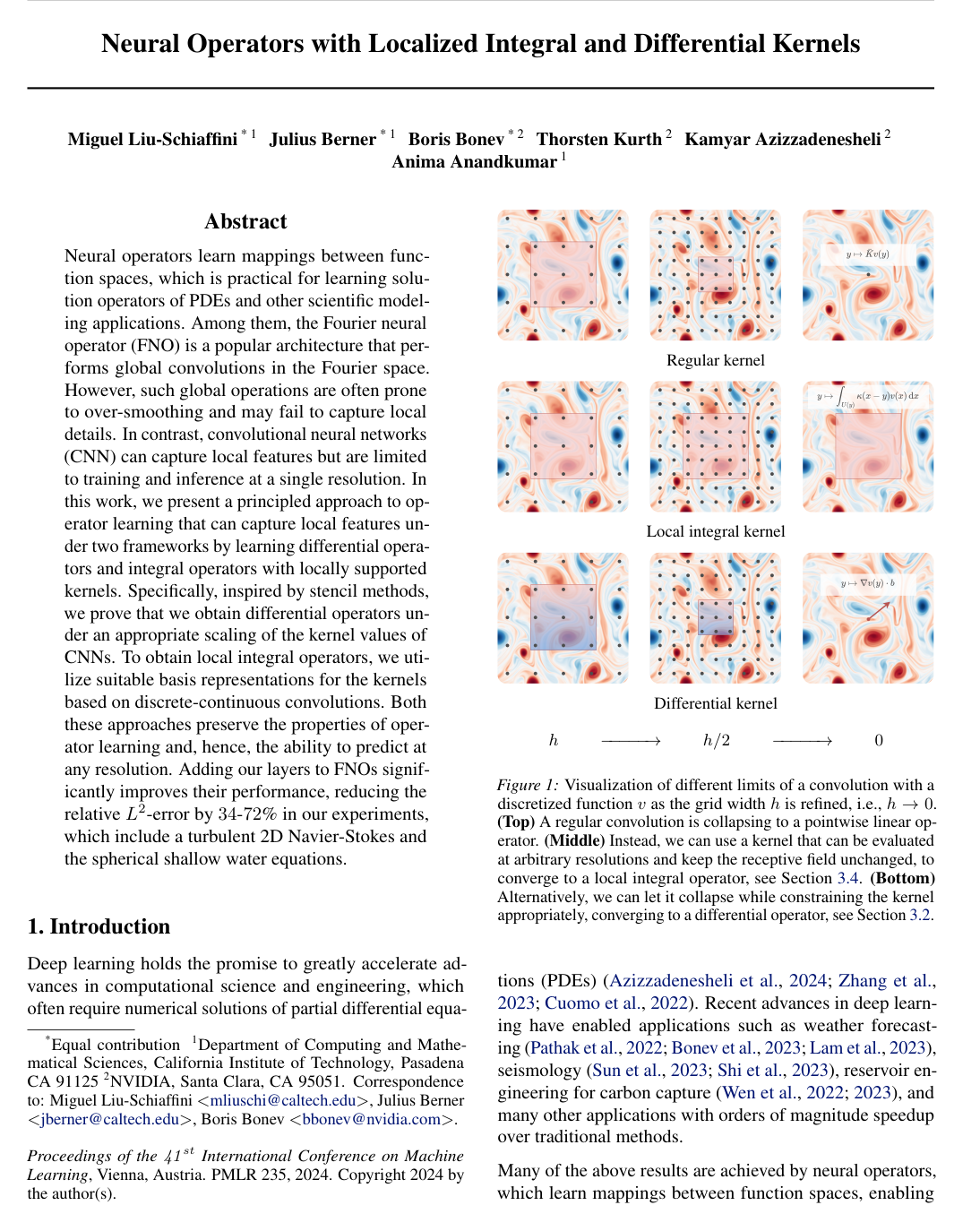
Neural operators learn mappings between function spaces, which is practical for learning solution operators of PDEs and other scientific modeling applications. Among them, the Fourier neural operator (FNO) is a popular architecture that performs global convolutions in the Fourier space. However, such global operations are often prone to over-smoothing and may fail to capture local details. In contrast, convolutional neural networks (CNN) can capture local features but are limited to training and inference at a single resolution. In this work, we present a principled approach to operator learning that can capture local features under two frameworks by learning differential operators and integral operators with locally supported kernels. Specifically, inspired by stencil methods, we prove that we obtain differential operators under an appropriate scaling of the kernel values of CNNs. To obtain local integral operators, we utilize suitable basis representations for the kernels based on discrete-continuous convolutions. Both these approaches preserve the properties of operator learning and, hence, the ability to predict at any resolution. Adding our layers to FNOs significantly improves their performance, reducing the relative L2-error by 34-72% in our experiments, which include a turbulent 2D Navier-Stokes and the spherical shallow water equations.

Added

2026-09-26