
keyword
Navier-Stokes equations
The Navier-Stokes equations are a set of nonlinear partial differential equations that describe the motion of viscous fluid substances, such as liquids and gases. Derived by applying Isaac Newtons second law of motion along with the principles of conservation of mass and momentum to fluid elements, these equations relate a fluids velocity, pressure, density, and viscosity. They serve as the fundamental mathematical framework for fluid mechanics, governing phenomena ranging from simple laminar flow to complex turbulence, aerodynamics, atmospheric weather patterns, and ocean currents. Because exact analytical solutions exist only for a limited number of simplified cases, these equations are typically solved using numerical approximations and computational fluid dynamics techniques.
6 items
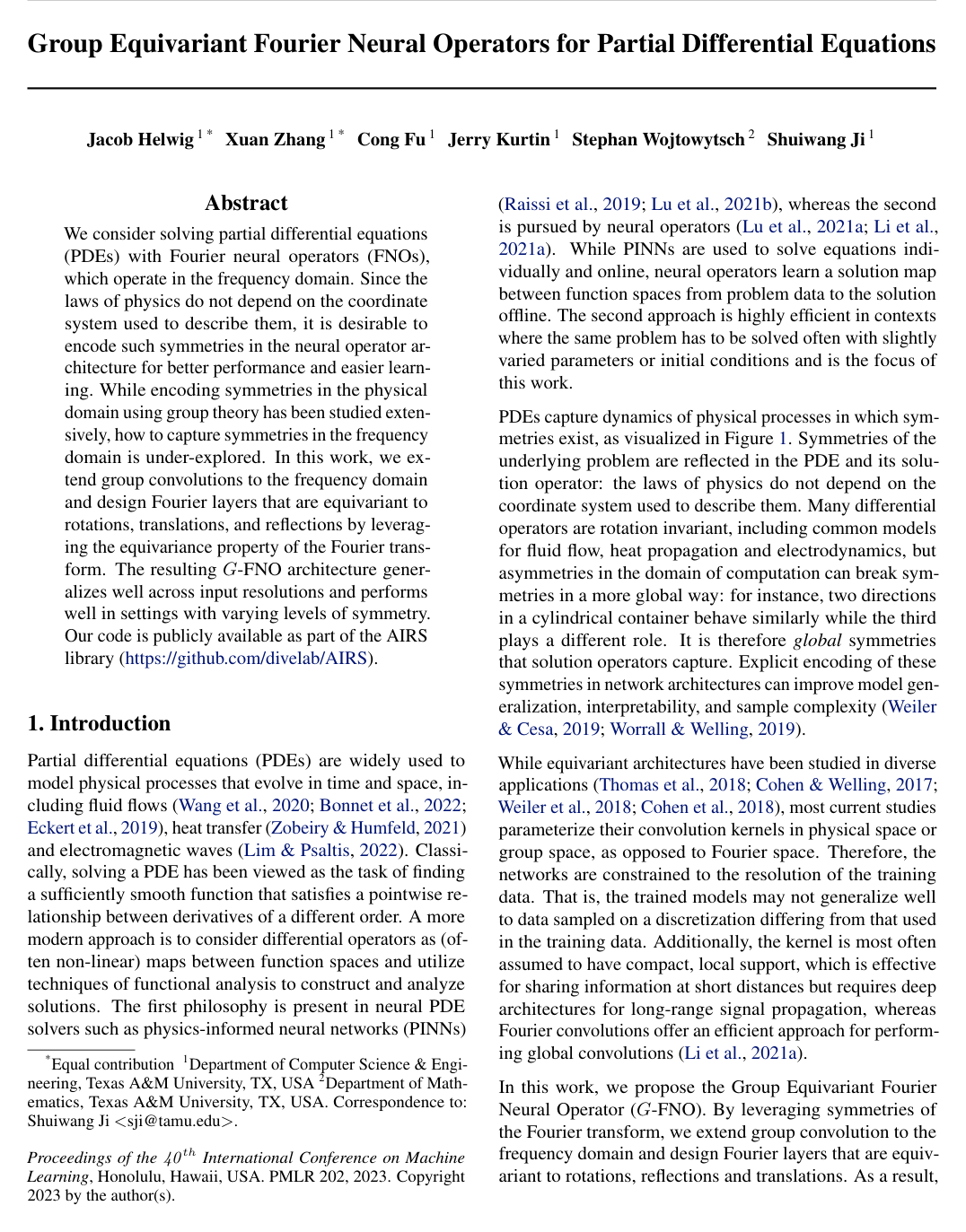
Group Equivariant Fourier Neural Operators for Partial Differential Equations
Jacob Helwig, Xuan Zhang, Cong Fu, Jerry Kurtin, Stephan Wojtowytsch, Shuiwang Ji
Why you should read this
Develops Group Equivariant Fourier Neural Operators (G-FNO) to embed geometric symmetries into frequency-domain operator learning, significantly improving partial differential equation solution accuracy and zero-shot super-resolution generalization.
We consider solving partial differential equations (PDEs) with Fourier neural operators (FNOs), which operate in the frequency domain. Since the laws of physics do not depend on the coordinate system used to describe them, it is desirable to encode such symmetries in the neural operator architecture for better performance and easier learning. While encoding symmetries in the physical domain using group theory has been studied extensively, how to capture symmetries in the frequency domain is under-explored. In this work, we extend group convolutions to the frequency domain and design Fourier layers that are equivariant to rotations, translations, and reflections by leveraging the equivariance property of the Fourier transform. The resulting G-FNO architecture generalizes well across input resolutions and performs well in settings with varying levels of symmetry. Our code is publicly available as part of the AIRS library (https://github.com/divelab/AIRS).
Added
2026-10-05
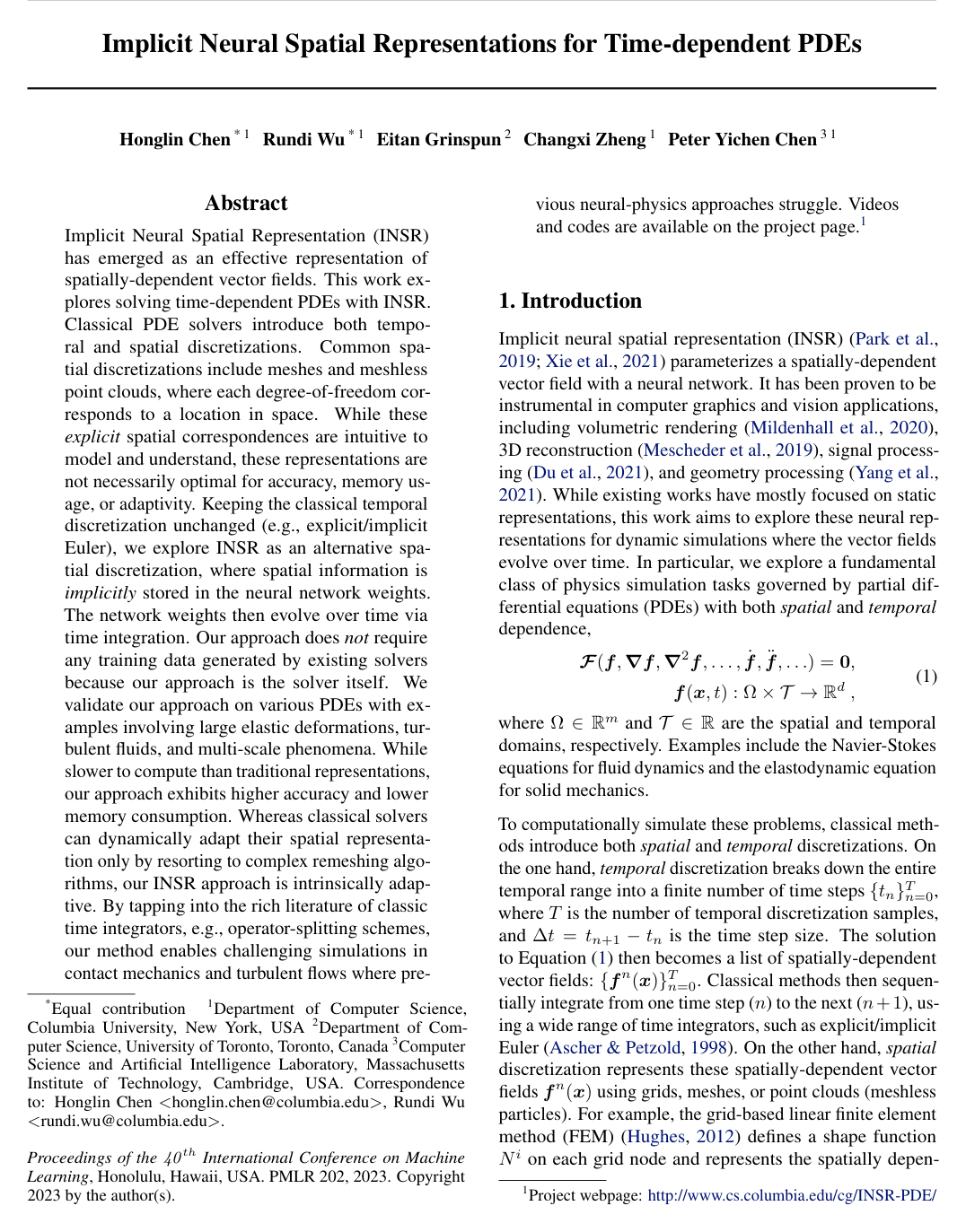
Implicit Neural Spatial Representations for Time-dependent PDEs
Honglin Chen, Rundi Wu, Eitan Grinspun, Changxi Zheng, Peter Yichen Chen
Why you should read this
Proposes replacing traditional spatial grids with implicit neural representations evolved through classical time integrators, enabling higher accuracy, lower memory usage, and intrinsic spatial adaptivity for time-dependent physics simulations without requiring pre-generated training data.
Implicit Neural Spatial Representation (INSR) has emerged as an effective representation of spatially-dependent vector fields. This work explores solving time-dependent PDEs with INSR. Classical PDE solvers introduce both temporal and spatial discretizations. Common spatial discretizations include meshes and meshless point clouds, where each degree-of-freedom corresponds to a location in space. While these explicit spatial correspondences are intuitive to model and understand, these representations are not necessarily optimal for accuracy, memory usage, or adaptivity. Keeping the classical temporal discretization unchanged (e.g., explicit/implicit Euler), we explore INSR as an alternative spatial discretization, where spatial information is implicitly stored in the neural network weights. The network weights then evolve over time via time integration. Our approach does not require any training data generated by existing solvers because our approach is the solver itself. We validate our approach on various PDEs with examples involving large elastic deformations, turbulent fluids, and multi-scale phenomena. While slower to compute than traditional representations, our approach exhibits higher accuracy and lower memory consumption. Whereas classical solvers can dynamically adapt their spatial representation only by resorting to complex remeshing algorithms, our INSR approach is intrinsically adaptive. By tapping into the rich literature of classic time integrators, e.g., operator-splitting schemes, our method enables challenging simulations in contact mechanics and turbulent flows where previous neural-physics approaches struggle. Videos and codes are available on the project page.
Added
2026-10-03
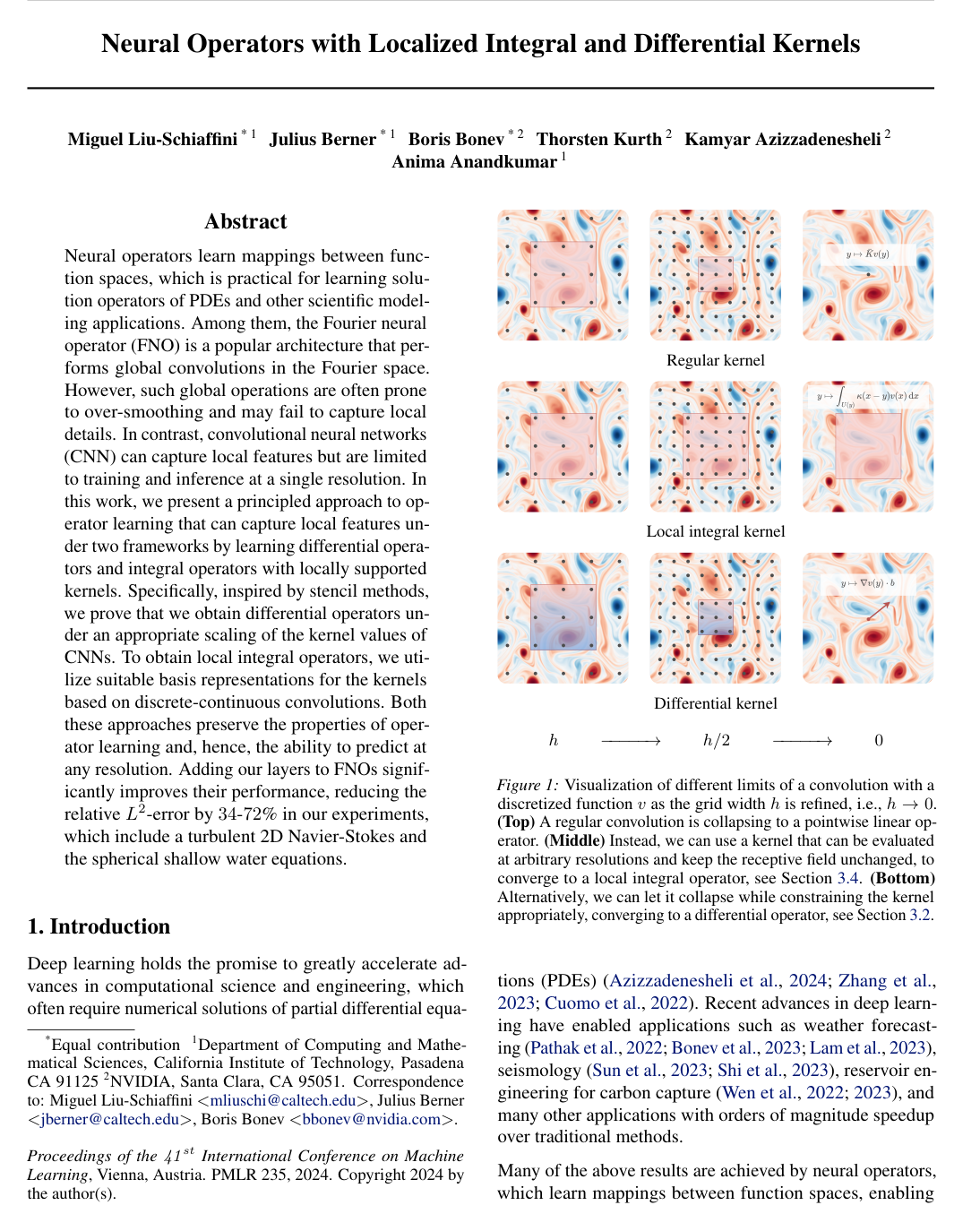
Neural Operators with Localized Integral and Differential Kernels
Miguel Liu-Schiaffini, Julius Berner, Boris Bonev, Thorsten Kurth, Kamyar Azizzadenesheli, Anima Anandkumar
Why you should read this
Develops discretization-independent localized differential and integral kernel layers for Fourier neural operators, enabling high-resolution local feature capture in PDE modeling and cutting relative prediction error by up to 72% across fluid dynamics benchmarks.
Neural operators learn mappings between function spaces, which is practical for learning solution operators of PDEs and other scientific modeling applications. Among them, the Fourier neural operator (FNO) is a popular architecture that performs global convolutions in the Fourier space. However, such global operations are often prone to over-smoothing and may fail to capture local details. In contrast, convolutional neural networks (CNN) can capture local features but are limited to training and inference at a single resolution. In this work, we present a principled approach to operator learning that can capture local features under two frameworks by learning differential operators and integral operators with locally supported kernels. Specifically, inspired by stencil methods, we prove that we obtain differential operators under an appropriate scaling of the kernel values of CNNs. To obtain local integral operators, we utilize suitable basis representations for the kernels based on discrete-continuous convolutions. Both these approaches preserve the properties of operator learning and, hence, the ability to predict at any resolution. Adding our layers to FNOs significantly improves their performance, reducing the relative L2-error by 34-72% in our experiments, which include a turbulent 2D Navier-Stokes and the spherical shallow water equations.
Added
2026-09-26
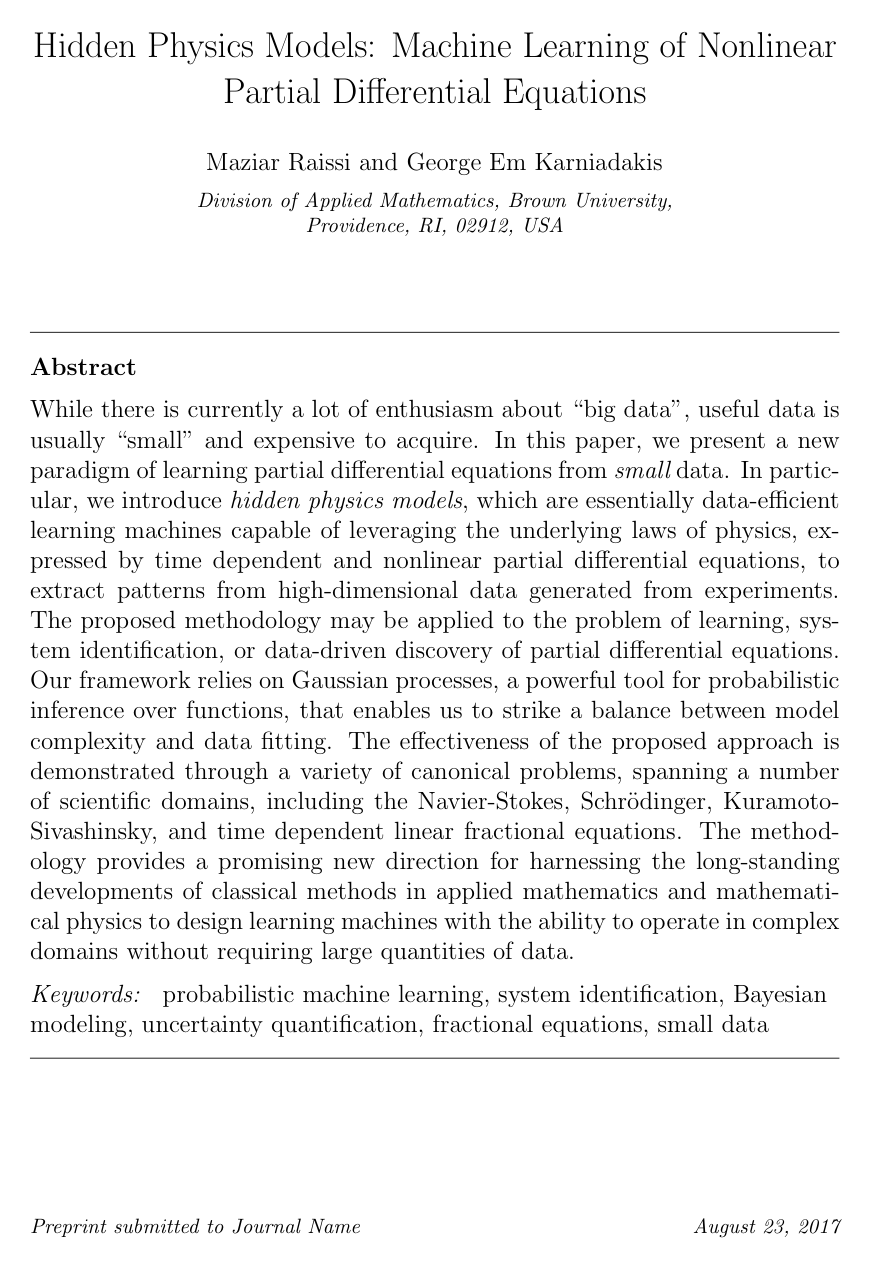
Hidden physics models: Machine learning of nonlinear partial differential equations
Maziar Raissi, George Em Karniadakis
Why you should read this
Introduces hidden physics models, a Gaussian process-based machine learning framework that identifies and discovers governing nonlinear partial differential equations from sparse experimental data.
While there is currently a lot of enthusiasm about "big data", useful data is usually "small" and expensive to acquire. In this paper, we present a new paradigm of learning partial differential equations from {\em small} data. In particular, we introduce \emph{hidden physics models}, which are essentially data-efficient learning machines capable of leveraging the underlying laws of physics, expressed by time dependent and nonlinear partial differential equations, to extract patterns from high-dimensional data generated from experiments. The proposed methodology may be applied to the problem of learning, system identification, or data-driven discovery of partial differential equations. Our framework relies on Gaussian processes, a powerful tool for probabilistic inference over functions, that enables us to strike a balance between model complexity and data fitting. The effectiveness of the proposed approach is demonstrated through a variety of canonical problems, spanning a number of scientific domains, including the Navier-Stokes, Schrödinger, Kuramoto-Sivashinsky, and time dependent linear fractional equations. The methodology provides a promising new direction for harnessing the long-standing developments of classical methods in applied mathematics and mathematical physics to design learning machines with the ability to operate in complex domains without requiring large quantities of data.
Added
2026-09-25
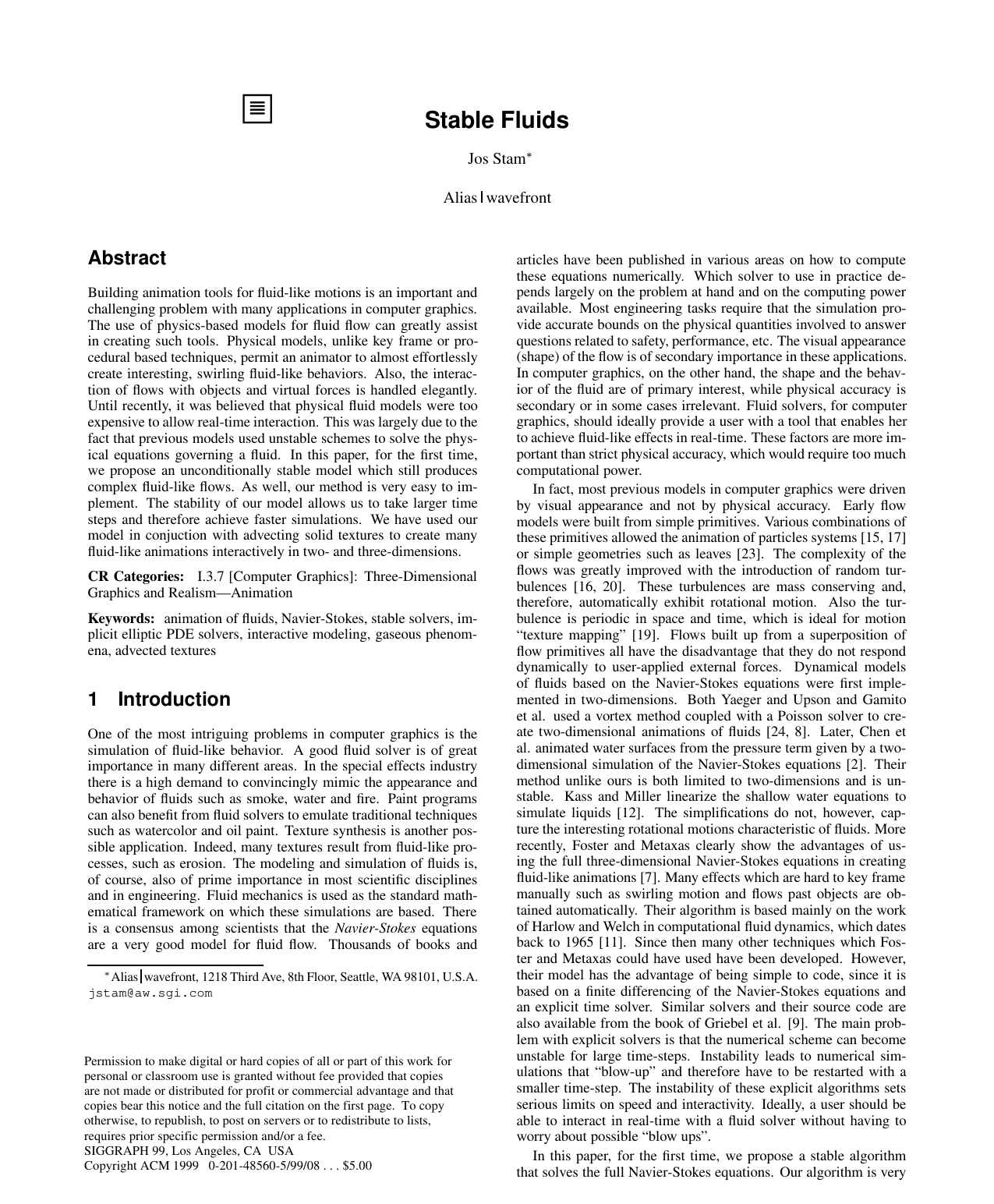
Stable fluids
Jos Stam
Why you should read this
Introduces an unconditionally stable numerical method for solving the Navier-Stokes equations via semi-Lagrangian advection and implicit diffusion, enabling fast, real-time, and blowup-free fluid simulation in computer graphics.
Building animation tools for fluid-like motions is an important and challenging problem with many applications in computer graphics. The use of physics-based models for fluid flow can greatly assist in creating such tools. Physical models, unlike key frame or procedural based techniques, permit an animator to almost effortlessly create interesting, swirling fluid-like behaviors. Also, the interaction of flows with objects and virtual forces is handled elegantly. Until recently, it was believed that physical fluid models were too expensive to allow real-time interaction. This was largely due to the fact that previous models used unstable schemes to solve the physical equations governing a fluid. In this paper, for the first time, we propose an unconditionally stable model which still produces complex fluid-like flows. As well, our method is very easy to implement. The stability of our model allows us to take larger time steps and therefore achieve faster simulations. We have used our model in conjuction with advecting solid textures to create many fluid-like animations interactively in two- and three-dimensions.
Added
2026-09-18
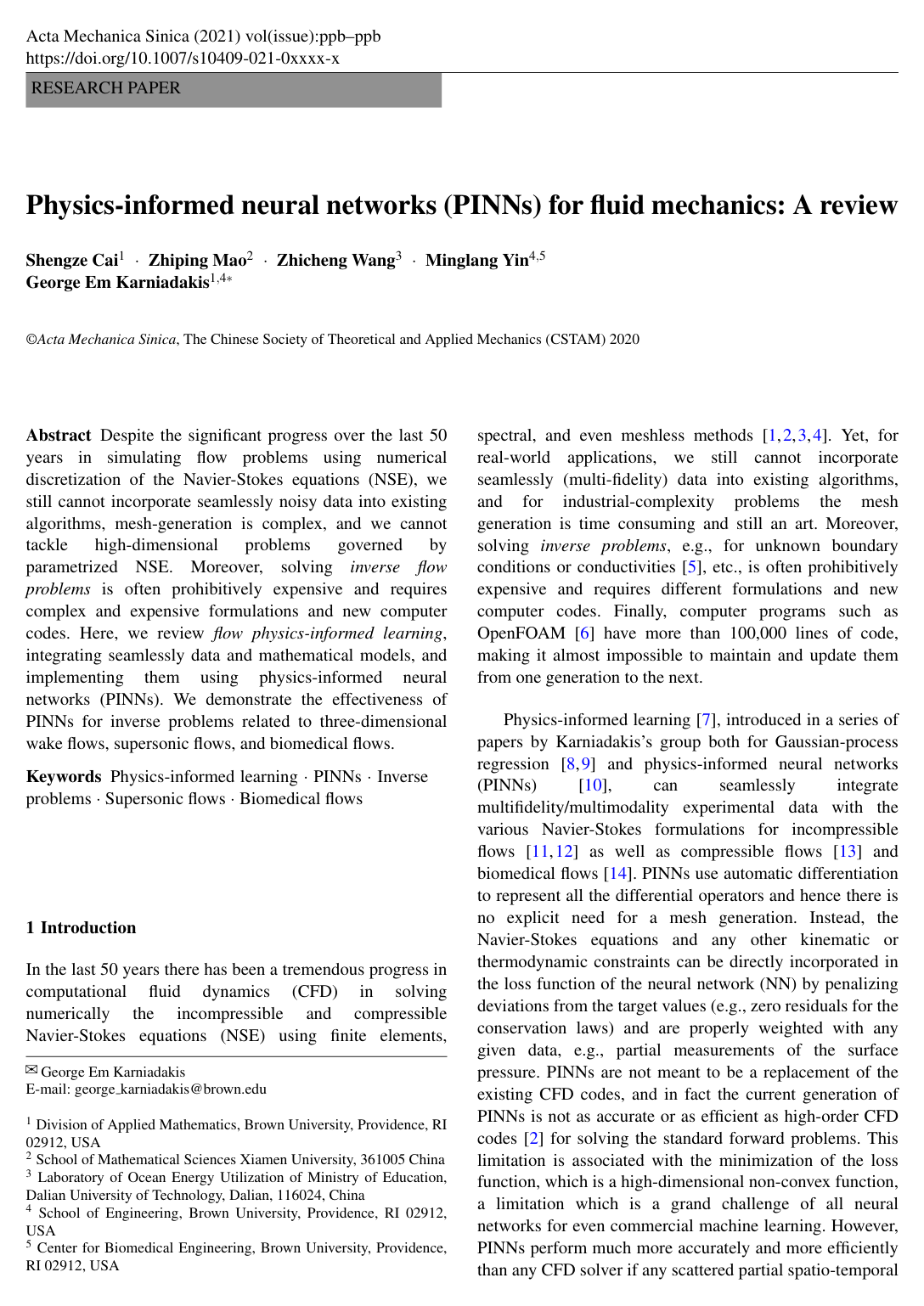
Physics-informed neural networks (PINNs) for fluid mechanics: a review
Shengze Cai, Zhiping Mao, Zhicheng Wang, Minglang Yin, George Em Karniadakis
Why you should read this
Explains how physics-informed neural networks integrate Navier-Stokes equations with observational data to overcome mesh-generation bottlenecks and solve complex inverse problems in supersonic, biomedical, and three-dimensional wake flows.
Despite the significant progress over the last 50 years in simulating flow problems using numerical discretization of the Navier-Stokes equations (NSE), we still cannot incorporate seamlessly noisy data into existing algorithms, mesh-generation is complex, and we cannot tackle high-dimensional problems governed by parametrized NSE. Moreover, solving inverse flow problems is often prohibitively expensive and requires complex and expensive formulations and new computer codes. Here, we review flow physics-informed learning, integrating seamlessly data and mathematical models, and implementing them using physics-informed neural networks (PINNs). We demonstrate the effectiveness of PINNs for inverse problems related to three-dimensional wake flows, supersonic flows, and biomedical flows.
Added
2026-09-16