Instance Relation Graph Guided Source-Free Domain Adaptive Object Detection
Vibashan VSPoojan OzaVishal M. Patel
Proposes an Instance Relation Graph framework that models inter-proposal similarities to guide contrastive representation learning, enabling object detectors to adapt to new target domains without requiring access to source training data.
Deploying deep learning object detection models into new visual environments frequently leads to substantial performance drops caused by domain shift, such as changes in weather, camera hardware, or artistic styles. While conventional adaptation methods rely on simultaneous access to the original training data and new target data, real-world constraints such as strict privacy regulations, data proprietary concerns, and bandwidth limitations often make transmitting large source datasets impractical. Organizations therefore require techniques to adapt existing models to new operational domains using only the pre-trained model and unlabeled target data.
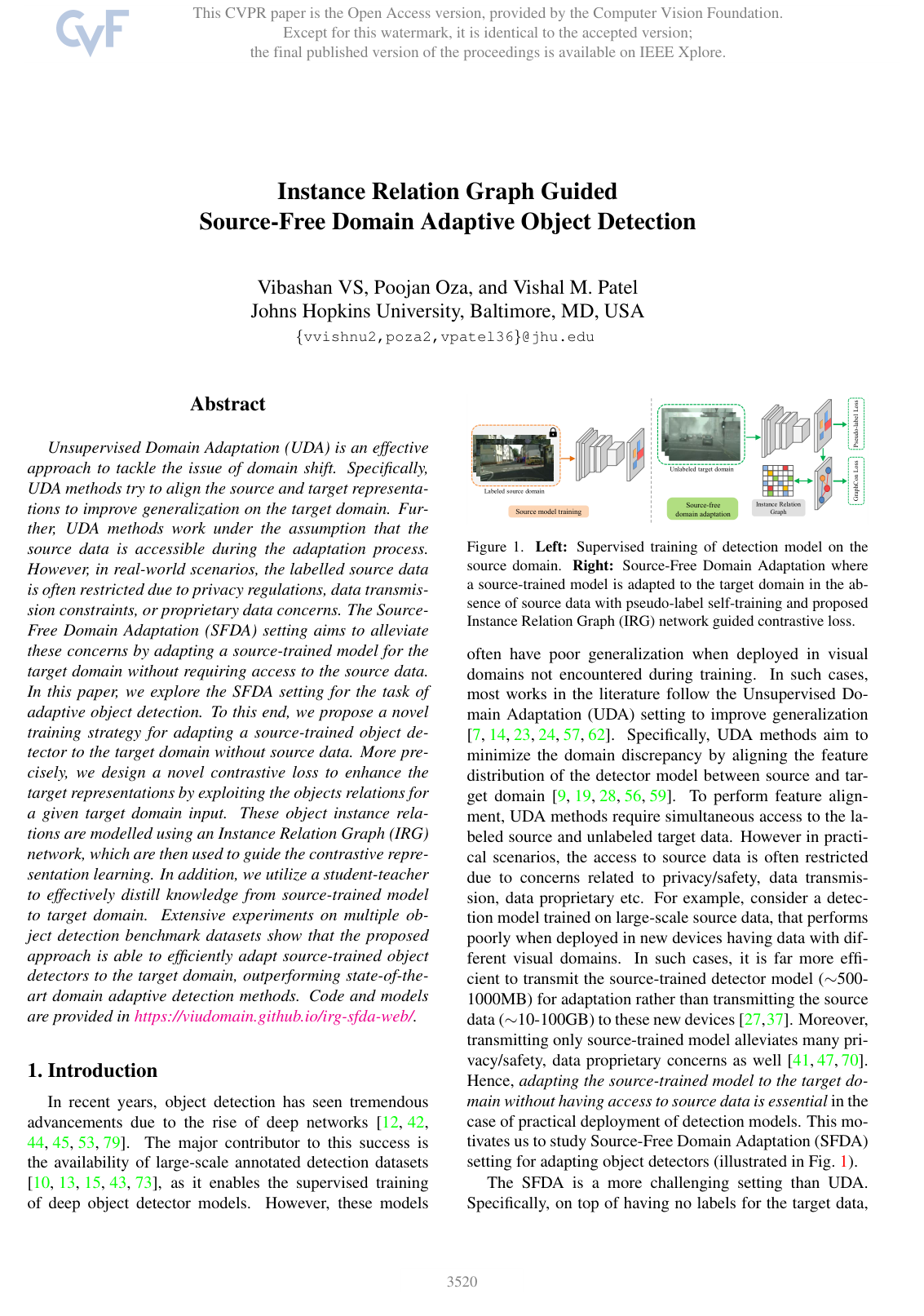
The article develops and evaluates a source-free domain adaptation framework that updates an object detector on unlabeled target imagery without accessing the original source dataset. The method introduces an Instance Relation Graph network paired with a graph-guided contrastive loss within a student-teacher knowledge distillation architecture to enhance target feature representations.
To establish credibility across varied deployment scenarios, the approach was tested on standard benchmarks covering four distinct domain shifts: adverse weather (adapting from clear to foggy driving scenes), cross-camera sensor variations, synthetic-to-real transfer, and realistic-to-artistic style transitions. Rather than relying on computationally heavy image-level contrastive learning, the method leverages class-agnostic proposals naturally generated by the detector's region proposal network as built-in augmentations. A graph neural network models the pairwise relationships between these proposals, generating positive and negative pairings to guide contrastive representation learning without requiring true target labels.
The experimental findings show significant performance gains across all evaluated scenarios. In adverse weather adaptation, the method achieved a 37.1 mean Average Precision, outperforming previous source-free baselines by 2.4 to 6.5 percentage points and surpassing many methods that require full source data access. In cross-camera and synthetic-to-real scenarios, the model delivered top-tier performance (reaching 46.9 and 45.2 mean Average Precision for car detection), improving upon competing source-free frameworks by roughly 2.0 to 3.3 percentage points. Ablation experiments confirmed that incorporating the relation graph network and its associated contrastive loss systematically improved target accuracy by 2.8 percentage points over basic student-teacher self-training.
These results demonstrate that organizations can successfully deploy and refine computer vision models on edge devices or decentralized environments without transmitting tens to hundreds of gigabytes of proprietary source data. This substantially reduces data transmission costs, mitigates privacy and regulatory risks, and shortens deployment timelines when expanding vision systems into unmodeled operating conditions.
Engineering and deployment teams should consider adopting graph-guided source-free adaptation pipelines when migrating detection systems to client-side hardware or privacy-constrained domains. Prior to full-scale rollout, teams should conduct pilot evaluations in the intended target environment to select appropriate prediction confidence thresholds (such as the 0.9 threshold utilized here) and graph relation cutoff parameters. While the methodology was validated across multiple standard benchmarks using two-stage detector architectures, performance depends on the initial quality of the source model and the presence of sufficient object proposals. Further testing is advised when applying this framework to extreme visual shifts or alternative single-stage detector backbones.
- Paper: SIGMA: Semantic-complete Graph Matching for Domain Adaptive Object Detection, Wuyang Li et al. (2022). Introduces graph matching and relation modeling across instance nodes in domain adaptive object detection, providing the direct conceptual foundation for graph-guided instance alignment.
- Paper: Domain Adaptive Faster R-CNN for Object Detection in the Wild, Yuhua Chen et al. (2018). Establishes the foundational two-stage adversarial framework for domain adaptive Faster R-CNN across image and instance levels, defining the base architecture and standard benchmarks used in the paper.
- Paper: Do We Really Need to Access the Source Data? Source Hypothesis Transfer for Unsupervised Domain Adaptation, Jian Liang et al. (2020). Pioneers source-free domain adaptation via information maximization and target-specific pseudo-labeling, establishing the core problem formulation and learning principles extended here.
- Paper: Contrastive Test-Time Adaptation, Dian Chen et al. (2022). Demonstrates how to adapt visual encoders without source data using contrastive learning and nearest-neighbor pseudo-label refinement.
- Paper: Multi-Granularity Alignment Domain Adaptation for Object Detection, Wenzhang Zhou et al. (2022). Formulates multi-granularity instance and category alignment across domain shifts in object detection, contextualizing the need for structured instance-level representations.
- Paper: Attracting and Dispersing: A Simple Approach for Source-free Domain Adaptation, Shiqi Yang et al. (2022). Provides fundamental insights into source-free clustering objectives that attract similar target representations while dispersing dissimilar ones.
- Paper: Tent: Fully Test-Time Adaptation by Entropy Minimization, Dequan Wang et al. (2021). Establishes the widely used paradigm of source-free adaptation via test-time prediction entropy minimization.
- Paper: Confidence Score for Source-Free Unsupervised Domain Adaptation, Jonghyun Lee et al. (2022). Develops confidence scoring and pseudo-label weighting strategies to prevent error propagation during source-free domain adaptation.
- Paper: Feature Alignment and Uniformity for Test Time Adaptation, Shuai Wang et al. (2023). Extends source-free and test-time adaptation concepts by formulating online feature uniformity and alignment through memory-bank clustering and dual-filtering mechanisms.
- Paper: Improved Test-Time Adaptation for Domain Generalization, Liang Chen et al. (2023). Explores how test-time adaptation strategies can be generalized to unseen domains via learnable consistency objectives and lightweight deployment-specific parameters.