Cold Diffusion: Inverting Arbitrary Image Transforms Without Noise
Arpit BansalEitan BorgniaHong-Min ChuJie LiHamid KazemiFurong HuangMicah GoldblumJonas GeipingTom Goldstein
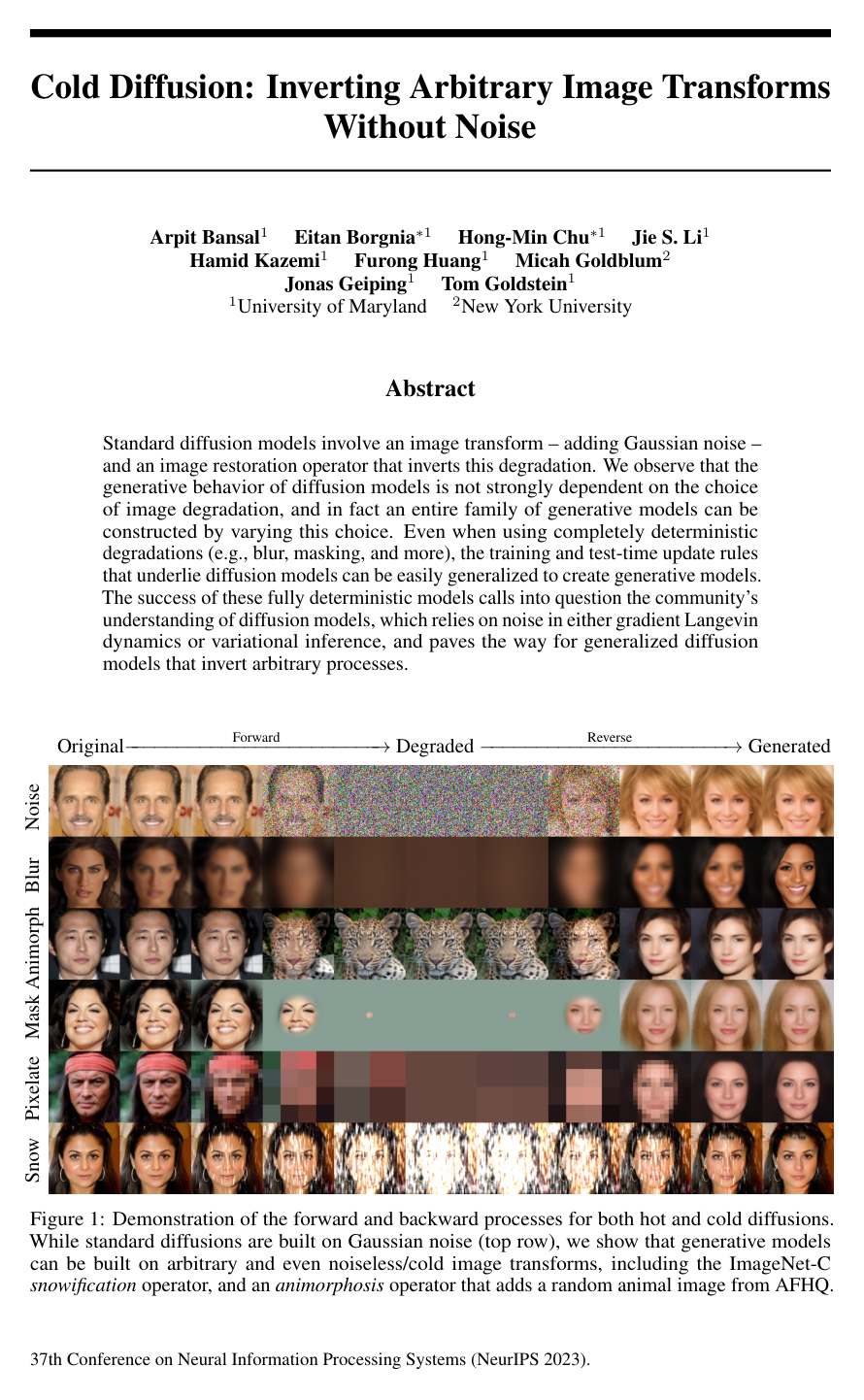
Demonstrates that generative diffusion models do not require Gaussian noise or stochasticity, showing that iterative restoration algorithms can synthesize realistic images by inverting arbitrary deterministic transformations such as blurring, downsampling, and masking.
Modern generative artificial intelligence relies heavily on diffusion models to synthesize high-quality images. The prevailing theoretical foundation assumes that these models require random Gaussian noise during both training and generation to navigate complex data distributions. This article investigates whether random noise is truly essential, demonstrating that generative behavior can be achieved using completely deterministic and arbitrary image transformations, a framework termed cold diffusion.
The article evaluates both conditional restoration tasks and unconditional image generation from scratch across standard benchmark datasets, including MNIST, CIFAR-10, CelebA, and AFHQ. To invert non-random transformations such as Gaussian blur, pixel masking, resolution downsampling, color desaturation, and snow corruption, the researchers developed Transformation Agnostic Cold Sampling (TACoS). This sampling algorithm corrects errors introduced by imperfect neural network approximations by subtracting and re-applying degradation steps iteratively rather than relying on naive update rules.
The findings show that generalized diffusion models successfully reconstruct and generate images without noise. In conditional tasks, TACoS consistently outperformed direct single-step restoration and naive sampling; for instance, on CelebA deblurring, TACoS achieved an image quality score of 26.14 compared to 36.37 for direct reconstruction and 299.61 for naive sampling (where lower scores indicate closer alignment with real data). In unconditional generation from scratch, starting from low-dimensional representations such as average color values, cold diffusion with blur produced competitive results (a score of 49.45 on CelebA), especially when minor variations were introduced to break pixel symmetry. The analysis also proved that naive sampling accumulates compounding mathematical errors under deterministic transformations, explaining why earlier methods failed without noise.
These results demonstrate that iterative diffusion is a general mathematical framework for reversing degradation processes rather than a technique strictly tied to noise or thermodynamics. For practitioners and decision-makers, this expands generative modeling to domain-specific physical processes, potentially reducing training constraints and enabling specialized restoration pipelines in imaging, security, and industrial design. While the empirical results firmly establish feasibility, generation diversity currently trails state-of-the-art noise-based models unless symmetry-breaking steps are applied, indicating that further work on larger datasets and refined scheduling is necessary before deploying cold diffusion in production generative systems.
- Paper: Denoising Diffusion Probabilistic Models, Jonathan Ho et al. (2020). Cold Diffusion directly challenges and generalizes the foundational thermodynamic and Gaussian noise-based generative framework established in this seminal paper.
- Paper: Denoising Diffusion Implicit Models, Jiaming Song et al. (2021). Understanding deterministic reverse sampling and non-Markovian generation formulations provides the mathematical basis for analyzing error accumulation in deterministic degradation inversion.
- Paper: Score-Based Generative Modeling through Stochastic Differential Equations, Yang Song et al. (2021). This text provides the continuous-time stochastic and ordinary differential equation perspective that Cold Diffusion contrasts against when defining non-stochastic, operator-based degradation trajectories.
- Paper: Denoising Diffusion Restoration Models, Bahjat Kawar et al. (2022). Reading this paper introduces standard inverse problem setups in diffusion modeling, highlighting the limitations of relying on noise-driven schedules for general linear degradations.
- Paper: Diffusion Posterior Sampling for General Noisy Inverse Problems, Hyungjin Chung et al. (2022). This work establishes how classical diffusion models perform posterior sampling for image inverse problems, motivating Cold Diffusion's noise-free degradation and restoration alternative.
- Paper: Structured Denoising Diffusion Models in Discrete State-Spaces, Jacob Austin et al. (2021). This paper establishes structured forward corruption processes beyond isotropic Gaussian perturbations, serving as an important conceptual step toward arbitrary deterministic transformations.
- Paper: Elucidating the Design Space of Diffusion-Based Generative Models, Tero Karras et al. (2022). This work clarifies the components and sampling dynamics of noise-based diffusion models, contextualizing Cold Diffusion's departure from standard noise schedules.
- Paper: Palette: Image-to-Image Diffusion Models, Chitwan Saharia et al. (2021). Understanding image-to-image conditional diffusion models clarifies the benchmark restoration tasks—such as inpainting, deblurring, and colorization—that Cold Diffusion reformulates without noise.
- Paper: Stochastic Interpolants: A Unifying Framework for Flows and Diffusions, Michael S. Albergo et al. (2025). This work formalizes and extends finite-time probability transport between arbitrary distributions through stochastic interpolants, generalizing principles of deterministic and stochastic trajectory bridging.
- Paper: Zero-Shot Image Restoration Using Denoising Diffusion Null-Space Model, Yinhuai Wang et al. (2023). This paper builds on the problem of inverting deterministic linear degradations by mathematically decomposing the diffusion process into range and null spaces for zero-shot restoration.
- Paper: A Variational Perspective on Solving Inverse Problems with Diffusion Models, Morteza Mardani et al. (2024). This paper develops a variational optimization framework for solving general linear and non-linear inverse problems, advancing the image restoration goals explored in Cold Diffusion.
- Paper: Loss-Guided Diffusion Models for Plug-and-Play Controllable Generation, Jiaming Song et al. (2023). This study addresses approximation errors in guided sampling for inverse problems, offering an advanced loss-guided Monte Carlo alternative to deterministic correction strategies.
- Paper: Variational Flow Maps: Make Some Noise for One-Step Conditional Generation, Abbas Mammadov et al. (2026). This text explores fast, few-step conditional generation for inverse problems using variational flow maps, advancing efficient degradation inversion without lengthy sampling trajectories.