
keyword
image generation
Image generation is a subfield of artificial intelligence and computer vision focused on computationally synthesizing new visual images using machine learning algorithms. Instead of retrieving pre-existing files, generative models learn the underlying statistical distributions and structural patterns of visual data from large training datasets. Systems then produce novel images either unconditionally by sampling from learned probability spaces or conditionally based on guiding inputs such as natural language descriptions, class labels, sketches, or reference images. Common architectures employed for image generation include diffusion models, generative adversarial networks, variational autoencoders, and autoregressive transformers, which enable applications spanning creative design, visual simulation, and synthetic data augmentation.
23 items
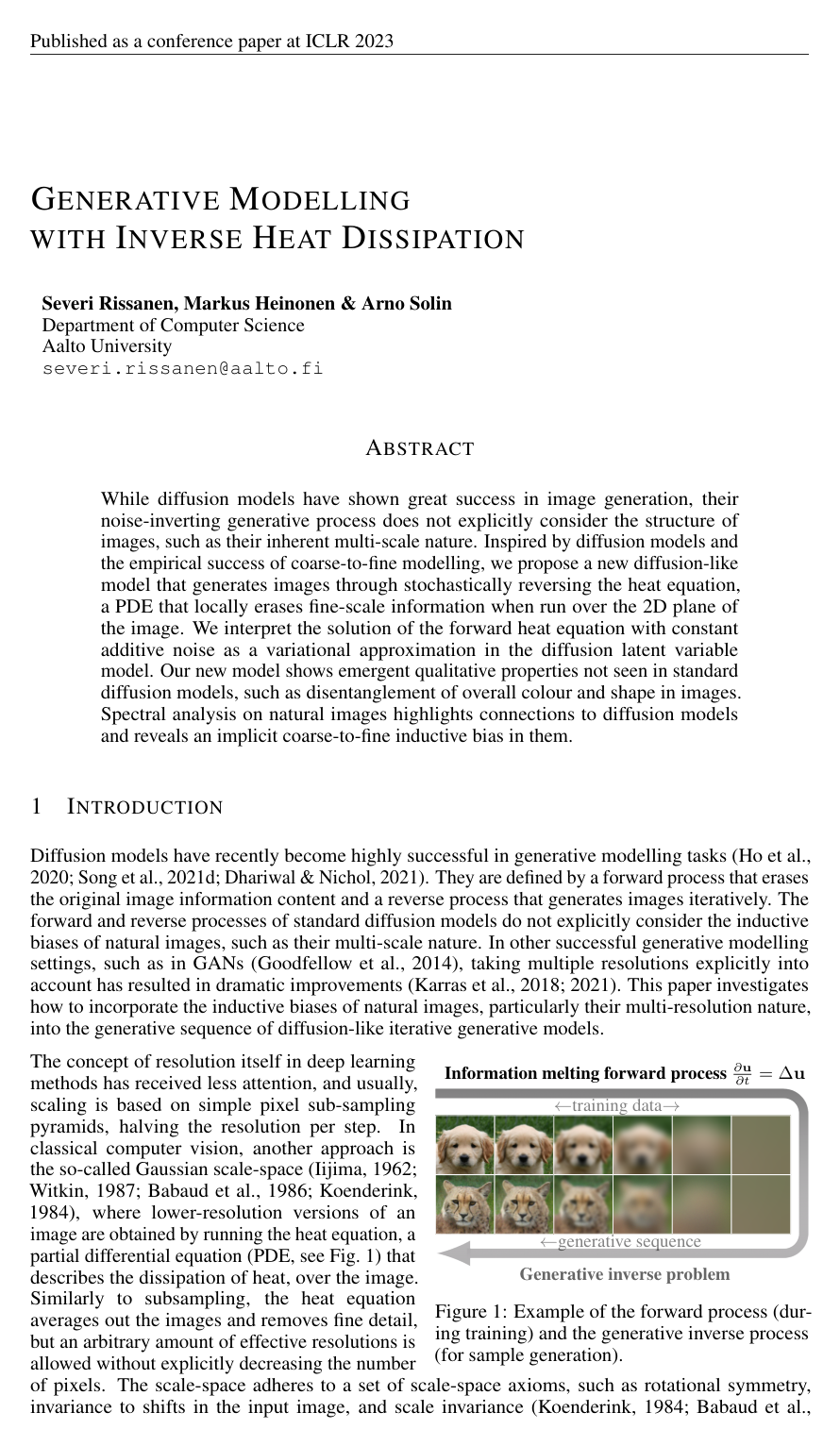
Generative Modelling with Inverse Heat Dissipation
Severi Rissanen, Markus Heinonen, Arno Solin
Why you should read this
Introduces a physics-inspired generative model that stochastically reverses 2D heat dissipation, establishing an explicit coarse-to-fine inductive bias that naturally separates shape and color during image synthesis.
While diffusion models have shown great success in image generation, their noise-inverting generative process does not explicitly consider the structure of images, such as their inherent multi-scale nature. Inspired by diffusion models and the empirical success of coarse-to-fine modelling, we propose a new diffusion-like model that generates images through stochastically reversing the heat equation, a PDE that locally erases fine-scale information when run over the 2D plane of the image. We interpret the solution of the forward heat equation with constant additive noise as a variational approximation in the diffusion latent variable model. Our new model shows emergent qualitative properties not seen in standard diffusion models, such as disentanglement of overall colour and shape in images. Spectral analysis on natural images highlights connections to diffusion models and reveals an implicit coarse-to-fine inductive bias in them.
Added
2026-10-05
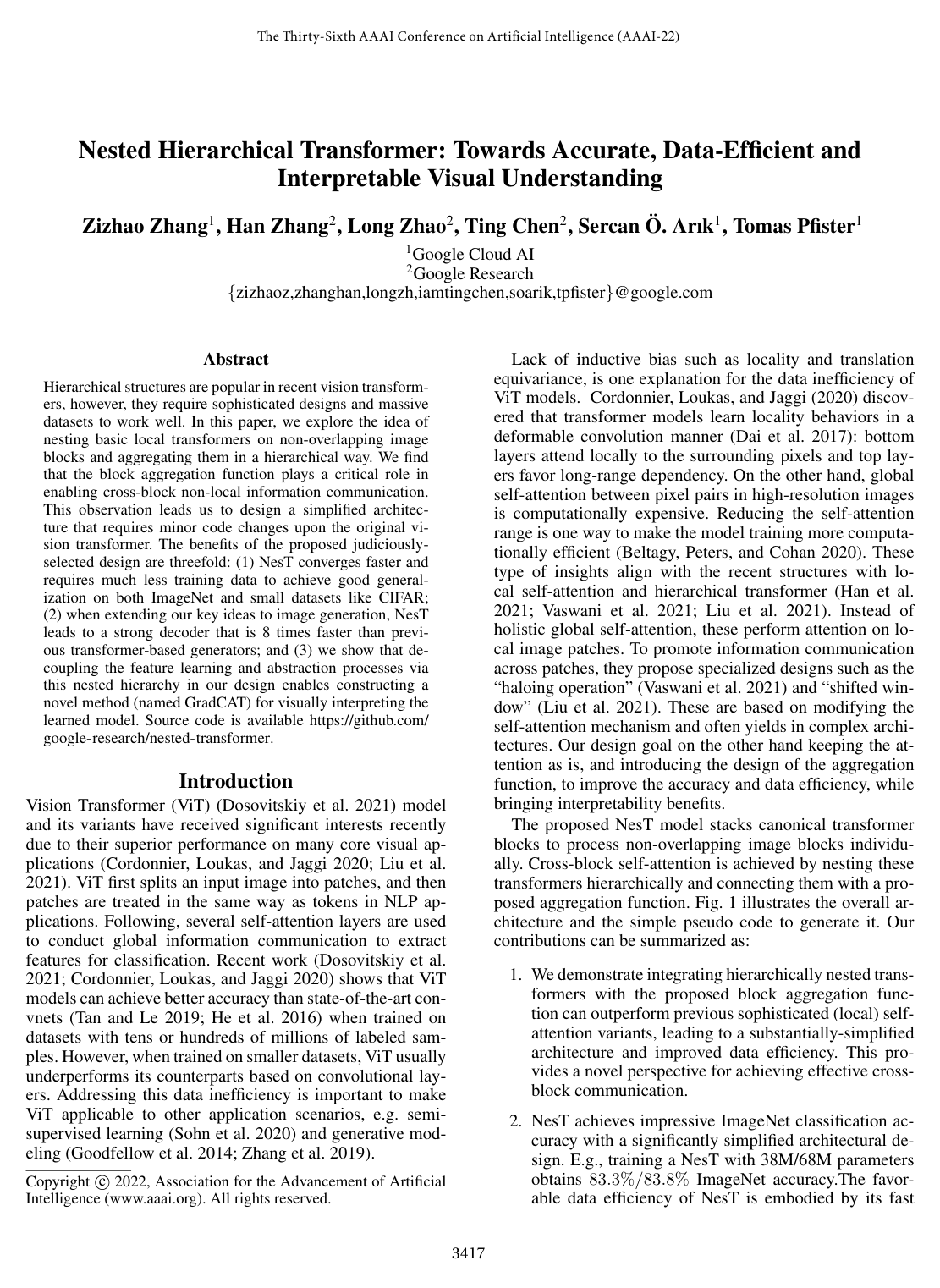
Nested Hierarchical Transformer: Towards Accurate, Data-Efficient and Interpretable Visual Understanding
Zizhao Zhang, Han Zhang, Long Zhao, Ting Chen, Sercan Ö. Arik, Tomas Pfister
Why you should read this
Proposes NesT, a simplified hierarchical vision transformer that nests canonical local attention layers with a spatial block aggregation function, achieving high data efficiency on small datasets, fast generative decoding, and tree-traversal visual interpretability.
Hierarchical structures are popular in recent vision transformers, however, they require sophisticated designs and massive datasets to work well. In this paper, we explore the idea of nesting basic local transformers on non-overlapping image blocks and aggregating them in a hierarchical way. We find that the block aggregation function plays a critical role in enabling cross-block non-local information communication. This observation leads us to design a simplified architecture that requires minor code changes upon the original vision transformer. The benefits of the proposed judiciously-selected design are threefold: (1) NesT converges faster and requires much less training data to achieve good generalization on both ImageNet and small datasets like CIFAR; (2) when extending our key ideas to image generation, NesT leads to a strong decoder that is 8 times faster than previous transformer-based generators; and (3) we show that decoupling the feature learning and abstraction processes via this nested hierarchy in our design enables constructing a novel method (named GradCAT) for visually interpreting the learned model. Source code is available https://github.com/google-research/nested-transformer.
Added
2026-10-05
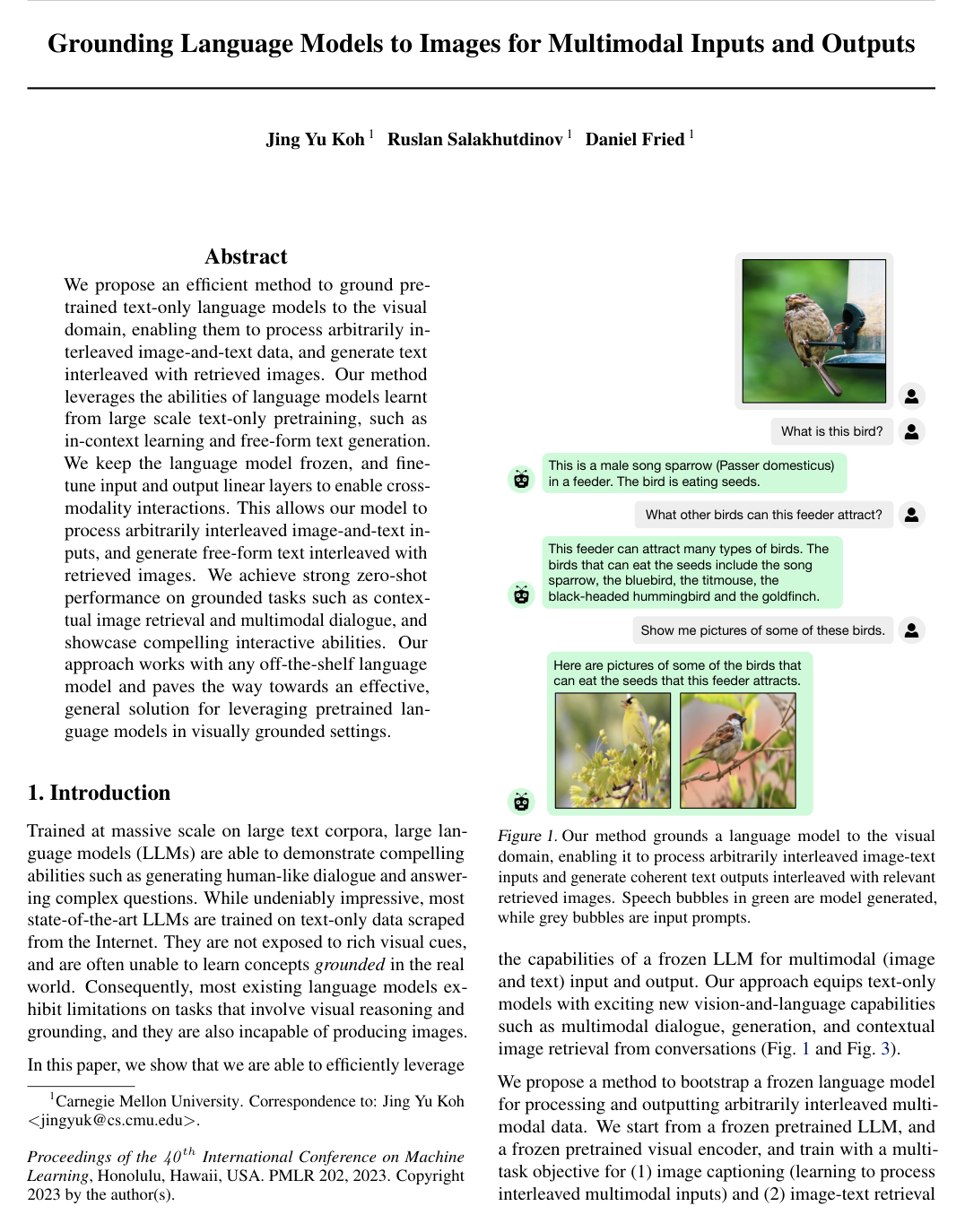
Grounding Language Models to Images for Multimodal Inputs and Outputs
Jing Yu Koh, Ruslan Salakhutdinov, Daniel Fried
Why you should read this
Presents FROMAGe, an efficient approach that equips frozen text-only language models to process arbitrarily interleaved image-text inputs and generate text interspersed with retrieved images by training only lightweight linear translation layers.
We propose an efficient method to ground pre-trained text-only language models to the visual domain, enabling them to process arbitrarily interleaved image-and-text data, and generate text interleaved with retrieved images. Our method leverages the abilities of language models learnt from large scale text-only pretraining, such as in-context learning and free-form text generation. We keep the language model frozen, and fine-tune input and output linear layers to enable cross-modality interactions. This allows our model to process arbitrarily interleaved image-and-text inputs, and generate free-form text interleaved with retrieved images. We achieve strong zero-shot performance on grounded tasks such as contextual image retrieval and multimodal dialogue, and showcase compelling interactive abilities. Our approach works with any off-the-shelf language model and paves the way towards an effective, general solution for leveraging pretrained language models in visually grounded settings.
Added
2026-09-30
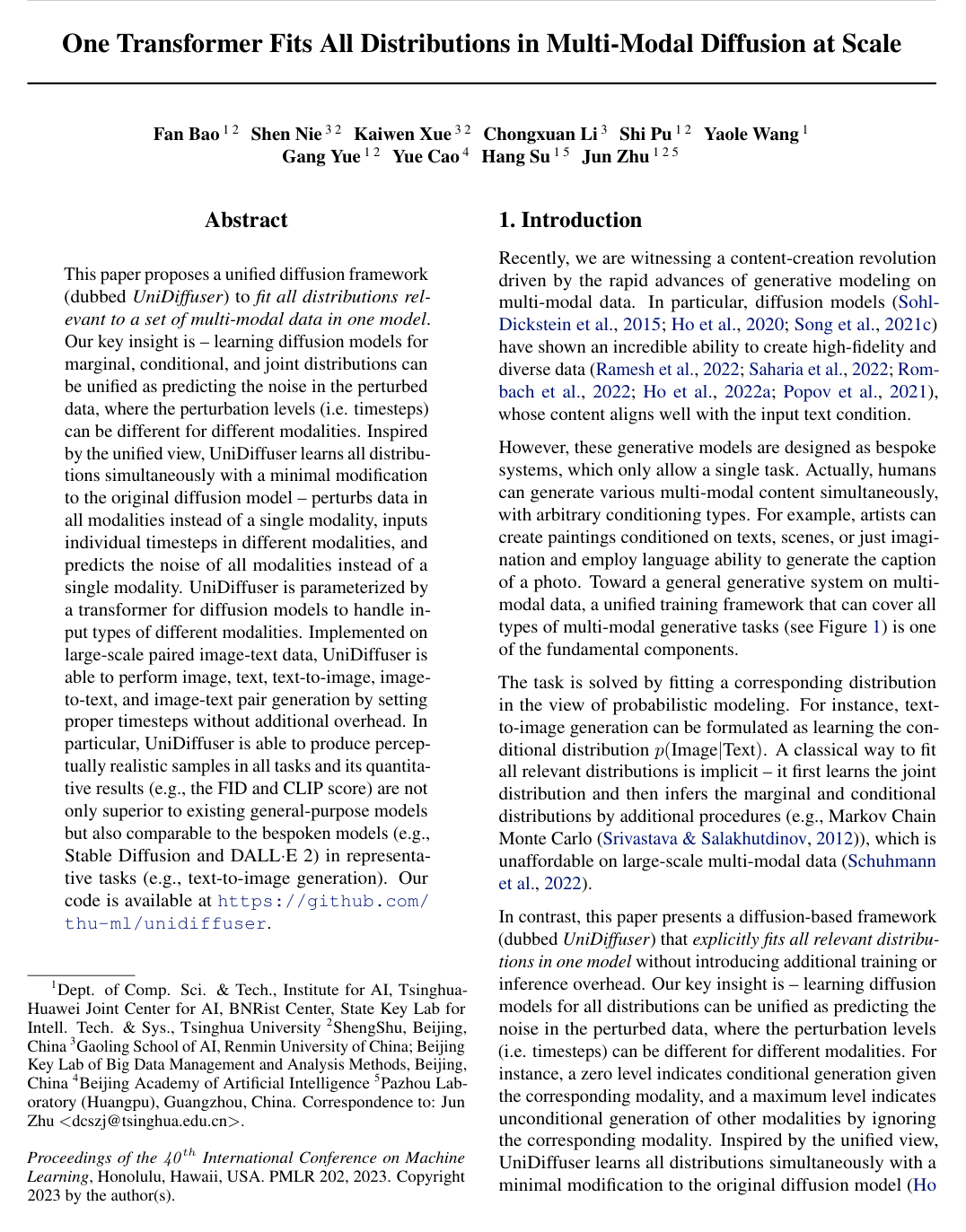
One Transformer Fits All Distributions in Multi-Modal Diffusion at Scale
Fan Bao, Shen Nie, Kaiwen Xue, Chongxuan Li, Shi Pu, Yaole Wang, Gang Yue, Yue Cao, Hang Su, Jun Zhu
Why you should read this
Proposes UniDiffuser, a single transformer-based framework that captures marginal, conditional, and joint multi-modal distributions to handle diverse generation tasks—including text-to-image, image-to-text, and paired generation—without requiring task-specific models or extra computational overhead.
This paper proposes a unified diffusion framework (dubbed UniDiffuser) to fit all distributions relevant to a set of multi-modal data in one model. Our key insight is – learning diffusion models for marginal, conditional, and joint distributions can be unified as predicting the noise in the perturbed data, where the perturbation levels (i.e. timesteps) can be different for different modalities. Inspired by the unified view, UniDiffuser learns all distributions simultaneously with a minimal modification to the original diffusion model – perturbs data in all modalities instead of a single modality, inputs individual timesteps in different modalities, and predicts the noise of all modalities instead of a single modality. UniDiffuser is parameterized by a transformer for diffusion models to handle input types of different modalities. Implemented on large-scale paired image-text data, UniDiffuser is able to perform image, text, text-to-image, image-to-text, and image-text pair generation by setting proper timesteps without additional overhead. In particular, UniDiffuser is able to produce perceptually realistic samples in all tasks and its quantitative results (e.g., the FID and CLIP score) are not only superior to existing general-purpose models but also comparable to the bespoke models (e.g., Stable Diffusion and DALL·E 2) in representative tasks (e.g., text-to-image generation). Our code is available at https://github.com/thu-ml/unidiffuser.
Added
2026-09-28
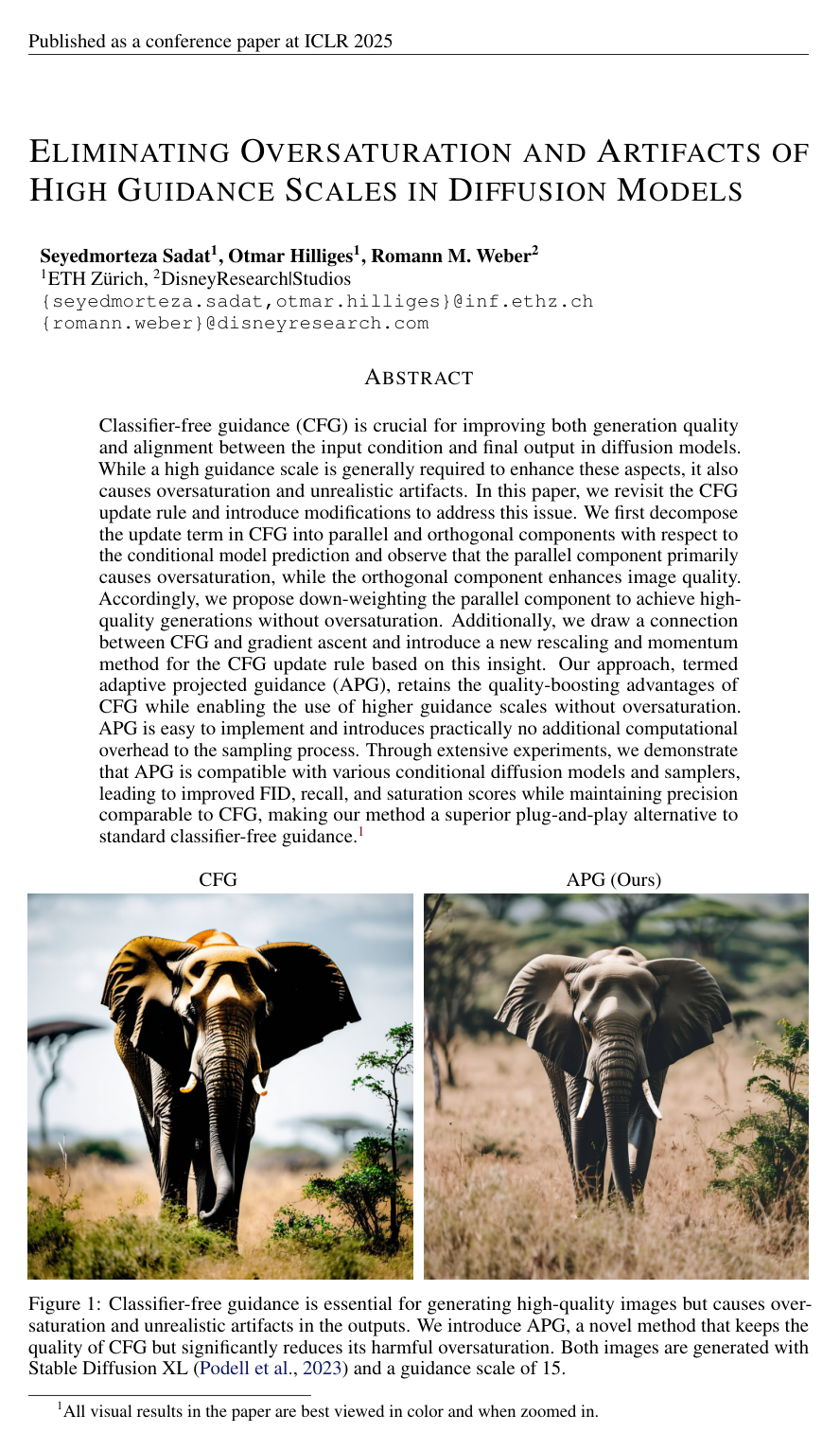
Eliminating Oversaturation and Artifacts of High Guidance Scales in Diffusion Models
Seyedmorteza Sadat, Otmar Hilliges, Romann M. Weber
Why you should read this
Proposes Adaptive Projected Guidance, a plug-and-play modification to classifier-free guidance that decomposes diffusion updates to eliminate oversaturation and visual artifacts at high guidance scales with negligible computational overhead.
Classifier-free guidance (CFG) is crucial for improving both generation quality and alignment between the input condition and final output in diffusion models. While a high guidance scale is generally required to enhance these aspects, it also causes oversaturation and unrealistic artifacts. In this paper, we revisit the CFG update rule and introduce modifications to address this issue. We first decompose the update term in CFG into parallel and orthogonal components with respect to the conditional model prediction and observe that the parallel component primarily causes oversaturation, while the orthogonal component enhances image quality. Accordingly, we propose down-weighting the parallel component to achieve high-quality generations without oversaturation. Additionally, we draw a connection between CFG and gradient ascent and introduce a new rescaling and momentum method for the CFG update rule based on this insight. Our approach, termed adaptive projected guidance (APG), retains the quality-boosting advantages of CFG while enabling the use of higher guidance scales without oversaturation. APG is easy to implement and introduces practically no additional computational overhead to the sampling process. Through extensive experiments, we demonstrate that APG is compatible with various conditional diffusion models and samplers, leading to improved FID, recall, and saturation scores while maintaining precision comparable to CFG, making our method a superior plug-and-play alternative to standard classifier-free guidance.
Added
2026-09-26
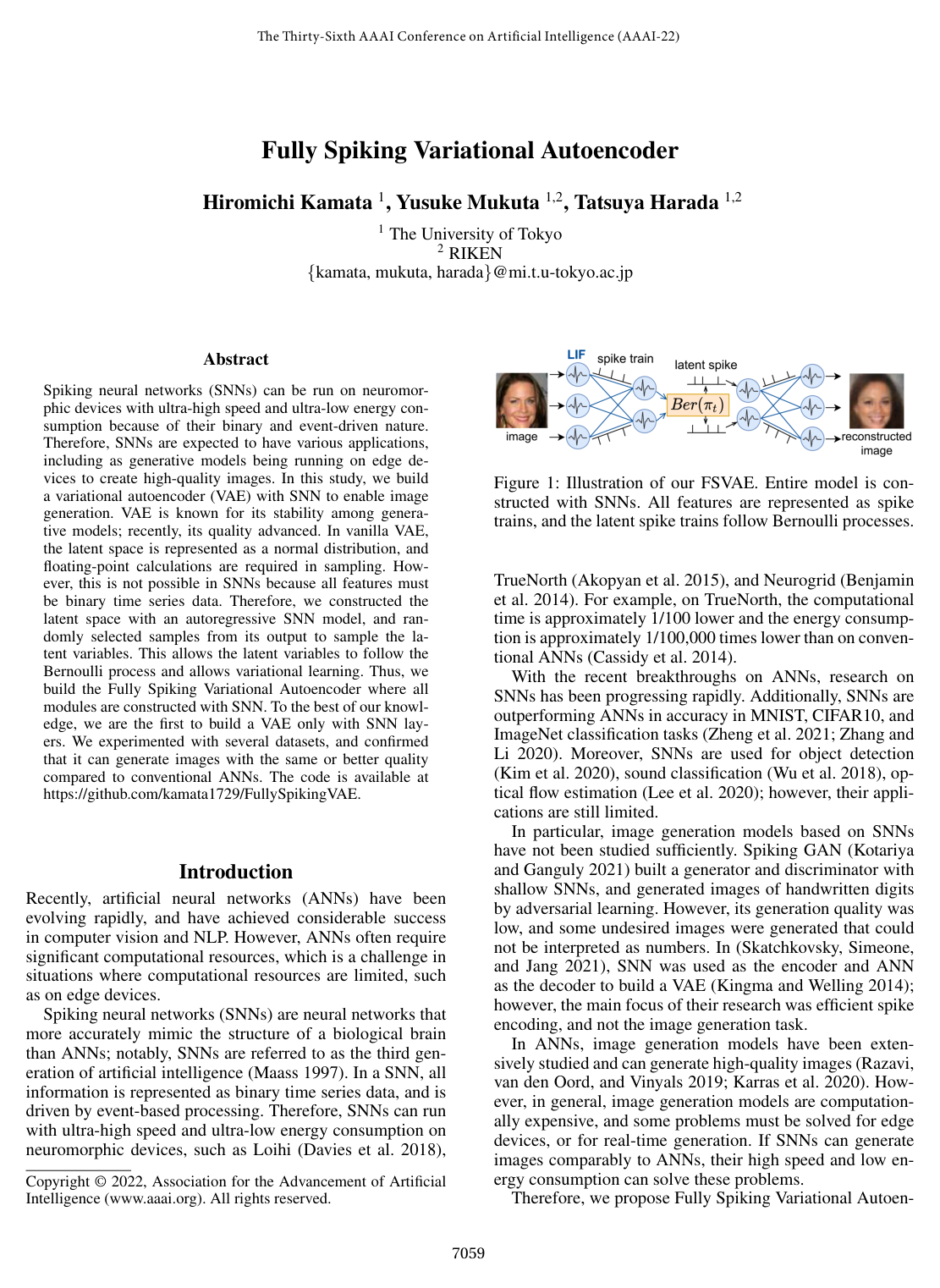
Fully Spiking Variational Autoencoder
Hiromichi Kamata, Yusuke Mukuta, Tatsuya Harada
Why you should read this
Proposes the first fully spiking variational autoencoder by modeling the latent space with autoregressive Bernoulli processes, enabling energy-efficient neuromorphic image generation that matches or exceeds the quality of conventional artificial neural networks.
Spiking neural networks (SNNs) can be run on neuromorphic devices with ultra-high speed and ultra-low energy consumption because of their binary and event-driven nature. Therefore, SNNs are expected to have various applications, including as generative models being running on edge devices to create high-quality images. In this study, we build a variational autoencoder (VAE) with SNN to enable image generation. VAE is known for its stability among generative models; recently, its quality advanced. In vanilla VAE, the latent space is represented as a normal distribution, and floating-point calculations are required in sampling. However, this is not possible in SNNs because all features must be binary time series data. Therefore, we constructed the latent space with an autoregressive SNN model, and randomly selected samples from its output to sample the latent variables. This allows the latent variables to follow the Bernoulli process and allows variational learning. Thus, we build the Fully Spiking Variational Autoencoder where all modules are constructed with SNN. To the best of our knowledge, we are the first to build a VAE only with SNN layers. We experimented with several datasets, and confirmed that it can generate images with the same or better quality compared to conventional ANNs. The code is available at https://github.com/kamata1729/FullySpikingVAE.
Added
2026-09-26
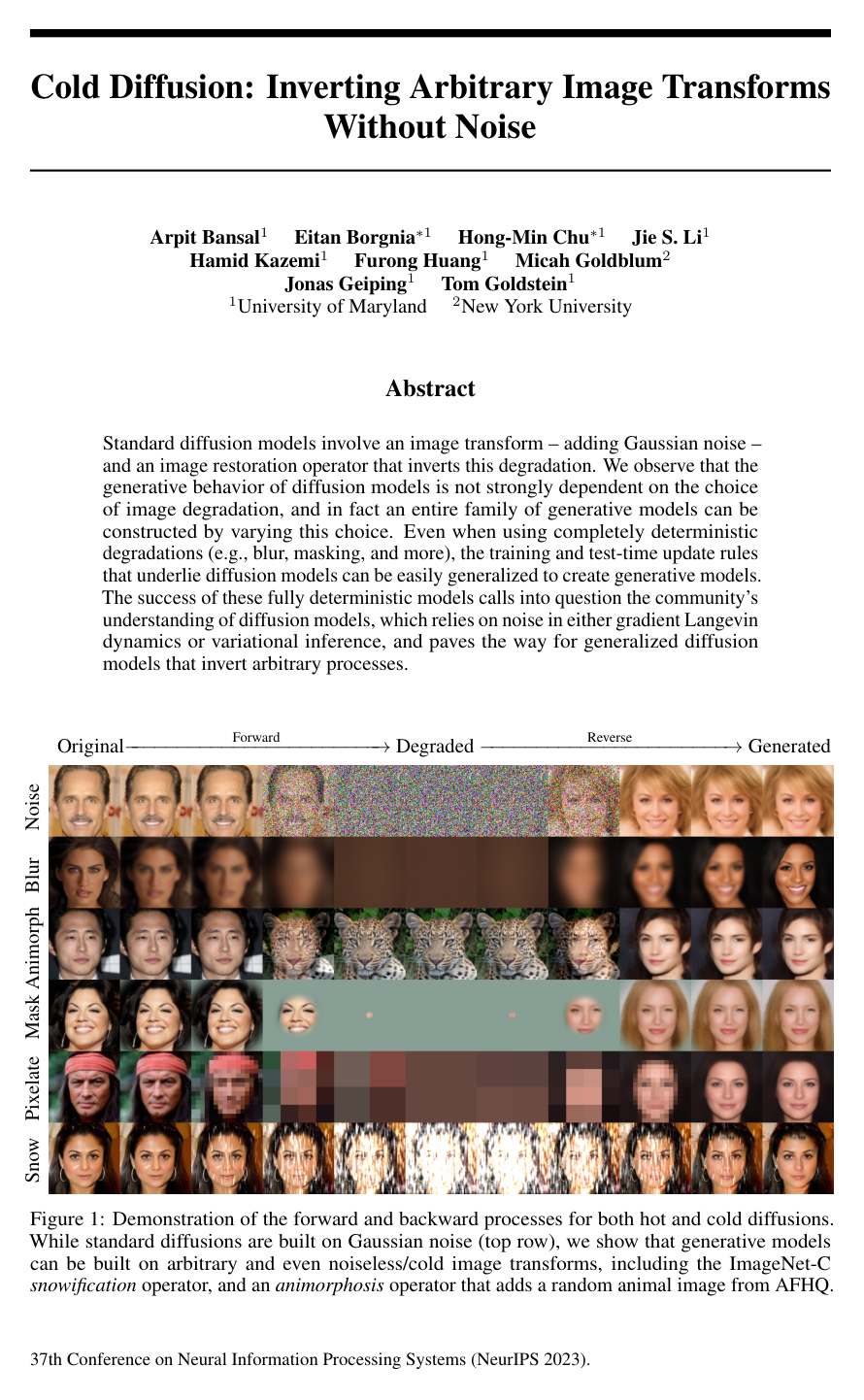
Cold Diffusion: Inverting Arbitrary Image Transforms Without Noise
Arpit Bansal, Eitan Borgnia, Hong-Min Chu, Jie Li, Hamid Kazemi, Furong Huang, Micah Goldblum, Jonas Geiping, Tom Goldstein
Why you should read this
Demonstrates that generative diffusion models do not require Gaussian noise or stochasticity, showing that iterative restoration algorithms can synthesize realistic images by inverting arbitrary deterministic transformations such as blurring, downsampling, and masking.
Standard diffusion models involve an image transform – adding Gaussian noise – and an image restoration operator that inverts this degradation. We observe that the generative behavior of diffusion models is not strongly dependent on the choice of image degradation, and in fact an entire family of generative models can be constructed by varying this choice. Even when using completely deterministic degradations (e.g., blur, masking, and more), the training and test-time update rules that underlie diffusion models can be easily generalized to create generative models. The success of these fully deterministic models calls into question the community’s understanding of diffusion models, which relies on noise in either gradient Langevin dynamics or variational inference, and paves the way for generalized diffusion models that invert arbitrary processes.
Added
2026-09-26
Generative Multimodal Models are In-Context Learners
Quan Sun, Yufeng Cui, Xiaosong Zhang, Fan Zhang, Qiying Yu, Yueze Wang, Yongming Rao, Jingjing Liu, Tiejun Huang, Xinlong Wang
Why you should read this
Introduces Emu2, a 37-billion-parameter generative multimodal model trained with a unified autoregressive objective that achieves state-of-the-art in-context learning and controllable generation across diverse visual-language tasks.
The human ability to easily solve multimodal tasks in context (i.e., with only a few demonstrations or simple instructions), is what current multimodal systems have largely struggled to imitate. In this work, we demonstrate that the task-agnostic in-context learning capabilities of large multimodal models can be significantly enhanced by effective scaling-up. We introduce Emu2, a generative multimodal model with 37 billion parameters, trained on large-scale multimodal sequences with a unified autoregressive objective. Emu2 exhibits strong multimodal in-context learning abilities, even emerging to solve tasks that require on-the-fly reasoning, such as visual prompting and object-grounded generation. The model sets a new record on multiple multimodal understanding tasks in few-shot settings. When instruction-tuned to follow specific instructions, Emu2 further achieves new state-of-the-art on challenging tasks such as question answering benchmarks for large multimodal models and open-ended subject-driven generation. These achievements demonstrate that Emu2 can serve as a base model and general-purpose interface for a wide range of multimodal tasks. Code and models are publicly available to facilitate future research.
Added
2026-09-26
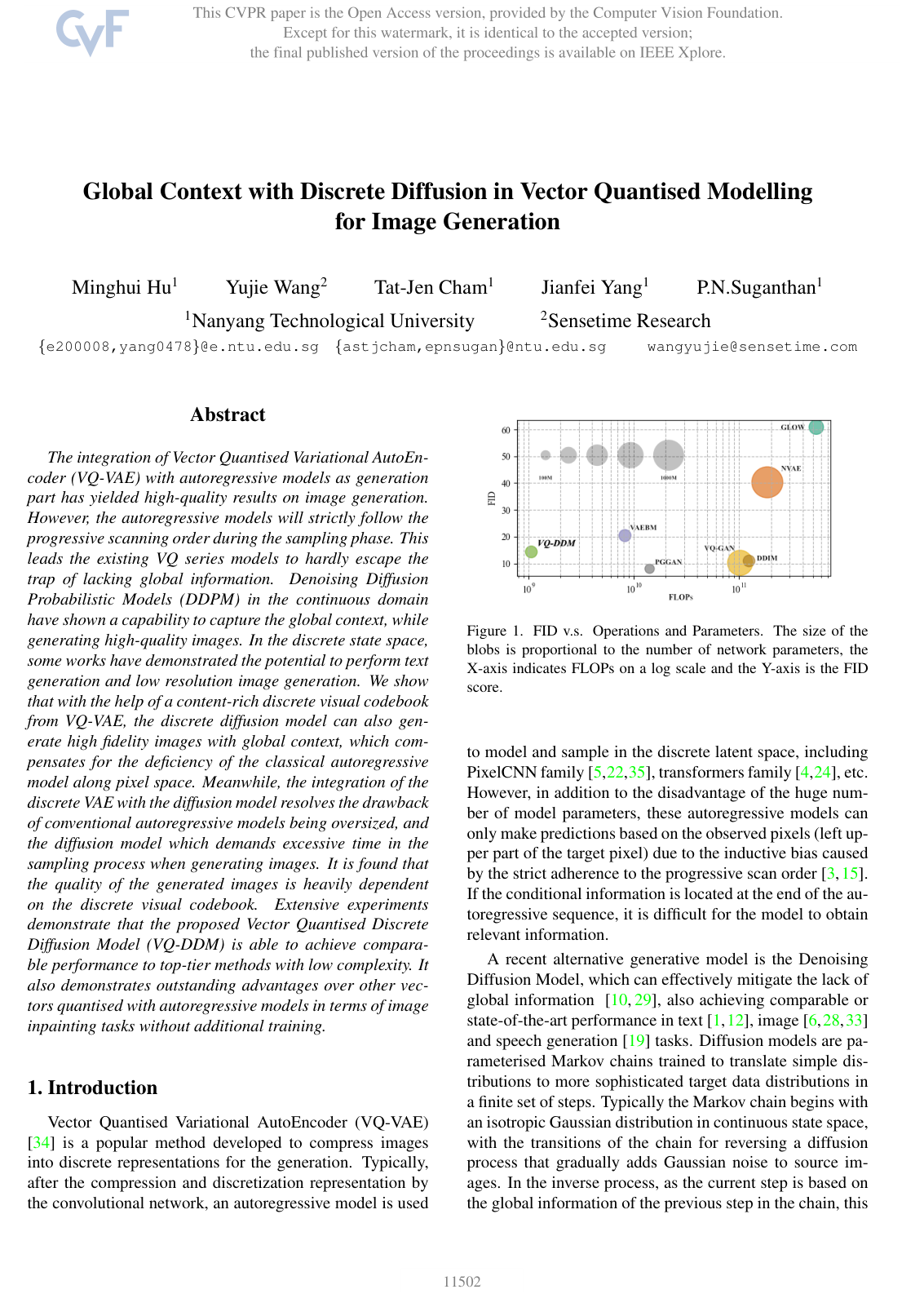
Global Context with Discrete Diffusion in Vector Quantised Modelling for Image Generation
Minghui Hu, Yujie Wang, Tat-Jen Cham, Jianfei Yang, Ponnuthurai N. Suganthan
Why you should read this
Proposes a discrete diffusion framework over vector-quantized latent codes that overcomes the sequential bias of autoregressive generation, achieving competitive image synthesis and training-free inpainting with substantially fewer parameters and faster sampling.
The integration of Vector Quantised Variational AutoEncoder (VQ-VAE) with autoregressive models as generation part has yielded high-quality results on image generation. However, the autoregressive models will strictly follow the progressive scanning order during the sampling phase. This leads the existing VQ series models to hardly escape the trap of lacking global information. Denoising Diffusion Probabilistic Models (DDPM) in the continuous domain have shown a capability to capture the global context, while generating high-quality images. In the discrete state space, some works have demonstrated the potential to perform text generation and low resolution image generation. We show that with the help of a content-rich discrete visual codebook from VQ-VAE, the discrete diffusion model can also generate high fidelity images with global context, which compensates for the deficiency of the classical autoregressive model along pixel space. Meanwhile, the integration of the discrete VAE with the diffusion model resolves the drawback of conventional autoregressive models being oversized, and the diffusion model which demands excessive time in the sampling process when generating images. It is found that the quality of the generated images is heavily dependent on the discrete visual codebook. Extensive experiments demonstrate that the proposed Vector Quantised Discrete Diffusion Model (VQ-DDM) is able to achieve comparable performance to top-tier methods with low complexity. It also demonstrates outstanding advantages over other vectors quantised with autoregressive models in terms of image inpainting tasks without additional training.
Added
2026-09-26
Improved Precision and Recall Metric for Assessing Generative Models
Tuomas Kynkäänniemi, Tero Karras, Samuli Laine, Jaakko Lehtinen, Timo Aila
Why you should read this
Introduces an improved precision and recall metric that reliably separates sample quality from distribution coverage in generative models, exposing failure modes in standard evaluation metrics and guiding practical architectural improvements in state-of-the-art image generators.
The ability to automatically estimate the quality and coverage of the samples produced by a generative model is a vital requirement for driving algorithm research. We present an evaluation metric that can separately and reliably measure both of these aspects in image generation tasks by forming explicit, non-parametric representations of the manifolds of real and generated data. We demonstrate the effectiveness of our metric in StyleGAN and BigGAN by providing several illustrative examples where existing metrics yield uninformative or contradictory results. Furthermore, we analyze multiple design variants of StyleGAN to better understand the relationships between the model architecture, training methods, and the properties of the resulting sample distribution. In the process, we identify new variants that improve the state-of-the-art. We also perform the first principled analysis of truncation methods and identify an improved method. Finally, we extend our metric to estimate the perceptual quality of individual samples, and use this to study latent space interpolations.
Added
2026-09-25
Improved Techniques for Training Score-Based Generative Models
Yang Song, Stefano Ermon
Why you should read this
Develops practical training methods and theoretical principles that scale score-based generative models up to 256x256 image synthesis, matching the visual quality of state-of-the-art GANs without adversarial training.
Score-based generative models can produce high quality image samples comparable to GANs, without requiring adversarial optimization. However, existing training procedures are limited to images of low resolution (typically below 32x32), and can be unstable under some settings. We provide a new theoretical analysis of learning and sampling from score models in high dimensional spaces, explaining existing failure modes and motivating new solutions that generalize across datasets. To enhance stability, we also propose to maintain an exponential moving average of model weights. With these improvements, we can effortlessly scale score-based generative models to images with unprecedented resolutions ranging from 64x64 to 256x256. Our score-based models can generate high-fidelity samples that rival best-in-class GANs on various image datasets, including CelebA, FFHQ, and multiple LSUN categories.
Added
2026-09-25
Generative AI
Stefan Feuerriegel, Jochen Hartmann, Christian Janiesch, Patrick Zschech
Why you should read this
Conceptualizes generative AI as an entity within socio-technical systems and sets a structured research agenda addressing the distinct operational challenges and opportunities it creates for business and information systems engineering.
The term "generative AI" refers to computational techniques that are capable of generating seemingly new, meaningful content such as text, images, or audio from training data. The widespread diffusion of this technology with examples such as Dall-E 2, GPT-4, and Copilot is currently revolutionizing the way we work and communicate with each other. In this article, we provide a conceptualization of generative AI as an entity in socio-technical systems and provide examples of models, systems, and applications. Based on that, we introduce limitations of current generative AI and provide an agenda for Business & Information Systems Engineering (BISE) research. Different from previous works, we focus on generative AI in the context of information systems, and, to this end, we discuss several opportunities and challenges that are unique to the BISE community and make suggestions for impactful directions for BISE research.
Added
2026-09-24
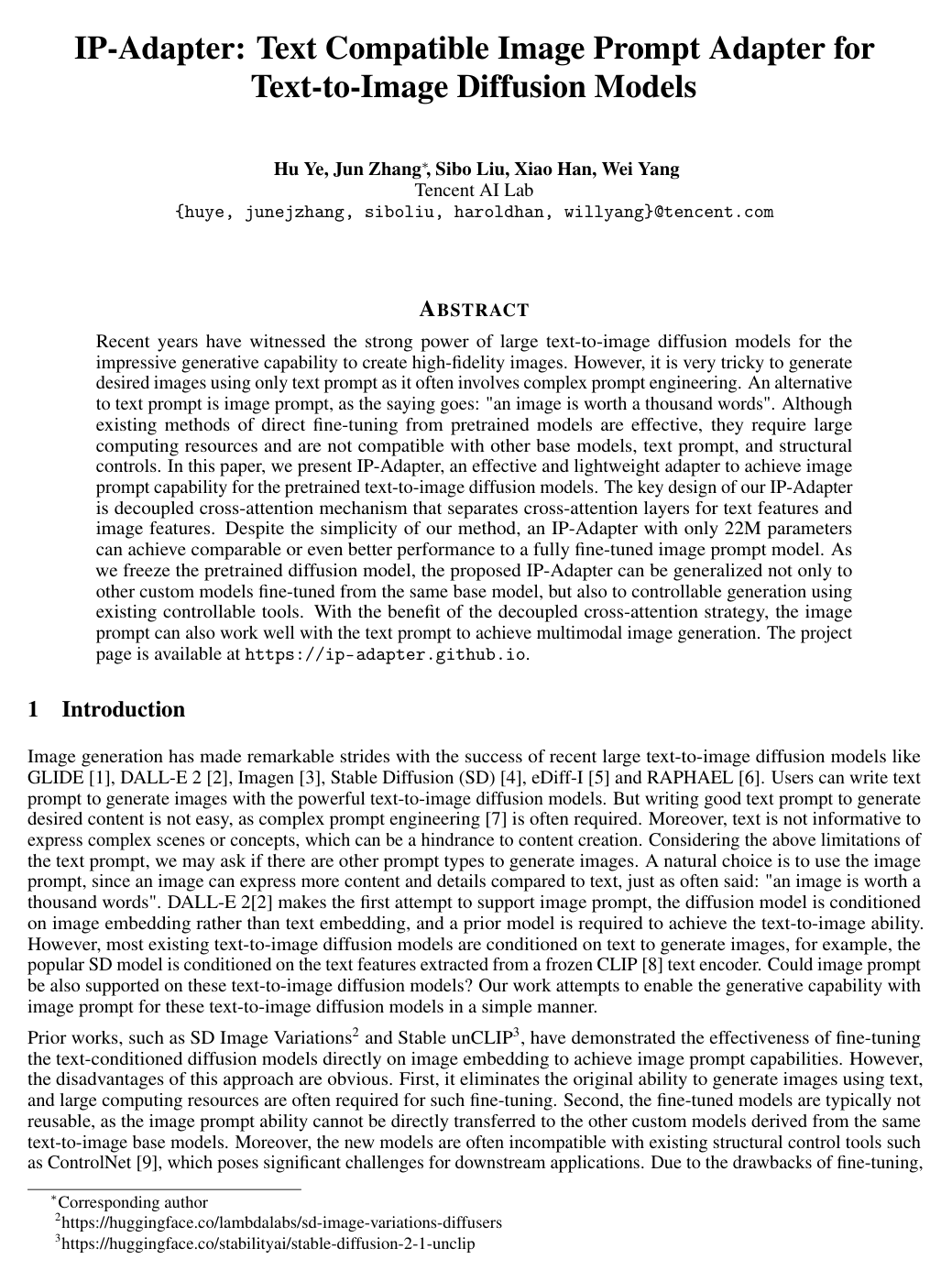
IP-Adapter: Text Compatible Image Prompt Adapter for Text-to-Image Diffusion Models
Hu Ye, Jun Zhang, Siyi Liu, Xiao Han, Wei Yang
Why you should read this
Introduces a lightweight, decoupled cross-attention adapter that equips pretrained text-to-image diffusion models with image prompting capabilities while maintaining full compatibility with text prompts and structural controls without retraining the base model.
Recent years have witnessed the strong power of large text-to-image diffusion models for the impressive generative capability to create high-fidelity images. However, it is very tricky to generate desired images using only text prompt as it often involves complex prompt engineering. An alternative to text prompt is image prompt, as the saying goes: "an image is worth a thousand words". Although existing methods of direct fine-tuning from pretrained models are effective, they require large computing resources and are not compatible with other base models, text prompt, and structural controls. In this paper, we present IP-Adapter, an effective and lightweight adapter to achieve image prompt capability for the pretrained text-to-image diffusion models. The key design of our IP-Adapter is decoupled cross-attention mechanism that separates cross-attention layers for text features and image features. Despite the simplicity of our method, an IP-Adapter with only 22M parameters can achieve comparable or even better performance to a fully fine-tuned image prompt model. As we freeze the pretrained diffusion model, the proposed IP-Adapter can be generalized not only to other custom models fine-tuned from the same base model, but also to controllable generation using existing controllable tools. With the benefit of the decoupled cross-attention strategy, the image prompt can also work well with the text prompt to achieve multimodal image generation. The project page is available at \url{this https URL}.
Added
2026-09-24
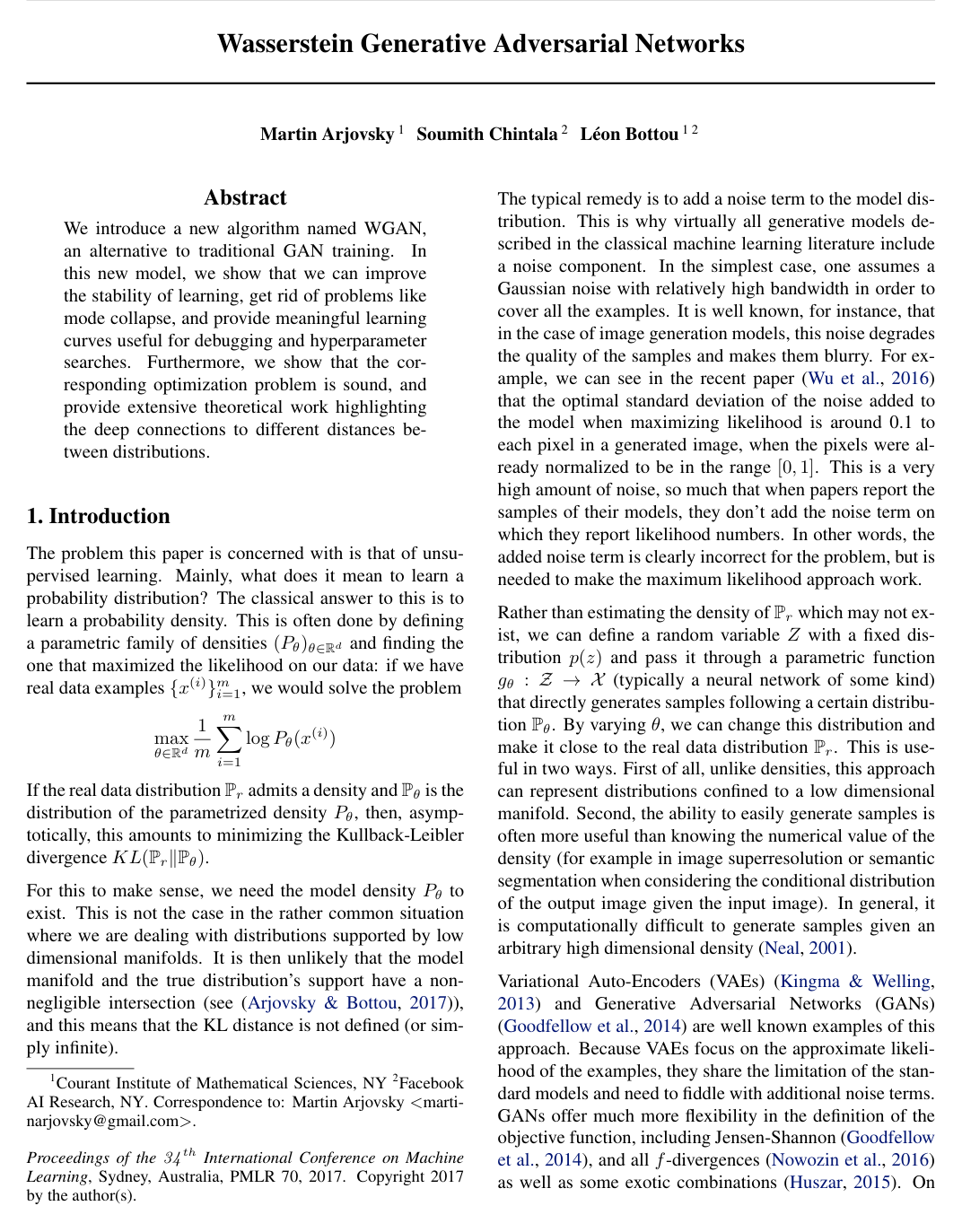
Wasserstein Generative Adversarial Networks
Martin Arjovsky, Soumith Chintala, Léon Bottou
Why you should read this
Introduces the Wasserstein GAN, a framework using the Earth Mover's distance to eliminate mode collapse, stabilize adversarial training, and provide a meaningful loss metric that correlates with sample quality.
We introduce a new algorithm named WGAN, an alternative to traditional GAN training. In this new model, we show that we can improve the stability of learning, get rid of problems like mode collapse, and provide meaningful learning curves useful for debugging and hyperparameter searches. Furthermore, we show that the corresponding optimization problem is sound, and provide extensive theoretical work highlighting the deep connections to different distances between distributions.
Added
2026-09-07
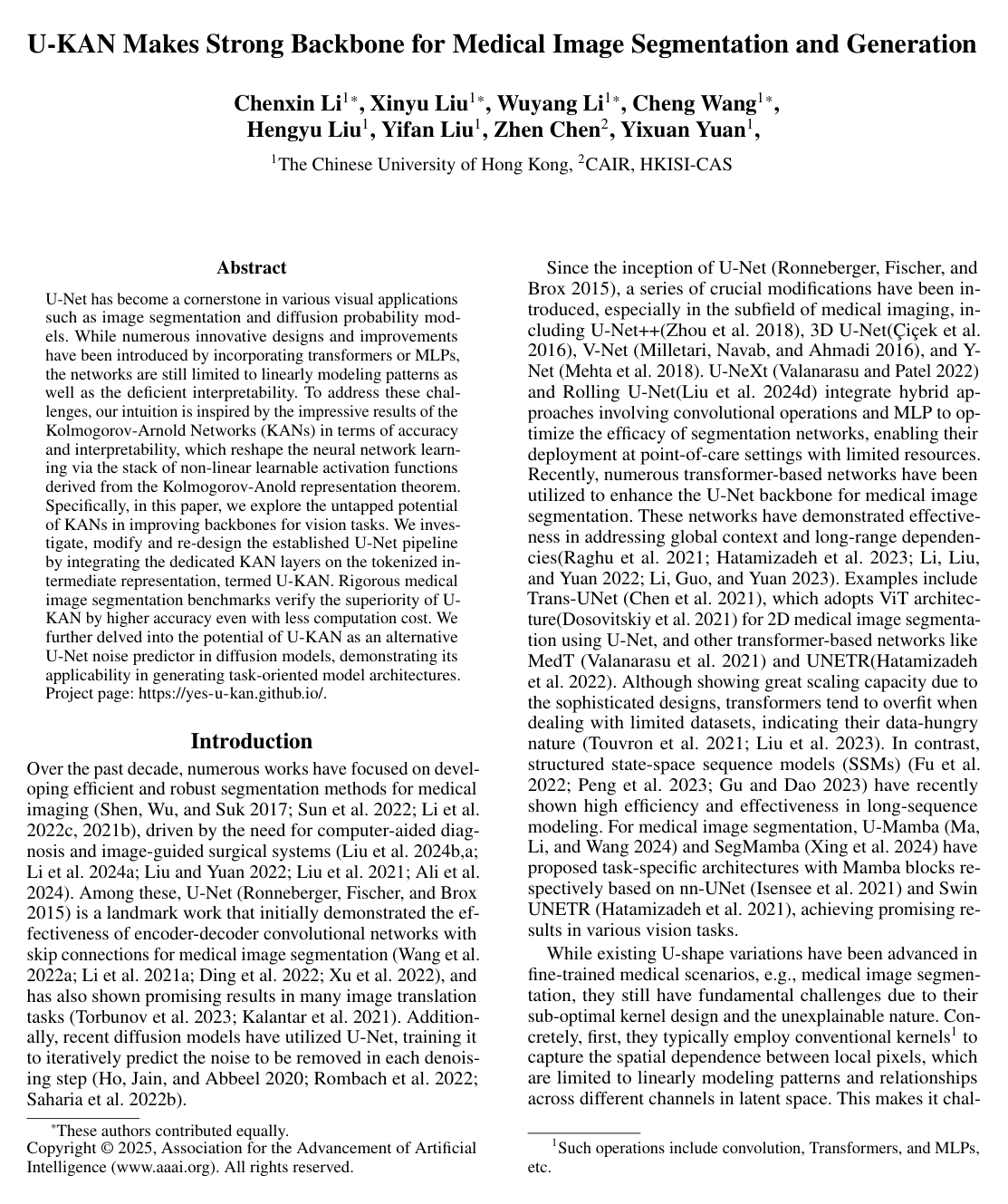
U-KAN Makes Strong Backbone for Medical Image Segmentation and Generation
Chenxin Li, Xinyu Liu, Wuyang Li, Cheng Wang, Hengyu Liu, Yifan Liu, Zhen Chen, Yixuan Yuan
Why you should read this
Proposes U-KAN, a pioneering architecture that integrates tokenized Kolmogorov-Arnold Network layers into the U-Net framework to deliver superior accuracy, interpretability, and computational efficiency for medical image segmentation and diffusion-based generative tasks.
U-Net has become a cornerstone in various visual applications such as image segmentation and diffusion probability models. While numerous innovative designs and improvements have been introduced by incorporating transformers or MLPs, the networks are still limited to linearly modeling patterns as well as the deficient interpretability. To address these challenges, our intuition is inspired by the impressive results of the Kolmogorov-Arnold Networks (KANs) in terms of accuracy and interpretability, which reshape the neural network learning via the stack of non-linear learnable activation functions derived from the Kolmogorov-Anold representation theorem. Specifically, in this paper, we explore the untapped potential of KANs in improving backbones for vision tasks. We investigate, modify and re-design the established U-Net pipeline by integrating the dedicated KAN layers on the tokenized intermediate representation, termed U-KAN. Rigorous medical image segmentation benchmarks verify the superiority of UKAN by higher accuracy even with less computation cost. We further delved into the potential of U-KAN as an alternative U-Net noise predictor in diffusion models, demonstrating its applicability in generating task-oriented model architectures.
Added
2026-05-18
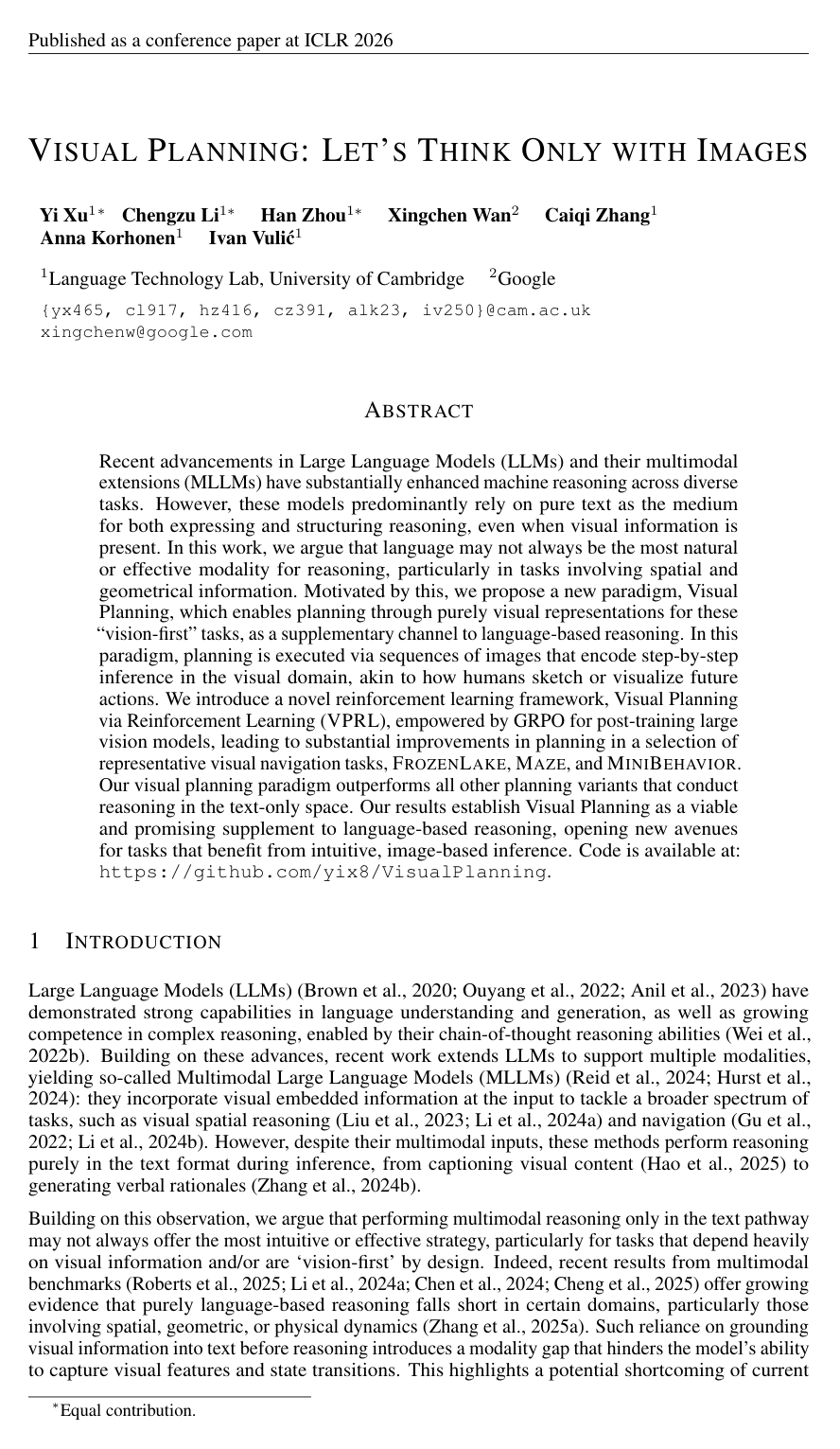
Visual Planning: Let's Think Only with Images
Yi Xu, Chengzu Li, Han Zhou, Xingchen Wan, Caiqi Zhang, Anna Korhonen, Ivan Vulić
Why you should read this
Introduces Visual Planning, a novel reinforcement learning framework (VPRL) that enables purely visual reasoning through sequences of images, outperforming text-only planning in visual navigation tasks and offering a promising supplement to language-based reasoning for "vision-first" challenges.
Recent advancements in Large Language Models (LLMs) and their multimodal extensions (MLLMs) have substantially enhanced machine reasoning across diverse tasks. However, these models predominantly rely on pure text as the medium for both expressing and structuring reasoning, even when visual information is present. In this work, we argue that language may not always be the most natural or effective modality for reasoning, particularly in tasks involving spatial and geometrical information. Motivated by this, we propose a new paradigm, Visual Planning, which enables planning through purely visual representations for these "vision-first" tasks, as a supplementary channel to language-based reasoning. In this paradigm, planning is executed via sequences of images that encode step-by-step inference in the visual domain, akin to how humans sketch or visualize future actions. We introduce a novel reinforcement learning framework, Visual Planning via Reinforcement Learning (VPRL), empowered by GRPO for post-training large vision models, leading to substantial improvements in planning in a selection of representative visual navigation tasks, FrozenLake, Maze, and MiniBehavior. Our visual planning paradigm outperforms all other planning variants that conduct reasoning in the text-only space. Our results establish Visual Planning as a viable and promising supplement to language-based reasoning, opening new avenues for tasks that benefit from intuitive, image-based inference.
Added
2026-05-16

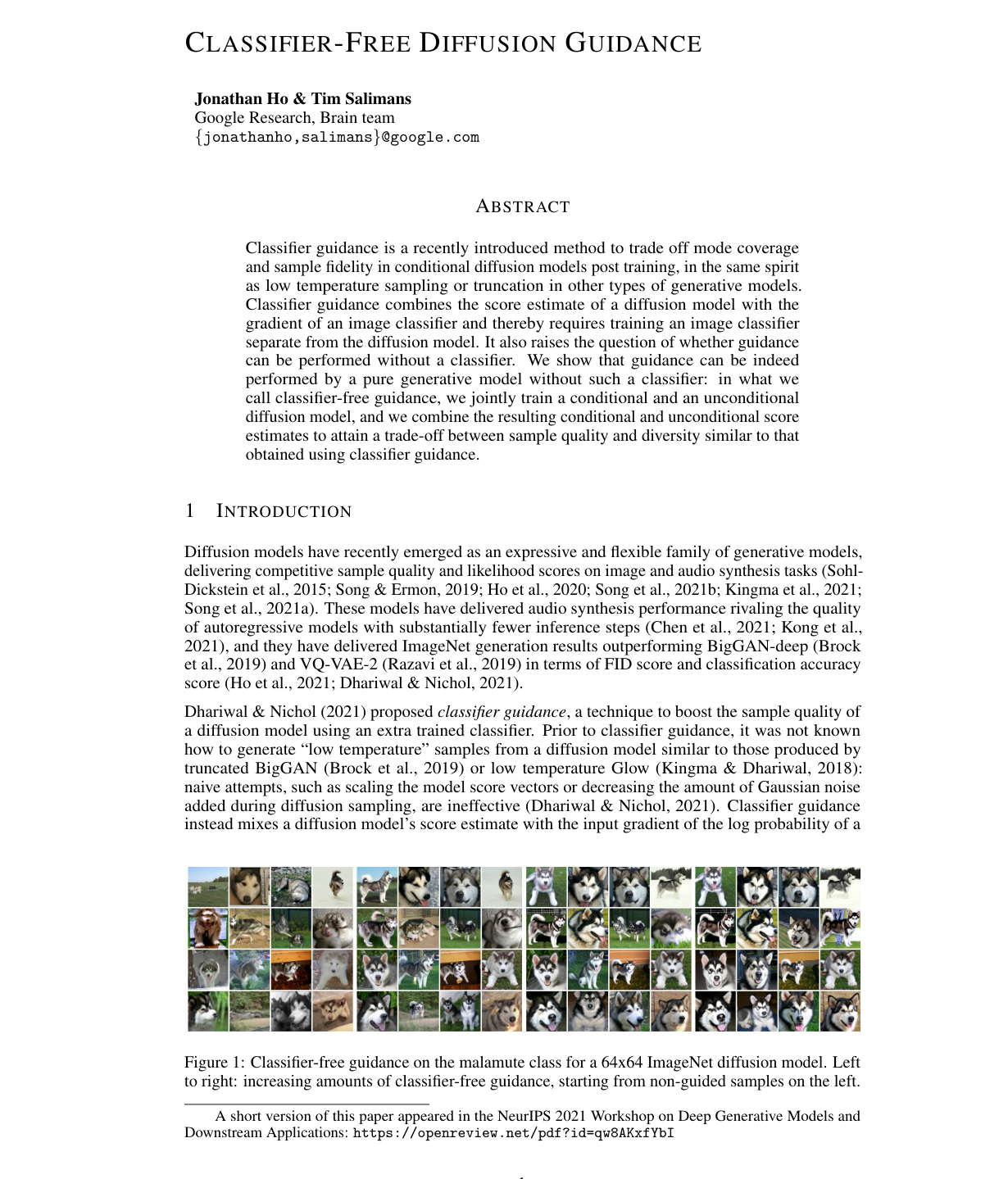
Classifier-Free Diffusion Guidance
Jonathan Ho, Tim Salimans
Why you should read this
Introduces a training technique to condition generation by balancing unconditional and conditional score estimates, eliminating the need for external classifiers.
Classifier guidance is a recently introduced method to trade off mode coverage and sample fidelity in conditional diffusion models post training, in the same spirit as low temperature sampling or truncation in other types of generative models. Classifier guidance combines the score estimate of a diffusion model with the gradient of an image classifier and thereby requires training an image classifier separate from the diffusion model. It also raises the question of whether guidance can be performed without a classifier. We show that guidance can be indeed performed by a pure generative model without such a classifier: in what we call classifier-free guidance, we jointly train a conditional and an unconditional diffusion model, and we combine the resulting conditional and unconditional score estimates to attain a trade-off between sample quality and diversity similar to that obtained using classifier guidance.
Added
2026-03-26
License
Published with permission
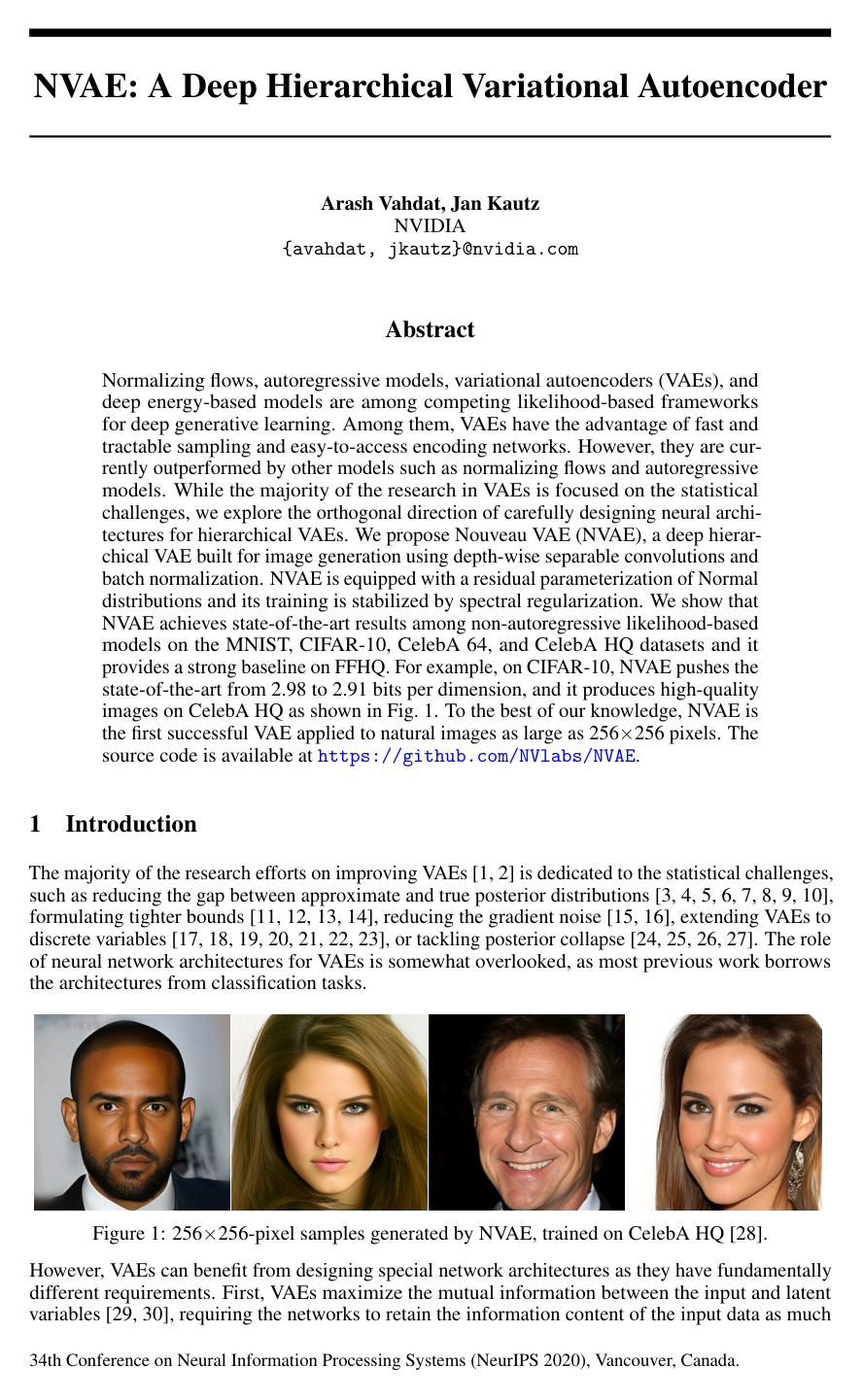
NVAE: A Deep Hierarchical Variational Autoencoder
Arash Vahdat, Jan Kautz
Why you should read this
Architectures a massive, multi-scale hierarchical continuous VAE that achieves state-of-the-art results without quantization.
Normalizing flows, autoregressive models, variational autoencoders (VAEs), and deep energy-based models are among competing likelihood-based frameworks for deep generative learning. Among them, VAEs have the advantage of fast and tractable sampling and easy-to-access encoding networks. However, they are currently outperformed by other models such as normalizing flows and autoregressive models. While the majority of the research in VAEs is focused on the statistical challenges, we explore the orthogonal direction of carefully designing neural architectures for hierarchical VAEs. We propose Nouveau VAE (NVAE), a deep hierarchical VAE built for image generation using depth-wise separable convolutions and batch normalization. NVAE is equipped with a residual parameterization of Normal distributions and its training is stabilized by spectral regularization. We show that NVAE achieves state-of-the-art results among non-autoregressive likelihood-based models on the MNIST, CIFAR-10, CelebA 64, and CelebA HQ datasets and it provides a strong baseline on FFHQ. For example, on CIFAR-10, NVAE pushes the state-of-the-art from 2.98 to 2.91 bits per dimension, and it produces high-quality images on CelebA HQ. To the best of our knowledge, NVAE is the first successful VAE applied to natural images as large as 256256 pixels. The source code is available at https://github.com/NVlabs/NVAE .
Added
2026-03-09
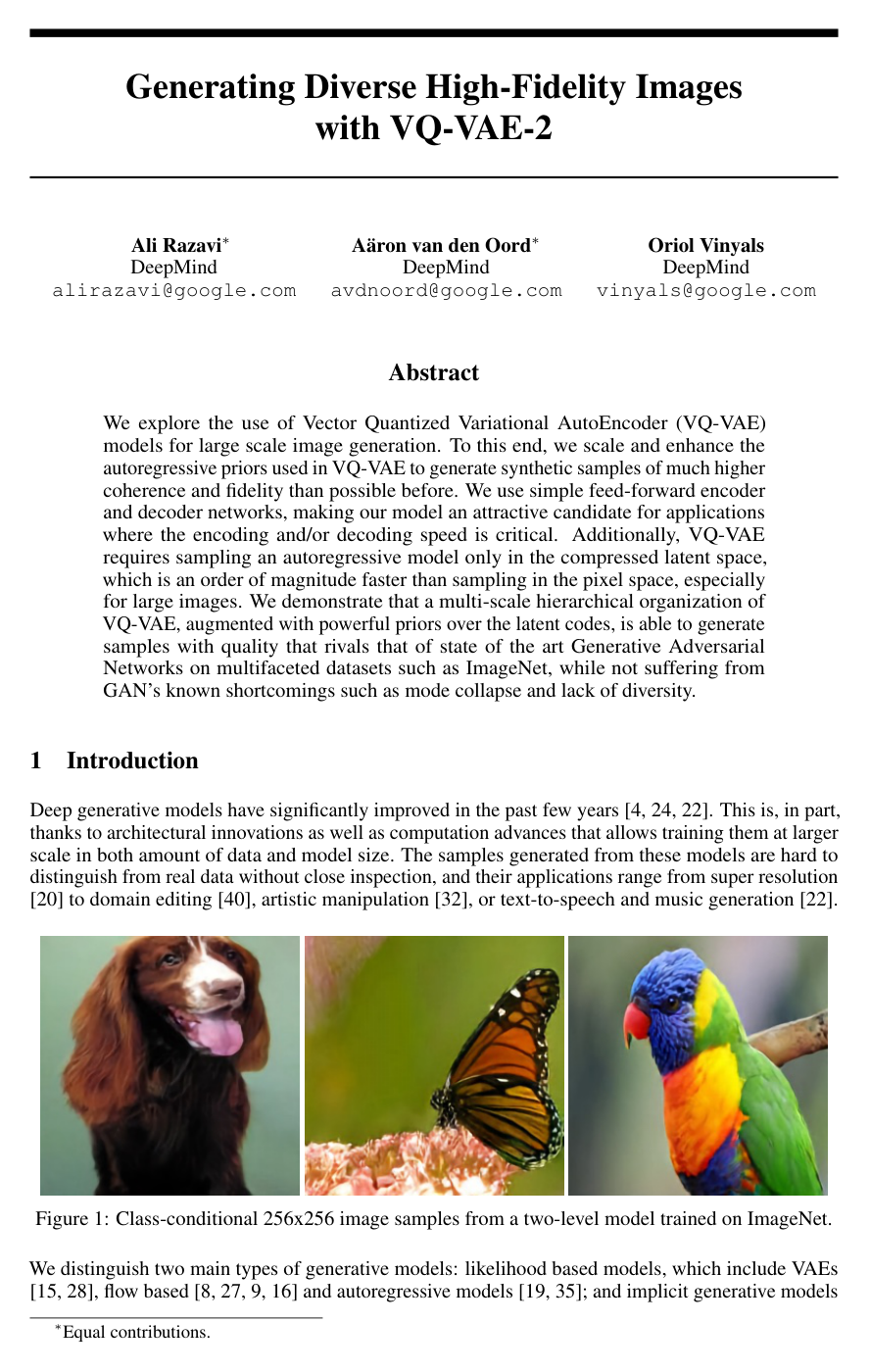
Generating Diverse High-Fidelity Images with VQ-VAE-2
Ali Razavi, Aäron van den Oord, Oriol Vinyals
Why you should read this
Demonstrates that hierarchical discrete VAEs can generate photorealistic, high-resolution images, rivaling the best adversarial models.
We explore the use of Vector Quantized Variational AutoEncoder (VQ-VAE) models for large scale image generation. To this end, we scale and enhance the autoregressive priors used in VQ-VAE to generate synthetic samples of much higher coherence and fidelity than possible before. We use simple feed-forward encoder and decoder networks, making our model an attractive candidate for applications where the encoding and/or decoding speed is critical. Additionally, VQ-VAE requires sampling an autoregressive model only in the compressed latent space, which is an order of magnitude faster than sampling in the pixel space, especially for large images. We demonstrate that a multi-scale hierarchical organization of VQ-VAE, augmented with powerful priors over the latent codes, is able to generate samples with quality that rivals that of state of the art Generative Adversarial Networks on multifaceted datasets such as ImageNet, while not suffering from GAN's known shortcomings such as mode collapse and lack of diversity.
Added
2026-03-09
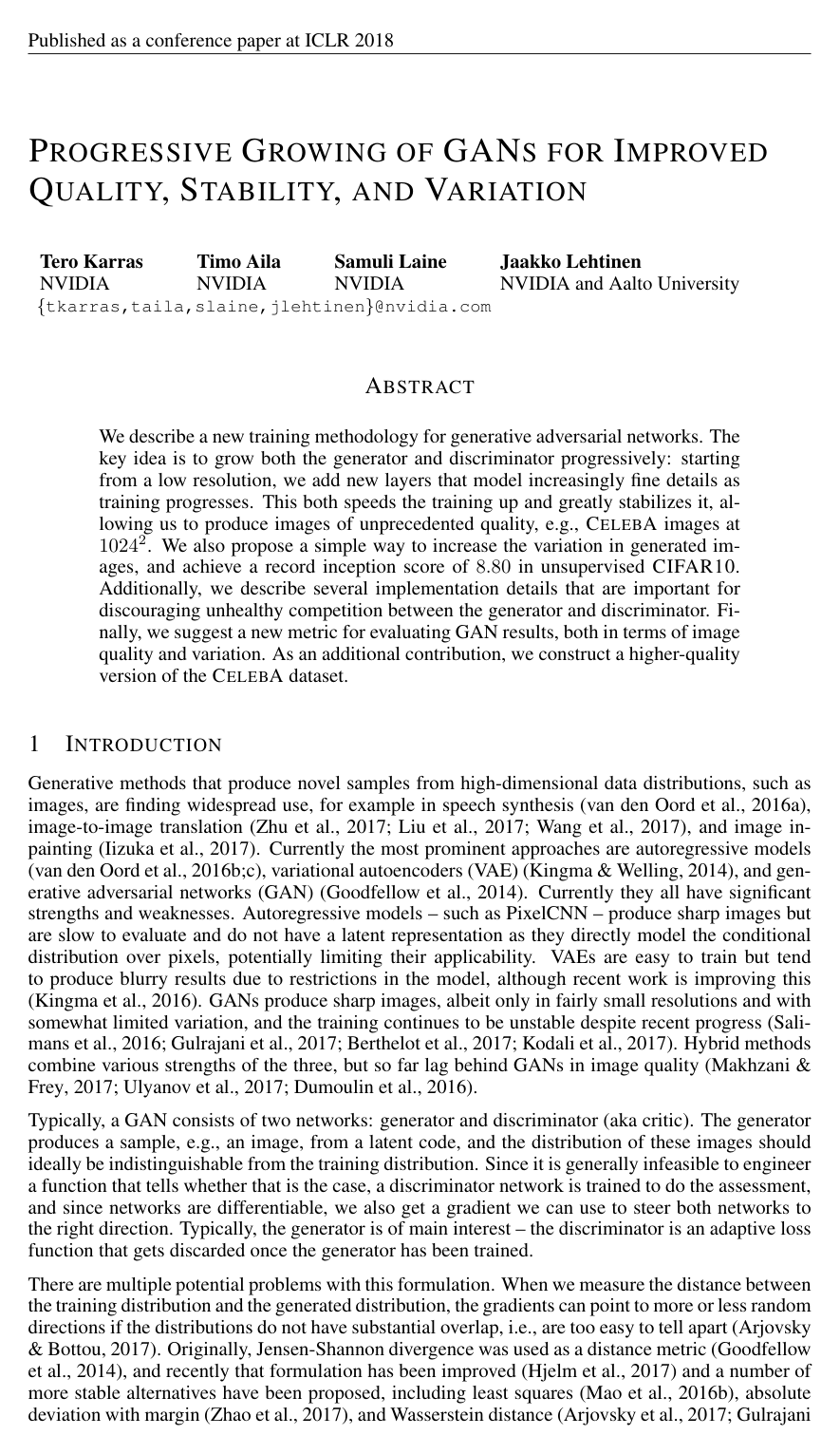
Progressive Growing of GANs for Improved Quality, Stability, and Variation
Tero Karras, Timo Aila, Samuli Laine, Jaakko Lehtinen
Why you should read this
Demonstrates a training methodology that starts with low resolution and progressively adds layers to achieve megapixel scale.
We describe a new training methodology for generative adversarial networks. The key idea is to grow both the generator and discriminator progressively: starting from a low resolution, we add new layers that model increasingly fine details as training progresses. This both speeds the training up and greatly stabilizes it, allowing us to produce images of unprecedented quality, e.g., CelebA images at 1024^2. We also propose a simple way to increase the variation in generated images, and achieve a record inception score of 8.80 in unsupervised CIFAR10. Additionally, we describe several implementation details that are important for discouraging unhealthy competition between the generator and discriminator. Finally, we suggest a new metric for evaluating GAN results, both in terms of image quality and variation. As an additional contribution, we construct a higher-quality version of the CelebA dataset.
Added
2026-03-07