
keyword
Support Vector Machines
Support Vector Machines are supervised machine learning algorithms used primarily for classification and regression tasks. The core objective of a support vector machine is to find an optimal decision boundary, known as a hyperplane, that maximizes the margin of separation between distinct classes of data points. The specific training data points located closest to this decision boundary determine its position and orientation and are referred to as support vectors. When data is not linearly separable in its original input space, support vector machines can employ kernel functions to implicitly map inputs into higher-dimensional feature spaces where linear separation becomes possible. Recognized for their strong theoretical foundations and effective generalization capabilities, these algorithms are extensively applied in areas with high-dimensional data, including image recognition, text categorization, and bioinformatics.
46 items
Certified Robustness of Nearest Neighbors against Data Poisoning and Backdoor Attacks
Jinyuan Jia, Yupei Liu, Xiaoyu Cao, Neil Zhenqiang Gong
Why you should read this
Proves that the intrinsic majority voting mechanisms in standard nearest neighbor algorithms naturally provide certified defense guarantees against data poisoning and backdoor attacks that outperform existing specialized methods on MNIST and CIFAR-10.
Data poisoning attacks and backdoor attacks aim to corrupt a machine learning classifier via modifying, adding, and/or removing some carefully selected training examples, such that the corrupted classifier makes incorrect predictions as the attacker desires. The key idea of state-of-the-art certified defenses against data poisoning attacks and backdoor attacks is to create a majority vote mechanism to predict the label of a testing example. Moreover, each voter is a base classifier trained on a subset of the training dataset. Classical simple learning algorithms such as k nearest neighbors (kNN) and radius nearest neighbors (rNN) have intrinsic majority vote mechanisms. In this work, we show that the intrinsic majority vote mechanisms in kNN and rNN already provide certified robustness guarantees against data poisoning attacks and backdoor attacks. Moreover, our evaluation results on MNIST and CIFAR10 show that the intrinsic certified robustness guarantees of kNN and rNN outperform those provided by state-of-the-art certified defenses. Our results serve as standard baselines for future certified defenses against data poisoning attacks and backdoor attacks.
Added
2026-09-26
Optimal Strategies for Reject Option Classifiers
Vojtech Franc, Daniel Prusa, Václav Vorácek
Why you should read this
Unifies cost-based, bounded-improvement, and bounded-abstention selective classification models by proving they share the same optimal strategy, while developing two Fisher consistent algorithms to learn optimal rejection functions for arbitrary black-box classifiers across diverse prediction tasks.
In classification with a reject option, the classifier is allowed in uncertain cases to abstain from prediction. The classical cost-based model of a reject option classifier requires the rejection cost to be defined explicitly. The alternative bounded-improvement model and the bounded-abstention model avoid the notion of the reject cost. The bounded-improvement model seeks a classifier with a guaranteed selective risk and maximal cover. The bounded-abstention model seeks a classifier with guaranteed cover and minimal selective risk. We prove that despite their different formulations the three rejection models lead to the same prediction strategy: the Bayes classifier endowed with a randomized Bayes selection function. We define the notion of a proper uncertainty score as a scalar summary of the prediction uncertainty sufficient to construct the randomized Bayes selection function. We propose two algorithms to learn the proper uncertainty score from examples for an arbitrary black-box classifier. We prove that both algorithms provide Fisher consistent estimates of the proper uncertainty score and demonstrate their efficiency in different prediction problems, including classification, ordinal regression, and structured output classification.
Added
2026-09-26
Kernel Methods for Relation Extraction
Dmitry Zelenko, Chinatsu Aone, Anthony Richardella
Why you should read this
Develops tree kernels defined over shallow parse representations along with efficient computation algorithms, enabling Support Vector Machines and Voted Perceptrons to accurately extract semantic relations without manual feature engineering.
We present an application of kernel methods to extracting relations from unstructured natural language sources. We introduce kernels defined over shallow parse representations of text, and design efficient algorithms for computing the kernels. We use the devised kernels in conjunction with Support Vector Machine and Voted Perceptron learning algorithms for the task of extracting person-affiliation and organization-location relations from text. We experimentally evaluate the proposed methods and compare them with feature-based learning algorithms, with promising results.
Added
2026-09-26

SVM-KNN: Discriminative Nearest Neighbor Classification for Visual Category Recognition
Haotong Zhang, A. Berg, M. Maire, Jitendra Malik
Why you should read this
Combines nearest-neighbor retrieval with local support vector machine training to enable scalable multiclass image classification using complex perceptual distance functions without the steep computational cost of full SVM training.
We consider visual category recognition in the framework of measuring similarities, or equivalently perceptual distances, to prototype examples of categories. This approach is quite flexible, and permits recognition based on color, texture, and particularly shape, in a homogeneous framework. While nearest neighbor classifiers are natural in this setting, they suffer from the problem of high variance (in bias-variance decomposition) in the case of limited sampling. Alternatively, one could use support vector machines but they involve time-consuming optimization and computation of pairwise distances. We propose a hybrid of these two methods which deals naturally with the multiclass setting, has reasonable computational complexity both in training and at run time, and yields excellent results in practice. The basic idea is to find close neighbors to a query sample and train a local support vector machine that preserves the distance function on the collection of neighbors. Our method can be applied to large, multiclass data sets for which it outperforms nearest neighbor and support vector machines, and remains efficient when the problem becomes intractable for support vector machines. A wide variety of distance functions can be used and our experiments show state-of-the-art performance on a number of benchmark data sets for shape and texture classification (MNIST, USPS, CUReT) and object recognition (Caltech-101). On Caltech-101 we achieved a correct classification rate of 59.05%(±0.56%) at 15 training images per class, and 66.23%(±0.48%) at 30 training images.
Added
2026-09-25
Machine Learning Force Fields
Oliver T. Unke, Stefan Chmiela, Huziel E. Sauceda, Michael Gastegger, Igor Poltavsky, Kristof T. Schütt, Alexandre Tkatchenko, Klaus-Robert Müller
Why you should read this
Presents a comprehensive guide to the theory and construction of machine learning force fields, providing practical instructions to build models that achieve quantum-mechanical accuracy at the computational speed of classical molecular dynamics.
In recent years, the use of Machine Learning (ML) in computational chemistry has enabled numerous advances previously out of reach due to the computational complexity of traditional electronic-structure methods. One of the most promising applications is the construction of ML-based force fields (FFs), with the aim to narrow the gap between the accuracy of ab initio methods and the efficiency of classical FFs. The key idea is to learn the statistical relation between chemical structure and potential energy without relying on a preconceived notion of fixed chemical bonds or knowledge about the relevant interactions. Such universal ML approximations are in principle only limited by the quality and quantity of the reference data used to train them. This review gives an overview of applications of ML-FFs and the chemical insights that can be obtained from them. The core concepts underlying ML-FFs are described in detail and a step-by-step guide for constructing and testing them from scratch is given. The text concludes with a discussion of the challenges that remain to be overcome by the next generation of ML-FFs.
Added
2026-09-25
Text Classification using String Kernels
H. Lodhi, C. Saunders, J. Shawe-Taylor, N. Cristianini, Christopher J. C. H. Watkins
Why you should read this
Proposes a string subsequence kernel for text categorization that captures non-contiguous character sequences via dynamic programming and outperforms traditional bag-of-words representations on benchmark corpora.
We propose a novel approach for categorizing text documents based on the use of a special kernel. The kernel is an inner product in the feature space generated by all subsequences of length k. A subsequence is any ordered sequence of k characters occurring in the text though not necessarily contiguously. The subsequences are weighted by an exponentially decaying factor of their full length in the text, hence emphasising those occurrences that are close to contiguous. A direct computation of this feature vector would involve a prohibitive amount of computation even for modest values of k, since the dimension of the feature space grows exponentially with k. The paper describes how despite this fact the inner product can be efficiently evaluated by a dynamic programming technique. Experimental comparisons of the performance of the kernel compared with a standard word feature space kernel (Joachims, 1998) show positive results on modestly sized datasets. The case of contiguous subsequences is also considered for comparison with the subsequences kernel with different decay factors. For larger documents and datasets the paper introduces an approximation technique that is shown to deliver good approximations efficiently for large datasets.
Added
2026-09-25
Max-Margin Markov Networks
B. Taskar, Carlos Guestrin, D. Koller
Why you should read this
Introduces Maximum Margin Markov networks, unifying kernel-based margin maximization with probabilistic graphical models to enable structured classification in high-dimensional feature spaces through an efficient, polynomial-size quadratic program.
In typical classification tasks, we seek a function which assigns a label to a single object. Kernel-based approaches, such as support vector machines (SVMs), which maximize the margin of confidence of the classifier, are the method of choice for many such tasks. Their popularity stems both from the ability to use high-dimensional feature spaces, and from their strong theoretical guarantees. However, many real-world tasks involve sequential, spatial, or structured data, where multiple labels must be assigned. Existing kernel-based methods ignore structure in the problem, assigning labels independently to each object, losing much useful information. Conversely, probabilistic graphical models, such as Markov networks, can represent correlations between labels, by exploiting problem structure, but cannot handle high-dimensional feature spaces, and lack strong theoretical generalization guarantees. In this paper, we present a new framework that combines the advantages of both approaches: Maximum margin Markov (M^3) networks incorporate both kernels, which efficiently deal with high-dimensional features, and the ability to capture correlations in structured data. We present an efficient algorithm for learning M^3 networks based on a compact quadratic program formulation. We provide a new theoretical bound for generalization in structured domains. Experiments on the task of handwritten character recognition and collective hypertext classification demonstrate very significant gains over previous approaches.
Added
2026-09-25
A kernel method for multi-labelled classification
A. Elisseeff, J. Weston
Why you should read this
Presents a large-margin kernel ranking framework for multi-label classification that directly minimizes ranking loss while capturing correlations between labels better than standard binary decomposition methods.
This article presents a Support Vector Machine (SVM) like learning system to handle multi-label problems. Such problems are usually decomposed into many two-class problems but the expressive power of such a system can be weak [5, 7]. We explore a new direct approach. It is based on a large margin ranking system that shares a lot of common properties with SVMs. We tested it on a Yeast gene functional classification problem with positive results.
Added
2026-09-25
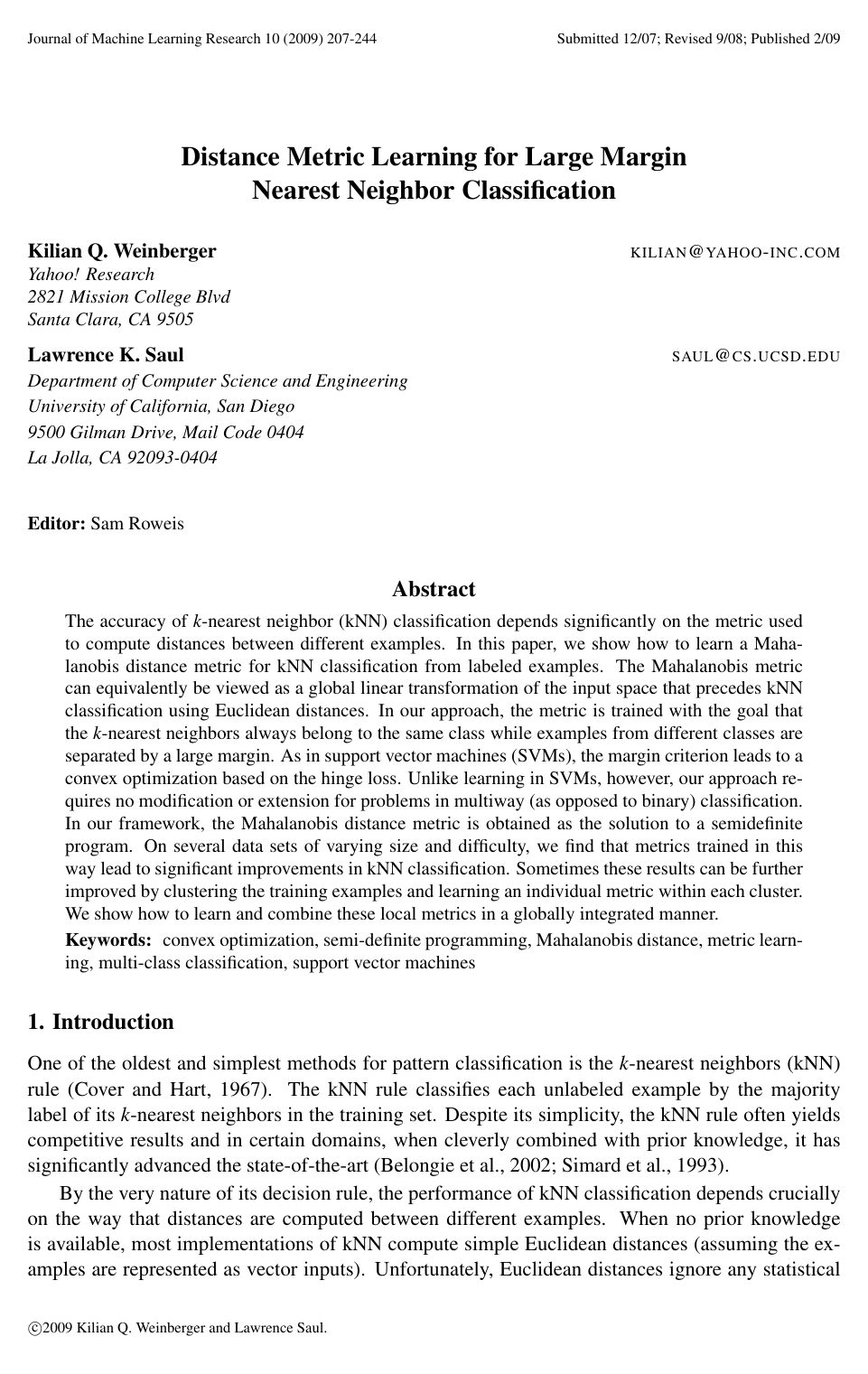
Distance Metric Learning for Large Margin Nearest Neighbor Classification
Kilian Q. Weinberger, Lawrence K. Saul
Why you should read this
Demonstrates how to optimize k-nearest neighbor classification through a convex optimization framework that learns Mahalanobis distance metrics using semidefinite programming.
The accuracy of k-nearest neighbor (kNN) classification depends significantly on the metric used to compute distances between different examples. In this paper, we show how to learn a Mahalanobis distance metric for kNN classification from labeled examples. The Mahalanobis metric can equivalently be viewed as a global linear transformation of the input space that precedes kNN classification using Euclidean distances. In our approach, the metric is trained with the goal that the k-nearest neighbors always belong to the same class while examples from different classes are separated by a large margin.
Added
2026-09-25
License
Published with permission
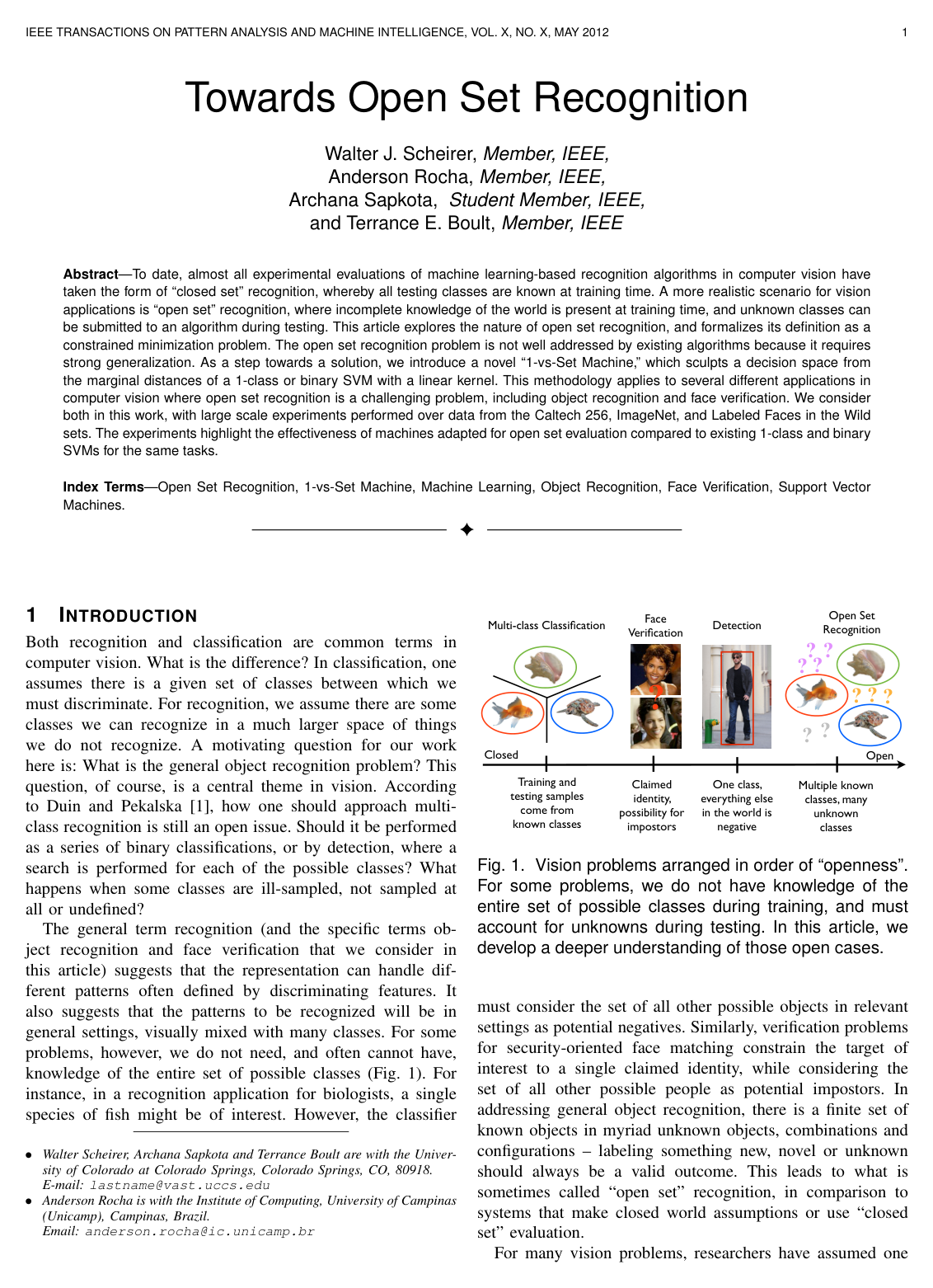
Toward Open Set Recognition
W. Scheirer, A. Rocha, Archana Sapkota, T. Boult
Why you should read this
Formalizes the open set recognition problem and introduces the 1-vs-Set Machine to limit classification risk in unconstrained spaces where unseen classes emerge at test time.
To date, almost all experimental evaluations of machine learning-based recognition algorithms in computer vision have taken the form of "closed set" recognition, whereby all testing classes are known at training time. A more realistic scenario for vision applications is "open set" recognition, where incomplete knowledge of the world is present at training time, and unknown classes can be submitted to an algorithm during testing. This article explores the nature of open set recognition, and formalizes its definition as a constrained minimization problem. The open set recognition problem is not well addressed by existing algorithms because it requires strong generalization. As a step towards a solution, we introduce a novel "1-vs-Set Machine," which sculpts a decision space from the marginal distances of a 1-class or binary SVM with a linear kernel. This methodology applies to several different applications in computer vision where open set recognition is a challenging problem, including object recognition and face verification. We consider both in this work, with large scale experiments performed over data from the Caltech 256, ImageNet, and Labeled Faces in the Wild sets. The experiments highlight the effectiveness of machines adapted for open set evaluation compared to existing 1-class and binary SVMs for the same tasks.
Added
2026-09-24
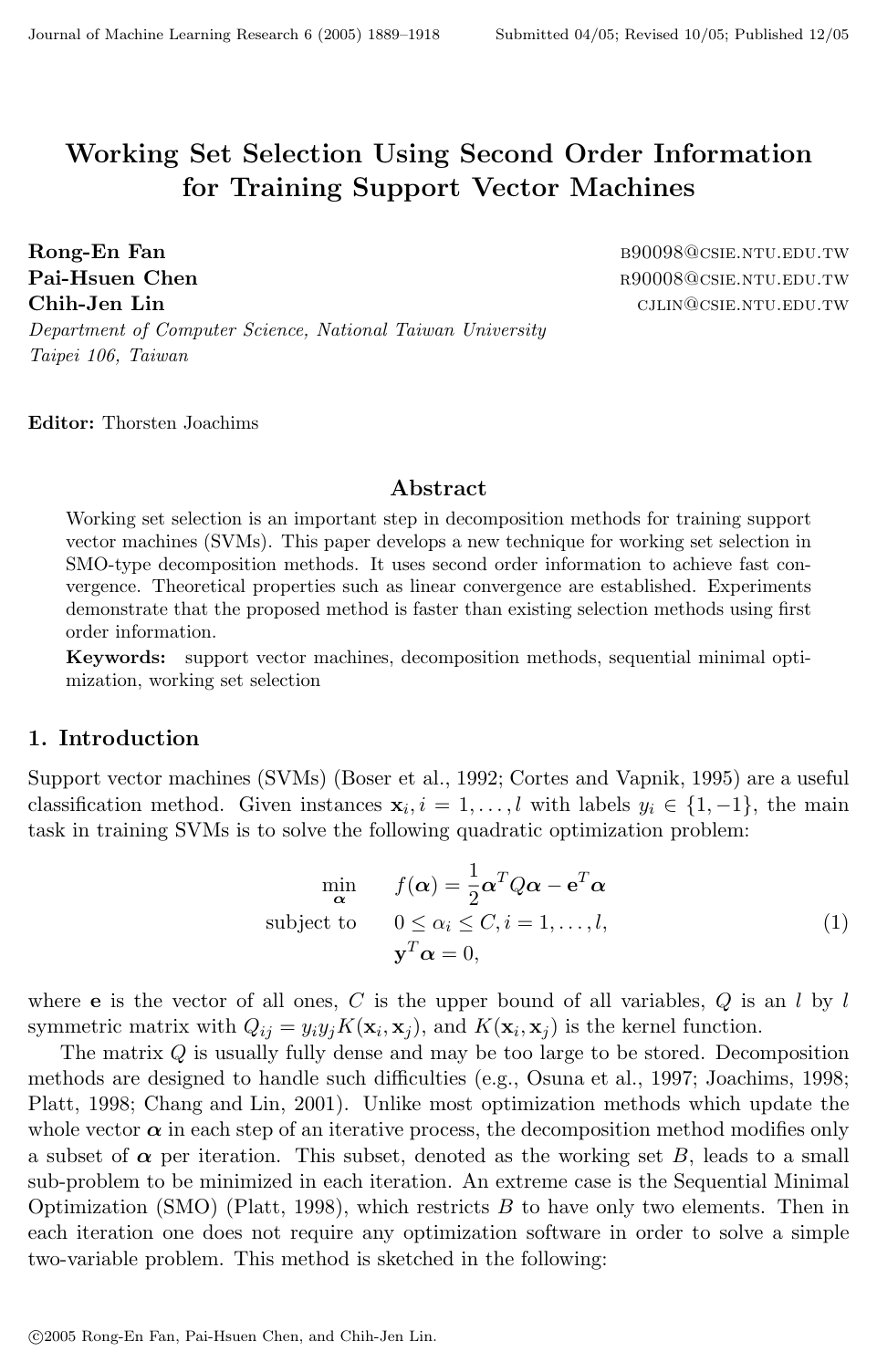
Working Set Selection Using Second Order Information for Training Support Vector Machines
Rong-En Fan, Pai-Hsuen Chen, Chih-Jen Lin
Why you should read this
Develops a fast, second-order working set selection strategy for SMO-type decomposition methods that provably achieves linear convergence and significantly reduces training times for support vector machines.
Working set selection is an important step in decomposition methods for training support vector machines (SVMs). This paper develops a new technique for working set selection in SMO-type decomposition methods. It uses second order information to achieve fast convergence. Theoretical properties such as linear convergence are established. Experiments demonstrate that the proposed method is faster than existing selection methods using first order information.
Added
2026-09-24
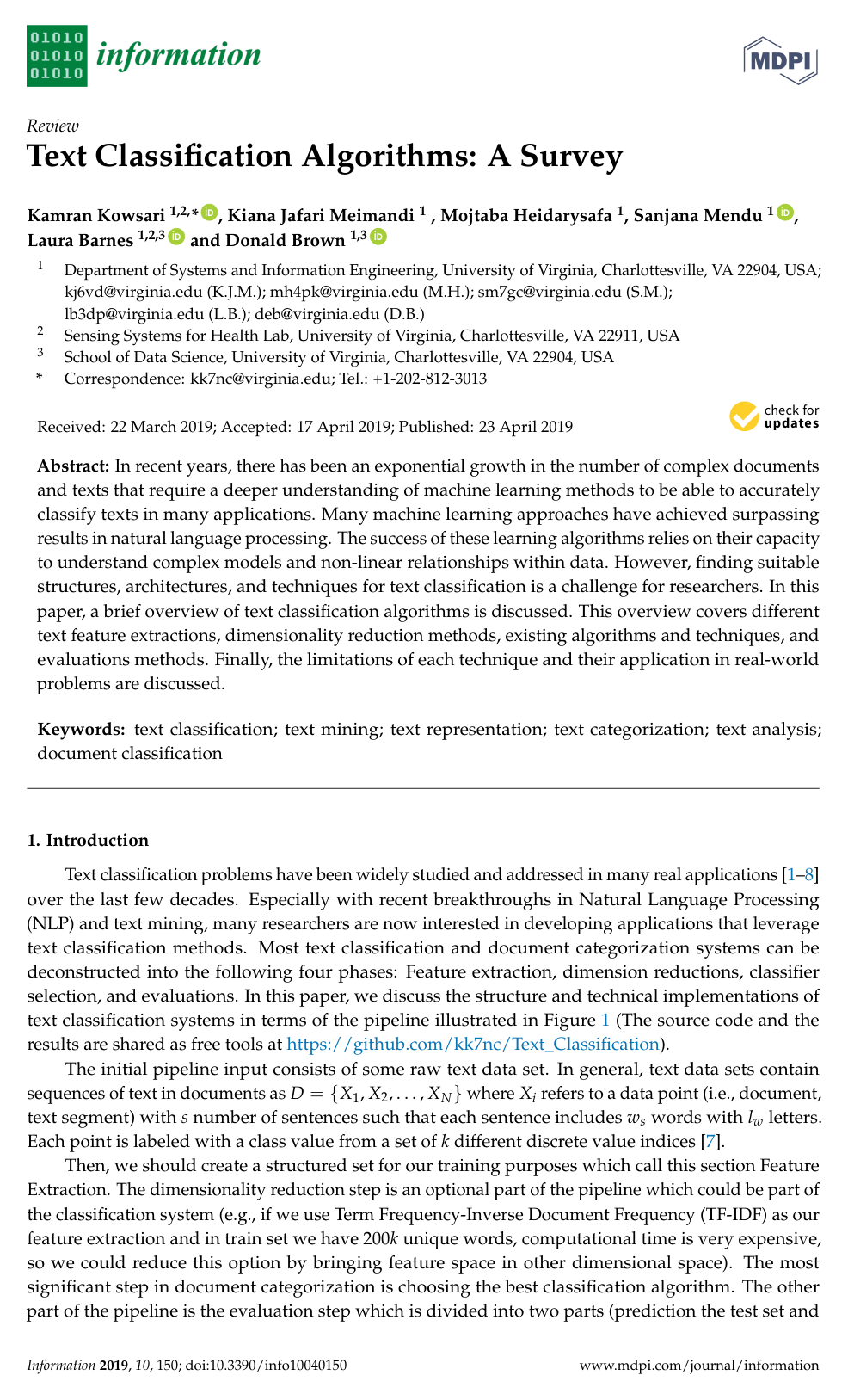
Text Classification Algorithms: A Survey
Kamran Kowsari, Kiana Jafari Meimandi, Mojtaba Heidarysafa, Sanjana Mendu, Laura E. Barnes, Donald E. Brown
Why you should read this
Synthesizes the complete text classification pipeline by systematically comparing feature extraction techniques, dimensionality reduction approaches, machine learning algorithms, and evaluation metrics alongside their practical limitations in real-world applications.
In recent years, there has been an exponential growth in the number of complex documents and texts that require a deeper understanding of machine learning methods to be able to accurately classify texts in many applications. Many machine learning approaches have achieved surpassing results in natural language processing. The success of these learning algorithms relies on their capacity to understand complex models and non-linear relationships within data. However, finding suitable structures, architectures, and techniques for text classification is a challenge for researchers. In this paper, a brief overview of text classification algorithms is discussed. This overview covers different text feature extractions, dimensionality reduction methods, existing algorithms and techniques, and evaluations methods. Finally, the limitations of each technique and their application in the real-world problem are discussed.
Added
2026-09-24
Regularized multi--task learning
T. Evgeniou, M. Pontil
Why you should read this
Extends kernel-based regularization methods like Support Vector Machines to multi-task learning by formulating a shared mean parameter vector that models task relationships and significantly improves predictive accuracy over independent learning.
Past empirical work has shown that learning multiple related tasks from data simultaneously can be advantageous in terms of predictive performance relative to learning these tasks independently. In this paper we present an approach to multi-task learning based on the minimization of regularization functionals similar to existing ones, such as the one for Support Vector Machines (SVMs), that have been successfully used in the past for single-task learning. Our approach allows to model the relation between tasks in terms of a novel kernel function that uses a task-coupling parameter. We implement an instance of the proposed approach similar to SVMs and test it empirically using simulated as well as real data. The experimental results show that the proposed method performs better than existing multi-task learning methods and largely outperforms single-task learning using SVMs.
Added
2026-09-24
Support Vector Machines for Multiple-Instance Learning
S. Andrews, Ioannis Tsochantaridis, Thomas Hofmann
Why you should read this
Extends Support Vector Machines to multiple-instance learning by formulating pattern-level and bag-level maximum margin optimizations as mixed integer quadratic programs, enabling kernel-based classification on weakly annotated data across drug design, image indexing, and text categorization tasks.
This paper presents two new formulations of multiple-instance learning as a maximum margin problem. The proposed extensions of the Support Vector Machine (SVM) learning approach lead to mixed integer quadratic programs that can be solved heuristically. Our generalization of SVMs makes a state-of-the-art classification technique, including non-linear classification via kernels, available to an area that up to now has been largely dominated by special purpose methods. We present experimental results on a pharmaceutical data set and on applications in automated image indexing and document categorization.
Added
2026-09-24
Reducing Multiclass to Binary: A Unifying Approach for Margin Classifiers
Erin L. Allwein, Rob Schapire, Y. Singer
Why you should read this
Unifies standard multiclass-to-binary reductions under a single framework by introducing margin- and loss-based decoding techniques backed by rigorous error bounds for algorithms like AdaBoost and support vector machines.
We present a unifying framework for studying the solution of multiclass categorization problems by reducing them to multiple binary problems that are then solved using a margin-based binary learning algorithm. The proposed framework unifies some of the most popular approaches in which each class is compared against all others, or in which all pairs of classes are compared to each other, or in which output codes with error-correcting properties are used. We propose a general method for combining the classifiers generated on the binary problems, and we prove a general empirical multiclass loss bound given the empirical loss of the individual binary learning algorithms. The scheme and the corresponding bounds apply to many popular classification learning algorithms including support-vector machines, AdaBoost, regression, logistic regression and decision-tree algorithms. We also give a multiclass generalization error analysis for general output codes with AdaBoost as the binary learner. Experimental results with SVM and AdaBoost show that our scheme provides a viable alternative to the most commonly used multiclass algorithms.
Added
2026-09-24
Exploiting Generative Models in Discriminative Classifiers
T. Jaakkola, D. Haussler
Why you should read this
Proposes a general framework for deriving kernel functions directly from generative probability models, enabling discriminative classifiers such as support vector machines to effectively process complex, variable-length biological sequences.
Generative probability models such as hidden Markov models provide a principled way of treating missing information and dealing with variable length sequences. On the other hand, discriminative methods such as support vector machines enable us to construct flexible decision boundaries and often result in classification performance superior to that of the model based approaches. An ideal classifier should combine these two complementary approaches. In this paper, we develop a natural way of achieving this combination by deriving kernel functions for use in discriminative methods such as support vector machines from generative probability models. We provide a theoretical justification for this combination as well as demonstrate a substantial improvement in the classification performance in the context of DNA and protein sequence analysis.
Added
2026-09-24
Attribute and simile classifiers for face verification
Neeraj Kumar, A. Berg, P. Belhumeur, S. Nayar
Why you should read this
Proposes novel attribute and simile classifiers that capture high-level visual traits and reference similarities, dramatically cutting face verification error rates on unconstrained benchmarks without requiring image pair alignment.
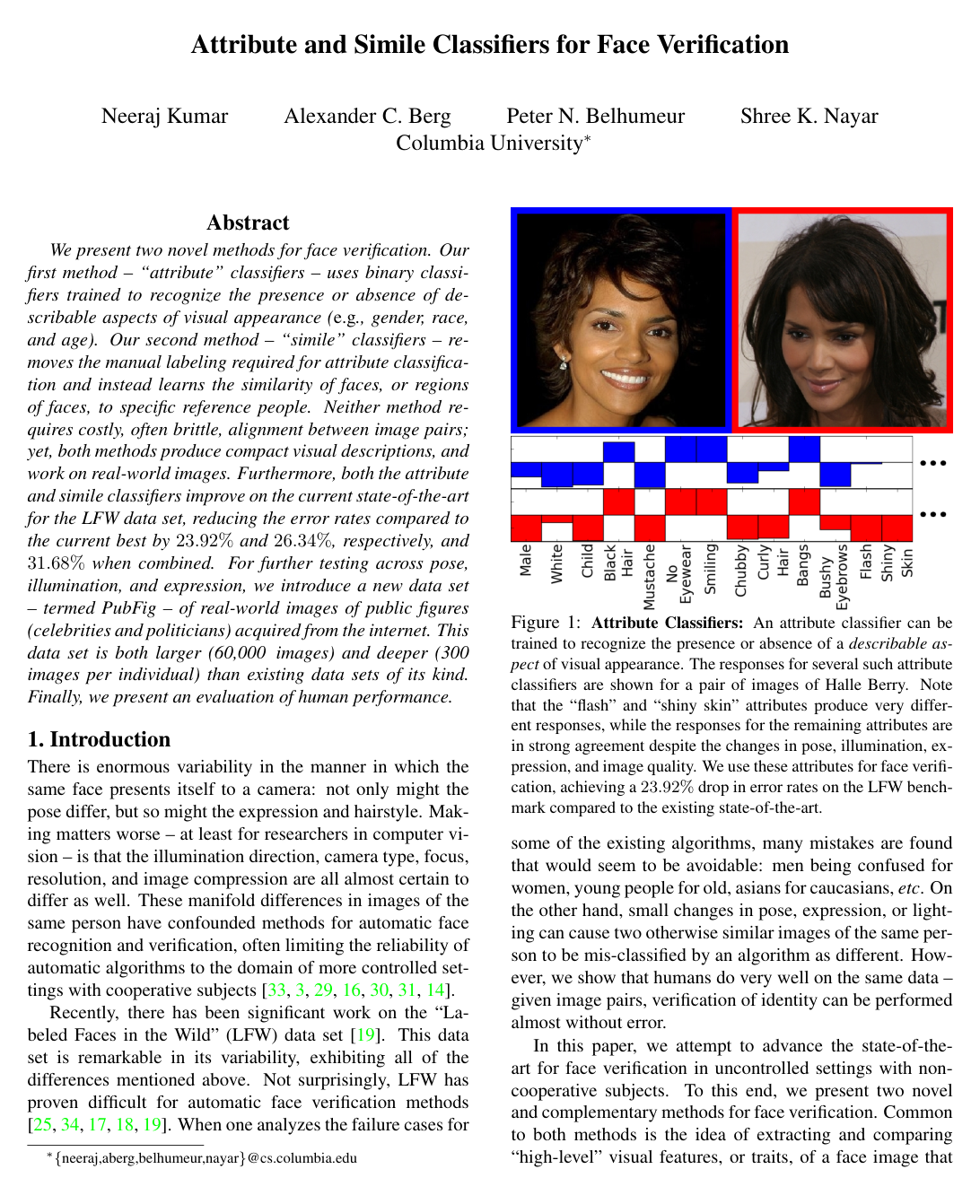
We present two novel methods for face verification. Our first method – “attribute” classifiers – uses binary classifiers trained to recognize the presence or absence of describable aspects of visual appearance (e.g., gender, race, and age). Our second method – “simile” classifiers – removes the manual labeling required for attribute classification and instead learns the similarity of faces, or regions of faces, to specific reference people. Neither method requires costly, often brittle, alignment between image pairs; yet, both methods produce compact visual descriptions, and work on real-world images. Furthermore, both the attribute and simile classifiers improve on the current state-of-the-art for the LFW data set, reducing the error rates compared to the current best by 23.92% and 26.34%, respectively, and 31.68% when combined. For further testing across pose, illumination, and expression, we introduce a new data set – termed PubFig – of real-world images of public figures (celebrities and politicians) acquired from the internet. This data set is both larger (60,000 images) and deeper (300 images per individual) than existing data sets of its kind. Finally, we present an evaluation of human performance.
Added
2026-09-24
The Tradeoffs of Large Scale Learning
L. Bottou, O. Bousquet
Why you should read this
Establishes a theoretical framework that incorporates optimization error and computational time constraints into statistical learning theory, revealing why fast approximate algorithms like stochastic gradient descent achieve superior generalization on massive datasets compared to precise batch optimizers.
This contribution develops a theoretical framework that takes into account the effect of approximate optimization on learning algorithms. The analysis shows distinct tradeoffs for the case of small-scale and large-scale learning problems. Small-scale learning problems are subject to the usual approximation–estimation tradeoff. Large-scale learning problems are subject to a qualitatively different tradeoff involving the computational complexity of the underlying optimization algorithms in non-trivial ways.
Added
2026-09-24
Boosting for transfer learning
Wenyuan Dai, Qiang Yang, Gui-Rong Xue, Yong Yu
Why you should read this
Proposes TrAdaBoost, an extension of AdaBoost that iteratively reweights source-domain instances to filter out conflicting data, enabling accurate classification in a new target domain using only a minimal set of labeled target samples.
Traditional machine learning makes a basic assumption: the training and test data should be under the same distribution. However, in many cases, this identical-distribution assumption does not hold. The assumption might be violated when a task from one new domain comes, while there are only labeled data from a similar old domain. Labeling the new data can be costly and it would also be a waste to throw away all the old data. In this paper, we present a novel transfer learning framework called TrAdaBoost, which extends boosting-based learning algorithms (Freund & Schapire, 1997). TrAdaBoost allows users to utilize a small amount of newly labeled data to leverage the old data to construct a high-quality classification model for the new data. We show that this method can allow us to learn an accurate model using only a tiny amount of new data and a large amount of old data, even when the new data are not sufficient to train a model alone. We show that TrAdaBoost allows knowledge to be effectively transferred from the old data to the new. The effectiveness of our algorithm is analyzed theoretically and empirically to show that our iterative algorithm can converge well to an accurate model.
Added
2026-09-18
Poisoning Attacks against Support Vector Machines
Battista Biggio, Blaine Nelson, Pavel Laskov
Why you should read this
Proposes a gradient-based poisoning attack that generates malicious training data to maximize validation error, demonstrating how intelligent adversaries can systematically subvert Support Vector Machines across linear and non-linear kernels.
We investigate a family of poisoning attacks against Support Vector Machines (SVM). Such attacks inject specially crafted training data that increases the SVM's test error. Central to the motivation for these attacks is the fact that most learning algorithms assume that their training data comes from a natural or well-behaved distribution. However, this assumption does not generally hold in security-sensitive settings. As we demonstrate, an intelligent adversary can, to some extent, predict the change of the SVM's decision function due to malicious input and use this ability to construct malicious data. The proposed attack uses a gradient ascent strategy in which the gradient is computed based on properties of the SVM's optimal solution. This method can be kernelized and enables the attack to be constructed in the input space even for non-linear kernels. We experimentally demonstrate that our gradient ascent procedure reliably identifies good local maxima of the non-convex validation error surface, which significantly increases the classifier's test error.
Added
2026-09-18